Processes on networks Robustness, resilience Random walks - - PowerPoint PPT Presentation

processes on networks
SMART_READER_LITE
LIVE PREVIEW

Processes on networks Robustness, resilience Random walks - - PowerPoint PPT Presentation

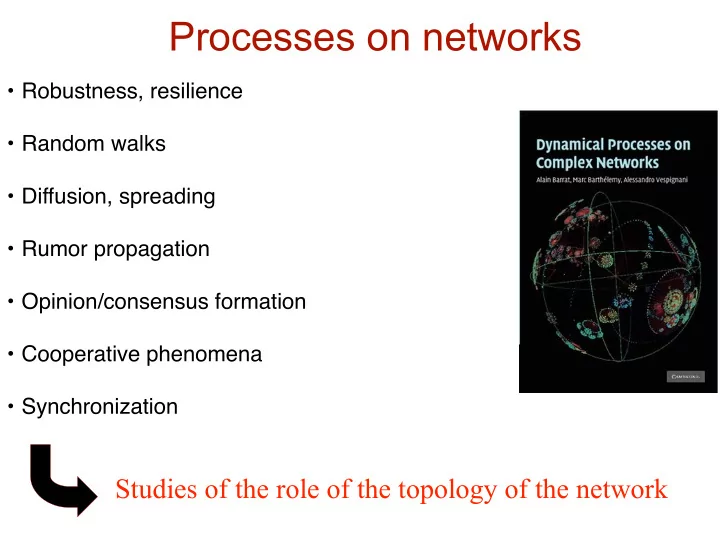
Processes on networks Robustness, resilience Random walks Diffusion, spreading Rumor propagation Opinion/consensus formation Cooperative phenomena Synchronization Studies of the role of the topology of the network


slide-1
SLIDE 1

Processes on networks

  • Robustness, resilience
  • Random walks
  • Diffusion, spreading
  • Rumor propagation
  • Opinion/consensus formation
  • Cooperative phenomena
  • Synchronization

Studies of the role of the topology of the network

slide-2
SLIDE 2

Robustness

Complex systems maintain their basic functions even under errors and failures (cell → mutations; Internet → router breakdowns)

node failure

fc 1 Fraction of removed nodes, f 1 S

S: fraction of giant component

slide-3
SLIDE 3

Case of Scale-free Networks

s fc

1 Random failure fc =1

(2 < γ ≤ 3) Attack =progressive failure of the most connected nodes fc <1

Internet maps

  • R. Albert, H. Jeong, A.L. Barabasi, Nature 406 378 (2000)
slide-4
SLIDE 4

Failures vs. attacks

1

S

1

f fc Attacks γ ≤ 3 : fc=1

(R. Cohen et al PRL, 2000)

Failures

Topological error tolerance

NB: mapping to percolation problem =>analytical solution

slide-5
SLIDE 5

Failures = percolation

p=probability of a node to be present in a percolation problem

Question: existence or not of a giant/percolating cluster, i.e. of a connected cluster of nodes of size O(N)

f=fraction of nodes removed because of failure

p=1-f

slide-6
SLIDE 6

Percolation

Question: existence or not of a giant/percolating cluster, i.e. of a connected cluster of nodes of size O(N)

slide-7
SLIDE 7

Percolation

Question: existence or not of a giant/percolating cluster, i.e. of a connected cluster of nodes of size O(N)

slide-8
SLIDE 8

Analytical approach

Initial network: P0(k), <k>0, <k2>0

Robustness!!!

existence of a giant cluster iff

slide-9
SLIDE 9

Attacks: various strategies

  • Most connected nodes
  • Nodes with largest betweenness
  • Removal of links linked to nodes with large k
  • Removal of links with largest betweenness
  • Cascades
  • ...
slide-10
SLIDE 10

Attacks in weighted networks

Weighted quantities:

– For attack strategies – For evaluating damage

slide-11
SLIDE 11

Attacks in weighted networks

Example: transportation network Centrality measures:

– Strength si = ∑ wij – Weighted betweenness centrality – Distance strength Di = ∑j dij – Outreach Oi = ∑j wij dij

slide-12
SLIDE 12

Attacks in weighted networks

Example: transportation network Damage measures:

– Topological integrity Ng/N0 – Weighted integrity measures:

  • Total strength Sg/S0
  • Total distance strength, outreach…
slide-13
SLIDE 13

Attacks in weighted networks

Example: world airport network

slide-14
SLIDE 14

Note: recomputed quantities

slide-15
SLIDE 15
  • Data:
  • http://www.cpt.univ-mrs.fr/~barrat/LYON_JAN2015/data.html
  • Create networks of N=103-105 nodes with same average degree

(e.g., 5) according to various models (ER, WS, BA, UCM)

  • Compute and plot basic properties (size, clustering coefficient, degree

distribution, clustering vs degree, knn, shortest paths (sampling))

  • Rank nodes according to degrees/betweenness
  • Remove nodes one after the other
  • at random
  • by decreasing order of degree (/strength if weighted network)
  • by decreasing order of betweenness centrality
  • After each removal, compute the size of the largest connected

component

  • Plot this size versus the number of nodes removed
  • Do it again, but recomputing the ranking after each node removal
  • Compare the results

Exercise