ISM Structure: Order from Chaos Philip Hopkins with Eliot Quataert, - - PowerPoint PPT Presentation

ism structure order from chaos
SMART_READER_LITE
LIVE PREVIEW

ISM Structure: Order from Chaos Philip Hopkins with Eliot Quataert, - - PowerPoint PPT Presentation

ISM Structure: Order from Chaos Philip Hopkins with Eliot Quataert, Norm Murray, Lars Hernquist, Dusan Keres, Todd Thompson, Desika Narayanan, Dan Kasen, T. J. Cox, Chris Hayward, Kevin Bundy, & more Thursday, August 16, 12 The Turbulent
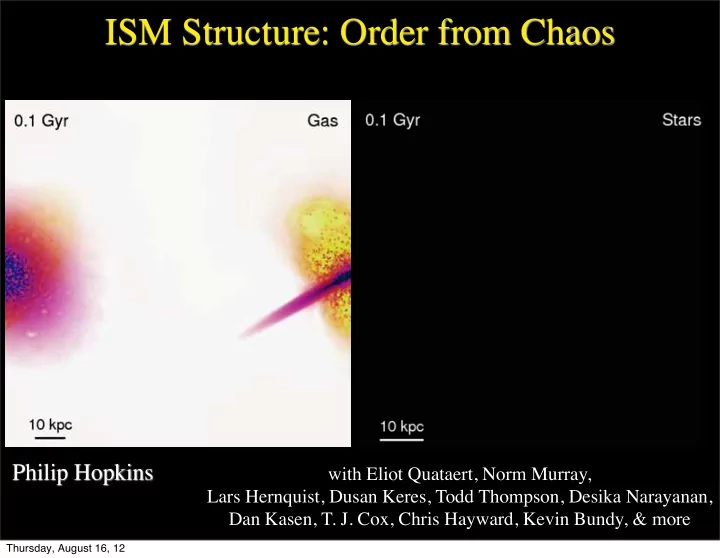

slide-1
SLIDE 1

ISM Structure: Order from Chaos

Philip Hopkins

with Eliot Quataert, Norm Murray, Lars Hernquist, Dusan Keres, Todd Thompson, Desika Narayanan, Dan Kasen, T. J. Cox, Chris Hayward, Kevin Bundy, & more

Thursday, August 16, 12

slide-2
SLIDE 2

LMC

The Turbulent ISM

IMPORTANT ON (ALMOST) ALL SCALES

  • Gravity
  • Turbulence
  • Magnetic, Thermal, Cosmic Ray, Radiation Pressure
  • Cooling (atomic, molecular, metal-line, free-free)
  • Star & BH Formation/Growth
  • “Feedback”: Massive stars, SNe, BHs,

external galaxies, etc.

Thursday, August 16, 12

slide-3
SLIDE 3

The ISM

YET THERE IS SURPRISING REGULARITY

Number

Giant Molecular Clouds:

Blitz, Rosolowski et al.

MW LMC SMC M33 M31 IC10

Number (dN/dM)

Mass [M]

Stars & Pre-Stellar Gas Cores:

Bastian Chabrier

Thursday, August 16, 12

slide-4
SLIDE 4

The ISM

YET THERE IS SURPRISING REGULARITY

Number

Giant Molecular Clouds:

Blitz, Rosolowski et al.

MW LMC SMC M33 M31 IC10

Number (dN/dM)

Mass [M]

Stars & Pre-Stellar Gas Cores:

Bastian Chabrier

dN dM ∝ M −1.8

∝ M −2.2

Thursday, August 16, 12

slide-5
SLIDE 5

The ISM

YET THERE IS SURPRISING REGULARITY

Number

Giant Molecular Clouds:

Blitz, Rosolowski et al.

MW LMC SMC M33 M31 IC10

Number (dN/dM)

Mass [M]

Stars & Pre-Stellar Gas Cores:

Bastian Chabrier

dN dM ∝ M −1.8

∝ M −2.2

DM Halos?!

Thursday, August 16, 12

slide-6
SLIDE 6

LMC

Extended Press-Schechter / Excursion-Set Formalism

  • Press & Schechter ‘74:
  • r Fluctuations a Gaussian random field
  • Know linear power spectrum P(k~1/r):

variance ~ k3 P(k)

Thursday, August 16, 12

slide-7
SLIDE 7

LMC

Extended Press-Schechter / Excursion-Set Formalism

  • Press & Schechter ‘74:
  • r Fluctuations a Gaussian random field
  • Know linear power spectrum P(k~1/r):

variance ~ k3 P(k)

  • “Count” mass above critical fluctuation: “Halos”
  • Turnaround & gravitational collapse

¯ ρ(< R ∼ 1/k) > ρcrit

Thursday, August 16, 12

slide-8
SLIDE 8

LMC

Extended Press-Schechter / Excursion-Set Formalism

  • Press & Schechter ‘74:
  • r Fluctuations a Gaussian random field
  • Know linear power spectrum P(k~1/r):

variance ~ k3 P(k)

  • “Count” mass above critical fluctuation: “Halos”
  • Turnaround & gravitational collapse

¯ ρ(< R ∼ 1/k) > ρcrit

  • Generalize to conditional probabilities,

N-point statistics, resolve “cloud in cloud” problem (e.g. Bond et al. 1991)

Thursday, August 16, 12

slide-9
SLIDE 9

E(k) ∝ k−p (k E(k) ∼ ut(k)2)

Turbulence

BASIC EXPECTATIONS

Velocity:

Thursday, August 16, 12

slide-10
SLIDE 10

E(k) ∝ k−p (k E(k) ∼ ut(k)2)

Turbulence

BASIC EXPECTATIONS

Velocity:

Text

dp(ln ρ | R) = 1 p 2π S(R) exp h(ln ρ hln ρi)2 2 S(R) i Lognormal in r:

Vasquez-Semadeni, Nordlund, Padoan, Ostriker, & others

Density:

Thursday, August 16, 12

slide-11
SLIDE 11

E(k) ∝ k−p (k E(k) ∼ ut(k)2)

Turbulence

BASIC EXPECTATIONS

Velocity:

Text

dp(ln ρ | R) = 1 p 2π S(R) exp h(ln ρ hln ρi)2 2 S(R) i Lognormal in r:

Vasquez-Semadeni, Nordlund, Padoan, Ostriker, & others

Density:

S(R) = Z d ln k Sk |W(k, R)|2

Thursday, August 16, 12

slide-12
SLIDE 12

ω2 = κ2 + c2

s k2 + ut(k)2 k2 − 4π G ρ |k|h

1 + |k|h

What Defines a Fluctuation of Interest?

DISPERSION RELATION:

Chandrasekhar ‘51, Vandervoort ‘70, Toomre ‘77

Thursday, August 16, 12

slide-13
SLIDE 13

ω2 = κ2 + c2

s k2 + ut(k)2 k2 − 4π G ρ |k|h

1 + |k|h

What Defines a Fluctuation of Interest?

DISPERSION RELATION:

Angular Momentum κ ∼ Vdisk Rdisk

Chandrasekhar ‘51, Vandervoort ‘70, Toomre ‘77

Thursday, August 16, 12

slide-14
SLIDE 14

ω2 = κ2 + c2

s k2 + ut(k)2 k2 − 4π G ρ |k|h

1 + |k|h

What Defines a Fluctuation of Interest?

DISPERSION RELATION:

Angular Momentum κ ∼ Vdisk Rdisk Thermal Pressure

∝ r−2

Chandrasekhar ‘51, Vandervoort ‘70, Toomre ‘77

Thursday, August 16, 12

slide-15
SLIDE 15

ω2 = κ2 + c2

s k2 + ut(k)2 k2 − 4π G ρ |k|h

1 + |k|h

What Defines a Fluctuation of Interest?

DISPERSION RELATION:

Angular Momentum κ ∼ Vdisk Rdisk Thermal Pressure

∝ r−2

Chandrasekhar ‘51, Vandervoort ‘70, Toomre ‘77

Turbulence

∝ rp−3 ∼ r−1

r > rsonic : u2

t > c2 s

Thursday, August 16, 12

slide-16
SLIDE 16

ω2 = κ2 + c2

s k2 + ut(k)2 k2 − 4π G ρ |k|h

1 + |k|h

What Defines a Fluctuation of Interest?

DISPERSION RELATION:

Angular Momentum κ ∼ Vdisk Rdisk Thermal Pressure

∝ r−2

Gravity

Chandrasekhar ‘51, Vandervoort ‘70, Toomre ‘77

Turbulence

∝ rp−3 ∼ r−1

r > rsonic : u2

t > c2 s

Thursday, August 16, 12

slide-17
SLIDE 17

ω2 = κ2 + c2

s k2 + ut(k)2 k2 − 4π G ρ |k|h

1 + |k|h

What Defines a Fluctuation of Interest?

DISPERSION RELATION:

Angular Momentum κ ∼ Vdisk Rdisk Thermal Pressure

∝ r−2

Gravity

Chandrasekhar ‘51, Vandervoort ‘70, Toomre ‘77

Turbulence

∝ rp−3 ∼ r−1

r > rsonic : u2

t > c2 s

Mode Grows (Collapses) when w<0:

ρ > ρc(k) = ρ0 (1 + |kh|) h (M−2

h

+ |kh|1−p) kh + 2 |kh| i

Thursday, August 16, 12

slide-18
SLIDE 18

“Counting” Collapsing Objects

EVALUATE DENSITY FIELD vs. “BARRIER”

PFH 2011

Averaging Scale R [pc]

Log[ Density / Mean ]

Thursday, August 16, 12

slide-19
SLIDE 19

“Counting” Collapsing Objects

EVALUATE DENSITY FIELD vs. “BARRIER”

PFH 2011

Averaging Scale R [pc]

Log[ Density / Mean ]

Thursday, August 16, 12

slide-20
SLIDE 20

Angular Momentum Turbulence Thermal+ Magnetic

“Counting” Collapsing Objects

EVALUATE DENSITY FIELD vs. “BARRIER”

PFH 2011

Averaging Scale R [pc]

Log[ Density / Mean ]

Thursday, August 16, 12

slide-21
SLIDE 21

Angular Momentum Turbulence Thermal+ Magnetic

“Counting” Collapsing Objects

EVALUATE DENSITY FIELD vs. “BARRIER”

PFH 2011

Averaging Scale R [pc]

Log[ Density / Mean ]

Thursday, August 16, 12

slide-22
SLIDE 22

Angular Momentum Turbulence Thermal+ Magnetic

“Counting” Collapsing Objects

EVALUATE DENSITY FIELD vs. “BARRIER”

PFH 2011

Averaging Scale R [pc]

Log[ Density / Mean ]

Thursday, August 16, 12

slide-23
SLIDE 23

Angular Momentum Turbulence Thermal+ Magnetic

“Counting” Collapsing Objects

EVALUATE DENSITY FIELD vs. “BARRIER”

PFH 2011

Averaging Scale R [pc]

Log[ Density / Mean ]

Thursday, August 16, 12

slide-24
SLIDE 24

“Counting” Collapsing Objects

EVALUATE DENSITY FIELD vs. “BARRIER”

PFH 2011

First Crossing

Averaging Scale R [pc]

Log[ Density / Mean ]

Thursday, August 16, 12

slide-25
SLIDE 25

GMCs

“Counting” Collapsing Objects

EVALUATE DENSITY FIELD vs. “BARRIER”

PFH 2011

First Crossing

Averaging Scale R [pc]

Log[ Density / Mean ]

Thursday, August 16, 12

slide-26
SLIDE 26

GMCs

“Counting” Collapsing Objects

EVALUATE DENSITY FIELD vs. “BARRIER”

PFH 2011

First Crossing Last Crossing

Averaging Scale R [pc]

Log[ Density / Mean ]

Thursday, August 16, 12

slide-27
SLIDE 27

GMCs

Cores/IMF

“Counting” Collapsing Objects

EVALUATE DENSITY FIELD vs. “BARRIER”

PFH 2011

First Crossing Last Crossing

Averaging Scale R [pc]

Log[ Density / Mean ]

Thursday, August 16, 12

slide-28
SLIDE 28

p(δ | τ) = 1 p 2π S (1 − exp [−2τ]) exp h − (δ − δ(t = 0) exp [−τ])2 2 S (1 − exp [−2τ]) i Evolve the Fluctuations in Time

CONSTRUCT “MERGER/FRAGMENTATION” TREES

Time

Thursday, August 16, 12

slide-29
SLIDE 29

p(δ | τ) = 1 p 2π S (1 − exp [−2τ]) exp h − (δ − δ(t = 0) exp [−τ])2 2 S (1 − exp [−2τ]) i Evolve the Fluctuations in Time

CONSTRUCT “MERGER/FRAGMENTATION” TREES

Fraction Collapsed Per Crossing Time

Simulations (Cooling+Gravity+MHD)

Padoan & Nordlund Vazquez-Semadeni PFH 2011

Time

Thursday, August 16, 12

slide-30
SLIDE 30

The “First Crossing” Mass Function

VS GIANT MOLECULAR CLOUDS

PFH 2011 log[ Mcloud / Msun ]

Number (>Mcloud)

Thursday, August 16, 12

slide-31
SLIDE 31

The “First Crossing” Mass Function

VS GIANT MOLECULAR CLOUDS

PFH 2011 log[ Mcloud / Msun ]

Number (>Mcloud)

rsonic ⌧ r ⌧ h

S(r) ∼ S0

Thursday, August 16, 12

slide-32
SLIDE 32

The “First Crossing” Mass Function

VS GIANT MOLECULAR CLOUDS

PFH 2011 log[ Mcloud / Msun ]

Number (>Mcloud)

rsonic ⌧ r ⌧ h

S(r) ∼ S0

dn dM ∝ M −α e−(M/MJ)β

Thursday, August 16, 12

slide-33
SLIDE 33

The “First Crossing” Mass Function

VS GIANT MOLECULAR CLOUDS

PFH 2011 log[ Mcloud / Msun ]

Number (>Mcloud)

rsonic ⌧ r ⌧ h

S(r) ∼ S0

α ≈ −2 + (3 − p)2 2 S p2 ln ⇣MJ M ⌘

≈ −2 + 0.1 log ⇣MJ M ⌘

dn dM ∝ M −α e−(M/MJ)β

Thursday, August 16, 12

slide-34
SLIDE 34

The “First Crossing” Mass Function

VS GIANT MOLECULAR CLOUDS

PFH 2011 log[ Mcloud / Msun ]

Number (>Mcloud)

rsonic ⌧ r ⌧ h

S(r) ∼ S0

α ≈ −2 + (3 − p)2 2 S p2 ln ⇣MJ M ⌘

≈ −2 + 0.1 log ⇣MJ M ⌘

dn dM ∝ M −α e−(M/MJ)β

α ≈ −2 + 0.1 log ⇣MJ M ⌘

Thursday, August 16, 12

slide-35
SLIDE 35

The “First Crossing” Mass Function

VS GIANT MOLECULAR CLOUDS

PFH 2011 log[ Mcloud / Msun ]

Number (>Mcloud)

rsonic ⌧ r ⌧ h

S(r) ∼ S0

α ≈ −2 + (3 − p)2 2 S p2 ln ⇣MJ M ⌘

≈ −2 + 0.1 log ⇣MJ M ⌘

dn dM ∝ M −α e−(M/MJ)β

α ≈ −2 + 0.1 log ⇣MJ M ⌘

Thursday, August 16, 12

slide-36
SLIDE 36

The “Last Crossing” Mass Function

VS PROTOSTELLAR CORES & THE STELLAR IMF

PFH 2012

Thursday, August 16, 12

slide-37
SLIDE 37

The “Last Crossing” Mass Function

VS PROTOSTELLAR CORES & THE STELLAR IMF

PFH 2012

Thursday, August 16, 12

slide-38
SLIDE 38

“Void” Abundance

VS HI “HOLES” IN THE ISM

PFH 2011

Don’t need SNe to “clear out” voids

Thursday, August 16, 12

slide-39
SLIDE 39

Structural Properties of “Clouds”

LARSON’S LAWS EMERGE NATURALLY

Thursday, August 16, 12

slide-40
SLIDE 40

Structural Properties of “Clouds”

LARSON’S LAWS EMERGE NATURALLY

Thursday, August 16, 12

slide-41
SLIDE 41

Clustering

PREDICT N-POINT CORRELATION FUNCTIONS

PFH 2011

1 + ξ(r | M) ⌘ hn[M | r0 < r]i hn[M]i

First Crossing: GMCs & new star clusters

Predicted

Thursday, August 16, 12

slide-42
SLIDE 42

Clustering

PREDICT N-POINT CORRELATION FUNCTIONS

Text

Last Crossing: Cores & Stars

PFH 2012b

1 + ξ(r | M) ⌘ hn[M | r0 < r]i hn[M]i

Thursday, August 16, 12

slide-43
SLIDE 43

Clustering

PREDICT N-POINT CORRELATION FUNCTIONS

Text

Last Crossing: Cores & Stars

PFH 2012b

1 + ξ(r | M) ⌘ hn[M | r0 < r]i hn[M]i

Thursday, August 16, 12

slide-44
SLIDE 44

Clustering

PREDICT N-POINT CORRELATION FUNCTIONS

Text

Last Crossing: Cores & Stars

Why is Star Formation Clustered?

S ∼ ln M(k)2 ∼ ln r3−p

PFH 2012b

1 + ξ(r | M) ⌘ hn[M | r0 < r]i hn[M]i

Thursday, August 16, 12

slide-45
SLIDE 45

Clustering of Stars: Predicted vs. Observations

PREDICT N-POINT CORRELATION FUNCTIONS

Thursday, August 16, 12

slide-46
SLIDE 46

Fragmentation Rate (per Dynamical Time)

Simulations (Cooling+Gravity+MHD)

k [kpc-1]

0.1 1 10

log( E[k] )

2

p=2 vz

Excursion Set

Number of GMCs Power spectra

Linewidth-Size Relation

Intermittency Exponents (ln[rho])

Testing the Analytics

  • vs. NUMERICAL SIMULATIONS

compilation (30 sims) Padoan & Nordlund Vazquez-Semadeni Liu & Fang Bournaud & Elmegreen PFH

Correlation Function/Clustering

Hansen, Klein et al.

Thursday, August 16, 12

slide-47
SLIDE 47

General, Flexible Theory:

EXTREMELY ADAPTABLE TO MOST CHOICES

  • Complicated, multivariable

gas equations of state

  • Accretion
  • Magnetic Fields
  • Time-Dependent Background

Evolution/Collapse

  • Intermittency
  • Correlated, multi-scale driving

Densities Core MFs GMC MFs

Lognormal Not-so Lognormal

Thursday, August 16, 12

slide-48
SLIDE 48

Variation in the Core Mass Function

VS “NORMAL” IMF VARIATIONS

PFH 2012

Weak variation with Galactic Properties

Near-invariant with “mean” cloud properties (up to sampling)

Thursday, August 16, 12

slide-49
SLIDE 49

Variation in the Core Mass Function

VS “NORMAL” IMF VARIATIONS

PFH 2012

Msonic ≡ M(ρcrit |Rsonic) ∼ c2

s Rsonic

G

Weak variation with Galactic Properties

Near-invariant with “mean” cloud properties (up to sampling)

Thursday, August 16, 12

slide-50
SLIDE 50

Variation in the Core Mass Function

VS “NORMAL” IMF VARIATIONS

PFH 2012

Msonic ≡ M(ρcrit |Rsonic) ∼ c2

s Rsonic

G

∼ M Tmin 10 K Rsonic 0.1 pc

Weak variation with Galactic Properties

Near-invariant with “mean” cloud properties (up to sampling)

Thursday, August 16, 12

slide-51
SLIDE 51

Variation in the Core Mass Function

VS “NORMAL” IMF VARIATIONS

PFH 2012

Msonic ≡ M(ρcrit |Rsonic) ∼ c2

s Rsonic

G

∝ T 2

min

Rcl σ2

cl

∼ M Tmin 10 K Rsonic 0.1 pc

Weak variation with Galactic Properties

Near-invariant with “mean” cloud properties (up to sampling)

Thursday, August 16, 12

slide-52
SLIDE 52

Variation in the Core Mass Function

VS “NORMAL” IMF VARIATIONS

PFH 2012

Msonic ≡ M(ρcrit |Rsonic) ∼ c2

s Rsonic

G

∝ T 2

min

Rcl σ2

cl

∼ M Tmin 10 K Rsonic 0.1 pc

Weak variation with Galactic Properties

Thursday, August 16, 12

slide-53
SLIDE 53

PFH 2012

MW: Tcold ∼ 10 K

σgas ∼ 10 km s−1

(Q ∼ 1 for Σgas ∼ 10 M pc2)

BUT, What About Starbursts?

Text

Thursday, August 16, 12

slide-54
SLIDE 54

PFH 2012

ULIRG: Tcold ∼ 70 K

σgas ∼ 80 km s−1

(Q ∼ 1 for Σgas ∼ 1000 M pc2)

MW: Tcold ∼ 10 K

σgas ∼ 10 km s−1

(Q ∼ 1 for Σgas ∼ 10 M pc2)

BUT, What About Starbursts?

Text

Thursday, August 16, 12

slide-55
SLIDE 55

PFH 2012

ULIRG: Tcold ∼ 70 K

σgas ∼ 80 km s−1

(Q ∼ 1 for Σgas ∼ 1000 M pc2)

MW: Tcold ∼ 10 K

σgas ∼ 10 km s−1

(Q ∼ 1 for Σgas ∼ 10 M pc2)

Core Mass Function ULIRG MW

BUT, What About Starbursts?

Text

Thursday, August 16, 12

slide-56
SLIDE 56

PFH 2012

ULIRG: Tcold ∼ 70 K

σgas ∼ 80 km s−1

(Q ∼ 1 for Σgas ∼ 1000 M pc2)

MW: Tcold ∼ 10 K

σgas ∼ 10 km s−1

(Q ∼ 1 for Σgas ∼ 10 M pc2)

Core Mass Function ULIRG MW

BUT, What About Starbursts?

Text Mach number in ULIRGs: M & 100 MJeans is bigger but MSonic is smaller (bigger clouds with

more fragmentation)

BOTTOM-HEAVY: TURBULENCE WINS!

Thursday, August 16, 12

slide-57
SLIDE 57

PFH 2012

ULIRG: Tcold ∼ 70 K

σgas ∼ 80 km s−1

(Q ∼ 1 for Σgas ∼ 1000 M pc2)

MW: Tcold ∼ 10 K

σgas ∼ 10 km s−1

(Q ∼ 1 for Σgas ∼ 10 M pc2)

Core Mass Function ULIRG MW

Kroupa Chabrier Van Dokkum & Conroy (nearby elliptical centers)

BUT, What About Starbursts?

Text Mach number in ULIRGs: M & 100 MJeans is bigger but MSonic is smaller (bigger clouds with

more fragmentation)

BOTTOM-HEAVY: TURBULENCE WINS!

Thursday, August 16, 12

slide-58
SLIDE 58

Open Questions:

  • 1. What Maintains the Turbulence?

Thursday, August 16, 12

slide-59
SLIDE 59

Open Questions:

  • 1. What Maintains the Turbulence?

˙ Pdiss ∼ Mgas vturb tcrossing

Efficient Cooling:

Thursday, August 16, 12

slide-60
SLIDE 60

Open Questions:

  • 1. What Maintains the Turbulence?
  • 2. Why Doesn’t Everything Collapse?

˙ Pdiss ∼ Mgas vturb tcrossing

Efficient Cooling:

Thursday, August 16, 12

slide-61
SLIDE 61

Open Questions:

  • 1. What Maintains the Turbulence?
  • 2. Why Doesn’t Everything Collapse?

˙ Pdiss ∼ Mgas vturb tcrossing

Efficient Cooling:

“Top-down” turbulence can’t stop collapse once self-gravitating Fast Cooling:

˙ M∗ ∼ Mgas tfreefall

Thursday, August 16, 12

slide-62
SLIDE 62

Summary:

  • Turbulence + Gravity: ISM structure follows
  • Lognormal density PDF is not critical
  • ANALYTICALLY understand:
  • GMC Mass Function & Structure (“first crossing”)
  • Core MF (“last crossing”) & Linewidth-Size-Mass
  • Clustering of Stars (correlation functions)
  • Feedback Regulates & Sets Efficiencies of Star Formation
  • K-S Law: ‘enough’ stars to offset dissipation (set by gravity)
  • Independent of small-scale star formation physics (how stars form)
  • * ISM statistics are far more fundamental than we typically assume *

Thursday, August 16, 12