Problem of man-made Sulphur is very actual for air quality in - - PowerPoint PPT Presentation

problem of man made sulphur is very actual for air
SMART_READER_LITE
LIVE PREVIEW

Problem of man-made Sulphur is very actual for air quality in - - PowerPoint PPT Presentation

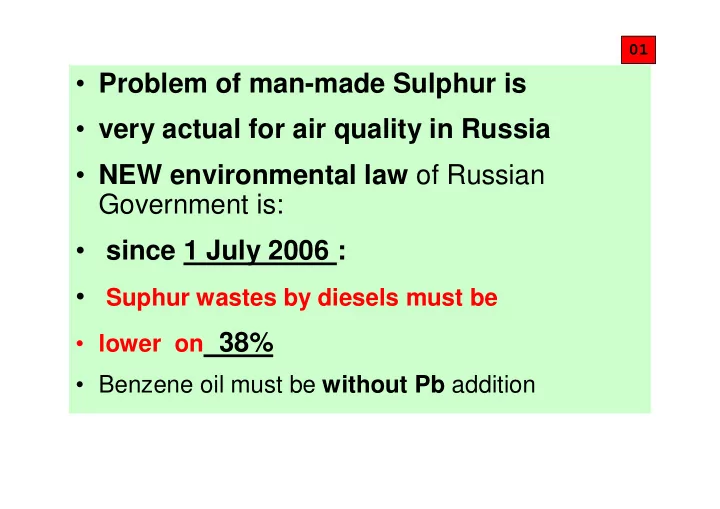
01 Problem of man-made Sulphur is very actual for air quality in Russia NEW environmental law of Russian Government is: since 1 July 2006 : Suphur wastes by diesels must be lower on 38% Benzene oil must be without Pb


slide-1
SLIDE 1
  • Problem of man-made Sulphur is
  • very actual for air quality in Russia
  • NEW environmental law of Russian

Government is:

  • since 1 July 2006 :
  • Suphur wastes by diesels must be
  • lower on 38%
  • Benzene oil must be without Pb addition

01

slide-2
SLIDE 2

Sunlight action on the oxidation SO2 into sulphate aerosol affecting the climate and ecology of the Earth

Galina Skubnevskaya,

Serge Dubtsov, Alex Ankilov Alex Kozlov Galina Dultseva RFBR Grant 02-05-64783

02

slide-3
SLIDE 3
  • Global Sulphur cycle
  • Man-made stress for Earth
  • Ways of SO2 transformation to H2SO4
  • About role of exited SO2 in the atmosphere
  • Some results of study of exited SO2 (1980-2005)

(Photolysis and Photonucleation )

  • Some conclusions and plans for future

03

slide-4
SLIDE 4

Global sulphur cycle

In the air over Baikal lake

Sulphur flow is ~ 3-5 tonn/km2year

Acidity of rains and snow << 5,6 pH

East Siberian forests are in danger

102 20

Атмосфера

0,7 0,5 2,3 0,8 Другие COS SO2 H SO4

2

258 163 26 72 28

Вулканы

Почва 2,6·10 S = 10 Биомасса 760

5 орг 4

~28

Реки Озёра

208 9

Океаны 1,3·10

9

35

Осадки 0,3·10

9

Кора 2,2·10

9

Осадки 5,2·10

9

Кора 16,6·10

9

138 Биота Суша Океаны

ATMOSPHERE OCEANS BIOTA OTHERS Oceans

1e9

Rivers Lakes

Soil 2e9

Precipitations 3e8 Crust 2e9 Precipitations 5e8 Crust 17e9

Volca- noes

Reservoirs (Gt): Crust 19000000 Sedimentary rock 5000000 Oceans 13000000 Soil 260 Living organisms 0.76 Atmosphere 0,004

Sulfur distribution (Mt) on the Earth surface and Sulfur flows (Мt/year)

g/m3

04

slide-5
SLIDE 5

Oxidation state of S changes in Global cycle

S

H S, ДМС

2

SO2 H SO

2 4

SO

4 2-

Сульфиды металлов Степень окисления

– 2 + 4 + 6

Red arrows – microbiological processes

Oxidation state

metal sulfides

H2S, (CH3)2S

05

slide-6
SLIDE 6

In XXI century Emission of S from Man-made sources became comparable with Natural ones

polluted air Remote regions

Content, ppb-1

NО+ NO2 0,1-0,5 50-750 SO2 0,1-1 2-300

О3

20-80 100-500 Man-made hydrocar- bons 1-5 500- 1200 3-10 mkg/ m3 50-70 mkg/ m3 aerosols

g/m3

06

slide-7
SLIDE 7

Acidity of rains ,snow and fogs < 5,6 pH is dangerous SO2 influence on the acidity of atmospheric precipitations:

Flow to the Earth surface

Oxidation

37

– –

Neutralization

– 50 –

Washing out

100 83 70

Dry deposition

70 200 – SO2 H2SO4 SO4

2–

Residence time, hour 07

slide-8
SLIDE 8

Sunlight action on SO2 generates ecological problems in Earth atmosphere

  • Sunlight action stimulates transformations of primary

S wastes into ecotoxicants in the air and in photosmog

  • Photosmog includes toxicants and aerosols with S

that affect on lungs and health of citizens.( H2S, (CH3)2S, SO2, H2SO4, organic sulphoacids in air and in aerosols)

  • Sulphate nanoparticles in lower stratosphere (Junge

layer on h~16 km) affect climate and fall of acid rains

  • Photochemistry and photonucleation of SO2 is

unsolved global problem in the Earth atmosphere.

08

slide-9
SLIDE 9

Typical Relation of SO4(2-)/ SO2 in the air

At the surface of Earth

SO / SO

4 2 2–

SO4

2–

SO2 10 4 1 0,4 0,2

[SO ], мкг/м

2 3

80° 60° 40° 20° 0° 20° 40° 60° с.ш. Географическая широта ю.ш.

Substance Remote regions Urban areas Cities SO2 (mcg/m3)

~0,2 0,1- 0,6 0,3-1

SO4

2– (aerosol) (mcg/m3)

~0,8 0,2-0,5 1-5

SO4

2– (aerosol) /SO2>1

is due to

SUNLIGHT ACTION?

09

slide-10
SLIDE 10

Chemical Ways of SO2 oxidation

Ways of SO2 transformation to H2SO4

  • Reactions on soot and atmospheric

particles ( heterogenic oxidation)

  • Reactions in rains (in liquid phase)
  • Reactions of photocatalysis by particles (ZnO )
  • Photochemical oxidation of SO2 in the air
  • a)SO2 is activated by free radicals OH,HO2, etc.
  • b) SO2 is activated by sunlight with SO2 exitation in high

electronic states of SO2 with energy > 2 Ev ( ~ 45 kcal/mole) (exited SO2 reactions) 10

slide-11
SLIDE 11

Troposphere Stratosphere Region

Range, km pressure, Torr Temperature, °С 0 –-18 760 -…. 15 – 56 18 – 50 – 56 – 2

T e m p e r a t u r e a n d p r e s s u r e v e r t i c a l d i s t r i b u t i

  • n

200 160 120 80 40 20 100 300 500 700 Мезосфера Стратосфера Тропосфера В ы с о т а H , к м Температура Давление 10

–6

10

–4

10

–2

10 10

6

10

4

Давление, Па Температура, К P(H)=P exp[–gmH/RT] n(H)=n exp[–gmH/KT]

SO2exited + SO2 SO3+SO is dominate?

Atmospheric structure

SO2+OH H2SO4 is dominate 12

slide-12
SLIDE 12

Heterogeneous oxidation of SO2 H2SO4

SO2 is absorbed by fly ash and soot particles. Photocatalysis is possible on metal oxides particles that have

semiconducters properties (TiO2, ZnO,etc.)

MeO (MeO

+, e ) –

(MeO

+)(O ) 2 Адс. –

2(O ) (MeO

· Адс.

) [SO (O)] (MeO

· 2 Адс.

)(O )

·

(SO ) (MeO

3 Адс.

)(O )

·

H O

2 2

(MeO

+)(H O ) 2 Адс. – 2

2(HO ) (MeO

· Адс.

) (SO ) + 2(

2 Адс.

HO )

· Адс.

[SO (HO )]

· 2 Адс. 2

(SO )

4 Адс.

+ 2(H )

+ 2– Адс.

SO2 I2

13

slide-13
SLIDE 13

Chemical Ways of SO2 oxidation

Ways of SO2 transformation to H2SO4

  • Reactions on soot and atmospheric

particles ( heterogenic oxidation)

  • Reactions in rains (in liquid phase)
  • Reactions of photocatalysis by particles (ZnO )
  • Photochemical oxidation of SO2 in the air
  • a)SO2 is activated by free radicals OH,HO2, etc.
  • b) SO2 is activated by sunlight with SO2 exitation in high

electronic states of SO2 with energy > 2 Ev ( ~ 45 kcal/mole) (exited SO2 reactions) 17

slide-14
SLIDE 14

Homogeneous oxidation where SO2 is “ passive”reactant

Reaction

k cm3/s time, h. Oxidant concentration, cm–3

SO2 + O2 → SO3 + O·

10–30 50000000 5 ·1018

SO2 + O3 → SO3 + O2

10–22 3000000 8 ·1011

SO2 + HO·

2 → SO3 + HO·

7,8 ·10–16 1200 3 ·108

SO2 + CH3OO· → SO3 + CH3O·

1,8 ·10–14 227 7 ·107 1,8 ·10–12 86

SO2 + HO· +H2O → H2SO4 + HO·

2

1,8 ·106

SO2 oxidation proceeds due to formation of secondary S radicals: SO2 + HO· → HSO3· HSO3· + O2 → HSO5· HSO3· + NO2 → HSO4· + NO HSO4· + NO2 + H2O → H2SO4 + HNO3 14

slide-15
SLIDE 15

SO2 can be photoactive reactant in the atmosphere Absorption spectra of SO2 Energy D (OS-O) = 5эВ=247 nm 330-390nm very week band 3B1 ; E~25-50 kcal week bands 1B1 , 1А2 ;E ~ 50-90 kcal 1800-2400А

Strong band, OS-O

O + SO ; 247nm

3SO2 + SO2 → 1,3SO2 + SO2 →

260-340 nm

15

slide-16
SLIDE 16

Heterogeneus

  • xidation of SO2

Soil and dust particles absorb SO2 and O2 and catalyze transformation SO2 H2SO4

0,02 0,01 6

k, ч

–1

Время суток, ч 8 10 12 14 16 18 1 2 3 4

0,2

Относительная доля

Время, ч

20 30 40 50 Сульфаты 0,6 1,0

H SO

2 4

SO2

10

Dependence of Rate of SO2

  • xidation over power plants

18

slide-17
SLIDE 17
  • Experimental set-up for study of photonucleation

19

slide-18
SLIDE 18
  • Kinetics of Photolysis of gas precursor
  • f aerosol formation

100 200 300 400 500 600

  • 0.35
  • 0.30
  • 0.25
  • 0.20
  • 0.15
  • 0.10
  • 0.05

0.00 0.05

Kphot = 5.3684x10

  • 4 s
  • 1

Photolysis rate

ln (D/D0)

Time / s

20

slide-19
SLIDE 19

Comparison of modeling and experimental data allows to calculate key

value of the photonucleation - rate of birth of particles

0,1 1 10 10

2

10

3

10

4

10

5

10

6

10

7

Particle concentration / cm

  • 3

Time / s

Wphot = 2.68х10

10

Wphot = 1.03х10

10

Wphot = 0.41х10

10

lines - model calculation

1 2 3

Rate of birth of particles = Rate of photolysis of precursor in the gas phase

Grows of particles in time during UV action

  • n precursor vapor in gas phase

21

slide-20
SLIDE 20

SO2 photonucleation is dependent on n-pentane pressure in SO2+C5H12+air mixture for reaction

2 4 6 8 10 12 14 2,0 2,5 3,0 3,5 4,0 4,5 5,0 5,5 6,0 6,5

Зависимость концентрации аэрозоля от давления пентана при фотолизе смеси SO

2 - C 5H 12 - воздух

Lg N / a.u. [C

5H 12] / Torr

NOTE: Photoaerosol of HRSOx acids continue to grow in dark but photoaerosol of H2SO4 does not grow in dark

Pentane Pressure, Torr

22

slide-21
SLIDE 21

Application HPLC, ESR, NMR,UV,IR,MS methods for analysis of chemical properties of photoproducts

Detection of short-lived radicals OH by spin traps ESR method

Analysis of Sulphate aerosol by Bigg’s method with electron microscopy help

Dultseva, G.G., Skubnevskaya, G.I., Volodarsky, L.V.,Tikhonov, A.Y. J.Phys.Chem. 1996, v.100, 17523

3380 3400 3420 3440 3460 3480

  • 10000
  • 5000

5000 10000

Gauss

Mironenko V.E., Graduate work, NSU (1982)

23

slide-22
SLIDE 22

Analysis of gas and aerosols products

Methods and approach for particles analysis employed

  • Procedures of sample preparation , arte-facts elimination
  • High Performance Liquid Chromatography
  • UV, IR spectroscopy
  • NMR spectroscopy
  • Electron microscopy
  • Gas chromatography – Mass spectrometry
  • Thin Layer Chromatography
  • Qualitative analytical procedures for functional groups
  • Ion chromatography
  • Etc.

24

slide-23
SLIDE 23

Chemical analysis of gas and aerosols

Basic methods and approach for particles analysis

  • High Performance Liquid Chromatography
  • UV, IR spectroscopy
  • NMR spectroscopy
  • Electron microscopy
  • Gas chromatography – Mass spectrometry
  • Thin Layer Chromatography
  • Qualitative analytical procedures for functional

groups

  • Ion chromatography

29

slide-24
SLIDE 24

What kinds of Gas Photochemistry are possible to lead to new nanoparticles generation in Earth atmosphere??????

Primary sunlight action hv produces short living active intermediates R i : hv+M " Mi; R1 + R2 " GAS products

MAJOR WAY ?????

R1,R2 +Mj " Ri + M nanoparticleS

MINOR WAY

???????

R or not R participate–what is the question

25

slide-25
SLIDE 25

Numerical modeling of Photonucleation

Basic model and further approach

  • Basic Model of nucleation witn fixed

source of embryos is applied (Mc Murry etc).

Smoluchowsky model+ fixed source for further growth of particles.

  • improved model by Koutsenogy K.P.,Levykin A.,

Dubtsov S,etc.(1982-2005)

Siberian approach

  • Application of McMurry

model to photonucleation. steady source of embryos is activated by sunlight ONLY

  • More effective algorithm for numerical modeling is

prepared

  • Experimental data of photonucleation is modeling with

most accuracy.

  • Due to comparing experimental data with numerical modelong
  • Rate of the initiall step of photonucleation is calculated at the first

```````````````````

30

slide-26
SLIDE 26

Specific Aerosol formation under UV light action –fundamental results

New properties of phenomenon:

– Formation of particles is result of UV light action ONLY – Specific photochemistry of gas precursor

  • f particles is very important

– Composition of all gas mixtures affects

  • n photoaerosol yield strongly

– Dose of illumination of precursor limits photoaerosol yield Modification of time

  • r intensity of light action brings the same

concentration of new Sparticles

First

CONCLUSIONS

31

slide-27
SLIDE 27

The application of SO2 studies for environmental problems

  • Monitoring of air quality and acidity of rains in region of Bailkal lake

(O3,SO2, NOx,aerosols, pH precipitaions etc) Acid rains pH <~ 4 (!) can be explained by SO2 photochemical transformation into H2SO4 partially

  • We expertized the air quality ( 1987-2005) of Novosibirsk region, Tomsk

,Kemerovo, Novokuznetsk – West Siberian Cities

  • We monitored Novosibirsk Power plants wastes on contents of SO2,O3,

NOx, HCHO, aerosols, acidity of precipitations., etc. at the distances up to 90 km from Novosibirsk ( in collaboration with Belan B and .,Panchenko M. team,IOA SB RAS)

  • Laboratory modeling of photosmog with UV light+SO2 + pentane+ air

mixture in small aerosol camera of IOA, Tomsk, 1982 ( Zuev V.E, Ippolitov I. I ,Kozlov V. and IOA team)

  • Participation in Novosibirsk Scientific Ecological Program of NSC (1990-

1994) headed by acad. Koptyg V.A.

  • Environmental Department of Novosibirsk expert opinion of

air quality of Novosibirsk region
  • 32
slide-28
SLIDE 28

Participation of colleagues in SO2 Project realization (1981-2005) А.Н.Анкилов, С.Н.Дубцов, Г.Г.Дульцева, Е.Н.Дульцев Monitoring in Siberian region С.Н.Дубцов, А.Н.Анкилов, Е.Н.Дульцев Photonucleation in lab Г.Г.Дульцева , Мироненко В. , Пащенко С.Э. I dentification of gas and aerosol products В.В.Пененко, Алоян А.Е., Н.М.Бажин, А.В.Кейко, А.И.Левыкин, Куценогий К. П Numerical modeling

SO2 Project I dea - Galina Skubnevskaya

Sut-up , methods

  • f analysis

33 А.Н.Анкилов, С.Н.Дубцов, А.М.Бакланов, А.Н.Козлов, Г.Г.Дульцева, Е.Н.Дульцев

slide-29
SLIDE 29

Some basic publications

Скубневская Г.И., Бажин Н.М., Метеорология и гидрология, 1982, № 9, С. 113-124 Пененко Скубневская Г. И., Успехи химии 1990 Скубневская Г И Дульцева Г Г Дубцов С Н Дульцев Е Н, Химия устойчивого развития, 1999 6. Skubnevskaya G.I., Dubtsov S.N., Dultsev E.N., Dultseva G.G. and Wing Tsang J.Phys.Chem 2004, August . . Пененко В.В.,Бажин Н.М.,Бобылева И.М.Цветова Е А Скубневская ГиИ Метеорология и гидрология 1989 №7 С.76-84.

34

slide-30
SLIDE 30

Sponsor supports of team:

Grants of SB RAS « Siberian Aerosols» и «Siberian Cities Ecology» (1990-2004) RFBR Grants (1992-2004) Budget of Government support since 1980 USA-Russian Grant CRDF (2002-2003)

35

slide-31
SLIDE 31

What can be news in future XXI for photonucleation of SO2 studies and applications for Earth sciences?

  • Is it possible to find the influence of magnetic field of the Earth on the

nucleation of SO2 under sunlight action? ( our preliminarily results- YES)

  • What will magnetic field studies of photonucleation can help in future ??

Getting inside spin chemistry of sunlight exited SO2 states in Earth atmosphere and understanding generation of sulphate aerosol layer (Junge layer h~16-18 km).Aerosol layer is situated situated under ozone layer. It wiil become possible to explain changing intensity of rains in different regions of Earth due to Earth magnetic field and magnetic storms of Sun variations that cause Junge sulphate aerosol layer variations under these magnetic impetus to rains flow .

36

slide-32
SLIDE 32

Spin chemistry of SO2 exited by sunlight

Not Energy,BUT selection of reaction ways by Earth maghetic field (as energy train is ruled by railway operator)

Magnetic interaction 38

slide-33
SLIDE 33

Luminescence

Reactions (YES,1983)

and photonucleation-

yes on no???

S1

Chemical transformation SO2 is regulated by Singlet and Triplet states oscillation of exited SO2

Magnetic Interactions inter- and external

Reactions ???

T1,3

37

slide-34
SLIDE 34

Our Institute, Novosibirsk, 2005

Thank you for your attention