} Probability hot rain 0.1 ? sun 0.6 Distribution cold sun - - PDF document

probability hot rain 0 1 sun 0 6 distribution cold sun 0
SMART_READER_LITE
LIVE PREVIEW

} Probability hot rain 0.1 ? sun 0.6 Distribution cold sun - - PDF document

Topics from 30,000 CSE 473: Artificial Intelligence Probability We re done with Part I Search and Planning! Part II: Probabilistic Reasoning Diagnosis Speech recognition Tracking objects Robot mapping Genetics


slide-1
SLIDE 1

1

CSE 473: Artificial Intelligence Probability

Steve Tanimoto University of Washington

[These slides were created by Dan Klein and Pieter Abbeel for CS188 Intro to AI at UC Berkeley. All CS188 materials are available at http://ai.berkeley.edu.]

Topics from 30,000’

  • We’re done with Part I Search and Planning!
  • Part II: Probabilistic Reasoning
  • Diagnosis
  • Speech recognition
  • Tracking objects
  • Robot mapping
  • Genetics
  • Error correcting codes
  • … lots more!
  • Part III: Machine Learning

Outline

  • Probability
  • Random Variables
  • Joint and Marginal Distributions
  • Conditional Distribution
  • Product Rule, Chain Rule, Bayes’ Rule
  • Inference
  • Independence
  • You’ll need all this stuff A LOT for the

next few weeks, so make sure you go

  • ver it now!

Uncertainty

  • General situation:
  • Observed variables (evidence): Agent knows certain

things about the state of the world (e.g., sensor readings or symptoms)

  • Unobserved variables: Agent needs to reason about
  • ther aspects (e.g. where an object is or what disease is

present)

  • Model: Agent knows something about how the known

variables relate to the unknown variables

  • Probabilistic reasoning gives us a framework for

managing our beliefs and knowledge

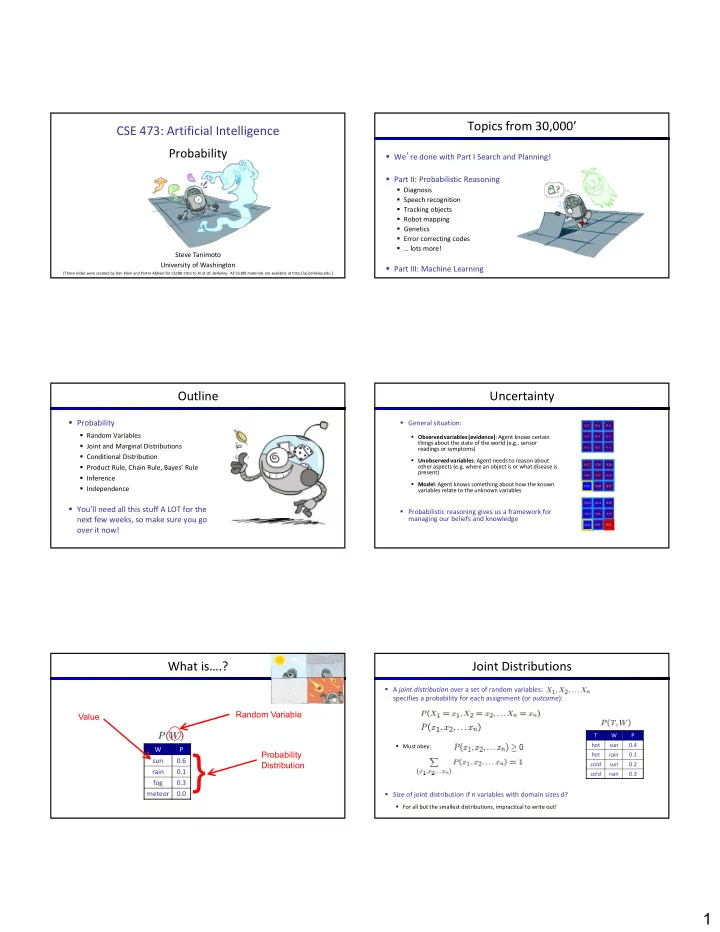
What is….?

W P sun 0.6 rain 0.1 fog 0.3 meteor 0.0

? ?

Random Variable

}

?

Value Probability Distribution

Joint Distributions

  • A joint distribution over a set of random variables:

specifies a probability for each assignment (or outcome):

  • Must obey:
  • Size of joint distribution if n variables with domain sizes d?
  • For all but the smallest distributions, impractical to write out!

T W P hot sun 0.4 hot rain 0.1 cold sun 0.2 cold rain 0.3

slide-2
SLIDE 2

2

Probabilistic Models

  • A probabilistic model is a joint distribution
  • ver a set of random variables
  • Probabilistic models:
  • (Random) variables with domains
  • Joint distributions: say whether assignments

(called “outcomes”) are likely

  • Normalized: sum to 1.0
  • Ideally: only certain variables directly interact
  • Constraint satisfaction problems:
  • Variables with domains
  • Constraints: state whether assignments are possible
  • Ideally: only certain variables directly interact

T W P hot sun 0.4 hot rain 0.1 cold sun 0.2 cold rain 0.3 T W P hot sun T hot rain F cold sun F cold rain T

Distribution over T,W Constraint over T,W

Events

  • An event is a set E of outcomes
  • From a joint distribution, we can

calculate the probability of any event

  • Probability that it’s hot AND sunny?
  • Probability that it’s hot?
  • Probability that it’s hot OR sunny?
  • Typically, the events we care about

are partial assignments, like P(T=hot)

T W P hot sun 0.4 hot rain 0.1 cold sun 0.2 cold rain 0.3

Quiz: Events

  • P(+x, +y) ?
  • P(+x) ?
  • P(-y OR +x) ?

X Y P +x +y 0.2 +x

  • y

0.3

  • x

+y 0.4

  • x
  • y

0.1

Marginal Distributions

  • Marginal distributions are sub-tables which eliminate variables
  • Marginalization(summing out): Combine collapsed rows by adding

T W P hot sun 0.4 hot rain 0.1 cold sun 0.2 cold rain 0.3 T P hot 0.5 cold 0.5 W P sun 0.6 rain 0.4

Quiz: Marginal Distributions

X Y P +x +y 0.2 +x

  • y

0.3

  • x

+y 0.4

  • x
  • y

0.1 X P +x

  • x

Y P +y

  • y

Conditional Probabilities

  • A simple relation between joint and marginal probabilities
  • In fact, this is taken as the definition of a conditional probability

T W P hot sun 0.4 hot rain 0.1 cold sun 0.2 cold rain 0.3 P(b) P(a) P(a,b)

slide-3
SLIDE 3

3

Quiz: Conditional Probabilities

X Y P +x +y 0.2 +x

  • y

0.3

  • x

+y 0.4

  • x
  • y

0.1

  • P(+x | +y) ?
  • P(-x | +y) ?
  • P(-y | +x) ?

Conditional Distributions

  • Conditional distributions are probability distributions over some variables

given fixed values of others

T W P hot sun 0.4 hot rain 0.1 cold sun 0.2 cold rain 0.3 W P sun 0.8 rain 0.2 W P sun 0.4 rain 0.6

Conditional Distributions Joint Distribution

Conditional Distribs - The Slow Way…

T W P hot sun 0.4 hot rain 0.1 cold sun 0.2 cold rain 0.3 W P sun 0.4 rain 0.6

Probabilistic Inference

  • Probabilistic inference =

“compute a desired probability from other known probabilities (e.g. conditional from joint)”

  • We generally compute conditional probabilities
  • P(on time | no reported accidents) = 0.90
  • These represent the agent’s beliefs given the evidence
  • Probabilities change with new evidence:
  • P(on time | no accidents, 5 a.m.) = 0.95
  • P(on time | no accidents, 5 a.m., raining) = 0.80
  • Observing new evidence causes beliefs to be updated

Inference by Enumeration

  • General case:
  • Evidence variables:
  • Query* variable:
  • Hidden variables:

All variables

* Works fine with multiple query variables, too

  • We want:
  • Step 1: Select the

entries consistent with the evidence

  • Step 2: Sum out H to get joint
  • f Query and evidence
  • Step 3: Normalize

Inference by Enumeration

  • P(W)?
  • P(W | winter)?
  • P(W | winter, hot)?

S T W P summer hot sun 0.30 summer hot rain 0.05 summer cold sun 0.10 summer cold rain 0.05 winter hot sun 0.10 winter hot rain 0.05 winter cold sun 0.15 winter cold rain 0.20

slide-4
SLIDE 4

4

  • Computational problems?
  • Worst-case time complexity O(dn)
  • Space complexity O(dn) to store the joint distribution

Inference by Enumeration The Product Rule

  • Sometimes have conditional distributions but want the joint

The Product Rule

  • Example:

R P sun 0.8 rain 0.2 D W P wet sun 0.1 dry sun 0.9 wet rain 0.7 dry rain 0.3 D W P wet sun 0.08 dry sun 0.72 wet rain 0.14 dry rain 0.06

The Chain Rule

  • More generally, can always write any joint distribution as an

incremental product of conditional distributions

Independence

  • Two variables are independentin a joint distribution if:
  • Says the joint distribution factors into a product of two simple ones
  • Usually variables aren’t independent!
  • Can use independence as a modeling assumption
  • Independence can be a simplifying assumption
  • Empirical joint distributions: at best “close” to independent
  • What could we assume for {Weather, Traffic, Cavity}?
  • Independence is like something from CSPs: what?

Example: Independence?

T W P hot sun 0.4 hot rain 0.1 cold sun 0.2 cold rain 0.3 T W P hot sun 0.3 hot rain 0.2 cold sun 0.3 cold rain 0.2 T P hot 0.5 cold 0.5 W P sun 0.6 rain 0.4

slide-5
SLIDE 5

5

Example: Independence

  • N fair, independent coin flips:

H 0.5 T 0.5 H 0.5 T 0.5 H 0.5 T 0.5

Conditional Independence Conditional Independence

  • P(Toothache, Cavity, Catch)
  • If I have a cavity, the probability that the probe catches in it

doesn't depend on whether I have a toothache:

  • P(+catch | +toothache, +cavity) = P(+catch | +cavity)
  • The same independence holds if I don’t have a cavity:
  • P(+catch | +toothache, -cavity) = P(+catch| -cavity)
  • Catch is conditionally independentof Toothache given Cavity:
  • P(Catch | Toothache, Cavity) = P(Catch | Cavity)
  • Equivalent statements:
  • P(Toothache | Catch , Cavity) = P(Toothache | Cavity)
  • P(Toothache, Catch | Cavity) = P(Toothache | Cavity) P(Catch | Cavity)
  • One can be derived from the other easily

Conditional Independence

  • Unconditional (absolute) independence very rare (why?)
  • Conditional independence is our most basic and robust form
  • f knowledge about uncertain environments.
  • X is conditionally independent of Y given Z

if and only if:

  • r, equivalently, if and only if

Conditional Independence

  • What about this domain:
  • Traffic
  • Umbrella
  • Raining

Conditional Independence

  • What about this domain:
  • Fire
  • Smoke
  • Alarm
slide-6
SLIDE 6

6

Bayes Rule Pacman – Sonar (P4)

[Demo: Pacman – Sonar – No Beliefs(L14D1)]

Video of Demo Pacman – Sonar (no beliefs) Bayes’ Rule

  • Two ways to factor a joint distribution over two variables:
  • Dividing, we get:
  • Why is this at all helpful?
  • Lets us build one conditional from its reverse
  • Often one conditional is tricky but the other one is simple
  • Foundation of many systems we’ll see later (e.g. ASR, MT)
  • In the running for most important AI equation!

That’s my rule!

Inference with Bayes’ Rule

  • Example: Diagnostic probability from causal probability:
  • Example:
  • M: meningitis, S: stiff neck
  • Note: posterior probability of meningitis still very small
  • Note: you should still get stiff necks checked out! Why?

Example givens =0.0079

Ghostbusters Sensor Model

36

P(red | 3) P(orange | 3) P(yellow | 3) P(green | 3) 0.05 0.15 0.5 0.3

Real Distance = 3 Values of Pacman’s Sonar Readings

slide-7
SLIDE 7

7

Ghostbusters, Revisited

  • Let’s say we have two distributions:
  • Prior distribution over ghost location: P(G)
  • Let’s say this is uniform
  • Sensor reading model: P(R | G)
  • Given: we know what our sensors do
  • R = reading color measured at (1,1)
  • E.g. P(R = yellow | G=(1,1)) = 0.1
  • We can calculate the posterior distribution

P(G|r) over ghost locations given a reading using Bayes’ rule:

[Demo: Ghostbuster – with probability (L12D2) ]

Video of Demo Ghostbusters with Probability Probability Recap

  • Conditional probability
  • Product rule
  • Chain rule
  • Bayes rule
  • X, Y independent if and only if:
  • X and Y are conditionally independent given Z:

if and only if: