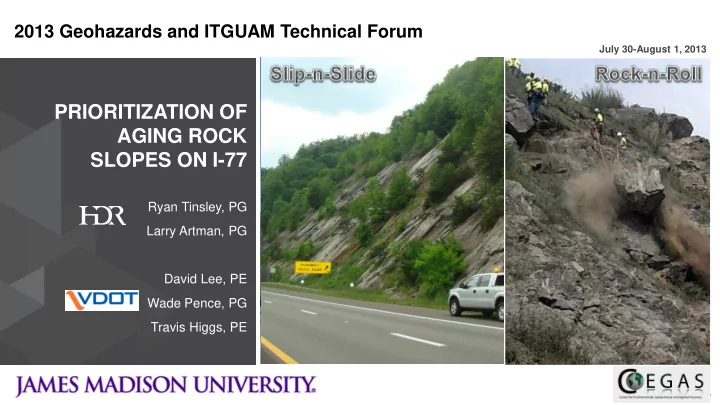
SLIDE 1 July 30-August 1, 2013
Ryan Tinsley, PG Larry Artman, PG David Lee, PE Wade Pence, PG Travis Higgs, PE
PRIORITIZATION OF AGING ROCK SLOPES ON I-77
2013 Geohazards and ITGUAM Technical Forum
SLIDE 2
PRESENTATION OUTLINE
Corridor Challenges Conclusions and a Look Ahead I-77 Rock Slope Management Program Geologic Evaluations Slope Remediation RHRS Preliminary Design
PRIORITIZATION OF AGING ROCK SLOPES ON I-77
SLIDE 3
I-77 Rock Slope Evaluations| Carroll County, VA
Roanoke Richmond Winchester Wytheville Harrisonburg
SLIDE 4
CORRIDOR CHALLENGES
► High AADT ► Steep Grades ► Foggy Conditions ► Unfavorable Geology
SLIDE 5
I-77 CORRIDOR CHALLENGES: FOGGY CONDITIONS
SLIDE 6
TYPICAL SECTION – SOUTHBOUND/NORTHBOUND
SLIDE 7
VDOT CHALLENGE: PRIORITIZATION OF AGING SLOPES
► Where are the problematic
slopes along 32 Lane Miles
► What are the primary
causes of the rockfall activity?
► What are feasible options? ► What are the probable
construction cost estimates?
► Study Challenges
– Significant slope height and length variability – No Existing Slope Inventory – No Survey – Limited Budget
Rock Slope Management Program
SLIDE 8
Rockfall Hazard Rating System
Corridor Challenges I-77 Rock Slope Management Program RHRS
PRIORITIZATION OF AGING ROCK SLOPES ON I-77
SLIDE 9
Alligator Back Formation
GEOLOGY
SLIDE 10 GEOLOGY
► Alligator Back Formation – Proterozoic Z – Cambrian ► Complexly Deformed With at Least 2 Periods of Ductile Deformation with Isoclinal
Folding
► Well-Developed Cleavage Dominates ► Rock Types:
Biotite Gneiss (Metagraywacke) Mica-Biotite Schist and Amphibolite
SLIDE 11
GEOLOGY
SLIDE 12
RHRS IMPLEMENTATION
SLIDE 13 2012 RHRS STUDY FOR – CUT SLOPE INVENTORY
► Initial Slope Inventory Using Plans and
Aerial Photography
► Develop Sequential List of Cut Slopes in
Each Lane Direction from South to North
► Field Verification of Cut Slopes Based on
Preliminary RHRS Classes A, B, and C
Some Slopes Eliminated from Further
Consideration and Rating
► Field Location of Class A, B, and C Slopes
Using Hand-held Garmin and MP Designations
► What is a Class A, B, or C Slope? Class A – High Potential for Rockfall on
Roadway
Class B – Moderate Potential for Rockfall
Class C – Low Potential for Rockfall on
Roadway (Class C Slopes Not Rated)
Ultimately, Preliminary Class Designations are Subjective Based on Experience of Rater, But Provide a Means for Prioritizing Slopes!
SLIDE 14
2012 RHRS STUDY FOR
Cut 10-NB(M)
SLIDE 15 2012 RHRS STUDY FOR
►
RHRS Key Rating Criteria: – Slope Height – Ditch Effectiveness – AVR – Average Vehicle Risk – % Site Distance – Roadway Width – Geologic Characteristics – Block Size or Volume of Rockfall – Rockfall History (Historical and Observed)
SLIDE 16
2012 RHRS STUDY FOR
Slope Heights: 25 to > 250 ft
Slope Height (ft) 25 50 75 100 Category Score 3 9 27 81
SLIDE 17
2012 RHRS STUDY FOR
Average Vehicle Risk: AADT = 18,000 Slope Length = 1280 feet Typical AVR Score :81-100
SLIDE 18
2012 RHRS STUDY FOR
% Decision Sight Distance: Worst Case: 420 ft % Decision S. D. Score = 81
SLIDE 19
2012 RHRS STUDY FOR
Sight Distance Estimated < 500 ft DSD Score = 81
Continuous and Adverse Orientation Slopes Showing Their Age
SLIDE 20
2012 RHRS STUDY FOR
MP 6.3 MP 2.9
►64 Slopes Inventoried ►28 Slopes – High Hazard
(RHRS Score >300)
►MP: 2.9 to 6.3 ►RHRS Scores: 319 to 565 ►How to prioritize beyond the
RHRS Ratings?
SLIDE 21
2012 RHRS STUDY FOR - CUT SLOPE PRIORITIZATION LIST
►RHRS Rating >500 ►Actively Producing
Rockfall
►Maintenance Records/
Rockfall Clean-up
SLIDE 22
Geologic Evaluations
Corridor Challenges I-77 Rock Slope Management Program RHRS
PRIORITIZATION OF AGING ROCK SLOPES ON I-77
Geologic Evaluations
SLIDE 23
GEOLOGIC EVALUATIONS
MP 6.3 MP 2.9
►3 Priority Slopes ►4,500 LF of Slope ►MP: 2.9 to 5.7 ►Goal:
– Feasible Options – Probable Construction Cost Estimates
Slope 8-SB Slope 14-SB Slope 19-SB
SLIDE 24 TEAM APPROACH Key Factors:
PROJECT TEAM
- Product Applicability
- Slope Access/ Construction Feasibility
- Understanding of Geologic Conditions
- Site Constraints
- Client Input (Throughout Project)
SLIDE 25 GEOLOGIC EVALUATIONS: STAGE 1 - ROAD LEVEL
Priority Slope Approach
- Establish Baseline
- Document Cut Slope Conditions
- Discontinuity Measurements
- Develop Slope Profiles for CRSP
- Identify Priority Slope Sections (AOI)
- Preliminary Kinematic Analysis
SLIDE 26
GEOLOGIC EVALUATIONS: STAGE 2 – ROPES ON THE SLOPE
► AOI Investigation – Geologic Investigation – potential failure mode(s) – Obscured slope sections – Stabilization requirements and option feasibility – Slope access
SLIDE 27
GEOLOGIC EVALUATIONS:
SLIDE 28
TECHNOLOGIES VS. SLOPE CONDITION
► Applicability – Maintain Existing Ditch – Scaling – Excavation – Rock Slope Drape – Attenuator Drape – Concrete Barrier – Flexible Rockfall Barrier – High Energy Barrier – Pinned Mesh – Rock Bolting
SLIDE 29
Preliminary Design
Corridor Challenges I-77 Rock Slope Management Program RHRS
PRIORITIZATION OF AGING ROCK SLOPES ON I-77
Geologic Evaluations Preliminary Design
SLIDE 30
PRELIMINARY DESIGN: CONSIDERATIONS FOR FEASIBLE OPTIONS Subglobal Condition (Rockfall) Height of Rockfall Generator Global Conditions (Planar, Wedge, Rock Mass) Maximum Bounce Height Height of Block Generator Maximum Energy (kJ) Slope Access/Site Constraints Slope Access/Site Constraints
SLIDE 31
FEASIBLE SUBGLOBAL OPTIONS FOR SLOPE CONDITIONS
SLIDE 32
SLOPE CONDITIONS: A, B AND C
SLIDE 33
FEASIBLE GLOBAL OPTIONS FOR SLOPE CONDITIONS
SLIDE 34 CLIENT INPUT: DRIVERS, IMPORTANCE FACTORS, & DRIVER RATING
Driver Importance Factor Construction Cost Effectiveness Construction Complexity Traffic Impacts Aesthetics Rockfall Maintenance System Maintenance
- 1. Driver = Aspect or consideration of a feasible slope mitigation option during
the selection process
Fog Impacts Maintenance Experience Environmental 7 10 6 9 3 5 8 7 7 3
- 2. Importance Factor = a weight assigned to each driver to determine relative
importance amongst the drivers.
- 3. Driver Rating = relative assessment of
each driver on a 1 to 5 scale
SLIDE 35 SCORED RELATIVE ASSESSMENT AND OPTION SHORTLIST
Driver VDOT Importance Factor (Weight) Effectiveness 10 Traffic Impacts 9 System Maintenance 8 Construction Cost 7 Fog Impacts 7 Maintenance Perception 7 Construction Complexity 6 Rockfall Maintenance 5 Aesthetics 3 Environmental Impacts 3 Total Subglobal Condition C Options C2: Scaling Total Scaling Score C4: Rock Slope Drape with Ditch Total Rock Slope Drape with Ditch Score C5: Attenuator Drape with Ditch Total Attenuator Drape with Ditch Score C6: Flexible Rockfall Barrier Total Flexible Rockfall Barrier Score 3 30 5 50 5 50 5 50 1 9 2 18 2 18 4 36 5 40 1 8 1 8 3 24 2 14 1 7 1 7 2 14 5 35 5 35 5 35 1 7 1 7 5 35 5 35 4 28 2 12 2 12 1 6 3 18 1 5 3 15 3 15 3 15 5 15 1 3 1 3 1 3 4 12 2 6 2 6 5 15 179 189 183 210
Total Option Score = Σ (Importance Factor X Driver Rating) Driver Rating = 1 to 5 scale
SLIDE 36
PRELIMINARY DESIGN
► VDOT Design Requirements (MOI, 2012)
– Rockfall Simulation:
I-77 Priority Rock Slopes = Critical Rock Slope 0% Design = Low Risk, but Higher $
SLIDE 37
PRELIMINARY DESIGN: ROCKFALL PROBABILITY
► Significant Variation in
Slope Height/Angle
► Varying Degrees of
Vegetation
► Changes in
Geology/Weathering Susceptibility
► Multiple Rockfall
Generators
► Multiple Launch
Features
Most Likely Rockfall Generator Highest Possible Rockfall Generator
SLIDE 38 PRELIMINARY DESIGN APPROACH
► Design Criteria
– Help Bracket Cost vs Rockfall Risk based on Probability of Occurrence:
Design Criteria Percentage of Rockfall Entering the Travel Lane (%) Probability
Being Retained (%) Rockfall Generator Location Probable Construction Cost 1 (per MOI) 99.9 Highest Possible Higher 2 5 95 Most Likely Lower
SLIDE 39
Conclusions and A Look Ahead
Corridor Challenges I-77 Rock Slope Management Program RHRS
PRIORITIZATION OF AGING ROCK SLOPES ON I-77
Geologic Evaluations Preliminary Design Conclusions and a Look Ahead
SLIDE 40
CONCLUSIONS
► Establishes Baseline (RHRS), Risk Assessment ► Geologic Evaluation
– Aids in Further Prioritization of High Hazard Slopes – Involves all key players for reasonable construction cost estimates – Supports emergency response remediation of slopes sections
► Design Approach
– Client input is very important – Design criteria allows for a relative Cost vs Risk assessment
SLIDE 41
A LOOK AHEAD
► Currently Conducting Preliminary
Design and Developing Probable Construction Costs for each slope
► VDOT plans to utilize these costs
for budgeting purposes for future final design and slope remediation
► Development of Contract Bid
Documents
► Contract Advertisements for slope
remediation as funding becomes available
SLIDE 42 ACKNOWLEDGEMENTS
- Wade Pence, PG – District Engineering Geologist, Salem District
- David Lee, PE – District Materials Engineer, Salem District
- Travis Higgs, PE – District Geotechnical Engineer, Salem District
- Jeff Boone – President of Ameritech Slope Constructors
- Bob Forbes – Vice President of Ameritech Slope Constructors
- Roger Moore, PG, PE – Partner/Geotechnical Engineer
- Aaron Zdinak, PE – Geotechnical Business Class Leader
- Russ Kanith, PG – Project Geologist
- Joe Wallen, PE – Geotechnical Engineer
- Matt Schuster, PhD, PE – Geotechnical Engineer
- Frank Amend, PE – Regional Manager, Southeastern USA
SLIDE 43
QUESTIONS…………SLIP - SLIDE & ROCK-N-ROLL?