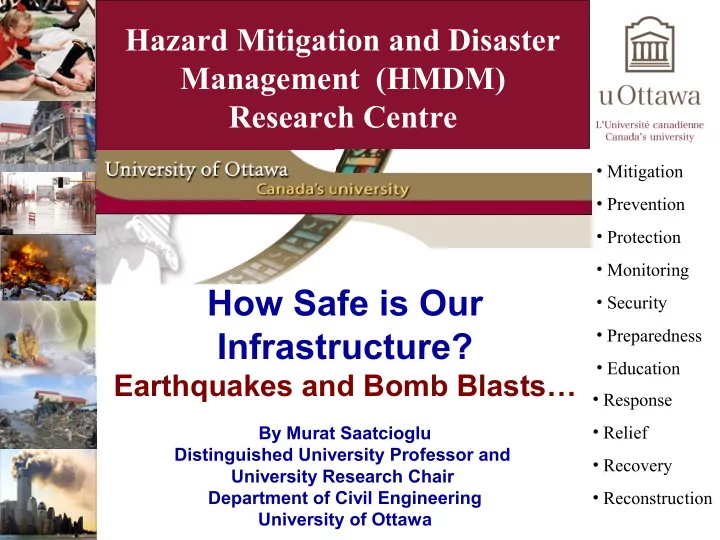
SLIDE 1 Hazard Mitigation and Disaster Management (HMDM) Research Centre
- Mitigation
- Prevention
- Protection
- Monitoring
- Security
- Preparedness
- Education
- Response
- Relief
- Recovery
- Reconstruction
How Safe is Our Infrastructure?
Earthquakes and Bomb Blasts…
By Murat Saatcioglu Distinguished University Professor and University Research Chair Department of Civil Engineering University of Ottawa
SLIDE 2
How Many Earthquakes Occur How Many Earthquakes Occur Worldwide Each Year? Worldwide Each Year?
Description Description Magnitude Magnitude Annual Average Annual Average Great Great 8 or higher 8 or higher 1 1 Major Major 7 – 7.9 7 – 7.9 18 18 Strong Strong 6 – 6.9 6 – 6.9 120 120 Moderate Moderate 5 – 5.9 5 – 5.9 800 800 Light Light 4 – 4.9 4 – 4.9 6,200 6,200 Minor Minor 3 – 3.9 3 – 3.9 49,000 49,000 Very Minor Very Minor 2 – 3 2 – 3 1,000/day 1,000/day Very Minor Very Minor 1 – 2 1 – 2 8,000/day 8,000/day
SLIDE 3
Causes of Earthquakes Causes of Earthquakes
Continental Drift Theory Continental Drift Theory
SLIDE 4
Causes of Earthquakes Causes of Earthquakes
Continental Drift Theory Continental Drift Theory
SLIDE 5
Earthquakes Between 1960 and 1995 Earthquakes Between 1960 and 1995
SLIDE 6 Elastic Rebound Theory Elastic Rebound Theory Most commonly accepted cause Most commonly accepted cause
- f earthquakes
- f earthquakes
SLIDE 7
Fault Rupture Fault Rupture
SLIDE 8
1977 Caucete E.Q. in Argentina
Vertical Offset Due to Vertical Offset Due to Fault Rupture Fault Rupture
Fault Rupture Fault Rupture
SLIDE 9
Fault Rupture Fault Rupture
SLIDE 10 How Many Earthquakes Occur How Many Earthquakes Occur in Canada? in Canada?
Approximately 300 earthquakes
- ccur each year in Eastern Canada.
Of this number, approximately four exceeds magnitude 4.0 More than 4000 earthquakes are recorded each year in Canada
SLIDE 11
Earthquakes That Occurred in the Last 30 Days Earthquakes That Occurred in the Last 30 Days
SLIDE 12
Seismic Hazard in Canada Seismic Hazard in Canada
SLIDE 13
Seismic Risk in Canada Seismic Risk in Canada
Seismic Risk = Hazard * Vulnerability * Exposure
SLIDE 14
Seismic Risk in Canada Seismic Risk in Canada
SLIDE 15 Seismic Vulnerability of Seismic Vulnerability of Buildings Buildings
Building designed and built prior to the enactment of modern seismic codes may be vulnerable against seismic
- motions. In Canada, this means
buildings prior to 1970’s and 1980’s. Buildings on soft soil are more vulnerable than those built on solid rock.
SLIDE 16
Effect of Soil Conditions Effect of Soil Conditions
The effect of ground motion is amplified by soft soil
SLIDE 17
Liquefaction Liquefaction
SLIDE 18
Liquefaction Liquefaction
SLIDE 19
Liquefaction Liquefaction
SLIDE 20
Seismic Vulnerability of Seismic Vulnerability of Buildings Buildings
Buildings constructed using brittle construction materials are more vulnerable than those built using ductile materials Typically, old masonry and non-ductile reinforced concrete buildings behave in a brittle manner Steel construction, well-designed reinforced concrete buildings and single-family timber houses often perform favorably
SLIDE 21
2010 Earthquake in Chile
SLIDE 22
2010 Earthquake in Chile
SLIDE 23
2010 Earthquake in Chile
SLIDE 24
2010 Earthquake in Chile
SLIDE 25
May 12, 2008 Wenchuan Earthquake in China
SLIDE 26
May 12, 2008 Wenchuan Earthquake in China
SLIDE 27
Seismic Vulnerability of Seismic Vulnerability of Buildings Buildings
Buildings with irregularities attract higher deformations during earthquakes, and hence are vulnerable. Lack of proper seismic design and detailing practices result in brittle behaviour. Interference of non-structural elements may cause unexpected deficiencies in seismic capacities.
SLIDE 28
Effect of Torsion Effect of Torsion
SLIDE 29
Effect of Torsion Effect of Torsion
SLIDE 30
Effect of Torsion Effect of Torsion
SLIDE 31
Effect of Vertical Discontinuity Effect of Vertical Discontinuity
SLIDE 32
Effect of Vertical Discontinuity Effect of Vertical Discontinuity
SLIDE 33 Effect of Vertical Irregularity Effect of Vertical Irregularity
Office in Concepcion
SLIDE 34
Effect of Vertical Irregularity Effect of Vertical Irregularity
SLIDE 35
Effect of Vertical Irregularity Effect of Vertical Irregularity
SLIDE 36
Effect of Soft Storey Effect of Soft Storey
SLIDE 37
Effect of Soft Storey Effect of Soft Storey
SLIDE 38
Effect of Soft Storey Effect of Soft Storey
SLIDE 39
Lack of Seismic Design and Detailing Lack of Seismic Design and Detailing
SLIDE 40
Lack of Seismic Design and Detailing Lack of Seismic Design and Detailing
SLIDE 41
Lack of Seismic Design and Detailing Lack of Seismic Design and Detailing
SLIDE 42 Condominium in Concepcion
Lack of Seismic Design and Detailing Lack of Seismic Design and Detailing
SLIDE 43
Lack of Seismic Design and Detailing Lack of Seismic Design and Detailing
SLIDE 44
Lack of Seismic Design and Detailing Lack of Seismic Design and Detailing
SLIDE 45
Lack of Seismic Design and Detailing Lack of Seismic Design and Detailing
SLIDE 46
Lack of Seismic Design and Detailing Lack of Seismic Design and Detailing
SLIDE 47
Lack of Seismic Design and Detailing Lack of Seismic Design and Detailing
SLIDE 48
Lack of Concrete Confinement Lack of Concrete Confinement
SLIDE 49
Short Column Effect Short Column Effect
SLIDE 50
Short Column Effect Short Column Effect
SLIDE 51
Damage to Bridge Infrastructure Damage to Bridge Infrastructure
SLIDE 52
1995 Kobe E.Q. in Japan 1995 Kobe E.Q. in Japan
SLIDE 53
1999 Kocaeli E.Q. in Turkey 1999 Kocaeli E.Q. in Turkey
SLIDE 54
1994 Northridge E.Q. 1994 Northridge E.Q.
SLIDE 55
May 12, 2008 Wenchuan Earthquake in China
SLIDE 56
Santiago
2010 Earthquake in Chile
SLIDE 57
2010 Earthquake in Chile
SLIDE 58
Earthquake Engineering Research
Structures Laboratory
SLIDE 59
Research on Seismic Retrofit
SLIDE 60
RetroBelt Seismic Retrofit Technique
SLIDE 61
RetroBelt Seismic Retrofit Technique
SLIDE 62
FRP Jacketing
SLIDE 63
FRP Jacketing
SLIDE 64
Lateral Bracing as Seismic Retrofit Technology
SLIDE 65
Lateral Bracing as Seismic Retrofit Technology
SLIDE 66
Lateral Bracing as Seismic Retrofit Technology
SLIDE 67
Lateral Bracing as Seismic Retrofit Technology
SLIDE 68
Seismic Risk Assessment
SLIDE 69
Microzonation for Ottawa
SLIDE 70
SLIDE 71
SLIDE 72
Data Collection for Ottawa
SLIDE 73
Data Collection for Ottawa
SLIDE 74
Blast Risk
SLIDE 75
Blast Risk
Bomb blasts generate: Shock Waves Flying debris (fragmentation) Fireball effect
SLIDE 76
Blast Hazard
Car Bombs Pose High Hazard Parcel Bombs Pose Low Hazard The primary parameters that define blast hazard are charge weight and standoff distance
SLIDE 77
Shock Waves
SLIDE 78
An important step is to reduce deformation and/or force demands in structural and non-structural building components. This is achieved through; proper selection of structural layout and/or structural system providing sufficient protection by increasing protected standoff distances against external attacks, and providing security and controlled access against internal attacks
To Reduce The Effects of Shock Waves…
SLIDE 79 The building shape and layout should be selected to minimize the effects of blast
- loading. Re-entrant corners and overhangs
are likely to trap shock wave and amplify the effect of blast. The reflected pressure
- n the surface of a circular building is less
intense than on a flat building. When curved surfaces are used, convex shapes are preferred over concave shapes.
Selection of Building Layout
SLIDE 80
Selection of Building Layout
SLIDE 81
Standoff Distance
SLIDE 82
Standoff Distance
SLIDE 83
Cast-in-place reinforced concrete is the structural system preferred for blast- resistant construction. This is the material and structural type used for military bunkers. The military has performed extensive research and testing of its performance
Selection of Structural Type and Material
SLIDE 84 Lightweight construction is unsuitable for providing air-blast resistance. For example, a building with steel deck roof construction will have little air-blast
- resistance. The performance of a
conventional steel frame with concrete fill over metal deck depends on the connection details.
Selection of Structural Type and Material
SLIDE 85 Unreinforced masonry provides some resistance at far standoff distances due to its mass. However, it does not posses any ductility, and fail catastrophically beyond the elastic limit. Reinforced masonry may show improved
- behaviour. However, it does not allow
sufficient continuity, ductility and redundancy
Selection of Structural Type and Material
SLIDE 86
Seismic Versus Blast Loading
SLIDE 87
Element Damage (near the exposed surface) Progressive collapse Global response (not likely to cause damage unless very light structure)
Structural Damage Due to Blast
SLIDE 88
Progressive Collapse
SLIDE 89
Progressive Collapse
SLIDE 90 Shock Tube
Capacity: Reflected Pressure : 10 psi (15 psi) Duration: 40 msec (50 msec) Service Life: 300 shots/year for 20 years Geometry: Length: Approx. 11 m Spool Diameter: 0.6 m Test Area: 2 m x 2 m
Research @ uOttawa
SLIDE 91
Shock Tube
SLIDE 92
Shock Tube
SLIDE 93
Example Shock Wave
SLIDE 94
Shock Tube Testing - Slab
SLIDE 95
Shock Tube Testing - Timber
SLIDE 96
Shock Tube Testing - Columns
SLIDE 97
Shock Tube Testing - Columns
SLIDE 98
Conclusions… Questions or Comments?