SLIDE 1 ROYAL DUTCH SHELL PLC FOURTH QUARTER AND FULL YEAR 2013 RESULTS
JANUARY 30th 2014 FOURTH QUARTER AND FULL YEAR 2013 RESULTS WEBCAST TO MEDIA BY BEN VAN BEURDEN, CHIEF EXECUTIVE OFFICER OF ROYAL DUTCH SHELL PLC SIMON HENRY, CHIEF FINANCIAL OFFICER OF ROYAL DUTCH SHELL PLC
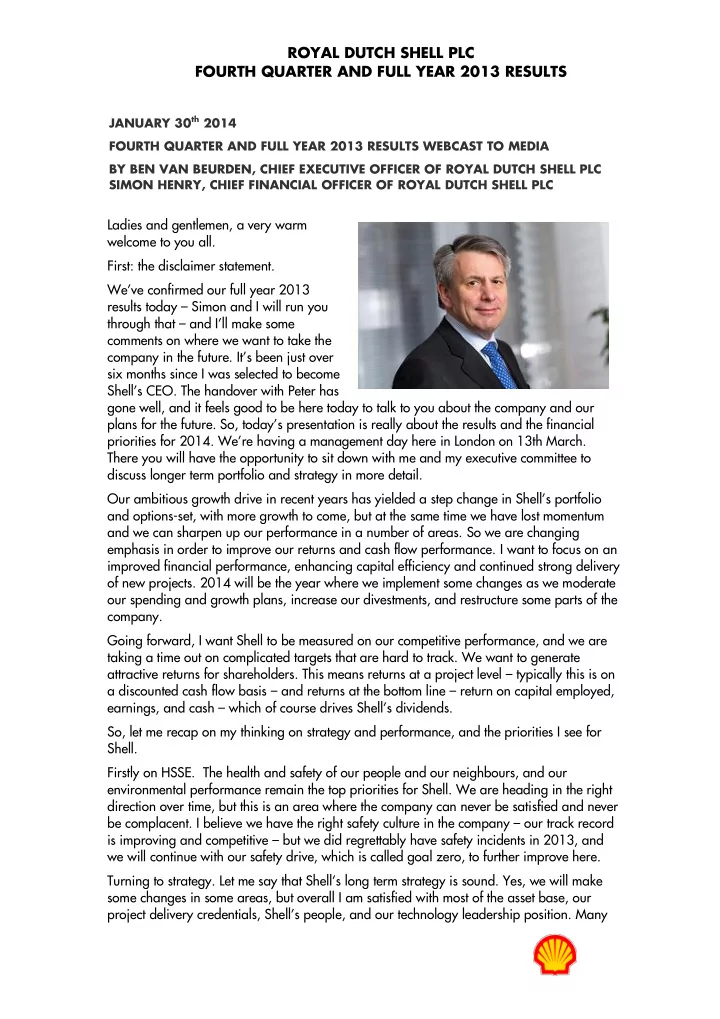
Ladies and gentlemen, a very warm welcome to you all. First: the disclaimer statement. We’ve confirmed our full year 2013 results today – Simon and I will run you through that – and I’ll make some comments on where we want to take the company in the future. It’s been just over six months since I was selected to become Shell’s CEO. The handover with Peter has gone well, and it feels good to be here today to talk to you about the company and our plans for the future. So, today’s presentation is really about the results and the financial priorities for 2014. We’re having a management day here in London on 13th March. There you will have the opportunity to sit down with me and my executive committee to discuss longer term portfolio and strategy in more detail. Our ambitious growth drive in recent years has yielded a step change in Shell’s portfolio and options-set, with more growth to come, but at the same time we have lost momentum and we can sharpen up our performance in a number of areas. So we are changing emphasis in order to improve our returns and cash flow performance. I want to focus on an improved financial performance, enhancing capital efficiency and continued strong delivery
- f new projects. 2014 will be the year where we implement some changes as we moderate
- ur spending and growth plans, increase our divestments, and restructure some parts of the
company. Going forward, I want Shell to be measured on our competitive performance, and we are taking a time out on complicated targets that are hard to track. We want to generate attractive returns for shareholders. This means returns at a project level – typically this is on a discounted cash flow basis – and returns at the bottom line – return on capital employed, earnings, and cash – which of course drives Shell’s dividends. So, let me recap on my thinking on strategy and performance, and the priorities I see for Shell. Firstly on HSSE. The health and safety of our people and our neighbours, and our environmental performance remain the top priorities for Shell. We are heading in the right direction over time, but this is an area where the company can never be satisfied and never be complacent. I believe we have the right safety culture in the company – our track record is improving and competitive – but we did regrettably have safety incidents in 2013, and we will continue with our safety drive, which is called goal zero, to further improve here. Turning to strategy. Let me say that Shell’s long term strategy is sound. Yes, we will make some changes in some areas, but overall I am satisfied with most of the asset base, our project delivery credentials, Shell’s people, and our technology leadership position. Many
SLIDE 2 ROYAL DUTCH SHELL PLC FOURTH QUARTER AND FULL YEAR 2013 RESULTS
- f our businesses demonstrate outstanding, world-class operational and financial
performance, and integration and scale are key strengths of the company. But as our business model is based on significant investment levels, it is essential that we allocate capital efficiently. This is going to be a stronger focus for the company going forward. We haven’t always made the right capital choices and we need to react more quickly to changes and opportunities in the industry environment. For all the parts that make up our business portfolio, be it existing assets or new projects, we need to scrutinize harder whether they are sufficiently attractive and resilient. Do they have plans that are credible, plans that are competitive and plans that are affordable? We can be more rigorous in our analysis sometimes, I believe. Overall, we manage through short term volatility and we look for through cycle growth in cash flow, competitive returns and growing the dividend. We need to be innovative and, generally, at the leading edge to be competitive. This is a consistent and long term approach from Shell and this is how we create value, and it also enables us to grow the dividend sustainably through the business cycle. Turning to financial performance. Firstly on cash flow. We had a cash flow deficit in 2013. This resulted from a step up in capital spending in 2013, driven by a higher pace of acquisitions, and by a slow-down in divestments. Going forward, we need to realign our cash inflows and outflows to a surplus position, not necessarily on an annual basis, but I do see the size of cash deficit in 2013 as unusual, and not something we will repeat lightly. Although our operating performance has been satisfactory overall, our earnings and cash flow have slipped in some areas, and there are several factors here. For example changes in the industry environment, such as low refining margins, low US gas prices, and the security picture in Nigeria. We can’t influence that, and we are looking carefully at where we need to adjust our strategy and our exposures. And on the Shell side, we’ve been hit with high levels of maintenance and exploration charges in 2013, which have reduced our results. In exploration we’ve had a mixed year with the drill bit, and exploration charges to income were $5 billion pre-tax in 2013. This does come with higher level of exploration activity, but I don’t like to see these dry holes. So, lots to work on. But clearly, none of us at Shell are comfortable with these results. This chart shows our competitive position on two very important metrics for Shell, and I think the competitive picture is a good way to assess our performance. Cash flow from
- perations reflects the quality of our investment choices and our operating performance.
Our cash flow has moved into a much stronger competitive position, from a low starting point, but the momentum has slowed in 2013, and we want to see more growth here. Return on average capital employed is also an important metric for us, and ROACE is important for any capital intensive business, on a long term basis. Plans to generate competitive returns have been firmly embedded in our strategy for some time. Our project flow will help here, and should drive returns higher in the next two to three years. Shell’s returns are around average on a long term basis, but we have slipped recently. There are many factors in that, such as growth spending and the macro cycle. But I want to see us moving to a higher level of return on capital employed going forward. Competitive performance on return on capital employed will be included in our executives’ remuneration packages from 2014 onwards. So, those are some comments on how I see the strategy and the competitive picture.
SLIDE 3 ROYAL DUTCH SHELL PLC FOURTH QUARTER AND FULL YEAR 2013 RESULTS
Now, let me make some comments on the priorities that I see for Shell in 2014. We’ve been following an ambitious growth strategy in the last few years. We’ve achieved a lot, and there’s more growth in cash flow and returns to come, but our momentum has slowed in 2013 and we need to improve here. Our overall strategy remains robust, but 2014 will be a year where we are changing emphasis. Our financial performance can improve. This means a more competitive picture on returns, as well as growing our cash flow, which should drive our dividends over time. Improving the profitability in oil products and North America upstream will be a particular priority for us. Overall, we need to enhance our capital efficiency, which will involve moderating the pace of growth investment, more asset sales, and hard decisions on new options. And of course we must integrate the 2013 acquisitions and continue to deliver our projects successfully. Let me highlight two areas of the company that we are restructuring, North America resources plays, or shales, which lost over $2 billion excluding identified items in 2013 and global oil products, where our returns – 4% in 2013 – are simply too low. Shell has substantial capital employed in these two areas of the business, nearly $80 billion combined at end-2013. Both have been impacted by weak industry conditions, a fall-off in US gas prices, and low refining margins, both triggered by over-supply, which could be a permanent structural change. We are restructuring both of these portfolios, with asset sales and potentially further write downs, and we are going to be much more selective on growth
- pportunities here. We’ll give you more information on all this in our March management
day, and this is clearly going to be a focus area for the company in 2014, in what is going to be a multi-year programme to address these issues. Shell has a rich opportunity set, which we have built up in the last few years. This is a good position to be in but we are capital constrained. We will go ahead with the most attractive investments on behalf of our shareholders but we need to make hard choices on pre-FID
- ptions and non-core assets. Are these fundamentally attractive on their economics and
growth potential? And are these positions resilient to price volatility and other risks? For example, we recently halted design work on a large scale gas-to-liquids plant in Louisiana, and postponed the FID on the Arrow LNG project in Australia. We didn’t like the economics and inflation risks on these proposals. We sold our Wheatstone LNG stake in Australia, which was too small to be material for Shell. Shell’s focus in LNG is to deliver the Prelude, Elba and the non-operated Gorgon project, and to be capital efficient in progressing the next wave of LNG options – Abadi, Canada LNG, Browse, and Arrow. We are not expecting any major FIDs in Asia Pacific LNG in 2014. We’re selling upstream assets in Nigeria and North America onshore, although prices have fallen in North America outside the sweetspots. We are divesting a series of refining and marketing positions in oil products, and there are more asset sales to come. Overall, we are announcing a step up in asset sales, which should reach $15 billion for 2014 and 2015
- combined. These asset sales and a rigorous portfolio approach will add more focus and
capital efficiency to the company. Let me make some comments on capital allocation at Shell. Our 2013 spending was $46 billion, including $8 billion of acquisitions. Bolt on acquisitions will remain part of our strategy, although I expect less activity on deals in 2014. Including the acquisitions we have already announced, our total capital spending in 2014 should be some $37 billion, or 20% lower than last year. Organic investment for 2014, which excludes acquisitions, is expected to be around $35 billion, or 8% lower than 2013. This marks a new emphasis in Shell to moderate our growth ambitions, and to improve our free cash flow and returns. We make
SLIDE 4 ROYAL DUTCH SHELL PLC FOURTH QUARTER AND FULL YEAR 2013 RESULTS
investment choices on a global, thematic basis, and you can see the main categories here. Each of these strategic themes has distinctive technology drivers, partnerships, financials, and markets. The “engines” businesses, in downstream and upstream, are mature, and they provide strong free cash flow for our dividends and growth themes, $7 billion free cash flow in 2013. The “growth priorities” – deep-water and integrated gas – are where Shell has leadership positions in the industry. In integrated gas, we have a very rich funnel of development opportunities, maybe a little too much, and this is an area where we have been trimming our portfolio recently. At the same time, we are building on our deep water funnel, with new exploration and deals like Libra in Brazil. The “longer term” category covers potentially very large positions for Shell in the future, but where we need to be careful not to over-invest at too early a stage. This includes politically complex plays like Iraq, Kazakhstan and Nigeria, and sensitive environments like Arctic and oil sands. We’ve put resources plays into this longer term category as well. I believe we have got a little ahead of ourselves in some of these longer term plays, and I want to moderate our investment pace there. Running through all of this, I want to make sure that we are applying rigorous capital efficiency. This means investing in the projects that generate the best returns and cash flow, and getting out of plays where we can’t add value for our shareholders. Let me make a comment on Alaska, where we have been in a multi-year exploration program in the Beaufort and Chukchi Sea. We took a pause in 2013 to prepare for the next drilling season. We’ve added additional people and resources to the venture, we’ve updated our plans with what we’ve learned from 2012, and we’ve worked closely with the U.S. Department of Interior and other government agencies in a programme. However, we are frustrated by the recent decision by the Ninth Circuit Court of Appeals in a six-year-old lawsuit against the government. The obstacles introduced by that decision makes it impossible to justify the commitment of cost, equipment and people needed to drill safely in Alaska this year. We will have to wait for the courts and the US administration to resolve this legal issue. Given all of this, we will not drill in Alaska in 2014, and we are reviewing
Turning to projects. We started up 7 large projects in 2013 that have some 180,000 boe per day potential when fully on stream, and we have four major project start-ups in 2014. Three of these are deep water fields operated by Shell. At Mars B, which is a 100,000 boe per day tension leg platform, we are expecting to start-up early production shortly. The fourth new one this year is the Repsol LNG acquisition and we are busy integrating that into
- ur LNG portfolio. So, some substantial portfolio additions coming on line in 2014.
Our strategy is designed to deliver through-cycle growth in cash flow and competitive
- returns. Shell has returned $12 billion to shareholders in dividends and buy-backs in 2013.
You can see the dividend track record on the slide, spanning many years of commitment to progressive shareholder returns. We expect to increase the dividend again in 2014, reflecting our confidence in Shell’s long term strategy, and we expect to continue with share buy backs this year to offset dilution from scrip dividends. With that, let me hand you over to Simon, to recap on the 2013 results.
SLIDE 5 ROYAL DUTCH SHELL PLC FOURTH QUARTER AND FULL YEAR 2013 RESULTS
Thanks Ben. Good to be here today to see you all. We’ve had a busy year in 2013, and let me summarise for you. CCS earnings, excluding identified items were $19
- billion. I’ll give you all the details in a
- moment. We had some substantial new
field start-ups, such as Iraq onshore, and in deep water Brazil, and we announced a series of acquisitions, adding assets in areas where Shell has leadership positions, such as deep water and LNG. At the same time, we have been reviewing our portfolio, with asset sales and project cancellations, which are all part of a drive to further improve the capital efficiency in the company. We updated on our 2013 results earlier this month. The numbers haven’t changed, and let me summarise this for you. Full year 2013 CCS earnings excluding identified items were $19 billion and earnings per share decreased by 23% from 2012, with lower earnings from both upstream and downstream. Cash flow from operations was $40 billion for the
- year. We’ve announced a $0.45 cents per share dividend for the fourth quarter 2013, 5%
higher than year ago levels. Buy-backs, which we use to offset dilution from scrip, were $5 billion for 2013, at the upper end of our guidance for last year. And on SEC reserves, when final volumes are reported in the 2013 Annual Report, we expect that proved oil and gas reserves additions will be around 1.6 billion boe, with a headline reserves replacement ratio for the year at around 131%. This chart shows the main drivers of our results on a full year, and on a fourth quarter to fourth quarter basis. In aggregate, the macro picture – that’s oil & gas prices, downstream margins and Nigeria security impacts – were a negative for us for the full year, and the fourth quarter. Volume and mix effects were a positive to earnings on a full year basis. However, fourth quarter 2013 was impacted by a fall-off in volumes which had a large impact on the results, with a Q4 to Q4 movement of some $300 million. This included uplift from growth projects which was more than offset by some $500 million higher maintenance and asset replacement effects compared with the fourth quarter 2012, reducing high value
- il and gas volumes in regions such as the Gulf of Mexico, Nigeria deep water and the
North Sea, as well as LNG sales volumes. Exploration charges increased, rising from $3.1 billion pre-tax in 2012 to $5.3 billion in 2013. These charges built up in the second half of last year, with a net impact of around $1.4 billion in Q4 2013, and a Q4 to Q4 movement
- f some $500 million. This was driven by a higher level of exploration well write-offs
quarter on quarter, particularly in French Guiana and resource plays globally with reduced tax offsets compared to a year ago. Costs, depreciation and taxes all increased on a year
- ver year, and a Q4 to Q4 basis. Fourth quarter 2013 results included an $170 million Q4
to Q4 impact for exchange rate movements on Australia deferred tax liability. Headline oil and gas production for the fourth quarter was 3.3 million boe per day, an underlying decrease of 3% excluding the impact from Nigeria and divestments. Volumes were supported by growth from liquids rich shales in North America, Iraq and others, offset by field decline and 95,000 boe per day of maintenance impacts. LNG sales volumes were down 10% Q4 to Q4, primarily due to maintenance activities. In Downstream, availability
SLIDE 6 ROYAL DUTCH SHELL PLC FOURTH QUARTER AND FULL YEAR 2013 RESULTS
was similar, and underlying oil products sales volumes were lower with chemicals sales volumes similar to fourth quarter 2012 levels. You will see some pointers for the first quarter of 2014 on the slide. Let me highlight that in Upstream we are expecting continued impacts from the Nigeria operating environment, which was a $54 million income and 40,000 boe per day movement on a Q4 to Q4 basis. The ADCO licence in Abu Dhabi expired in January 2014, which will reduce our production by 155,000 barrels per day, from a low margin contract. The Dutch Government has announced a gas production curtailment for the NAM joint venture which will be around 60,000 boe per day impact for Shell in the first quarter, and around 20,000 boe per day on average for the year, and we are expecting some 50,000 barrels per day
- f maintenance impacts on a Q1 to Q1 in high margin plays, which is about half of the
maintenance impact for Q4 2013. Exploration charges will be higher on a Q1 to Q1 basis. Upstream depreciation charges will increase in 2014. This step up includes increase related to the Repsol acquisition on an on-going basis, and Iraq impacts. Lastly on the outlook, refinery availability is expected to be lower than Q1 2013, due to higher turnaround activity in Q1 2014. Turning to cash flow. Cash generation on a 12-month rolling basis was some $42 billion, including $2 billion of disposals proceeds, with an average Brent price of $109 per barrel. Our free cash flow has declined in recent quarters, as we move through a phase of higher acquisitions and fewer asset sales. That position should improve in 2014, as the pace of asset sales increases, and we see cash flow growth from new projects. Acquisitions and divestments are distorting the core free cash flow picture, and these are short term effects. The dividend increase we are expecting for the first quarter 2014 reflects the confidence we have in the growth in Shell’s free cash flow over time. Share buy backs in 2014 will continue, as we offset the dilution from the scrip dividend programme. Our financial framework is straightforward. We use growth in our cash flow from
- perations to fund both capital spending and payout across the cycle. We keep a
conservative balance sheet. We take on debt in down-cycles or when the company is in a capital intensive stage. There is no formula for the right level of debt, but we want to keep gearing below 30%. We use our cash, after servicing debt, to fund a competitive dividend, and after that, to invest for future growth. We operate in a volatile world where our incoming cash can vary by over $10 bln per year. The scrip dividend and the balance sheet provide the flexibility to manage this risk, without jeopardising the dividend or potentially damaging value by short term swings in capital spending. If we get into a surplus cash position, then the first priority is buy backs to offset scrip dividends, and we have been doing that in 2013. If we get into a more substantial free cash flow position, we are not there today, then we have the option to increase buy backs and that would be a decision for the future. 2013 was a busy year on portfolio development. Let me summarize that for you. Working from left to right on this chart explains how we are filling our development funnel, and bringing new oil & gas on stream. We made strategic acquisitions during the year, and announced divestment or redesign on positions where our strict investment criteria were not
- achievable. Our explorers had 4 discoveries and appraisal successes with the drill bit.
We’re assessing the potential from these finds and we will update you on that at a later
- stage. We took final investment decision on 9 new projects in 2013, the largest of which
was the 80,000 barrels per day Carmon Creek development, and we started up 7 new
SLIDE 7 ROYAL DUTCH SHELL PLC FOURTH QUARTER AND FULL YEAR 2013 RESULTS
developments which should add some180,000 boe per day of peak production potential. This includes some large Shell operated projects, such as Majnoon, in Iraq, and the second phase of the BC-10 development in Brazil. The largest acquisition we made was the purchase of Repsol’s LNG portfolio. These assets fill a supply gap in our LNG portfolio, in the west Atlantic and east Pacific. We’ve bought 4.2 mtpa of equity LNG capacity, and 7.2 mtpa of total sales volumes. Shell can add value to this portfolio by supplying the already-contracted customer base from a more diversified LNG portfolio, for example from shorter shipping routes and optimizing gas quality, and by combining the Repsol positions with our world-wide LNG trading business. This acquisition is cash flow accretive for Shell shareholders in 2014, it has only very minor on-going capex requirements, expected to be less than $50 million per year, and it has the potential to deliver up to $1 billion per year of CFFO for Shell. So, we’re very pleased with this transaction, and I think this is a great addition to our portfolio. Now, let me turn to capital spending, and give you more details on the plans that Ben
- described. We are driving investment and, innovation along a series of distinct strategic
themes, and by implementing hard capital ceilings, we are driving tough choices in the
- company. Total capital spending in 2013 was $46 billion. This figure includes $8 billion of
acquisitions, which include the BC-10 pre-emption and the Repsol LNG deal, which closed across the New Year, with some of the accounting for that coming into this year. For 2014
- ur total spending should fall to $37 billion, or a reduction of 20%. Within these figures,
- rganic spending should decline by $3 billion, or 8%, to around $35 billion in 2014, with
the final outcome driven by the timing and structure of on-going divestments. On an
- rganic basis, so excluding announced acquisitions downstream spending will be similar in
2014 to last year at some $6 billion, upstream engines capex will fall to $6 billion from around $8 billion last year reflecting project phasing. In our growth priorities deep water spending will fall from around $7.5 billion to $6 billion, as new fields come on stream in the Gulf and integrated gas spending will be similar to last year’s levels, around $6 billion. Resources spending will be reduced in the Americas and international portfolio, from around $6 billion to $5 billion, of which just under $4 billion will be for the Americas, a reduction of $1 billion. Developments such as Carmon Creek will drive an increase in spending in the future opportunities category to around $6 billion, an increase from last
- year. Exploration spending, both capitalized and expensed, was some $7 billion in 2013
excluding acquisitions, and will be similar in 2014, split 60/40 conventional and resources plays. With that, let me hand you back to Ben. Thanks Simon. Let me sum up. Our strategy overall remains robust, but 2014 will be a year where we are changing emphasis. Our financial performance can improve here. This means a more competitive picture on returns as well as cash flow, and over the medium term, addressing underperforming areas of the business more robustly.
SLIDE 8
ROYAL DUTCH SHELL PLC FOURTH QUARTER AND FULL YEAR 2013 RESULTS
We need to further improve on our capital efficiency; there are some hard choices to be made there, more asset sales – $15 billion in 2014 and 2015 combined – and moderating the pace of growth investment after a strong growth drive in recent years. And we need to continue to work hard on project delivery, with a series of important start-ups in 2014, especially in deep water. Our strategy is designed to deliver through-cycle growth in cash flow and competitive returns, and Shell’s dividend track record underscores our commitment to shareholders. With that, let’s take your questions. Let me remind you that we are having a management day in London on 13th March. My executive committee will be there, and that’s an opportunity to go into the portfolio and strategy in more detail than today. Please could we have just one or two each, so that everyone has the opportunity to ask a question. We’ll start with questions in the room and also go to the phones for Q&A. Thank you for your questions and for joining the call today. Once again, let me remind you that we are having a management day in London on 13th March, and looking forward to seeing you then.
ROYAL DUTCH SHELL PLC JANUARY 30TH 2014 WWW.SHELL.COM/IR
DEFINITIONS AND CAUTIONARY NOTE
The companies in which Royal Dutch Shell plc directly and indirectly owns investments are separate entities. In this presentation “Shell”, “Shell group” and “Royal Dutch Shell” are sometimes used for convenience where references are made to Royal Dutch Shell plc and its subsidiaries in general. Likewise, the words “we”, “us” and “our” are also used to refer to subsidiaries in general or to those who work for them. These expressions are also used where no useful purpose is served by identifying the particular company or companies. ‘‘Subsidiaries’’, “Shell subsidiaries” and “Shell companies” as used in this presentation refer to companies in which Royal Dutch Shell either directly or indirectly has control, by having either a majority of the voting rights or the right to exercise a controlling influence. The companies in which Shell has significant influence but not control are referred to as “associated companies” or “associates” and companies in which Shell has joint control are referred to as “jointly controlled entities”. In this presentation, associates and jointly controlled entities are also referred to as “equity-accounted investments”. The term “Shell interest” is used for convenience to indicate the direct and/or indirect (for example, through our 23% shareholding in Woodside Petroleum Ltd.) ownership interest held by Shell in a venture, partnership or company, after exclusion of all third-party interest. This presentation contains forward-looking statements concerning the financial condition, results of operations and businesses of Royal Dutch Shell. All statements other than statements of historical fact are, or may be deemed to be, forward-looking statements. Forward-looking statements are statements of future expectations that are based on management’s current expectations and assumptions and involve known and unknown risks and uncertainties that could cause actual results, performance or events to differ materially from those expressed or implied in these statements. Forward-looking statements include, among other things, statements concerning the potential exposure of Royal Dutch Shell to market risks and statements expressing management’s expectations, beliefs, estimates, forecasts, projections and assumptions. These forward-looking statements are identified by their use of terms and phrases such as ‘‘anticipate’’, ‘‘believe’’, ‘‘could’’, ‘‘estimate’’, ‘‘expect’’,
SLIDE 9 ROYAL DUTCH SHELL PLC FOURTH QUARTER AND FULL YEAR 2013 RESULTS
‘‘intend’’, ‘‘may’’, ‘‘plan’’, ‘‘objectives’’, ‘‘outlook’’, ‘‘probably’’, ‘‘project’’, ‘‘will’’, ‘‘seek’’, ‘‘target’’, ‘‘risks’’, ‘‘goals’’, ‘‘should’’ and similar terms and phrases. There are a number of factors that could affect the future
- perations of Royal Dutch Shell and could cause those results to differ materially from those expressed in the
forward-looking statements included in this presentation, including (without limitation): (a) price fluctuations in crude oil and natural gas; (b) changes in demand for Shell’s products; (c) currency fluctuations; (d) drilling and production results; (e) reserves estimates; (f) loss of market share and industry competition; (g) environmental and physical risks; (h) risks associated with the identification of suitable potential acquisition properties and targets, and successful negotiation and completion of such transactions; (i) the risk of doing business in developing countries and countries subject to international sanctions; (j) legislative, fiscal and regulatory developments including potential litigation and regulatory measures as a result of climate changes; (k) economic and financial market conditions in various countries and regions; (l) political risks, including the risks of expropriation and renegotiation of the terms of contracts with governmental entities, delays or advancements in the approval of projects and delays in the reimbursement for shared costs; and (m) changes in trading
- conditions. All forward-looking statements contained in this presentation are expressly qualified in their entirety
by the cautionary statements contained or referred to in this section. Readers should not place undue reliance
- n forward-looking statements. Additional factors that may affect future results are contained in Royal Dutch
Shell’s 20-F for the year ended 31 December, 2012 (available at www.shell.com/investor and www.sec.gov ). These factors also should be considered by the reader. Each forward-looking statement speaks only as of the date of this presentation, 30 January, 2014. Neither Royal Dutch Shell nor any of its subsidiaries undertake any
- bligation to publicly update or revise any forward-looking statement as a result of new information, future
events or other information. In light of these risks, results could differ materially from those stated, implied or inferred from the forward-looking statements contained in this presentation. There can be no assurance that dividend payments will match or exceed those set out in this presentation in the future, or that they will be made at all. We use certain terms in this presentation, such as discovery potential, that the United States Securities and Exchange Commission (SEC) guidelines strictly prohibit us from including in filings with the SEC. U.S. Investors are urged to consider closely the disclosure in our Form 20-F, File No 1-32575, available on the SEC website www.sec.gov. You can also obtain this form from the SEC by calling 1-800-SEC-0330.