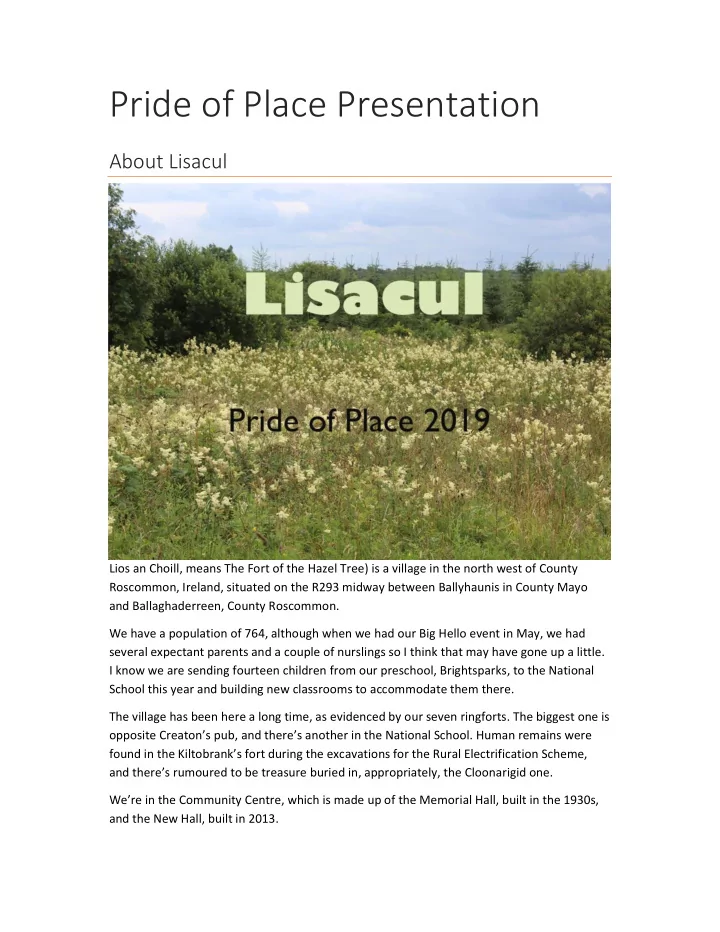
Pride of Place Presentation About Lisacul Lios an Choill, means The - - PDF document

pride of place presentation
SMART_READER_LITE
LIVE PREVIEW

Pride of Place Presentation About Lisacul Lios an Choill, means The - - PDF document

Pride of Place Presentation About Lisacul Lios an Choill, means The Fort of the Hazel Tree) is a village in the north west of County Roscommon, Ireland, situated on the R293 midway between Ballyhaunis in County Mayo and Ballaghaderreen, County


slide-1
SLIDE 1

Pride of Place Presentation

About Lisacul

Lios an Choill, means The Fort of the Hazel Tree) is a village in the north west of County Roscommon, Ireland, situated on the R293 midway between Ballyhaunis in County Mayo and Ballaghaderreen, County Roscommon. We have a population of 764, although when we had our Big Hello event in May, we had several expectant parents and a couple of nurslings so I think that may have gone up a little. I know we are sending fourteen children from our preschool, Brightsparks, to the National School this year and building new classrooms to accommodate them there. The village has been here a long time, as evidenced by our seven ringforts. The biggest one is

  • pposite Creaton’s pub, and there’s another in the National School. Human remains were

found in the Kiltobrank’s fort during the excavations for the Rural Electrification Scheme, and there’s rumoured to be treasure buried in, appropriately, the Cloonarigid one. We’re in the Community Centre, which is made up of the Memorial Hall, built in the 1930s, and the New Hall, built in 2013.

slide-2
SLIDE 2

Pride of Place Presentation Text Page 2 The Memorial was built to honour locals who died between 1920 and 1923 in the War of Independence and the Civil War. The dedication plaque over the building reads:

I ndil cuimhne ar Sheamus O’Maoil Bhreanainn Eoghan O’Ceallaigh Thomas O’ Flannghaile Phadhraic O’ Maoil Bhreanainn Tomas Mac Gabhann

A marbhuigheadh ar son poblacta na h-Eireann (1920-23) The Memorial Hall became well-known as a dance hall – for fourpence you could get tea, and an evening of dancing to a local band. Skipping forward a few decades … in September 1997, Brightsparks Preschool was founded and became a regular tenant of the hall. Like everyone else in Ireland, we took a huge hit from the recession – job losses, the sudden halt to work on new developments, the emigration of our children in search of better opportunities. But we gritted our teeth and carried on. In 2013, we published ‘The Gathering’, a book about Lisacul – past and present – and with a generous donation of land from a local farmer, a LOT of fundraising, a bank loan and a HUGE leap of faith, we extended the building to create a new hall, kitchen, office and toilet block.

slide-3
SLIDE 3

The Benefits of the Community Centre

With more than fifteen townlands, and with no post office of village shop, there’s no universally agreed village centre in Lisacul; and although we have thriving and well attended services of church, pub, preschool, and school, it is the Community Centre is where our widely scattered community comes together regardless of age, creed, culture, or nationality. And with our weather, we even have picnics in the Centre. Most of Lisacul’s clubs and societies use the Centre for meetings and events. You could almost say we have a cradle to the grave service, with people first coming here as babes in arms to the Toddler Group and finally being waked here with after funeral refreshments. In between are pre-school, Communion and Confirmation parties, children’s discos, Christmas parties, GRETB courses, Irish Dancing classes, Tractor runs, Drama Group, Tidy Towns, Active Age, and many, many others. The Resource Centre is an admin hub, from which we run the CE scheme with its sixteen employees and the Community Development Group. The Preschool Administrator sits in there too, as does our Active Age facilitator, and from there, we run most of our social

  • media. We put important village publications –The Gathering Book, or the School Reunion

Book, the weekly parish newsletter – on line. This keeps our Diaspora in touch with the

  • village. We use Facebook to keep up to date with village events and to publicise local

businesses such as taxi services, manicurists and, most recently, Willowbrook Glamping

slide-4
SLIDE 4

which we’ll be visiting later today. In addition to Glamping, Tuesday runs art classes, drama classes, creative writing courses, and comes to many of our child-centred events to do face painting. It’s that type of cross-over and helping further each other’s plans that is the primary benefit

  • f this Centre and makes Lisacul such a wonderful place. Farmers who need to register herd

movements on-line meet office staff and you get a deal about turf worked out; a CE scheme worker with a great singing voice entertains the Active Age group; toddlers look forward to joining the big children in preschool and preschool children look forward to joining the even bigger children at Big School (we have a graduation ceremony with caps and gowns – it’s ADORABLE) ; incomers looking for information about the village are invited to Christmas parties where they meet people who have been here forever and suddenly have a new social network and, if they don’t move quickly enough, a regular appointment with the our Wednesday Warriors, the Tidy Towns Clean Up Crew, and a seat on a committee.

Planning

And speaking of committees… One of the joys of a small village is that no one is ever on just one committee or a member of just one group – there’s a lot of cross-pollination going on. This means that there’s no “they should” because ‘they’ are ‘we’. So, we have a lot of ‘could we do…’ or ‘what if …’. We have

slide-5
SLIDE 5

Pride of Place Presentation Text Page 5 finite resources, but lots of imagination and ideas and we feed off each other. Here’s one example - The outdoor team from the CE scheme want to move from using bedding plants to using herbaceous perennials. This fits in with the Tidy Towns team who want to improve biodiversity in the area. Someone knows someone on another committee who is getting rid

  • f a polytunnel, someone else knows someone with a lot of overgrown perennials who

would welcome a hand with pruning and dividing. Someone has a lot of pallets that they don’t need any more and would be grateful if someone could take them. The Active Age group are doing a flower arranging course. In due course the polytunnel will be filled with cuttings from those overgrown perennials, sitting in steading made from old pallets, and the Active Age group will have a steady stream of flowers to arrange and decorate tables for dos at the Centre and our planters will be filled with plants that come back every year. So that was a small plan – moving from bedding to perennials. In 2016 we had a really, really big plan. The main drivers were the Development Committee and the Preschool, but as I said, we all sit on more than one committee, so almost every club and society was involved, as was the CE team – we even pulled in a Senator and local councillors and SEAI, the Sustainable Energy Authority. It started with a Sensory Garden for the preschool – done on a shoestring budget, most of which went on the non-slip soft surface – the garden furniture was sourced, built and placed by the CE team and we got a Senator to open the garden. So far so good, but we couldn’t help noticing how shabby the new garden made the rest of the place look and we shared this opinion with each other, over tea, in the kitchen, when out and about, and when dropping into the office. It started with wouldn’t it be nice if… and finished with a serious wish list. We wanted

 to reduce heating costs  enough plates and cutlery to host 100 people  more room for the children – it was getting so people had to put their names down for a place as soon as the line turned blue  somewhere to put stuff so we don’t have to haul it around in cars – that was every club that used the building  a kitchen where the floor doesn’t ‘bounce’  a training space so people don’t have to travel out of county and for things like manual handing and first aid, we can have the trainer come to us  storage space in the office so we don’t have things stacked up on top of the filing cabinets

 restoring the windows in the Main Hall to their old size, so we don’t need to get a ladder to open and close them

slide-6
SLIDE 6

Type of Work

Over two summers – because the building work couldn’t be done while the preschool was

  • pen - we insulated the hall and took a sledgehammer to the kitchen, discovering – as you

do – that someone had put a partition wall against a solid wall. We had an easier time removing the partition between the pre-school and what we used to call The Middle Room but which had become the Resting Place for Things We Haven’t Put In the Bin Yet. We knocked out the brick infill in the window spaces to put in new windows – that opened – and lowered the ceiling and filled the space with more insulation. We built a removable partition so we could have two classrooms but still retain a big space for events. We put in big presses in the new hall and in the office. We built a streamlined kitchen and filled the new presses with enough plates, bowls, mugs and cutlery to cater for 100 people. We upgraded the boiler and ran pipes into the New Hall so we could have radiators in there. And when we finished, we painted all the walls and gave the floor in the Memorial Hall a fresh coat of varnish as an eightieth birthday present.

slide-7
SLIDE 7

Fundraising, Local Involvement and Reaching out to the Wider Community

The work we did over those two summers cost, as my smallest niece would put it, “a really, really, lot”. And, like the village play, pretty nearly everyone in the village was involved in some way – from working on the projects, to dipping into their pockets, to supporting the fundraising auctions, tea parties, raffles, tractor runs and any other way we could think of to raise funds. The biggest single grant was from TUSLA, for the rebuilding work for the preschool work. The pre-school staff and committee, who are all volunteers, slaved over the bid, and almost went blind reading the small print and conditions, for months. They had so many conversations, in person, over the phone and by email, with Roscommon County Childcare that they became Best Friends Forever. With the help of our local councillors and a member of the CE team with a background in writing successful tenders, we identified and applied for grants from the Municipal, Community Enhancement, and Community Initiatives Funds of Roscommon County Council. SEAI part-funded our insulation and heating work, and one of our villagers, familiar with SEAI and somewhat expert in heating and insulating, helped us to make the best of the funding

slide-8
SLIDE 8

The Development Company Chair and Treasurer chatted up the bank manager and the committee juggled figures to come up with the best way to combine the various funding streams and spend them to best effect. Clubs and societies took tables at tea parties and Ros Go Run and Lisacul Players made large and very welcome donations. The Alan O’Dowd fund raised enough money through a football tournament to provide tables, chairs, cups, saucers, soup bowls and side plates, tea cloths, trays, jugs, and tea pots for a soup and sandwich lunch for 100 AND a refit of the small kitchen to store it all in. And we had two priceless contributions: our CE Team provided all of the non-professional labour, and our Supervisor managed the whole project –arranging the scheduling so there were no wasted days throughout the build and that pre-school time was never interrupted. Throughout the process of making over the Community Centre, the outdoor work continued. The CE Team and Tidy Towns do most of the work, but villagers have adopted spaces near their houses and generally agree with the move towards perennials and increasing biodiversity in our planting schemes. You will notice too, as you tour the village, that we reach out to our heritage and our place in our street furniture. In addition to the tyres, we have bog oaks, old farm equipment, an old pump, old sheds with green roofs.

slide-9
SLIDE 9

Future Plans

So, what’s next? Well, we have a list. We’re going to put in a shed to hold the tables and chairs when they’re not in use. And the Drama Group are planning to smuggle in a few small crates of teeny-tiny props that won’t take up any room at all, honest. From September, we will be inviting people back to the Centre after Mass, for a monthly get together over tea and coffee. We recently got fibre broadband and have gone from ‘I need to send an email, could everyone log off for five minutes’ to 5g. So, we’re thinking about using the New Hall as an

  • pen office for people who want to work from home but find they’re distracted by laundry,
  • r a sudden desire to water all the plants.

The polytunnel will go into its first full year of production in 2020. We’re aiming for 90% locally grown plants in 2021, and I do mean plants – not just flowers. We’ll be growing plants for scent so that sitting by a bench in summer is a complete sensory experience. And some

  • f the growers who will be using the polytunnel are keen on growing vegetables and fruit
  • nce the flowers have been planted out. We’re promised lettuces, scallions, and radishes at

the very least.

slide-10
SLIDE 10

Finally, our National School is expanding. This year our preschool graduation class numbered thirteen, all of whom have moved up to the Big School. There may be fewer next year, only about seven or eight, but it’s starting to get a bit squished. We have Department of Education approval for an 80 square metre classroom and we’re just waiting for planning permission before moving in. And then there’s the annual stuff – the play at Easter, Graduations in June, the Cemetery Mass in July, Ros Go Run in September, the Halloween Disco, the Christmas Parties – every year we plan to make them better than the year before. And someone is bound to say “What if…” at some point. So, watch this space.

Q&A

And now, before you set off on a tour of the village, do you have any questions?