SLIDE 1 CSci 5271 Introduction to Computer Security Day 3: Low-level vulnerabilities
Stephen McCamant
University of Minnesota, Computer Science & Engineering
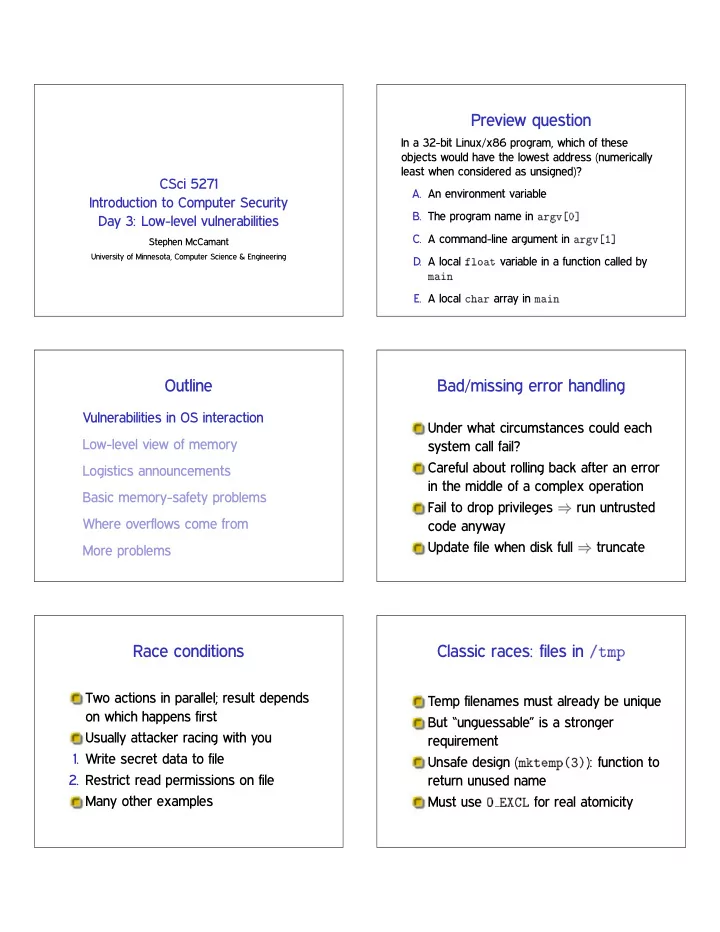
Preview question
In a 32-bit Linux/x86 program, which of these
- bjects would have the lowest address (numerically
least when considered as unsigned)?
- A. An environment variable
- B. The program name in ❛r❣✈❬✵❪
- C. A command-line argument in ❛r❣✈❬✶❪
- D. A local ❢❧♦❛t variable in a function called by
♠❛✐♥
- E. A local ❝❤❛r array in ♠❛✐♥
Outline
Vulnerabilities in OS interaction Low-level view of memory Logistics announcements Basic memory-safety problems Where overflows come from More problems
Bad/missing error handling
Under what circumstances could each system call fail? Careful about rolling back after an error in the middle of a complex operation Fail to drop privileges ✮ run untrusted code anyway Update file when disk full ✮ truncate
Race conditions
Two actions in parallel; result depends
Usually attacker racing with you
- 1. Write secret data to file
- 2. Restrict read permissions on file
Many other examples
Classic races: files in ✴t♠♣
Temp filenames must already be unique But “unguessable” is a stronger requirement Unsafe design (♠❦t❡♠♣✭✸✮): function to return unused name Must use ❖ ❊❳❈▲ for real atomicity
SLIDE 2 TOCTTOU gaps
Time-of-check (to) time-of-use races
- 1. Check it’s OK to write to file
- 2. Write to file
Attacker changes the file between steps 1 and 2 Just get lucky, or use tricks to slow you down
TOCTTOU example
✐♥t s❛❢❡❴♦♣❡♥❴❢✐❧❡✭❝❤❛r ✯♣❛t❤✮ ❢ ✐♥t ❢❞ ❂ ✲✶❀ str✉❝t st❛t s❀ st❛t✭♣❛t❤✱ ✫s✮ ✐❢ ✭✦❙ ■❙❘❊●✭s✳st ♠♦❞❡✮✮ ❡rr♦r✭✧♦♥❧② r❡❣✉❧❛r ❢✐❧❡s ❛❧❧♦✇❡❞✧✮❀ ❡❧s❡ ❢❞ ❂ ♦♣❡♥✭♣❛t❤✱ ❖ ❘❉❖◆▲❨✮❀ r❡t✉r♥ ❢❞❀ ❣
TOCTTOU example
✐♥t s❛❢❡❴♦♣❡♥❴❢✐❧❡✭❝❤❛r ✯♣❛t❤✮ ❢ ✐♥t ❢❞ ❂ ✲✶✱ r❡s❀ str✉❝t st❛t s❀ r❡s ❂ st❛t✭♣❛t❤✱ ✫s✮ ✐❢ ✭r❡s ⑤⑤ ✦❙ ■❙❘❊●✭s✳st ♠♦❞❡✮✮ ❡rr♦r✭✧♦♥❧② r❡❣✉❧❛r ❢✐❧❡s ❛❧❧♦✇❡❞✧✮❀ ❡❧s❡ ❢❞ ❂ ♦♣❡♥✭♣❛t❤✱ ❖ ❘❉❖◆▲❨✮❀ r❡t✉r♥ ❢❞❀ ❣
TOCTTOU example
✐♥t s❛❢❡❴♦♣❡♥❴❢✐❧❡✭❝❤❛r ✯♣❛t❤✮ ❢ ✐♥t ❢❞ ❂ ✲✶✱ r❡s❀ str✉❝t st❛t s❀ r❡s ❂ st❛t✭♣❛t❤✱ ✫s✮ ✐❢ ✭r❡s ⑤⑤ ✦❙ ■❙❘❊●✭s✳st ♠♦❞❡✮✮ ❡rr♦r✭✧♦♥❧② r❡❣✉❧❛r ❢✐❧❡s ❛❧❧♦✇❡❞✧✮❀ ❡❧s❡ ❢❞ ❂ ♦♣❡♥✭♣❛t❤✱ ❖ ❘❉❖◆▲❨✮❀ r❡t✉r♥ ❢❞❀ ❣
Changing file references
With symbolic links With hard links With changing parent directories Avoid by instead using:
❢✯ functions that operate on fds ✯❛t functions that use an fd in place of the CWD
Directory traversal with ✳✳
Program argument specifies file with directory ❢✐❧❡s What about ❢✐❧❡s✴✳✳✴✳✳✴✳✳✴✳✳✴❡t❝✴♣❛ss✇❞?
SLIDE 3
Environment variables
Can influence behavior in unexpected ways
P❆❚❍ ▲❉ ▲■❇❘❆❘❨ P❆❚❍ ■❋❙ . . .
Also umask, resource limits, current directory
IFS and why it’s a problem
In Unix, splitting a command line into words is the shell’s job
String ✦ argv array ❣r❡♣ ❛ ❜ ❝ vs. ❣r❡♣ ✬❛ ❜✬ ❝
Choice of separator characters (default space, tab, newline) is configurable Exploit s②st❡♠✭✧✴❜✐♥✴✉♥❛♠❡✧✮
Outline
Vulnerabilities in OS interaction Low-level view of memory Logistics announcements Basic memory-safety problems Where overflows come from More problems
Overall layout (Linux 32-bit) Detail: static code and data Detail: heap
SLIDE 4
Detail: initial stack Example stack frame Outline
Vulnerabilities in OS interaction Low-level view of memory Logistics announcements Basic memory-safety problems Where overflows come from More problems
Canvas, discussions
Canvas page started, will use for assignment turn-in Online discussions, including for group formation For spoiler questions, email both me and the TA, keep CC’d
Finding project topics
Pre-proposal due 9/18 (one week from today) Don’t skimp on topic selection: important to success Conference papers linked from class site Scheduling grid now available
More on choosing topics
Can’t: wait to see what part of class you like best
But feel free to look ahead
Think about your group’s skills
Also: available hardware/software
Think about where to find novelty Topic changes allowed, but will set you back
SLIDE 5 Outline
Vulnerabilities in OS interaction Low-level view of memory Logistics announcements Basic memory-safety problems Where overflows come from More problems
Stack frame overflow Overwriting adjacent objects
Forward or backward on stack
Other local variables, arguments
Fields within a structure Global variables Other heap objects
Overwriting metadata
On stack:
Return address Saved registers, incl. frame pointer
On heap:
Size and location of adjacent blocks
Double free
Passing the same pointer value to ❢r❡❡ more than once More dangerous the more other heap
- perations occur in between
Use after free
AKA use of a dangling pointer Could overwrite heap metadata Or, access data with confused type
SLIDE 6
Outline
Vulnerabilities in OS interaction Low-level view of memory Logistics announcements Basic memory-safety problems Where overflows come from More problems
Library funcs: unusable
❣❡ts writes unlimited data into supplied buffer No way to use safely (unless stdin trusted) Finally removed in C11 standard
Library funcs: dangerous
Big three unchecked string functions
str❝♣②✭❞❡st✱ sr❝✮ str❝❛t✭❞❡st✱ sr❝✮ s♣r✐♥t❢✭❜✉❢✱ ❢♠t✱ ✳✳✳✮
Must know lengths in advance to use safely (complicated for s♣r✐♥t❢) Similar pattern in other funcs returning a string
Library funcs: bounded
Just add “n”:
str♥❝♣②✭❞❡st✱ sr❝✱ ♥✮ str♥❝❛t✭❞❡st✱ sr❝✱ ♥✮ s♥♣r✐♥t❢✭❜✉❢✱ s✐③❡✱ ❢♠t✱ ✳✳✳✮
Tricky points:
Buffer size vs. max characters to write Failing to terminate str♥❝♣② zero-fill
More library attempts
OpenBSD str❧❝♣②, str❧❝❛t
Easier to use safely than “n” versions Non-standard, but widely copied
Microsoft-pushed str❝♣② s, etc.
Now standardized in C11, but not in glibc Runtime checks that ❛❜♦rt
Compute size and use ♠❡♠❝♣② C++ st❞✿✿str✐♥❣, glib, etc.
Still a problem: truncation
Unexpectedly dropping characters from the end of strings may still be a vulnerability E.g., if attacker pads paths with ✴✴✴✴✴✴✴ or ✴✳✴✳✴✳✴✳ Avoiding length limits is best, if implemented correctly
SLIDE 7
Off-by-one bugs
str❧❡♥ does not include the terminator Comparison with ❁ vs. ❁❂ Length vs. last index ①✰✰ vs. ✰✰①
Even more buffer/size mistakes
Inconsistent code changes (use s✐③❡♦❢) Misuse of s✐③❡♦❢ (e.g., on pointer) Bytes vs. wide chars (UCS-2) vs. multibyte chars (UTF-8) OS length limits (or lack thereof)
Other array problems
Missing/wrong bounds check
One unsigned comparison suffices Two signed comparisons needed
Beware of clever loops
Premature optimization
Outline
Vulnerabilities in OS interaction Low-level view of memory Logistics announcements Basic memory-safety problems Where overflows come from More problems
Integer overflow
Fixed size result ✻❂ math result Sum of two positive ✐♥ts negative or less than addend Also multiplication, left shift, etc. Negation of most-negative value ✭❧♦✇ ✰ ❤✐❣❤✮✴✷
Integer overflow example
✐♥t ♥ ❂ r❡❛❞❴✐♥t✭✮❀ ♦❜❥ ✯♣ ❂ ♠❛❧❧♦❝✭♥ ✯ s✐③❡♦❢✭♦❜❥✮✮❀ ❢♦r ✭✐ ❂ ✵❀ ✐ ❁ ♥❀ ✐✰✰✮ ♣❬✐❪ ❂ r❡❛❞❴♦❜❥✭✮❀
SLIDE 8 Signed and unsigned
Unsigned gives more range for, e.g., s✐③❡ t At machine level, many but not all
Most important difference: ordering In C, signed overflow is undefined behavior
Mixing integer sizes
Complicated rules for implicit conversions
Also includes signed vs. unsigned
Generally, convert before operation:
E.g., ✶❯▲▲ ❁❁ ✻✸
Sign-extend vs. zero-extend
❝❤❛r ❝ ❂ ✵①❢❢❀ ✭✐♥t✮❝
Null pointers
Vanilla null dereference is usually non-exploitable (just a DoS) But not if there could be an offset (e.g., field of struct) And not in the kernel if an untrusted user has allocated the zero page
Undefined behavior
C standard “undefined behavior”: anything could happen Can be unexpectedly bad for security Most common problem: compiler
- ptimizes assuming undefined behavior
cannot happen
Linux kernel example
str✉❝t s♦❝❦ ✯s❦ ❂ t✉♥✲❃s❦❀ ✴✴ ✳✳✳ ✐❢ ✭✦t✉♥✮ r❡t✉r♥ P❖▲▲❊❘❘❀ ✴✴ ♠♦r❡ ✉s❡s ♦❢ t✉♥ ❛♥❞ s❦
Format strings
♣r✐♥t❢ format strings are a little interpreter ♣r✐♥t❢✭❢♠t✮ with untrusted ❢♠t lets the attacker program it Allows:
Dumping stack contents Denial of service Arbitrary memory modifications!
SLIDE 9
Next time
Exploitation techniques for these vulnerabilities