
SLIDE 1
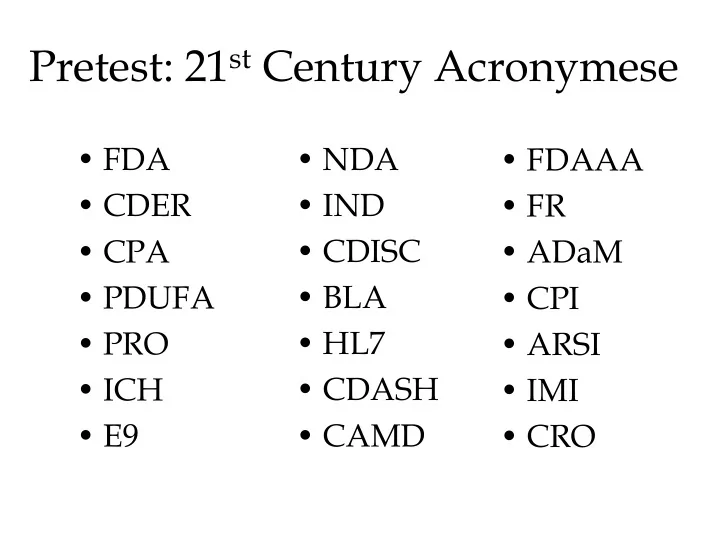
Pretest: 21st Century Acronymese
- FDA
- CDER
- CPA
- PDUFA
- PRO
- ICH
- E9
- NDA
- IND
- CDISC
- BLA
- HL7
- CDASH
- CAMD
- FDAAA
- FR
- ADaM
- CPI
- ARSI
- IMI
- CRO
Pretest: 21 st Century Acronymese FDA NDA FDAAA CDER IND FR - - PowerPoint PPT Presentation
Pretest: 21 st Century Acronymese FDA NDA FDAAA CDER IND FR CPA CDISC ADaM PDUFA BLA CPI PRO HL7 ARSI ICH CDASH IMI CAMD E9 CRO 21 st Century Review at the
―21st Century Review‖ at the Center for Drug Evaluation and Research (CDER): So Many Data, So Little Time*
Stephen E. Wilson, Dr.P.H., CAPT USPHS
Director, Division of Biometrics III Center for Drug Evaluation and Research US Food and Drug Administration
Institute of Biostatistics Department of Statistics & Biostatistics,
Rutgers University
Fiber Optics Auditorium, Busch Campus, Rutgers Friday, April 16, 2010 *Or … How I Learned to Stop Worrying and Love the Critical Path, the FDAAA and the PDUFAs
Views expressed in this presentation are those of the speaker and not, necessarily, of the Food and Drug Administration
Views expressed in this presentation are those of the speaker and not, necessarily, of the Food and Drug Administration, but they should be
understanding variability in nature
making decisions about nature in the presence of variability
Winer, et.al., Statistical Principles in Experimental Design, New York, 1962, 1971, 1991
World
– Organization – The Regulatory World
– The Critical Path – The Food and Drug Administration Amendments Act (FDAAA) and the Prescription Drug Users Fee Act IV (PDUFA IV)
This Right?
Office of the Commissioner
Office of Regulatory Affairs Center for Food Safety & Applied Nutrition Center for Drug Evaluation & Research Center for Biologics Evaluation & Research Center for Devices & Radiological Health Center for Veterinary Medicine National Center for Toxicological Research Office of Policy and Planning
Other Offices and Programs
Chief Information Officer
Chief Operating Officer Bertoni, 2006
Mission of the FDA
efficacy, and security of human and veterinary drugs, biological products, medical devices, our nation’s food supply, cosmetics, and products that emit radiation.
health by helping to speed innovations…
– 1906 -- Food Drug and Cosmetics (FD&C) Act – 1938 -- Food Drug and Cosmetics (FD&C) Act – 1962 – Kefauver-Harris Amendment to the FD&C Act – 1997 -- FDA Modernization Act (FDAMA)
characterized by increasing technological, trade and public health complexities.
– 2007 -- FDA Amendments Act (FDAAA)*
standards base information technology (IT) environment for the exchange, review, and management of information supporting the process for the review of human drug applications throughout the product life cycle. * Including PDUFA IV
– 21 CFR 314.50 -- The NDA
CDER
application.
– 21 CFR 11 –Good practice for all computerized processes
– Systems – Guidance – Procedures
technology…‖
Science
such approach satisfies the requirements
both.
Arnold
sponsor’s results (we are ―reviewers‖)
conclusions – programs & analysis datasets
derived variables, missing/messy data (―quirks‖ – R. Helms) – sensitivity analyses
NDA/BLA/SUPPLEMENT SPONSOR
FDA
NDA/BLA/SUPPLEMENT STATISTICAL REVIEWER
21st Century Review: A CDER Initiative
performance standards the Center for Drug Evaluation and Research (CDER) follows when doing drug reviews that involve multiple offices.
identify problems early in the review process.
more organized and integrated, and ensure all decision makers are heard.
for raising and addressing differing points in a timely manner over the course of the drug review.
Jenkins, 2009
Amendments Act (FDAAA) and Prescription Drug User Fee Act IV (PDUFA IV)
A serious attempt to focus attention on modernizing the evaluation of safety, efficacy and quality of medical products
Safety Medical Utility Industrialization Murphy, 2007
2000’s did not appear to be producing at the expected level
various experts
investment in development science
Woodcock, 2008
First Achievement of Critical Path: Defining (Naming) the Problem
medical community, etc) did not grasp this issue
undiscovered safety issues as well as slowdowns of important drugs and devices
to improve development
– Biologics and device programs have (very modest) research funds – Drugs program does not have any significant funding
Woodcock, 2008
medical professional societies, and some academics rapidly on board
definition but not sure of its relative importance
group as projects in their regulatory area are addressed)
– Innovative Medicines Initiative (IMI) in Europe
Woodcock, 2008
March ch 2006 006
Bioinformatics -- Standards
Trials – Adaptive Designs, CDASH, CTTI
Address Urgent Public Health Needs -- CAMD
Biomarkers, SAEC
Harnessing Bioinformatics – Data Standards
―FDA Announces Standard Format That Drug Sponsors Can Use to Submit Human Drug Clinical Trial Data,‖ 2004
Example of the Problem: Locate Relevant Data and Merge/Concatenate/Subset
Prior Medical History data here Demographic data here Lab data here Adverse Event data here Concomitant Meds data here
Demographic data here from DEM dataset Laboratory data here from LAB dataset
Concomitant Meds data here from Conmed dataset
Past Medical History data here from MEDH dataset Adverse Event data here from AE dataset
3 Weeks of Data Manipulation – 36 pages taped together to explore one question
To Drill Down
…hold face closer to page
41
Assessing Potential Liver Injury by Analyzing Increases in Serum Alanine Aminotransferase (ALT) and Total Serum Bilirubin (TBILI) IN ONE STEP
X-axis: Days into Study Individual Patient Profile: Linkage of several data tables using the same timeline
Drug experience Data Adverse Event Data Concomitant Drugs Laboratory Data
Cooper, 2008
CDASH, etc.
SPL, etc.
Computational Science Meeting in Bethesda
– …fundamental principles that apply to all analysis datasets, with the driving principle being that the design
explicit communication of the content of, input to, and purpose of submitted analysis datasets. – …describes ADaM metadata, the subject-level dataset ADSL, and a new multiple-record-per-subject data structure: the ADaM Basic Data Structure (BDS). – The Analysis Data Model supports efficient generation, replication, and review of analysis results.
standards, including the associated Standards Development Organization, are being considered for adoption or
in international Standards Development Organizations and supports global harmonization of data standards through
etc.
Streamlining Clinical Trials – Adaptive Designs, CTTI, CDASH
current FDA thinking on certain critical trial design issues
– Clinical Hepatotoxicity -FY2008 – Non-inferiority Trials –FY2008 – Adaptive Trial Designs –FY2008 – End of Phase 2(a) Meetings –FY2008 – Multiple Endpoints in Clinical Trials –FY2009 – Enriched Trial Designs –draft by end of FY 2010 – Imaging Standards as End Point in Clinical Trials -FY2011
areas
– Predictive toxicology – Biomarker qualification – Missing clinical trial data
Adaptive Design Draft Guidance
February 2010
Clinical Data Acquisition Standards Harmonization
(Association of Clinical Research Organizations)
2006 DIA Annual meeting-- FDA Critical Path Opportunity #45,
Baylor College of Medicine, CDISC, Clinical Research Forum, FDA, NCI, NCRR, NIH, NLM, C-Path Institute, PhRMA, BIO, SCDM and Duke Clinical Research Institute.
www.cdisc.org
standards" (element name, definition, and related metadata) for a basic set of global data collection fields (also known as CRF, or Case Report Form, variables) that will support clinical research studies.
"safety data domains" (i.e. Adverse Events, Prior and Concomitant Medication, Demographics and Subject Characteristics, Medical History, etc.).
www.cdisc.org
Collecting the Data CTTI
Transformation Initiative
University, Industry, NIH, FDA, law firms
as a quality system to support efficient product development
designs
novel technological and statistical tools
Throckmorton, 2009
improve the design and execution of clinical trials
applicable to all clinical trials
when adopted broadly, will increase the quality and efficiency of clinical trial
Throckmorton, 2009
Improving the System of Reporting and Interpreting Serious Adverse Events (SAEs)
expedited manner
including investigators, institutional review boards, industry and FDA, to identify and communicate SAEs in a more efficient and informative manner
Throckmorton, 2009
sponsors to notify investigators of all unexpected SAEs associated with the drug
SAEs as individual expedited reports
– Go to overburdened IRBs and investigators – Individual reports often lack context and detail, making interpretation difficult
little-to-no gain in understanding investigational product risk-benefit
– Risks distracting from direct study participant care and more meaningful safety data communications
Throckmorton, 2009
– Assess resource utilization and value of current system – Develop proposal for possible modification of the current system
investigators will:
– More efficiently and effectively inform investigators of safety events – Improve protection of study participants
Throckmorton, 2009
Developing Products to Address Urgent Public Health Needs -- CAMD
Disease Focus
CAMD
Diseases
Alzheimer’s
Brookings Institutes, Academia and Industry
history using shared data from placebo use (aim: natural history of the disease)
and improved trial efficiency
Throckmorton, 2009
Better Evaluation Tools – Biomarkers, SAEC
drug warfarin – label change
public–private partnership, led by the non-profit Critical Path Institute (C-Path)
– FDA and the European Medicines Evaluation Agency (EMEA). – May 2008, FDA and EMEA announced that they had reviewed and accepted seven new biomarkers— laboratory tests on urine that signal kidney injury. – Predict the safety of experimental drugs, enabling drugs to reach market faster and with greater confidence in their safety
Personalized Medicine October 26, 2009
investment in this still-evolving arena, they need clear guidelines setting out our expectations and approval standards. One important step in that direction is likely to come before the end of this year when we issue a draft guidance on biomarker qualification. This will enable developers to gain a clear picture of the criteria the FDA will use to vet the usefulness of biomarkers in the evaluation of clinical trial data.‖
The Biomarkers Consortium Launches I-Spy 2 Breast Cancer Clinical Trial
Personalized Medicine and Novel Trial Design to Develop Potentially Life Saving New Breast Cancer Drugs
Consortium, a unique public-private partnership that includes the U.S. Food and Drug Administration (FDA), the National Institutes of Health (NIH), and major pharmaceutical companies, led by the Foundation for the National Institutes of Health (FNIH), today announced the launch of a highly anticipated clinical trial to help screen promising new drugs being developed for women with high risk, fast-growing breast cancers—women for whom an improvement over standard treatment could dramatically change the odds of survival.
three years ($8 million, $16 million, and $18 million in 2008, 2009, and 2010, respectively) to support project activity areas across all FDA centers
processes through which FDA-regulated products are developed, evaluated, manufactured, and used.
collaborative organizations through grants and contracts; some has gone to support projects in the centers, often encompassing extensive collaborations.
manage electronically the massive amounts of information submitted to the agency.
February 2010
Health (NIH) ― announced by HHS Secretary Sibelius on February 24, 2010 ― will help focus additional funding on developing and applying the new tools, standards, and approaches we need to properly assess the safety, effectiveness, and quality of products currently in development.
leader in biomedical sciences to help make the regulatory review process at FDA as seamless as possible.
applicants with relevant project proposals in a variety of areas related to regulatory science. (The application deadline is April 27, 2010.)
help develop and apply the new
assess the safety, effectiveness, and quality of medical products currently in development
CPI's goals and collaborative approach.
additional funding ($6.5 million in 2010) on many of the areas CPI has identified to support the development and evaluation of human medical products and ensure their safety and effectiveness.
through an NIH competitive grant proces.
identify ways that FDA and NIH can work together to support common goals
Initiative and Food Safety.
(including more than $4 million to support CPI) for fiscal year 2011 to fund the Advancing Regulatory Science Initiative.
culture and science of product research, development, and evaluation.
* Not to be confused with the The Advanced Rutabaga Studies Institute
needs
(information technology)
product development to provide better tools, standards, assays, disease models, and science-based pathways to improve the efficiency, predictability, capacity, and quality of FDA-regulated products, as well as to support safety surveillance of FDA-regulated products once they reach the market.
which the Advancing Regulatory Sciences Initiative is
together multiple partners to spur the transformation of processes through which FDA-regulated products are developed, evaluated, manufactured, and used.
engaging academia, non-profits, and industry to address major regulatory science questions that cut across multiple interests.
better predict product safety or efficacy, new approaches to improve the quality and conduct of clinical studies, and new ways to monitoring the safety of approved products, the Sentinel Initiative and the DAPT Trial, mentioned in the question above being two
the CPI Reports from 2006, 2007, and 2008.
http://www.fda.gov/ScienceResearch/SpecialTopics/CriticalPathInitiative/default.htm
– ―They don’t understand us.‖ – ―Academics don’t think about what we really need to make decisions.‖
Collaboration or Confusion?
Actually Plan for the future/progress?
understanding variability in nature
making decisions about nature in the presence of variability
Winer, et.al., Statistical Principles in Experimental Design, New York, 1962, 1971, 1991
pursue this strategy
an organization's future course.
stands, then determine where it wants to go and how it will get there.
―organization‖ (profession) of actually doing this?
to the public and ourselves to try
stephen.wilson@fda.hhs.gov