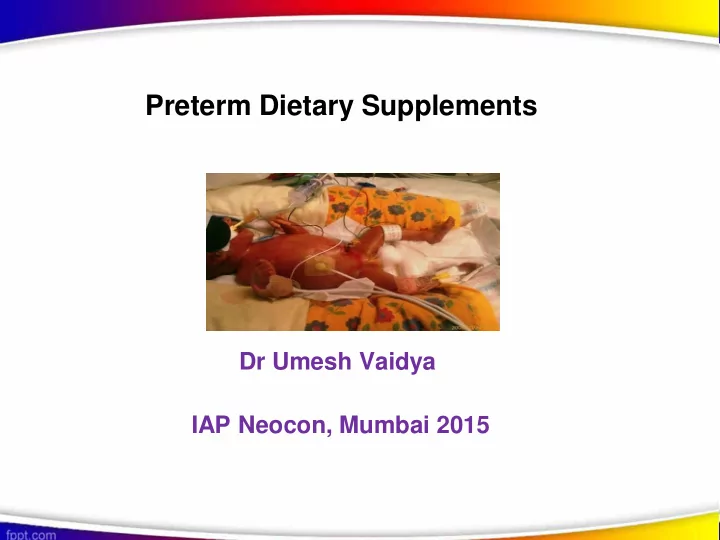
SLIDE 1
Preterm Dietary Supplements
Dr Umesh Vaidya IAP Neocon, Mumbai 2015
SLIDE 2
Minimal enteral feeds (10 ml / kg / day) Human breast milk Feed advancement @ 20 ml / kg / day Human milk fortification 100 ml / kg /day Parenteral nutrition (ELBW < 1000 g ) Aminoacids 1 – 1.5 g / kg / day Day 1 Lipids 1 – 2 g / kg / day Day 1-3
Ziegler EE –J Mat – Fed – Neonatal Med, Mar 2009
Preterm VLBW Nutrition : Ideal practice
SLIDE 3
Case, Baby of MI 28 wks, BW 1280 gms
DAYS NUTRITION
DAY 1 TPN (1.5 g amino acids; 1.5 g lipids)
DAY 2 Minimal Enteral Feeding DAY 2-8 Grading up of feeds HMF started DAY 9-30 Fortified milk- full feeds DAY 33-34 Sodium supplementation DAY 30- 35 Transition to oral feeds- discharge Weight gain: Day 9 –30 - 10 gms / day
SLIDE 4
Initial birth weight: 1280 gms Birth weight regained on day 34 Birth centile : 30 th (Fenton) Discharge centile : 3 rd
SLIDE 5
Extrauterine growth retardation – EUGR
Wt at 1 month 720 gm
Born at 28 wks, BW 1020 gm RDS / Pulmonary morbidity
SLIDE 6 EUGR - A serious problem in preterms
- Preterms 23 – 34 weeks, 24371 Preterms
Growth < 10th percentile at 40 weeks WT 28 % LNTH 34 % HC 16 % Possible neurologic and sensory handicaps
Clark RH, Thomas P, Peabody J, Pediatrics 2003
SLIDE 7
Ehrenkranz et al Pediatrics 2006
CONSEQUENCES OF INADEQUATE EARLY NUTRITION
Vulnerable periods Nutritional insults – impaired somatic growth Impaired neuro-cognitive development Post-natal Growth Restriction - a global concern
SLIDE 8
In-hospital Growth Velocity and Neurodevelopmental Outcomes
SLIDE 9
DEFINING GROWTH TARGETS
Weight gain 10-15 gm/kg/day Length gain 0.75-1 cm/wk HC gain 0.75 cm/wk
SLIDE 10 Page 12
12
NUTRITIONAL CARE PLAN
1.
EARLY PARENTERAL NUTRITION
ENTERAL NUTRITION
FORTIFICATION OF ENTERAL FEEDS
POST DISCHARGE NUTRITION
Early Intermediate Late
SLIDE 11
Denne SC, J Clin Invest 1996
GLUCOSE ALONE AS NUTRITION (26 weeks, 1000g)
SLIDE 12 First Week Protein and Energy Intake and Neurodevelopmental Outcomes
- Retrospective study of 124 ELBW infants at 18 months CA
- AA intake 1st week: 1.8±0.4 g/kg/day
- Energy intake 1st week: 60±8 kcal/kg/day
Stephen BE
SLIDE 13
EARLY AGGRESSIVE PN
Current recommendation Day 1
Min AA 1.5 g/kg (3 g / kg preferred) Started within 1 hr of birth Increase to 4 g / kg within few days LIPIDS 1 – 2 g / kg Day 1
Several studies (AA 3.5 g / kg , Lipids 3 g / kg) No increase in BUN, lipids, acidosis
Uhing MR Clin Perinatol 2009
SLIDE 14 MINIMAL ENTERAL FEEDING
- EBM 8 -12 ml / kg , 3-6 hrly, starting 1-3 hrs after birth
- Preferably with EBM / Donor Human milk
GRADING UP FEEDS
Increments of at least 20 ml / kg / day (Full feeds Day 7 ) Caution in babies < 750 g and SGA infants as data limited
(Cochrane Systematic Review 2011)
SLIDE 15
Human Milk Banking
A National mission Network of Human Milk Banking
SLIDE 16 Effect of human milk feeding on morbidity & hospital stay
Human Milk > 50 ml/kg/d Human milk and formula Preterm formula No.infants 62 63 42 Human milk intake 96 + 23 20 + 15 NEC n(%) 1(2%) 16(25%) 6(13%) Late onset sepsis (LOS) n (%) ** 19(31%) 29(45%) 22(48%) LOS & NEC n(%) 19(31%) 35(56%) 25(54%) Hosp stay days *** 73 + 19 87 + 43 88 + 47
Schanler , et al . Pediatrics 1999; 103: 1150 – 57
- B. Wt . 1000 g GA < 30 wks, *p < 0.01, ** p < 0.07, ***p < 0.05
SLIDE 17
SLIDE 18
Enteral nutrient supply for preterm Infants : Commentary ESPGHAN Committee on Nutrition
J Pediatric Gastroenterology & Nutrition 50 : 1- 9 2010
SLIDE 19 23
NUTRIENT PRETERM MILK (PER 100ML) EBM 200 ml / kg Requirement DEFICIT Protein (g) 1.1 – 1.5 2.2 - 3.0 3.5 – 4 1.3 – 1 Calcium (mg) 20 40 120 – 140 80 – 100 Phosphorus (mg) 15 30 60 – 90 30 – 60 Zinc (mcg) 295 590 800 – 1200 500 – 700 Vitamin A (IU) 250 500 1400 – 2500 1000 – 2000 Vitamin D(IU) 2.2 4.4 800 – 1000 800 - 1000
PRETERM : ADEQUACY OF BREAST MILK ?
SLIDE 20 Types of Fortification
Mono- component Fortification Carbohydrates Proteins Fats Calcium PO4 Iron Vitamins Multi-component Fortification Combination of 2
SLIDE 21
MONO- COMPONENT FORTIFICATION
Carbohydrates
no evidence available Fats (MCT oil) Little evidence (1 RCT) showed no effect Proteins 4 studies 90 babies, Better short term growth Long term effects ?
SLIDE 22
MULTI-COMPONENT FORTIFICATION : The Evidence
13 studies, > 600 patients Short term outcome Increased wt gain 3.6 g /kg / d Increased LNTH increment 0.12 cm / week Increased HC 0.12 cm / week Long term outcome No difference in WT./LNTH/HC at 12 & 18 mths No effects on neurodevelopmental outcome No effects on bone mineral content Cochrane database 2009
SLIDE 23
Problems with Standard Fortification
58 % VLBW infants receiving fortified EBM have extra – uterine growth retardation at discharge
Henrikson C et al 2009
Standard Fortification – Protein deficits
SLIDE 24 Proteins is the issue !!
LOW PROTEIN INTAKE IS THE PRIMARY LIMITING FACTOR FOR GROWTH FAILURE
- Assumed higher protein content of human milk
- Low protein content of fortifiers
- Transition from high protein PN solutions to lower
protein enteral feeds
SLIDE 25
Variable Protein Content of EBM
SLIDE 26 30
Variable Protein content of EBM
Baby G Baby S EBM protein 1.9 g / 100 ml EBM protein 0.8 g / 100 ml
SLIDE 27 MIRIS
- Human milk analysis is essential to the
health and growth of preterm babies.
- Miris Human Milk Analyser helps clinicians
manage preterm nutrition quickly and simply
SLIDE 28 Protein content of Fortifiers (per gm)
Lactodex HMF (Raptakos) 0.1 Hijam (Endocura) 0.25 Enfamil HMF (MJ) 0.27 Similac HMF (Abbott) 0.25 Aptamil BMF (Milupa) 0.2 FM 85 (Nestle) 0.2
SLIDE 29 Novel Methods of Fortification Focus on more protein
Standard Fortification Pre-determined amount of fortifier added to EBM Targeted Fortification Analyse EBM for proteins and a add desired amount of fortifier to reach 3.5 g / kg /day Adjustable Fortification Assess protein intake by evaluation of infant’s metabolic response by checking BUN (Increase dose of fortifier if BUN < 9 mg %, maintain between 9 - 14)
Recommendation & Guidelines for perinatal practice Arslanoglou S, Moro GE, Ziegler E, J. Perinatal Med 2010
SLIDE 30
Adjustable Fortification : Turkey study
58 preterm VLBWs (<32 weeks,<1500 g) Adjustable Fortification based on Blood urea levels BUN < 9 mg % Increase Protein by 0.55 g 14-20 mg % Decease Protein by 0.55 g > 20 mg % Stop Protein supplement Study group 4g/kg/day versus Control group 2.78 g/kg/day Result : Significant improvements in WT,LNTH,HC
Alan S et al, Early Human Dev 2013
SLIDE 31
Is there an alternative Protein supplement ? Skimmed Milk Powder (SMP)
Each 100 g contains Energy 360 kcal Proteins 34.5 g Fats 1 g CHO 52 g Calcium 1250 mg PO4 970 mg Sodium 500mg
SLIDE 32 SMP FORTIFICATION (2 gm / 100 ml @ 170 ml / kg / day)
Energy kcal 126 (110 – 135) Proteins (g) 3 (3.5 – 4) CHO (g) 13.7 (11.6 – 13.2) Fats (g) 7.2 (4.8 – 8.8) Calcium (mg) 102 (120 – 140) Phosphorus (mg) 58.5 (60 – 90) Sodium (mg) 25.5 (69 – 115)
SLIDE 34 39
WHAT WE DO ??? NUTRITIONIST-GUIDED ENTERAL FEEDING
- Early TPN for all < 1500 g
- Minimal Enteral Nutrition with Colostrum
- Use of Expressed Breast milk /Donor milk
- Rapid grading up in stable prems (20-30 ml/kg/day)
- Fortification at 100 ml/kg/day with HMF/SMP
- Optimal calories , proteins, Vitamin D, Calcium PO4, Iron
SLIDE 35
- Bedside nutrition plan
- Individualized calculations for Enteral & Parenteral
Nutrition
- Linkage between EN & PN
- Helps in optimizing calorie & protein intake
- Growth chart interface
Bedside Nutrition Management Tool
Kimaya NICU Nutrition Software
SLIDE 36
TPN Calculation
SLIDE 37
Enteral Calculation
SLIDE 38
Growth chart
SLIDE 39
SLIDE 40 Daily Nutrition Plan
Date Fluid (ml/kg/day) Proteins (gm/kg/day) Calories (kcal/kg/day) Total Fluid (ml/kg/day) Total Proteins (gm/kg/day) Total Calories (kcal/kg/day) 2015-10-10 Enteral 175 2.86 128.50 175 2.86 128.5 TPN 2015-10-06 Enteral 177 2.89 129.85 177 2.89 129.85 TPN 2015-10-02 Enteral 177 2.89 129.85 177 2.89 129.85 TPN 2015-09-30 Enteral 175 2.90 129.02 175 2.9 129.02 TPN 2015-09-29 Enteral 175 2.94 129.57 175 2.94 129.57 TPN 2015-09-23 Enteral 163 2.90 122.52 163 2.9 122.52 TPN 2015-09-13 Enteral 175 3.17 132.25 175 3.17 132.25 TPN 2015-09-04 Enteral 173 3.10 130.18 173 3.1 130.18 TPN 2015-09-02 Enteral 179 3.37 137.05 179 3.37 137.05 TPN 2015-08-23 Enteral 140 3.46 117.06 140 3.46 117.06 TPN 2015-08-18 Enteral 174 3.49 135.32 174 3.49 135.32
SLIDE 41 Tailor-made Nutrition
- Optimal fortification of human
milk
monitoring (Proteins, Hb, Ferritin, Ca PO4,alk PO4)
SLIDE 42
Growth of KEM babies
2010 2015
SLIDE 43 48
Baby K , GA 25 weeks Triplet, Weight 710 gms POST-DISCHARGE NUTRITION
SLIDE 44 49
What could be the reasons for poor growth ?
Inadequate feeding due to poor suck and swallow Inadequate breast milk Cold stress Exaggerated anaemia of prematurity Inadequate calorie / protein intake due to discontinuation of fortification Sepsis/sickness in the baby Electrolyte imbalance (Late onset Hyponatraemia)
SLIDE 45
- 3. Human milk fortification after Discharge
Powdered Human Milk Fortifier (HMF) Proper training of mother important
Estimate approx milk intake and calculate dose of HMF Express milk to mix HMF and then can breastfeed 2 gm in 50 ml EBM (1 gm HMF in 25 ml EBM)
Fortification with MCT oil – not recommended due to lack of
scientific evidence (Cochrane Review 2009 )
Special post – discharge formulae (72–80 kcal/dl)
50
SLIDE 46 Stable, full feeds eds
Multivitamin with Zinc (? Continue till 1 year) Calcium : Phosphorus (continue till term / 3 kg) Vitamin D 800 IU per day (ESPGHAN 2010) (continue till 1 year)
4 4 -6 we week eks s
Start Iron supplementation Continue till one year
ischarge Nutritio ritional Supplem plementatio ion
SLIDE 47 Nutritional supplementation for preterms
- Vitamin A - 1500 IU per day
(Dose of multivitamin drops to be titrated accordingly)
- Zinc 2.5 mg - 3 mg / d
- Vitamin D: 800-1000 IU /day (ESPGHAN 2010)
- Calcium 150 mg /kg
- Phosphorus 75 mg /kg
52
SLIDE 48 MULTIVITAMIN DROPS (per 1 ml)
Brand A Brand B Brand C A 2500 IU 1000 IU 2750 IU D3 200 IU 400 IU 250 IU E 2.5 mg 1.5 mg 5 mg C 40 mg 40 mg 40 mg B1 1 mg 2 mg 1 mg B6
1 mg K
0.5 ml 1 ml 0.5 ml
SLIDE 49 Iron supplementation
4 mg / kg / d
3-4 mg / kg / d
2-3 mg / kg / d
2 mg / kg / d
- Start at 4-6 weeks, Continue till 12-15 months
- For babies <1500 gm early supplementation (2 weeks)
may be considered
54
SLIDE 50 IRON DROPS (per ml)
Brand T Brand F Brand R
Elemental iron 25 mg 20 mg 10 mg B12 12.5 ug 4 ug NIL Folic acid 200 ug 200 ug 100 ug Lysine 200 mg 5 mg NIL mg Fe / drop 1 1 0.3
SLIDE 51
- 6. When to start complementary foods?
- Complementary food should be started about at
corrected age of 4-6 months for preterm infants
Deborah L, Unger S. Seminars in fetal and neonatal medicine, (2013)
- Generally, most babies would be around 5 kg, would
have some neck support and tongue-thrust reflex would have diminished
- Complementary foods are chosen as per
recommendation for term infants
56
SLIDE 52 SUMMARY
- Postnatal growth retardation common in preterm LBWs
- Optimal growth targets unclear , but prevention of EUGR
is mandatory
- Current trends favour aggressive nutrition strategies to
improve neurologic outcome
- Early PN, use of human milk, fortification of enteral feeds to
achieve adequate calories and proteins
SLIDE 53
SUMMARY (Contd)
Human Milk Banking now a national mission Donor Human milk has both short and long-term benefits Protein deficits are contributing to growth failure Recent guidelines suggest higher protein intakes for for babies < 1500 g Novel methods for protein fortification are being studied
SLIDE 54 SUMMARY (Contd)
Essential to drive and achieve optimal growth amongst all
Bedside management tool facilitates better nutrition by providing the interface between nutrition delivery and growth outcome
SLIDE 55
LET US PROVIDE THE BEST NUTRITION !!! OPTIMAL GROWTH IS TOMORROW’S OUTCOME!