Accelerator Program (IAP) IAP Information Session: Physical and - - PowerPoint PPT Presentation

accelerator program iap
SMART_READER_LITE
LIVE PREVIEW

Accelerator Program (IAP) IAP Information Session: Physical and - - PowerPoint PPT Presentation

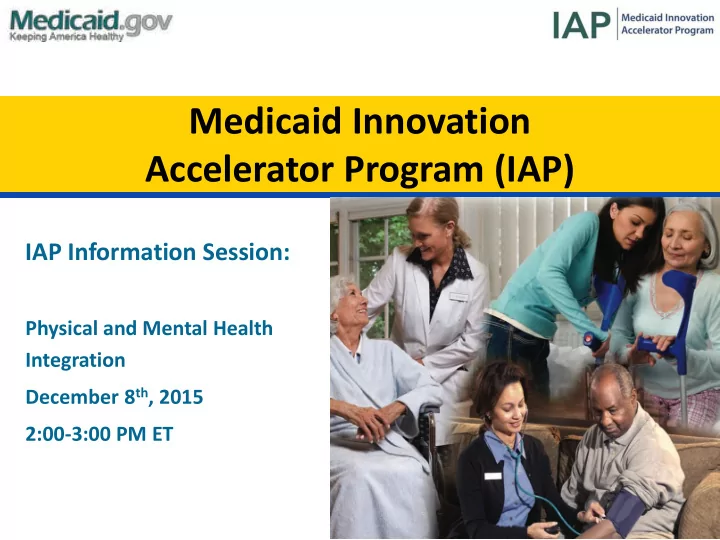
Medicaid Innovation Accelerator Program (IAP) IAP Information Session: Physical and Mental Health Integration December 8 th , 2015 2:00-3:00 PM ET Welcome Timothy Hill Deputy Center Director, Center for Medicaid and CHIP Services (CMCS),


slide-1
SLIDE 1

Medicaid Innovation Accelerator Program (IAP)

IAP Information Session:

Physical and Mental Health Integration December 8th, 2015 2:00-3:00 PM ET
slide-2
SLIDE 2

2

Welcome

  • Timothy Hill

Deputy Center Director, Center for Medicaid and CHIP Services (CMCS), CMS

slide-3
SLIDE 3

3

IAP Team for Physical and Mental Health Integration (PMH)

  • Karen LLanos, Director Medicaid IAP
  • John O’Brien, CMCS
  • David Shillcutt, CMCS
  • Christa Speicher, CMCS
  • Suzanne Fields, University of Maryland
  • Contracting team led by:

– National Academy for State Health Policy (NASHP): Neva Kaye, Kitty Purington, Ledia Tabor, Kathy Witgert – Truven Health Analytics: Brian Burwell

slide-4
SLIDE 4

4

Agenda for Today’s Call

  • What is the Medicaid Innovation Accelerator Program?
  • Why Focus on Physical and Mental Health Integration

(PMH)?

  • Overview and Proposed Approach of Program Support to

States

  • How to Apply for Program Support
  • Next Steps
slide-5
SLIDE 5

5

Medicaid Innovation Accelerator Program

What is the Medicaid Innovation Accelerator Program (IAP)?

slide-6
SLIDE 6

6

Medicaid IAP

  • Four year commitment by CMS to build state capacity

and accelerate ongoing innovation in Medicaid through targeted program support

  • A CMMI-funded program that is led by and lives in CMCS
  • Supports states’ and HHS delivery system reform efforts

– The end goal for IAP is to increase the number of states moving towards delivery system reform across program priorities

slide-7
SLIDE 7

7

IAP Program Priority Areas

slide-8
SLIDE 8

8

Functional Areas: Targeted Technical Support For States

  • Functional areas:

– Data analytics – Quality measurement – Performance improvement – Payment modeling & financial simulations

  • States can request targeted technical support unique to

their own needs in these areas

  • Available in early 2016
slide-9
SLIDE 9

9

How Do We Define Success Across IAP?

  • Has participation in IAP led to increased delivery system

reform in the IAP program priority areas/populations?

  • Has IAP increased states’ capacity to make substantial

improvements in:

– Better care, smarter spending, healthier people

  • Has IAP built states’ capacity in the following areas:
  • Data analytics, quality measurement, performance

improvement, payment modeling & financial simulations

slide-10
SLIDE 10

10

PMH

Physical and Mental Health Integration (PMH)

slide-11
SLIDE 11

11

What is Physical and Mental Health Integration within IAP?

  • IAP PMH is using a broad interpretation of the AHRQ

Lexicon definition to define Physical and Mental Health Integration:

The care that results from a practice team of primary care and behavioral health clinicians, working together with patients and families, using a systematic and cost-effective approach to provide patient-centered care for a defined

  • population. This care may address mental health and

substance abuse conditions, health behaviors (including their contribution to chronic medical illnesses), life stressors and crises, stress-related physical symptoms, and ineffective patterns of health care utilization.

slide-12
SLIDE 12

12

Why Focus on Physical and Mental Health Integration (PMH)?

  • Of the top 5% of high-cost Medicaid beneficiaries, over 70%

have either a mental health or substance use diagnosis (or both).

  • People with serious behavioral health needs also often have

multiple comorbidities, poor physical health outcomes, and high costs.

  • Both the general Medicaid population and people served in

specialty behavioral health settings can benefit from improved integration.

  • State feedback indicates PMH can be a challenging area for

state policymakers: payment, data sharing and analytics, target population, workforce, measurement, etc.

slide-13
SLIDE 13

13

State Levers to Promote/Improve Physical and Mental Health Integration

  • Diverse and flexible Medicaid payment strategies
  • Licensing and regulatory changes
  • Provider education and support
  • Workforce development
  • Data and data analytics
  • Measurement and shared accountability
slide-14
SLIDE 14

14

Available Support

Overview & Proposed Approach of Program Support Available to State Medicaid Agencies

slide-15
SLIDE 15

15

IAP’s Goals for PMH

Selected states will enhance or expand existing state physical and mental health integration efforts

slide-16
SLIDE 16

16

IAP’s Goals for PMH (1 of 2)

May include:

  • Improving the behavioral and physical health outcomes and

experience of individuals with a mental health condition;

  • Linking payments with improved outcomes for Medicaid

beneficiaries with these co-morbid conditions;

  • Expanding or enhancing existing state physical and mental health

integration efforts to include specific populations, new areas of the state, or new health professionals.

slide-17
SLIDE 17

17

IAP’s Goals for PMH (2 of 2)

Will also include:

  • Identifying and spreading innovations to the field that

improve and expand physical and mental health integration initiatives in various settings and for various populations.

slide-18
SLIDE 18

18

Program Support Approach

  • Tailored to selected states’ unique policy environment
  • Support states in improving/expanding use of integrated

models for diverse Medicaid populations/subpopulations

  • Assistance leveraging/expanding current Medicaid authorities
  • Support states in improved use of data in planning,
  • perationalizing, and measuring their integrated care

initiatives

  • Identify a finite set of measures for IAP PMH program

evaluation.

  • Provide performance improvement support to set goals and

identify drivers to address the goals.

slide-19
SLIDE 19

19

Components of Program Support

Component Timeframe State Participation

Kick off and state PMH strategic planning March-April 2016 Kick off webinar, Strategic planning workshop, Team meetings, as needed Individualized program support May 2016 – Jan.2017; ongoing as needed Monthly one hour calls (or more frequently, as directed by state team) Virtual state-to-state workshops May 2016- Jan. 2017 Quarterly 1.5 hour web-assisted workshops (3 total) Periodic affinity groups as identified by state needs May, 2016 – Jan. 2017 TBD In-person meeting(s) June 2016; Jan 2017 (potential) 1.5 day meeting(s) with state teams

slide-20
SLIDE 20

20

Applying to the Program

How to Apply for Program Support

slide-21
SLIDE 21

21

Key Considerations

  • Expression of Interest
  • State Selection Factors
  • Key Dates
  • Where to go with questions or for more information
slide-22
SLIDE 22

22

How to Apply: Expression of Interest

Elements:

  • Team Composition
  • Existing PMH approach
  • Alignment with Goals of

IAP PMH

slide-23
SLIDE 23

23

State Selection Factors

  • State team composition reflects commitment and requisite state

leadership

  • State team composition aligns with the goals of its proposed PMH

work

  • Proposed initiative builds on a current, Medicaid-funded integrated

care initiative

  • Current or proposed state PMH integrated care approach falls within

the broad IAP PMH definition

  • Proposed PMH work aligns with IAP goals, and will benefit from the

IAP approach

  • State can participate in IAP PMH quality measurement and reporting
  • State can gather and analyze data needed for its IAP PMH initiative
slide-24
SLIDE 24

24

Examples of States That May Benefit from IAP PMH

  • States with Health Homes or Shared Savings programs

interested in developing or improving value-based payment strategies

  • States with existing integrated care programs that want to

spread the model to other populations, areas of the state, or provider types

  • States with integrated or specialty behavioral health managed

care contracts that want to improve integration and outcomes at the clinical level

  • States with established integrated care approaches that seek to

improve or enhance aspects of these programs: e.g., data infrastructure, provider capacity, quality measurement

slide-25
SLIDE 25

25

Key Dates

Event Date

Expression of Interest forms due January 29th, 2016 CMS conducts 1:1 calls with interested states February, 2016 States selected for participation February/March, 2016 Project Kick-off Webinar March/April, 2016

slide-26
SLIDE 26

26

To apply, or for more information, visit the Medicaid IAP PMH Page

Medicaid IAP Physical and Mental Health Integration Page

slide-27
SLIDE 27

27

Where Can Interested States Go with Questions?

States with questions about this opportunity can email MedicaidIAP@CMS.HHS.gov Include subject line “PMH Integration” Watch for SOTA emails from CMS for additional information on IAP

slide-28
SLIDE 28

28

Thank You!

Thank you for joining today’s webinar!