Presenting a live 90-minute webinar with interactive Q&A Key - - PowerPoint PPT Presentation

presenting a live 90 minute webinar with interactive q a
SMART_READER_LITE
LIVE PREVIEW

Presenting a live 90-minute webinar with interactive Q&A Key - - PowerPoint PPT Presentation

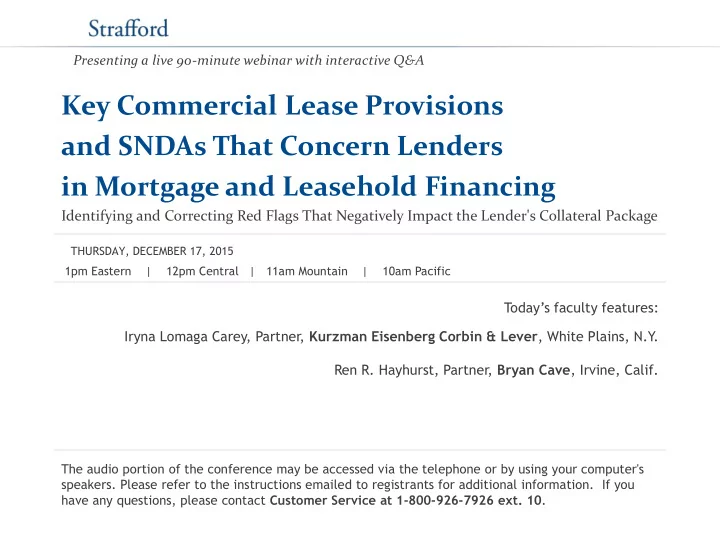
Presenting a live 90-minute webinar with interactive Q&A Key Commercial Lease Provisions and SNDAs That Concern Lenders in Mortgage and Leasehold Financing Identifying and Correcting Red Flags That Negatively Impact the Lender's Collateral


slide-1
SLIDE 1

The audio portion of the conference may be accessed via the telephone or by using your computer's

  • speakers. Please refer to the instructions emailed to registrants for additional information. If you

have any questions, please contact Customer Service at 1-800-926-7926 ext. 10.

Presenting a live 90-minute webinar with interactive Q&A

Key Commercial Lease Provisions and SNDAs That Concern Lenders in Mortgage and Leasehold Financing

Identifying and Correcting Red Flags That Negatively Impact the Lender's Collateral Package

Today’s faculty features:

1pm Eastern | 12pm Central | 11am Mountain | 10am Pacific THURSDAY, DECEMBER 17, 2015

Iryna Lomaga Carey, Partner, Kurzman Eisenberg Corbin & Lever, White Plains, N.Y . Ren R. Hayhurst, Partner, Bryan Cave, Irvine, Calif.

slide-2
SLIDE 2

Tips for Optimal Quality

Sound Quality If you are listening via your computer speakers, please note that the quality

  • f your sound will vary depending on the speed and quality of your internet

connection. If the sound quality is not satisfactory, you may listen via the phone: dial 1-866-961-9091 and enter your PIN when prompted. Otherwise, please send us a chat or e-mail sound@straffordpub.com immediately so we can address the problem. If you dialed in and have any difficulties during the call, press *0 for assistance. Viewing Quality To maximize your screen, press the F11 key on your keyboard. To exit full screen, press the F11 key again.

FOR LIVE EVENT ONLY

slide-3
SLIDE 3

Continuing Education Credits

In order for us to process your continuing education credit, you must confirm your participation in this webinar by completing and submitting the Attendance Affirmation/Evaluation after the webinar. A link to the Attendance Affirmation/Evaluation will be in the thank you email that you will receive immediately following the program. For additional information about continuing education, call us at 1-800-926-7926

  • ext. 35.

FOR LIVE EVENT ONLY

slide-4
SLIDE 4

Program Materials

If you have not printed the conference materials for this program, please complete the following steps:

  • Click on the ^ symbol next to “Conference Materials” in the middle of the left-

hand column on your screen.

  • Click on the tab labeled “Handouts” that appears, and there you will see a

PDF of the slides for today's program.

  • Double click on the PDF and a separate page will open.
  • Print the slides by clicking on the printer icon.

FOR LIVE EVENT ONLY

slide-5
SLIDE 5

Ren R Hayhurst ren.hayhurst@bryancave.com 949-223-7125 Iryna Lomaga Carey icarey@kelaw.com 914-286-6372

Legal and Practical Commercial Leasing Issues For Real Estate Lenders

slide-6
SLIDE 6

Overview of Commercial Leasing Issues

  • Commercial Leases

– Distinctions Between Credit Tenant Leases vs. Other Commercial Leases

  • Process of What to Review and Focus on with Standard

Commercial Leases

  • Ground Leases

– Pad or Parcel Ground Leases Between Borrower and Ground Tenant – Borrower as Ground Tenant

  • Distinction Between Ground Lease Assignment and Leasehold

Mortgage

6

slide-7
SLIDE 7

Key Distinctions In Property Types

  • Commercial Retail vs. Multi-Family Loans

– Owner-Occupied vs. Single Tenant Buildings – Multi-Tenant Issues

  • Major vs. Minor Leases
  • Insurance Provisions

– SNDAs vs. “Super” Estoppels – Financial Covenants Relating to Recourse Issues – Ground Tenants vs. Retail/Commercial Tenants

  • Key Lease Review Issues

7

slide-8
SLIDE 8

Key Lender Underwriting Concerns

  • A lender is granted a lien or deed of trust on real property.

– Underlying leasing distinctions for multi-family vs. commercial deals

  • SNDAs and estoppels; Major vs. Other Leases (approval issues)
  • Owner-Occupied Property.

– Two entities involved (owner entity vs. occupant entity under identical

  • wnership) vs. single entity as owner and occupant
  • Single Tenant Property.

– Key Issues Include – Insurance provisions; replacement of single tenant; re-purposing of property for multiple tenants

  • Multi-Tenant Property

– Key Issues Include – Special tenant rights - such as purchase or expansion

  • ption, “go dark rights”, exclusivity, “incentive” payments, etc.; tenant mix –

power center vs. anchor tenant and small shops

8

slide-9
SLIDE 9

Approach to Reviewing Commercial Leases

  • Key Commercial Lease Provisions for Lenders

– Payment of Rent –

  • Rent Abatement
  • Rent “Subsidy”
  • Free Rent Period(s)
  • Security Deposits

– Lease Term – Any renewal or extension options during loan term – “Go Dark” Provisions – Purchase Option or “ROFO” – Leased Premises Expansion Rights – Future Lease “Incentive” or Other “Partial Refund” Payments by the Owner to the Tenant

9

slide-10
SLIDE 10

Approach to Reviewing Commercial Leases Part 2

  • Funding for Construction of Tenant Improvements

– Payment by Owner with Reimbursement Obligations of Tenant – Payment by Tenant with Reimbursement Obligations of Owner

  • Development, Leasing or Below Market Rent

Restrictions

– Development Agreement Requirements – Fair Housing Requirements – Letter of Credit for Infrastructure Improvements

10

slide-11
SLIDE 11

Introduction to Ground Leases

  • Ground Lease – Subordinated Or Not?
  • Elements of Standard Ground Lease Arrangement

– Acknowledge Leasehold Mortgage – No Lien on Fee – If So, Must Accept Terms of Mortgage – Notice and Cure Rights For Lender (No Termination; Curable or Not)

  • Foreclosure Rights Related to Cure
  • Bankruptcy/Termination

– New Lease/Direct Relationship – No Acceptance Of Rejection or Termination Of Lease

  • Application of Insurance or Condemnation Proceeds
  • Ground Lease “Mortgagee Protection” Provisions

– How should Lender address its requirements if they are essentially included in the lease – e.g., what type of privity agreement is required, if any?

11

slide-12
SLIDE 12

Approach to Reviewing Ground Leases

  • Is Borrower Ground Tenant or is Borrower the Fee Owner and

Ground Lessor?

– If Borrower is Ground Tenant –

  • Reasons for Using Leasehold DOT vs. Lease Assignment
  • Reasons for Ground Lessor Consent and Estoppel
  • Elements of Ground Lessor Consent and Estoppel

– Approval of Leasehold DOT and Agreement for Mortgagee Protections

  • Including Notice and Cure Rights; Time to Foreclose if Necessary for

Cure

– Termination Issues, Both Pre- and Post-Bankruptcy

  • These are Legal Rights Which Cannot be Waived, so Must be

Addressed to Permit Continuation of Lease Between Lender and Ground Lessor

– Rights Regarding Lien Against Fee Interest

  • Prohibition or Requirement for Acknowledgment to Consent and

Estoppel by Fee Lender

12

slide-13
SLIDE 13

Approach to Reviewing Ground Leases Part 2

  • If Borrower is the Fee Owner and Ground Lessor

– Reasons for ARNDA vs. SNDA

  • ARNDA Creates a More Interactive Relationship to Preserve the

Ground Lease, Which Often is the Key to Property Success

  • Elements of ARNDA

– Contains Standard SNDA Provisions – Addresses Broader Tax Obligations, Insurance Obligations and Other Construction or Quasi-Ownership Rights Inherent in Ground Lease – Includes Additional Ground Tenant Protections, Including Bankruptcy Related Protections Similar to Ground Lessor Consent and Estoppel, Development and Construction Obligations, etc.

13

slide-14
SLIDE 14

Introduction to SNDAs and Estoppels

  • Lease/Mortgage Subordination Generally

– The “first-in-time, first-in-right” rule

  • Lease Subordination Clauses

– Automatic, unconditional subordination – Subordination conditioned on non-disturbance protection

  • The SNDA Agreement

– Subordination – Non-Disturbance – Attornment – Lender Protections Notice and opportunity to cure lease defaults Lender exculpation Lease modifications require lender consent

14

slide-15
SLIDE 15

SNDAs and Estoppels – Practical Considerations

  • Practical Considerations

– Offering non-disturbance protection to future tenants and/or tenants that are affiliated with the borrower – Recorded memo of lease: Does it always require a recorded SNDA? – Cost-benefit analysis of obtaining/requiring SNDA – Use of expanded estoppel (i.e., the unrecorded “super estoppel”)

  • General distinctions between SNDA for Commercial Lease and

Ground Lease

– Acknowledgment of Underlying Commercial “Sublease” in Ground Lease Arrangement

  • Treatment of Lease Guaranties

– Lease Guarantor Acknowledgment and Consent

15

slide-16
SLIDE 16

Lease Subordination Issues – Overview

Subordination, Non-Disturbance and Attornment (“SNDA”)

  • SNDA provisions usually control the rights and remedies of the

foreclosing lender (new landlord) and the tenants.

  • Subordination: If a mortgage or deed of trust predates a lease, then

the lease would be terminated upon foreclosure. In most jurisdictions, if the lease is prior in time to the mortgage or deed of trust, there would not be termination upon foreclosure. SNDAs can alter the priorities.

  • Sometimes a lease contains a subordination provision which entitles

foreclosing lender to terminate at its election upon foreclosure. These are often contained in loans were the originating lender required it as a condition for a loan. SNDAs signed by tenants often contain subordination provisions.

– Inadequate because it does not typically address all issues, but also does not create a “privity” relationship between Lender and Tenant

16

slide-17
SLIDE 17

Lease Subordination Issues – Overview (cont.)

Attornment v. Non-Disturbance

  • Attornment provisions provide a benefit to the foreclosing lender

(new landlord). Requires tenant to abide by lease to the benefit of the foreclosing lender.

  • Non-Disturbance provisions are obligations imposed on the

foreclosing lender in which the lender agrees that it will not terminate lease upon foreclosure. Law usually requires that the lender actually sign and not binding on lender is just signed by borrower and tenant.

17

slide-18
SLIDE 18

Lease Subordination Issues – Part 2

  • Lease Subordinations or SNDA

– “Subordination” is the Least Important Element of an SNDA

  • Really do not Want a True Subordination Because the Purpose of

the Agreement is to Preserve the Lease, Not Wipe it Out

– Non-Disturbance and Attornment Provisions are the Key Elements

  • Frame of Mind – View SNDA as Addressing Three

Relationships Between the Lender and the Tenant

– “Pre-Default” Relationship (Both Lease or Loan) – “Post-Default” Relationship (Both Lease or Loan) – “Post-Foreclosure or Deed-in-Lieu” Relationship

18

slide-19
SLIDE 19

Lease Subordination Issues – Part 3

  • SNDA - “Pre-Default” Relationship (Both Lease or Loan)

– No Assignment or Subleasing Beyond Lease Terms – No Obligations for Lender Until Assumption of Ownership – Respective Obligations for Insurance and Application of Proceeds

  • SNDA - “Post-Default” Relationship (Both Lease or Loan)

– Limitations on Lease Modifications – Limitations on Pre-Paid Rents – Exculpation for Environmental and Construction Obligations

  • No Liens on Property Permitted; No Obligation to Finance Construction

– Notice and Cure Rights

  • SNDA - “Post-Foreclosure or Deed-in-Lieu” Relationship

– Limitation for Lessee Against Lender to Lender’s “Rights in the Property” – No Personal Recourse – Express Release of Liability After Transfer of Title – Limitations for Trailing Liability – Only Responsible for Matters for Which Lender Received Prior Notice and Cure Opportunity

19

slide-20
SLIDE 20

Lease Subordination Issues – Part 4

  • Schoolcraft Issues for Insurance and Condemnation

Proceeds

– Must Apply Proceeds to Restoration Regardless of Loan Document Requirements

  • “Non-Negotiable” Issues

– Exculpation from “Special Obligations”

  • Unique Payment Refunds
  • Environmental Responsibilities
  • Construction and Expansion Obligations

– Restrictions on Option and ROFO Rights in Favor of Tenants

  • Only Exercise Upon Repayment of Loan and not Triggered by

Foreclosure or Deed-in-Lieu

– Termination of Lender’s Liability After Post-Foreclosure Transfer

20

slide-21
SLIDE 21

Acquisition Phase

Special Use Permits/Requirements; Maintenance and Management Agreements; CC&Rs and Trailing Security Interests

  • Need to determine if notices of termination or continuation are required,

length of any notice periods, exercising rights under assignments and pledge agreements, etc.

  • Explore means of securing/obtaining rights to additional pledged

collateral, such as LCs for tenants, deposits, bond proceeds, reserve accounts, tax refunds, etc.

  • Investigate any potential property or use violations under local
  • rdinances and have corrected, if possible, prior to transition.
  • Receivership Transition –

– Lender can Control Terms of Receivership and Selection of Receiver – This is Key Decision Which Will Either Create or Avoid Problems During Receivership Pending Foreclosure

  • Problems can arise if a Receiver consents to a lease extension or modification during the term
  • f the receivership. Lender should closely monitor leasing activity during receivership and

raise objections to the court if needed.

  • Courts and Title Companies Still Hesitant to Grant Receiver Right to Sell Property Prior to

Foreclosure – Usually will Require Borrower Consent

21

slide-22
SLIDE 22

Summary; Final Thoughts

  • Commercial Leases are Key to Success or Failure of

Project

  • Critical to Understand Lease Terms and How They

Relate to Lender’s Rights and Obligations Under Loan Documents

  • Many Provisions of Ground Lease or Commercial Lease

Can Be Treated by Negotiation in ARNDA or SNDA

– Remember the “Non-Negotiable” Items, Which are not Numerous

  • Pending and Following Foreclosure, the SNDA and

ARNDA Will Continue to Control Relationship Between Lender and Tenant

22