Presenting a live 90-minute webinar with interactive Q&A - - PowerPoint PPT Presentation

presenting a live 90 minute webinar with interactive q a
SMART_READER_LITE
LIVE PREVIEW

Presenting a live 90-minute webinar with interactive Q&A - - PowerPoint PPT Presentation

Presenting a live 90-minute webinar with interactive Q&A Medicaid Crisis Planning: Advanced Techniques for Preserving Assets After Nursing Home Admission Leveraging DRA Promissory Notes, Community Spouse Resource Allowance and Medicaid


slide-1
SLIDE 1

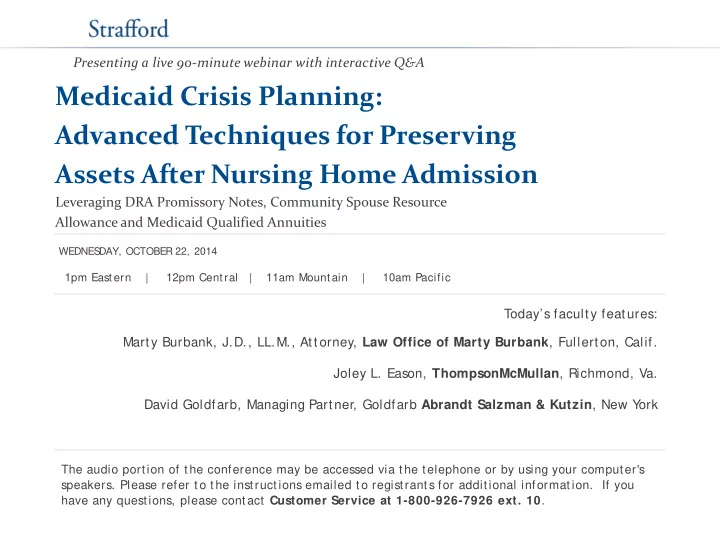
Medicaid Crisis Planning: Advanced Techniques for Preserving Assets After Nursing Home Admission

Leveraging DRA Promissory Notes, Community Spouse Resource Allowance and Medicaid Qualified Annuities

Today’s faculty features:

1pm East ern | 12pm Cent ral | 11am Mount ain | 10am Pacific

The audio portion of the conference may be accessed via the telephone or by using your computer's

  • speakers. Please refer to the instructions emailed to registrants for additional information. If you

have any questions, please contact Customer Service at 1-800-926-7926 ext. 10.

WEDNES DAY, OCTOBER 22, 2014

Presenting a live 90-minute webinar with interactive Q&A

Marty Burbank, J.D., LL.M., Attorney, Law Office of Marty Burbank, Fullerton, Calif. Joley L. Eason, ThompsonMcMullan, Richmond, Va. David Goldfarb, Managing Partner, Goldfarb Abrandt Salzman & Kutzin, New Y

  • rk
slide-2
SLIDE 2

Tips for Optimal Quality

S

  • und Qualit y

If you are listening via your computer speakers, please note that the quality

  • f your sound will vary depending on the speed and quality of your internet

connection. If the sound quality is not satisfactory, you may listen via the phone: dial 1-866-961-9091and enter your PIN when prompted. Otherwise, please send us a chat or e-mail sound@ straffordpub.com immediately so we can address the problem. If you dialed in and have any difficulties during the call, press *0 for assistance. Viewing Qualit y To maximize your screen, press the F11 key on your keyboard. To exit full screen, press the F11 key again.

FOR LIVE EVENT ONLY

slide-3
SLIDE 3

Continuing Education Credits

For CLE purposes, please let us know how many people are listening at your location by completing each of the following steps:

  • In the chat box, type (1) your company name and (2) the number of

attendees at your location

  • Click the S

END button beside the box If you have purchased S trafford CLE processing services, you must confirm your participation by completing and submitting an Official Record of Attendance (CLE Form). Y

  • u may obtain your CLE form by going to the program page and selecting the

appropriate form in the PROGRAM MATERIALS box at the top right corner. If you'd like to purchase CLE credit processing, it is available for a fee. For additional information about CLE credit processing, go to our website or call us at 1-800-926-7926 ext. 35.

FOR LIVE EVENT ONLY

slide-4
SLIDE 4

Program Materials

If you have not printed the conference materials for this program, please complete the following steps:

  • Click on the ^ symbol next to “ Conference Materials” in the middle of the left -

hand column on your screen.

  • Click on the tab labeled “ Handouts” that appears, and there you will see a

PDF of the slides for today's program.

  • Double click on the PDF and a separate page will open.
  • Print the slides by clicking on the printer icon.

FOR LIVE EVENT ONLY

slide-5
SLIDE 5

Medicaid Spend “UP”

Marty Burbank, JD, LLM Law Office of Marty Burbank Fullerton, CA 92832 www.OCElderLaw.com marty@ocelderlaw.com

slide-6
SLIDE 6

Spend Down vs. Spend Up

  • Traditional Information from Discharge

Planners and Skilled Nursing Social Workers is: Your parents will have to spend down there assets on care before they are eligible for

  • Medicaid. After paying for care for several

months or more than a year, when all of their wealth has been depleted then they will qualify for Medicaid.

6

slide-7
SLIDE 7

Problem with Spend Down

Preserves no assets for the unforeseen needs of the senior institutionalized client, or the well spouse of an institutionalized client.

7

slide-8
SLIDE 8

Converting Countable Assets to Non-Countable Assets

Spending Up

  • Countable Assets can Be converted into non

countable or non available assets and a person can be immediately qualified for Medicaid without penalty.

8

slide-9
SLIDE 9

Countable or Available Assets

  • Cash
  • Marketable Securities
  • Real Estate Other than a Home
  • More than one car
  • Jewelry
  • Savings Bonds
  • Life Insurance

9

slide-10
SLIDE 10

Non-Countable Assets

Non-Countable Home of Any Value (depending on state) Car of Any Value Musical Instruments Household Furnishings Funeral Arrangements Medicaid Qualified Annuity

10

slide-11
SLIDE 11

Spend UP -- Strategies

  • If there is debt, Pay down mortgage
  • Buy a home or even party of a child’s home
  • Deferred maintenance on home
  • Update: Kitchen, Roof, Bathrooms, etc.
  • Buy a new or newer car
  • Set aside funds for funeral
  • Buy Long Term Care Insurance

11

slide-12
SLIDE 12

Benefits of Spending Up

  • Accelerated Eligibility
  • Preserved Assets for Well Spouse
  • Created a Better Quality of Life for Well

Spouse.

  • If pre need planning then both spouses can

benefit from updated house and car

  • Funeral arrangements are taken care of

12

slide-13
SLIDE 13

Wealth Preservation

  • Advanced Strategies are now available to

avoid Medicaid Recovery and transfer wealth to the children or other beneficiaries.

13

slide-14
SLIDE 14

Outright Gifting

  • There is no penalty period for gifts of exempt

assets.

  • Transfers to Adult Responsible Children
  • Transfers to Irrevocable Trust
  • Eligibility for Medicaid and VA Benefits

14

slide-15
SLIDE 15

Irrevocable Trusts for Medicaid Planning

Marty Burbank, JD, LLM Law Office of Marty Burbank Fullerton, CA 92832 www.OCElderLaw.com marty@ocelderlaw.com

slide-16
SLIDE 16

VA and Medicaid

  • Veterans Asset Protection(VAP) Trusts
  • Medicaid Asset Protection(MAP) Trusts

16

slide-17
SLIDE 17

Veterans Pension Aid and Attendance

  • Aid & Attendance Benefits are available to

war era veterans and their surviving spouses who require the regular attendance of another person to assist in at least two activities of daily living such as eating, bathing, dressing and undressing, transferring and the needs of nature

  • Can be at Home, Assisted Living, or SNF

17

slide-18
SLIDE 18

Veterans Pension Aid and Attendance

  • Benefits:

– Single Veteran $1,758 – Married Veteran $2,085 – Surviving Spouse of Veteran $1,130 – Both Spouses are Vets $2,788

18

slide-19
SLIDE 19

Medicaid Long Term Care

  • Generally provides only for care in a Skilled

Nursing Facility (SNF) although some states have programs that provide funding fro assisted living.

  • Patient pays a share of cost and state

guarantees balance to give the SNF the total equal to the Average Private Pay Rate

19

slide-20
SLIDE 20

VA Service Qualifications

  • War Time Veteran

– One Day during time of war

  • WWI
  • WWII
  • Korea
  • Vietnam
  • War on Terror
  • 90 days consecutive service
  • Honorable discharge

20

slide-21
SLIDE 21

Asset Qualifications Generally Less Than $80,000

– Countable

  • Cash
  • Marketable Securities
  • Real Property other than Home
  • IRA, 401(k), 403(b)

– Not Countable

  • Home
  • Care
  • Furnishings
  • Funeral Arrangements

21

slide-22
SLIDE 22

VA Income Qualification

  • Income must be less than:

– Single Veteran $1,733/mo – Married Veteran $2,054/mo – Surviving Spouse $1,114/mo

22

slide-23
SLIDE 23

Income for VA Purposes (IVAP)

  • All Countable Income less Out of Pocket

Medical Expenses = IVAP

23

slide-24
SLIDE 24

Example 1 Sammy Seal

  • Served 2 years in the Navy in Coronado
  • California. He started his service in December

8th 1939 and was discharged December 9th, 1941.

  • He has income from his teachers pension of

$4000 per month. His expenses for assisted living total $5500 per month his IVAP is 0

24

slide-25
SLIDE 25

Example 1 cont.

  • Income

$4000

  • Out of Pocket Exp.
  • $5,500
  • IVAP

$0

25

slide-26
SLIDE 26

Example 2 Freddie Frogman

  • Served from December 8 1942 to Jan 1, 1955.
  • Eniwetok, Saipan, Guam, Tinian, Angaur,

Ulithi, Pelilui, Leyte, Lingayen Gulf, Zambales, Iwo Jima, Okinawa, Labuan, Brunei Bay, and Borneo, Inchon, Wonsan Harbor, Hungnam.

  • Lives in assisted living and rents out his home.

He as a pension from the carpenter’s union.

26

slide-27
SLIDE 27

Example 2 Freddie Frogman Cont.

Rental Income $2000 Pension Income $4000 Social Security $1200 Total $7200 Out of Pocket Medical Exp.

  • $5500

Income for IVAP $1700

27

slide-28
SLIDE 28

VA - Asset Protection Trust

  • Qualify for VA Pension with Aid and

Attendance

  • Protect from the Creditors of the Beneficiary
  • Protect from Capital Gains Taxes
  • Protect from Spendthrift Beneficiaries
  • Protect Special Needs Beneficiaries

28

slide-29
SLIDE 29

Medicaid Issues

  • Qualification
  • Share of Cost
  • Medical Recovery

29

slide-30
SLIDE 30

Medicaid Qualification

  • Single

– Countable Assets less than $2000

  • Married with community spouse

– Community Spouse Resource Allowance $117,240

30

slide-31
SLIDE 31

Share of Cost

  • Minimum Monthly Maintenance needs

Allowance

– $2,931

31

slide-32
SLIDE 32

Medicaid Penalty

  • In most states there is a 60 month look back

penalty that will assign a penalty for any gifts made in the previous 60 months. (not California)

  • Penalty is calculated by dividing the amount of

the gift by the average private pay rate of a nursing home. (about $7500)

  • The quotient, rounded down, is the number of

months of ineligibility.

32

slide-33
SLIDE 33

Virginia Puller

  • Gifts $80,000 to grandson in January of 2014.
  • 7500/80,000 = 10.6666
  • Round down to give us Virginia a penalty of 10

months.

  • Applies for benefits January of 2015.
  • In most states she will have to wait until 10

months (November 2015) after her application for Medicaid before she will be eligible for benefits.

33

slide-34
SLIDE 34

Some Tax Issues

  • Capital Gains Tax Step Up IRC 1014
  • Capital Gains Home Exclusions IRC 121

$250,000/$500,000

34

slide-35
SLIDE 35

One Approach is Outright Gifting

  • Transfer Assets to Adult Children
  • Loss of Step Up IRC 1014
  • Loss of $250,000/$500,000 Exclusion IRC 121
  • Risk from Beneficiary’s Creditors
  • Multiple Beneficiary Issues
  • Lack of Spendthrift and SNT options

35

slide-36
SLIDE 36

Better Approach Irrevocable Trust

  • Get Step up at Death
  • 121 Exclusion
  • Protected from Creditors of Beneficiary
  • Income generated by trust assets can be excluded

from Share of Cost

  • Trust Assets are Protected from Medicaid

Recovery

  • SNT and Spendthrift Provisions for Beneficiaries

possible

36

slide-37
SLIDE 37

Medicaid Asset Protection Trust

  • Protect Assets from Medicaid Recovery
  • Protect from the Creditors of the Beneficiary
  • Protect from Share of Cost
  • Protect from Capital Gains Taxes
  • Protect from Spendthrift Beneficiaries
  • Protect Special Needs Beneficiaries

37

slide-38
SLIDE 38

Grantor Trust Issues for VA

  • Grantor Trust Status May Cause Income to Be

attributed to the grantor which can cause the VA to wrongly deny benefits based on phantom income attributed to the grantor.

  • For VA cases we do one non-grantor trust for

all assets other than home.

  • For the Home in a grantor trust.

38

slide-39
SLIDE 39

Thank You

39

Marty Burbank, JD, LLM marty@ocelderlaw.com

slide-40
SLIDE 40

Advance Techniques for Preserving Assets After Nursing Home Admission

Joley L. Eason ThompsonMcMullan

Richmond, VA

slide-41
SLIDE 41

 Leveraging the Community Spouse

Resource Allowance

 Conversion of countable assets to

exempt assets

41

slide-42
SLIDE 42

 Medicaid law provides for special protections

for the spouse of a nursing home resident/ Waiver recipient.

 “Community Spouse” &

“Institutionalized Spouse”

42

slide-43
SLIDE 43

 Community spouse is permitted to keep 100% of

the couple’s combined assets, up to the minimum Community Spouse Resource Allowance (CSRA).

 Community Spouse is permitted to keep 50% of the

couple’s combined assets, up to the maximum Community Spouse Resource Allowance.

43

slide-44
SLIDE 44

Community Spouse

 Minimum Resource Allowance $23,448  Maximum Resource Allowance $117,240

Institutionalized Spouse (single or married)

 Maximum Resource Allowance $2,000

44

slide-45
SLIDE 45

SNAPS PSHOT D DATE

 Date that Medicaid uses to determine the total

countable assets for purposes of calculating the Community Spouse Resource Allowance.

 Resource assessment as of first day of the month

  • f institutionalization of the nursing home

spouse in the hospital or long-term care facility with subsequent 30-day stay. (If not institutionalized, use date Medicaid determined the individual met medical requirements.)

45

slide-46
SLIDE 46

 It is advantageous for the couple to have as much

money as possible in their names on the snapshot date up to $234,480 ($117,240 x 2) so that the amount the community spouse is allowed to keep will be as high as possible.

46

slide-47
SLIDE 47

 After the institutionalized spouse qualifies for

Medicaid long-term care assistance, the community spouse’s resources are no longer deemed available to the institutionalized spouse.

47

slide-48
SLIDE 48

 $117,240 in Virginia

  • If countable assets have value of more than

$234,480 ($117,240 x 2)

 Allocate tax-free assets to CS

  • If countable assets have value of less than

$234,480 ($117,240 x 2)

 Borrow before snapshot date to increase the community spouse resource allowance

 Home equity loan  Personal loan (eg from family member)

48

slide-49
SLIDE 49

 Jim and Jane have $150,000 in countable

assets.

  • Jane’s Community Spouse Resource Allowance

$75,000

  • Jim’s Resource Allowance

 $2,000

  • Excess: $73,000

 Remaining excess toward exempt assets, other debts

49

slide-50
SLIDE 50

 Jim and Jane had $150,000 in countable

assets.

 By borrowing $80,000 before the snapshot

date, their net worth increases to $230,000.

  • Jane’s Community Spouse Resource Allowance

$115,000

  • Jim’s Resource Allowance

 $2,000

  • Excess: $112,000

 Use $80,000 to repay loan after snapshot date  Remaining excess toward exempt assets, other debts

50

slide-51
SLIDE 51

This strategy resulted in an additional $40,000 in protected assets for the Community Spouse.

51

slide-52
SLIDE 52

 Transfer home to Community Spouse  Transfer all other assets to Community

Spouse

 Draft new Last Will and Testament for

Community Spouse that includes a Special Needs Trust for the Institutionalized Spouse

(VA- elective share requirement)

52

slide-53
SLIDE 53

 Community spouse is permitted to keep 100% of his/her

income, and will not have to use his/her income to support the institutionalized spouse.

 Community Spouse is also entitled to a share of the

institutionalized spouse’s income if his/her own income falls below the Minimum Monthly Maintenance Needs Allowance (MMMNA).

 Community Spouse may be able to keep an additional share

  • f the institutionalized spouse’s income if they have excess

shelter expenses (certain calculations apply).

53

slide-54
SLIDE 54

Com

  • mmunit

ity Spou Spouse Income A Allow llowance

 Minimum Monthly Maintenance Needs Allowance

$1,938

 Maximum Income Allowance $2,931

Instit itutionali lized Spou Spouse P Pers rsonal l Ne Needs ds A Allow llowance

(if available after patient pay deductions)

 Waiver Recipients- $1,186  Skilled Nursing Facility Residents- $40

54

slide-55
SLIDE 55

 Purchase or upgrade principal residence  Purchase or upgrade vehicle  Purchase household furnishings  Purchase irrevocable funeral plan & burial plot  Purchase life estate (12 month residency required in VA)  Purchase savings bonds (up to $20,000/yr per person)

55

slide-56
SLIDE 56

 Purchase Medicaid-qualifying annuity in the

name of the Community Spouse

 Purchase Medicaid-qualifying promissory

note in the name of the Community Spouse

56

slide-57
SLIDE 57

Thank you for your time and attention! Joley L. Eason ThompsonMcMullan 100 S hockoe S lip Richmond, VA 2319 (804) 698-5934 j eason@ t-mlaw.com

57

slide-58
SLIDE 58

Medicaid Crisis Planning

David Goldfarb Goldfarb Abrandt Salzman & Kutzin LLP 350 Fifth Ave. Suite 4310 New York, NY 10118 www.seniorlaw.com

goldfarb@seniorlaw.com

  • V. Deficit Reduction Act qualified

promissory notes

  • VI. Medicaid qualified annuities
slide-59
SLIDE 59

Deficit Reduction Act qualified promissory notes

Medicaid Crisis Planning

59

slide-60
SLIDE 60

Transfer of Asset Rules

  • The Social Security Act was amended regarding

transfers of assets effective February 8, 2006, by the Deficit Reduction Act of 2005 (DRA '05) and the Tax Relief and Health Care Act of 2006.

  • The federal provisions for liens, adjustments and

recoveries, and transfers of assets are codified at 42 USC § 1396p.

  • Most state’s rules did not change until enabling

legislation or regulations were enacted.

60

slide-61
SLIDE 61

Transfer of Asset Rules

  • Federal law requires a state plan to impose a transfer of assets

penalty for institutionalized individuals, but the state has an

  • ption to impose a penalty on non-institutionalized
  • individuals. 42 USC § 1396p(c)(1)(A).
  • Usually, a transfer of asset penalty will not apply to care,

services, and supplies provided as part of a waivered program under Section 1915(c) of the Social Security Act.

  • Transfers between spouses are exempt and no penalty

period is imposed.

  • Prior to the application for Medicaid coverage of nursing

facility services, nonexempt transfers by either spouse to third parties are attributed to the Medicaid applicant, who is subject to any resulting penalty periods.

61

slide-62
SLIDE 62

Transfer of Assets & MAGI Medicaid

  • CMS has concluded that the transfer rules do

apply to MAGI individuals who meet the definition of "institutionalized individuals.“ CMS State Medicaid Director Letter 14-001 (02/21/2014) at http://www.medicaid.gov/Federal-Policy- Guidance/Downloads/SMD-14-001.pdf.

  • Since MAGI individuals do not include persons

disabled or 65 years of age and over, it will be rare cases where MAGI individuals qualify as institutionalized individuals.

62

slide-63
SLIDE 63

Transfer of Assets & Look Back

  • When a person transfers assets and then receives
  • r applies for Medicaid-covered nursing facility

services, the local agency "looks back" at financial transactions made within a certain period of time from the first date on which the person was institutionalized and applied for Medicaid coverage that includes nursing facility services.

  • Under DRA '05, the look back is 60 months for

any disposal of assets made on or after the date

  • f enactment (February 8, 2006).

63

slide-64
SLIDE 64

Transfer Penalty

  • A penalty period of ineligibility will be

imposed on transfers that are not exempt.

  • The formula for calculating the penalty period

is simple: divide the total amount of assets transferred for less than fair market value by the average monthly private pay rate of a nursing home in the area where the client is receiving nursing facility services.

64

slide-65
SLIDE 65

When Transfer Penalty Begins

  • Under DRA '05, the penalty period for transfers made
  • n or after February 08, 2006,
  • begins

– the first day of the first month during or after which assets have been transferred, – or the date on which the individual is eligible for Medicaid and would otherwise be receiving institutional care based on an approved application but for the application of the penalty period, – whichever is later, – and which does not occur in any other period of ineligibility.

  • 42 USC § 1396p(c)(1)(D)(ii)

65

slide-66
SLIDE 66

When Transfer Penalty Begins

  • Penalties for transfers made after February 8, 2006,

don't begin to run until the applicant/recipient is

– in a nursing home, – has exhausted all non exempt resources, – and is "otherwise" Medicaid eligible.

  • In other words, if a transfer has been made within the

five year look back, the applicant who has made a transfer will under usual circumstances face a penalty based on that transfer once she has exhausted non- transferred funds.

66

slide-67
SLIDE 67

Transfer of Assets & Promissory Notes

  • The transfer of assets under DRA '05 includes

funds used to purchase a promissory note, loan

  • r mortgage UNLESS the note, loan or mortgage:

– (1) has a repayment term that is actuarially sound; – (2) has equal repayments during the term of the loan, with no deferral or balloon payments; – (3) prohibits cancellation upon death of the lender.

  • 42 USC § 1396p(c)(1)(I).

67

slide-68
SLIDE 68

Actuarially Sound

  • Actuarially sound will be determined in

accordance with actuarial publications of the Office of the Chief Actuary of the Social Security Administration.

68

slide-69
SLIDE 69

Rule of Halves after DRA ‘05

  • After DRA ’05 an

individual can no longer transfer assets and use

  • ther funds to wait out

a penalty period because he would not be "otherwise" eligible, by virtue of the retained funds.

  • But, a similar planning

technique is available under DRA 2005, by combining a transfer with an actuarially sound annuity or loan.

69

slide-70
SLIDE 70

Gift & Loan

  • At the time of the transfer the institutionalized

person would have to make a loan (or purchase an annuity), so that funds are not retained and she is otherwise eligible for Medicaid.

  • The institutionalized person's monthly income,

including loan (or the annuity) repayment, would have to render her Medicaid eligible, but she could not actually receive Medicaid institutional services during the penalty period from the transfer.

70

slide-71
SLIDE 71

Gift & Loan

  • The shortfall for the nursing home payment could

be made by an in-kind voluntary contribution from a non-legally responsible relative;

  • or alternatively the individual's income could be

between the Medicaid rate and the private pay rate at the facility, rendering her a "certain medicaid-eligible individual" (individuals who are otherwise entitled to Medicaid in the facility but such benefits are not being paid because, their income exceeds the Medicaid level). 42 USC § 1396r(c)(7)(A); 42 CFR § 447.20.

71

slide-72
SLIDE 72

Promissory Note: Possible Issues

  • Although under the DRA the making a loan or

mortgage (or purchase of an annuity) may not be considered a transfer;

  • nevertheless the promissory note (or annuity)

may be given a value as a resource even though they are drafted as "non-assignable."

  • There is some question whether a note (or

annuity) can be made non-assignable under some state laws. See UCC §§ 9-406.

72

slide-73
SLIDE 73

Sable v. Velez

  • Sable v. Velez, 437 Fed. Appx. 73, 76 (3d Cir. N.J. 2011)
  • In order to show a likelihood of success on the merits, the plaintiffs

must establish that it was improper for the agencies to consider the notes as trust-like devices.

  • To qualify as a "cash loan" under the SSI POMS, the instrument

must be a "negotiable, bona fide loan agreement." § 1120.220(B)(2)(a).

  • An informal loan may be bona fide if :

– (1) it is enforceable under state law, – (2) was in effect at the time the cash proceeds were provided, – (3) there is an acknowledgment of an obligation to repay, – (4) there is a plan for repayment, and – (5) the repayment plan is feasible.

  • Id. § 1120.220(C).

73

slide-74
SLIDE 74

Sable v. Velez

  • The POMS defines trust-like devices as instruments which involve

– (1) a grantor – (2) who transfers property – (3) to a person or entity with fiduciary obligations – (4) with the intention that it be held, managed, or administered by the person or entity for the benefit of the grantor or others.

  • Id. §§ 1120.201 (B)(5) & (G)(1).
  • “We conclude that the plaintiffs have not met the burden of

showing that it was more likely than not that a fiduciary relationship did not exist between the parents and children.”

  • “Considering that loans between parents and children generally are

made in an environment of trust and confidence, … the evidence presented did not demonstrate that the notes were created without any understanding that the children would simply hold the money for the benefit of the parents.”

74

slide-75
SLIDE 75

Medicaid qualified annuities

Medicaid Crisis Planning

75

slide-76
SLIDE 76

Annuities

  • Use Annuities in Situations Where an Income Stream

May Be More Beneficial than Holding a Non-Exempt Resource.

  • The purchase of a single premium immediate annuity

with a guarantee pay-out period based on the purchaser's life expectancy, will convert resources into income.

  • To the extent that the anticipated return is

commensurate with the money invested, purchase of an insurance company or private annuity is considered a compensated transfer of assets.

76

slide-77
SLIDE 77

Purchase of an Annuity

  • Under DRA '05, the purchase of an annuity is treated as a

transfer for less than fair market value, UNLESS the annuity meets the following criteria: (1) it names the State as the first remainder beneficiary for at least the total amount of medical assistance paid on behalf of the institutionalized individual

  • r the second remainder beneficiary after a community

spouse or minor or disabled child; (2) it is irrevocable and non-assignable; (3) it is actuarially sound; (4) it provides for equal payments during the term with no deferral or balloon payment. 42 USC §§ 1396p(c)(1)(F) and (c)(1)(G)

77

slide-78
SLIDE 78

Annuities and Retirement Plans

  • If annuitizing a retirement plan, make sure that it

falls under the Internal Revenue Code sections listed in the statute.

  • The provisions (2) through (4) do not apply to

annuitizing certain qualified retirement plans, an IRA or a Roth IRA. 42 USC §§ 1396p(c)(1)(G)(i)(I) and (c)(1)(G)(i)(II).

  • Even so, the restrictions in (1) above--naming the

state as a remainder beneficiary--may apply, if under the plan there are remainder beneficiaries after the annuitant or his spouse.

78

slide-79
SLIDE 79

Annuity: Income and not Resource

  • Lopes v. Dep't of Soc. Servs., 696 F.3d 180 (2d
  • Cir. 2012).
  • The Second Circuit Court of Appeals upheld

the District Court for the District of Connecticut, finding that a non-assignable annuity provides an income stream which should be treated as income and not as a resource.

79

slide-80
SLIDE 80

Gift and Annuity

  • Planning technique is available under DRA 2005, by combining a

transfer with an actuarially sound annuity.

  • At the time of the transfer the institutionalized person would have

to purchase an annuity, so that funds are not retained and she is

  • therwise eligible for Medicaid.
  • The institutionalized person's monthly income, including the

annuity or loan repayment, would have to render her Medicaid eligible, but she could not actually receive Medicaid during the penalty period from the transfer.

  • The individual's income could be between the Medicaid rate and

the private pay rate at the facility, rendering her a "certain medicaid-eligible individual" (individuals who are otherwise entitled to Medicaid in the facility but such benefits are not being paid because, their income exceeds the Medicaid level). 42 USC § 1396r(c)(7)(A); 42 CFR § 447.20.

80

slide-81
SLIDE 81

Annuities: Possible Issues

  • Although under the DRA the purchase of an annuity,

(or making a loan or mortgage) may not be considered a transfer;

  • nevertheless the annuity (or promissory note) may be

given a value as a resource even though they are drafted as "non-assignable."

  • There is some question whether an annuity (or a note)

can be made non-assignable under some state laws. See UCC §§ 9-406.

  • But see James v. Richman, 547 F.3d 214 (3d Cir. 2008)

which finds non-assignable annuity purchased by community spouse to have no value as a resource.

81