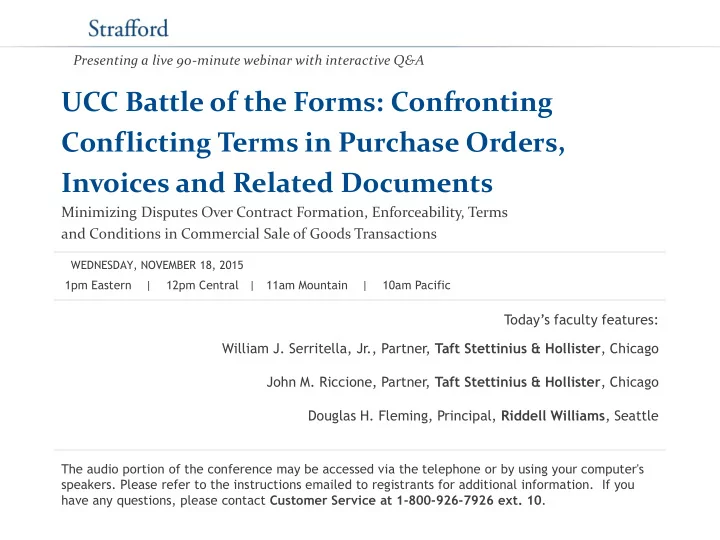
Presenting a live 90-minute webinar with interactive Q&A UCC - - PowerPoint PPT Presentation

presenting a live 90 minute webinar with interactive q a
SMART_READER_LITE
LIVE PREVIEW

Presenting a live 90-minute webinar with interactive Q&A UCC - - PowerPoint PPT Presentation

Presenting a live 90-minute webinar with interactive Q&A UCC Battle of the Forms: Confronting Conflicting Terms in Purchase Orders, Invoices and Related Documents Minimizing Disputes Over Contract Formation, Enforceability, Terms and


slide-1
SLIDE 1

The audio portion of the conference may be accessed via the telephone or by using your computer's

  • speakers. Please refer to the instructions emailed to registrants for additional information. If you

have any questions, please contact Customer Service at 1-800-926-7926 ext. 10.

Presenting a live 90-minute webinar with interactive Q&A

UCC Battle of the Forms: Confronting Conflicting Terms in Purchase Orders, Invoices and Related Documents

Minimizing Disputes Over Contract Formation, Enforceability, Terms and Conditions in Commercial Sale of Goods Transactions

Today’s faculty features:

1pm Eastern | 12pm Central | 11am Mountain | 10am Pacific

WEDNESDAY, NOVEMBER 18, 2015

William J. Serritella, Jr., Partner, Taft Stettinius & Hollister, Chicago John M. Riccione, Partner, Taft Stettinius & Hollister, Chicago Douglas H. Fleming, Principal, Riddell Williams, Seattle

slide-2
SLIDE 2

Tips for Optimal Quality

Sound Quality If you are listening via your computer speakers, please note that the quality

  • f your sound will vary depending on the speed and quality of your internet

connection. If the sound quality is not satisfactory, you may listen via the phone: dial 1-866-961-8499 and enter your PIN when prompted. Otherwise, please send us a chat or e-mail sound@straffordpub.com immediately so we can address the problem. If you dialed in and have any difficulties during the call, press *0 for assistance. Viewing Quality To maximize your screen, press the F11 key on your keyboard. To exit full screen, press the F11 key again.

FOR LIVE EVENT ONLY

slide-3
SLIDE 3

Continuing Education Credits

In order for us to process your continuing education credit, you must confirm your participation in this webinar by completing and submitting the Attendance Affirmation/Evaluation after the webinar. A link to the Attendance Affirmation/Evaluation will be in the thank you email that you will receive immediately following the program. For additional information about continuing education, call us at 1-800-926-7926

  • ext. 35.

FOR LIVE EVENT ONLY

slide-4
SLIDE 4

Program Materials

If you have not printed the conference materials for this program, please complete the following steps:

  • Click on the ^ symbol next to “Conference Materials” in the middle of the left-

hand column on your screen.

  • Click on the tab labeled “Handouts” that appears, and there you will see a

PDF of the slides for today's program.

  • Double click on the PDF and a separate page will open.
  • Print the slides by clicking on the printer icon.

FOR LIVE EVENT ONLY

slide-5
SLIDE 5

5

Welcome

UCC Battle of the Forms:

Confronting Conflicting Terms in Purchase Orders, Invoices and Related Documents November 18, 2015

slide-6
SLIDE 6

6

Minimizing Disputes Over Contract Formation, Enforceability, and Terms and Conditions in the Commercial Sales of Goods Transactions

John M. Riccione Partner, Taft Stettinius & Hollister jriccione@taftlaw.com William J. Serritella, Jr. Partner, Taft Stettinius & Hollister wserritella@taftlaw.com Douglas Fleming Principal, Riddell Williams dfleming@riddellwilliams.com

slide-7
SLIDE 7

7

The Bottom Line

1. Battle of the Forms is critical to your business

– Unless you have a signed contract, you will be in a Battle of the Forms – For the sale of goods, it’s the buyer’s game to lose – For the sale of services, the winner may be whoever fires the “last shot”

2. You must have terms and conditions

– If not, you are potentially stuck with the other side’s terms – Their terms will not favor you

3. You should reference and attach your terms and conditions

– Every time – URL

4. “Magic Language” matters 5. Watch out for international transactions

– The United Nations Convention on the International Sale of Goods (CISG) is not the same as the UCC – Default favors seller, not buyer

slide-8
SLIDE 8

8

How Sales Contracts are Formed

  • 3. By conduct
  • 2. By exchange of purchase and sale

documents 1. By signed agreement

slide-9
SLIDE 9

9

Contract by Signed Agreement

Best Case Scenario No Battle of the Forms

slide-10
SLIDE 10

10

Countersigning

  • Avoid the battle and win the war

– There is no battle of the forms if the other side signs your form — you win! – Create forms that give you a chance – When possible, try to get it signed

  • Casual efforts often work best
  • Little risk in trying unless you have no leverage and invite a request

that you sign the other side’s form

– Do not sign the other side’s forms – Countersigning is even more important for purchases of services

slide-11
SLIDE 11

11

Contracts Formed by Exchange of Documents (Sale of Goods)

Purchase and sale documents:

Request for Quote, Quote, Purchase Order, Order Acknowledgement Shipping documents, Invoice (usually too late)

When conflicts arise, 2-step analysis:

  • 1. If/when was a contract formed?

OFFER + ACCEPTANCE = CONTRACT Offer:

  • Typically Purchase Order
  • Can be Quote if the terms are sufficiently definite to invite

acceptance by simply saying “yes” (varies by jurisdiction)

Acceptance:

  • Typically Order Acknowledgment, but could be a Purchase

Order if the Quote was sufficiently definite to constitute an Offer

slide-12
SLIDE 12

12

UCC § 2-206: Offer and Acceptance in Formation of a Contract

  • An offer will be construed as inviting acceptance

in any manner and by any medium reasonable under the circumstances.

  • UCC 2-201: The Statute of Frauds
slide-13
SLIDE 13

13

The UCC Supplies “Gap Fillers” to Fill in Terms Which are Missing from a Contract

  • UCC § 2-305: Open Price Term
  • UCC § 2-306(1): Quantity Only if Output or

Requirement

  • UCC § 2-308: Place for Delivery
  • UCC § 2-309: Time for Performance
  • UCC § 2-310: Time for Payment
  • UCC § 2-312: Title
slide-14
SLIDE 14

14

Mirror Image Rule

  • Common Law
  • UCC 2-207(1) modifies the Mirror Image Rule
  • Exception: The Offer/Acceptance is expressly

conditioned upon the assent to the terms and conditions in this offer/acceptance, including any additional or different terms.

  • Exception to Exception: Performance
slide-15
SLIDE 15

15

UCC § 2-207(2)(a) – (c): Proposed Additional Terms Do Not Become Part of the Contract When:

a) The offer expressly limits acceptance to the terms

  • f the offer;

b) The proposed terms materially alter the contract; or c) The recipient previously objected to inclusion of any additional terms or objects within a reasonable time after notice of the proposed terms was received

slide-16
SLIDE 16

16

Material vs. Non-Material Additions (Sale of Goods)

Material Terms: OUT Split Among Jurisdictions Non-Material Terms: IN

Why: Result in surprise or hardship Examples: LIMITING REMEDY IN A REASONABLE MANNER* Why: No unreasonable surprise Examples:

  • Price, quantity, quality
  • Choice of law
  • Limitation/disclaimer of

remedies?

  • 90-100% guaranty of

deliveries

  • Cancellation of contract upon

failure to pay a single invoice when due

  • Unreasonably short time for

complaints

  • Arbitration clauses
  • Attorneys fees
  • Force majeure
  • Choice of law
  • Payment of costs of

collection/attorney’s fees upon breach

*In jurisdictions that follow the comments to UCC 2-718 AND 2-719

  • Limited (reasonable) time to

complain

  • Credit terms within trade

practice

  • Limited right to rejection for

defects (within customary trade tolerances)

  • Interest on overdue invoices
slide-17
SLIDE 17

17

What About Different Terms? (Sale of Goods)

  • Not the same everywhere

– “Majority Rule”

  • Knock-out Rule
  • UCC gap fillers

– “Leading Minority Rule”

  • Acceptor’s terms rejected
  • Offeror’s terms control!

– “California Rule” (possibly also followed by New York)

  • Different terms treated the same as additional terms
  • Acceptor’s material terms rejected
  • Acceptor’s non-material terms added
slide-18
SLIDE 18

18

Battle of the Forms “Hot Topics”

The most common “Battle of the Forms” issues:

1.Warranty disclaimers 2.Limitations/exclusions of remedies 3.ADR clauses 4.Delivery terms 5.Insurance

slide-19
SLIDE 19

19

Contracts Formed by Conduct: No Additional Terms (Sale of Goods)

What happens when purchase and sale documents don’t meet elements necessary to form a contract (i.e., no agreement on key terms or “expressly conditional” language of 2-207(1) is used in acceptance)?

UCC §2-207 continued. . . (3) Conduct by both parties which recognizes the existence of a contract is sufficient to establish a contract for sale although the writings of the parties do not otherwise establish a contract. In such case, the terms of the particular contract consist of those terms

  • n which the writings of the parties agree, together with any

supplementary terms incorporated under any other provisions of this Act.

slide-20
SLIDE 20

20

The “Mirror Image Rule” (Sale of Services)

  • UCC 2-207 does not apply to sales of services
  • Common Law “Mirror Image Rule”

– An acceptance that does not “mirror” the offer is deemed a counteroffer – Who fired the “last shot” before acceptance by performance?

  • Courts look to mitigate

– Course of performance – Industry practice

  • Good forms won’t save you
  • You must be vigilant about responding to seller’s documents
  • Have countersigned agreements whenever possible
slide-21
SLIDE 21

21

Buyer: Magic Language for Front of Purchase Order

THIS PURCHASE ORDER IS EXPRESSLY LIMITED TO, AND EXPRESSLY MADE CONDITIONAL ON, SELLER’S ACCEPTANCE OF THE TERMS OF THE ORDER AND THE ATTACHED ________ PURCHASE ORDER TERMS AND CONDITIONS. (A COPY OF THE PURCHASE ORDER TERMS AND CONDITIONS IS AVAILABLE AT [INSERT URL].) BUYER OBJECTS TO ANY DIFFERENT OR ADDITIONAL TERMS.

Acknowledged and Accepted By Seller: Name: ________________________ Date: ________________

slide-22
SLIDE 22

22

Seller: Magic Language for Front of Quotation, Order Acknowledgment, and Invoice

[THIS QUOTATION] or [SELLER’S ACCEPTANCE OF THIS ORDER] IS EXPRESSLY LIMITED TO, AND EXPRESSLY MADE CONDITIONAL ON, BUYER’S ACCEPTANCE OF THESE TERMS AND THE ATTACHED ______ TERMS AND

  • CONDITIONS. (A COPY OF THE ____ TERMS AND

CONDITIONS IS AVAILABLE AT [INSERT URL].) SELLER OBJECTS TO ANY DIFFERENT OR ADDITIONAL TERMS.

Acknowledged and Accepted By Buyer: Name: ________________________ Date: ________________

slide-23
SLIDE 23

23

International Sales - CISG

  • Article 19 – “Last Shot Rule”

– Acceptance with different material terms = counteroffer – Virtually everything is “material” under the CISG – Performance after last form means that the last form wins

  • Favors seller who sends order acknowledgment

– Buyer must object after receiving counteroffer – Requires buyer vigilance

  • Opting out – the chicken and egg problem

– CISG is a treaty signed by most industrial countries – Both parties’ forms must opt out

  • Buyer’s form should opt out
  • Seller’s form should not opt out
slide-24
SLIDE 24

24

Practical Tips

  • 1. Review existing terms and conditions

 Do you have standard Terms and Conditions?  Do those terms maximize your business advantage?

  • 2. Review existing purchase/sale documents

 Do they have the right magic language?  Do they properly incorporate your T&Cs?

slide-25
SLIDE 25

25

  • 3. Review existing purchase/sale processes

 Do you have policies, practices, equipment and training in place to ensure that your T&Cs are universally used and that procurement personnel do not sign the other party’s terms?

  • 4. Establish a triage plan for potential claims

 Do your employees know who to contact when potential claims arise?  Does your legal department have the resources they need to decide whether to pursue a claim?

  • Ignoring or litigating to death are rarely the only options
  • Quick early analysis is key to making good business decisions

Practical Tips

slide-26
SLIDE 26

26

Questions?

John M. Riccione Partner, Taft Stettinius & Hollister jriccione@taftlaw.com William J. Serritella, Jr. Partner, Taft Stettinius & Hollister wserritella@taftlaw.com Douglas Fleming Principal, Riddell Williams dfleming@riddellwilliams.com