Presenter Disclosures Diabetes management: focusing on CV outcomes - - PowerPoint PPT Presentation

presenter disclosures
SMART_READER_LITE
LIVE PREVIEW

Presenter Disclosures Diabetes management: focusing on CV outcomes - - PowerPoint PPT Presentation

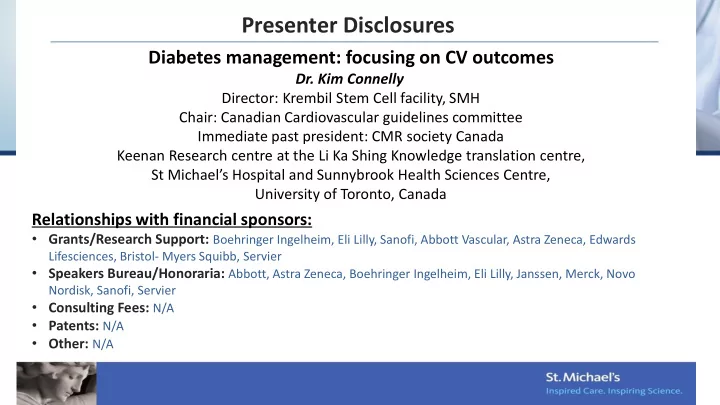
Presenter Disclosures Diabetes management: focusing on CV outcomes Dr. Kim Connelly Director: Krembil Stem Cell facility, SMH Chair: Canadian Cardiovascular guidelines committee Immediate past president: CMR society Canada Keenan Research


slide-1
SLIDE 1

Presenter Disclosures

Diabetes management: focusing on CV outcomes

  • Dr. Kim Connelly

Director: Krembil Stem Cell facility, SMH Chair: Canadian Cardiovascular guidelines committee Immediate past president: CMR society Canada Keenan Research centre at the Li Ka Shing Knowledge translation centre, St Michael’s Hospital and Sunnybrook Health Sciences Centre, University of Toronto, Canada

Relationships with financial sponsors:

  • Grants/Research Support: Boehringer Ingelheim, Eli Lilly, Sanofi, Abbott Vascular, Astra Zeneca, Edwards

Lifesciences, Bristol- Myers Squibb, Servier

  • Speakers Bureau/Honoraria: Abbott, Astra Zeneca, Boehringer Ingelheim, Eli Lilly, Janssen, Merck, Novo

Nordisk, Sanofi, Servier

  • Consulting Fees: N/A
  • Patents: N/A
  • Other: N/A
slide-2
SLIDE 2

Booth, et al.; Hux, et al.; and Oliver, et al. Diabetes in Ontario: An ICES Practice Atlas. 2003. www.ices.on.ca.

In Canada, People with Diabetes Account For…

1/3

  • f all heart

attacks & strokes

2/5

  • f all heart

failure admissions

2/3 1/2

slide-3
SLIDE 3

SHOULD WE ADD AN ANTIHYPERGLYCEMIC AGENT TO REDUCE CARDIOVASCULAR OUTCOMES?

slide-4
SLIDE 4

CV considerations Class Agents Relative A1C lowering Risk of hypoglycemia Heart failure BP effect

CV superiority demonstrated as primary endpoint in RCT by ≥1 agent in class GLP-1 receptor agonist

liraglutide, lixisenatide, dulaglutide, exenatide, semaglutide

↓↓/↓↓↓

Rare Neutral ↓ SGLT-2 inhibitor

empagliflozin, canagliflozin* dapagliflozin

↓↓/↓↓↓

Rare ↓ ↓ CV safety demonstrated as primary endpoint in RCT by ≥1 agents in class DPP-4 inhibitor

alogliptin, sitagliptin, saxagliptin, linagliptin

↓↓

Rare Neutral Neutral  saxa Thiazolidinedione

pioglitazone, rosiglitazone

↓↓

Rare  Neutral Insulin

glargine 100 u/mL, degludec, other basal/bolus/premixed

↓↓↓

Yes** Neutral Neutral CV safety unknown or RCT results not yet available Weight loss agent

  • rlistat

None α-glucosidase inhibitor

acarbose

Rare Meglitinide

nateglinide, repaglinide

↓↓

Yes Sulfonylurea

gliclazide, glimepiride, glyburide

↓↓

Yes

Cardiovascular Considerations for Add-On Antihyperglycemic Agents

*Increased lower extremity amputations. | **Lower hypoglycemia risk with newer generation basal insulins (e.g., degludec, glargine 300 u/mL). Adapted from: Mancini GB, et al. Can J Cardiol 2017;33(3):366-77. Agents in blue bold text showed CV superiority for MACE. Agents in black bold text showed CV safety.

slide-5
SLIDE 5

CVOTs in Diabetes Demonstrating Superiority

5

CV, cardiovascular; CVOT, cardiovascular outcome trial, HR, hazard ratio; NS, not significant; MI, myocardial infarction; hHF hospitalization for heart failure 1 Zinman B, et al. N Engl J Med 2015;373(22):2117-28. 2 Neal B, et al, N Engl J Med 2017;377:644-57. 3 Marso S, et al. N Engl J Med 2016;375(4):311-22. 4 Marso S, et al. N Engl J Med 2016;375:1834-44. 5 Gerstein H, et al. Lancet June 2019.

  • 6. Wiviott S, et al. N Engl J Med 2018.

PRIMARY OUTCOME SECONDARY OUTCOMES

Medication CV Death All cause mortality Nonfatal MI Nonfatal Stroke Hospitalization for Heart Failure

EMPA-REG OUTCOME1

HR (95% CI)

Empagliflozin MACE 0.86

(0.74, 0.99)

0.62 (0.49, 0.77) 0.68 (0.57-0.82) NS NS 0.65 (0.50, 0.85)

CANVAS2

HR (95% CI)

Canagliflozin MACE 0.86

(0.75, 0.97)

NS NS NS NS 0.67 (0.52, 0.87)

DECLARE6

HR (95% CI)

Dapagliflozin hHF/ CV Mortality 0.83

(0.73-0.95)

NS NS NS NS 0.73 (0.61-0.88)

LEADER3

HR (95% CI)

Liraglutide MACE 0.87

(0.78, 0.97)

0.78 (0.66, 0.93) 0.85 (0.74,0.97) NS NS NS

SUSTAIN-64

HR (95% CI)

Semaglutide MACE 0.74

(0.58, 0.95)

NS NS NS 0.61 (0.38, 0.99) NS

PIONEER-64

HR (95% CI)

Semaglutide oral

MACE 0.79 (0.57,1.11)

0.49 (0.27,0.92) 0.51 (0.31,0.84) NS NS NS

REWIND5

HR (95% CI)

Dulaglutide

MACE 0.88 (0.79-0.99)

NS NS NS 0.76 (0.61-0.95) NS

slide-6
SLIDE 6

DAPA HF: International, multicentre, event-driven, randomized, double- blind, parallel group, placebo-controlled study

Primary endpoint: Composite of CV death or HF event Placebo once daily Added to current background therapy Dapagliflozin 10 mg once daily

Added to current background therapy Estimated Study duration ~33 month Estimated Average follow-up ~24 months

  • Duration is event-driven: 844 events
  • Powered for superiority (power 90%)
  • HR of 0.80 for dapagliflozin vs. placebo,

and using a one-sided alpha of 2.5% 1:1 Double-blind

Inclusion criteria

  • Adults ≥18 yrs
  • NYHA Class II-IV HF
  • LVEF ≤40%
  • Nt-proBNP ≥600 pg/ml*
  • eGFR ≥30 ml/min/1.73 m2
  • Stable SoC HF treatment
  • No. of randomized patients: 4,744

* ≥400 pg/mL if hospitalised for heart failure within the previous 12months; ≥900 pg/mL with atrial fibrillation or atrial flutter HF event: hospitalisation for heart failure or urgent treatment visit for HF McMurray et al European Journal of Heart Failure 2019 doi:10.1002/ejhf.1432

slide-7
SLIDE 7

Primary Endpoint: CV Death or hHF or an Urgent HF Visit1

7 DAPA = dapagliflozin; HF = heart failure; hHF = hospitalization for heart failure; HR = hazard ratio; NNT = number needed to treat.

  • 1. McMurray J. Presentation at: European Society of Cardiology Congress. September 1, 2019; Paris, France.

210 593 1096 1478 1917 2075 2163 2258 2371 Placebo 210 612 1146 1560 2002 2147 2221 2305 2373 DAPA 32 28 24 20 16 12 8 4 24 21 15 18 12 9 6 3

  • No. at Risk

Months from Randomization Cumulative Percentage (%) 36

HR 0.74 (0.65, 0.85) p=0.00001 NNT = 21 DAPA Placebo

26% RRR

slide-8
SLIDE 8
  • 1. Proven CVD benefit means it has a label indication of reducing CVD events. 2. Be aware that SGLT2i labeling varies by region and individual agent with regard to indicated level of eGFR for initiation and continued use. 3. Empagliflozin,

canagliflozin and dapagliflozin have shown reduction in HF and to reduce CKD progression in CVOTs. Canagliflozin has primary renal outcome data from CREDENCE. Dapagliflozin has primary HF outcome data in DAPA-HF. ƗActioned whenever these become new clinical considerations regardless of background glucose-lowering medications. ADA = American Diabetes Association; EASD = European Association for the Study of Diabetes; ASCVD = atherosclerotic cardiovascular disease; GLP-1RA = glucagon-like peptide-1 receptor agonists; SGLT2i = sodium glucose co-transporter 2 inhibitors; HF = heart failure; HFrEF = heart failure with reduced ejection fraction; CVD = cardiovascular disease; UACR = urinary albumin-to- creatinine ratio; LVEF = left ventricular ejection fraction; eGFR = estimated glomerular filtration rate; CVOTs = cardiovascular outcome trials; LVH = left ventricular hypertrophy; CKD = chronic kidney disease. Adapted from: Buse JB, et al. Diabetes Care 2020;43:487-93. Updates to the 2018 consensus report are indicated in magenta font.

2019 ADA/EASD Update: Overall Approach to Glucose-Lowering Medication in Type 2 Diabetes

FIRST-LINE THERAPY IS METFORMIN AND COMPREHENSIVE LIFESTYLE (INCLUDING WEIGHT MANAGEMENT AND PHYSICAL ACTIVITY) INDICATORS OF HIGH-RISK OR ESTABLISHED ASCVD, CKD OR HFƗ Consider independent of individualized HbA1C target ASCVD PREDOMINATES

  • Established ASCVD
  • Indicators of high ASCVD risk (age ≥55

years + LVH or coronary, carotid, lower extremity artery stenosis >50%) HF OR CKD PREDOMINATES

  • Particularly HFrEF (LVEF < 45%)
  • CKD: Specifically eGFR 30-60 ml min/1.73m2
  • r UACR >30 mg/g, particularly UACR >300 mg/g

PREFERABLY GLP-1 RA with proven CVD benefit1 OR SGLT2i with proven CVD benefit1 if eGFR adequate2 PREFERABLY SGLT2i with evidence of reducing HF and/or CKD progression in CVOTs if eGFR adequate3 OR If SGLT2i not tolerated or contraindicated or if eGFR less than adequate,2 add GLP-1 RA with proven CVD benefit1

Added high-risk patients

TOP TIPS!

slide-9
SLIDE 9

Practical Considerations

Characteristic Empagliflozin Canagliflozin Dapagliflozin Liraglutide Semaglutide Dulaglutide

Class SGLT2 inhibitor SGLT2 inhibitor SGLT2 inhibitor GLP-1 receptor agonist GLP-1 receptor agonist GLP-1 receptor agonist Route of administration Oral once daily Oral once daily Oral once daily SC injection daily SC injection once weekly Oral sema not yet available SC injection once weekly Dosage 10 mg or 25 mg 100 mg or 300 mg 10mg 0.6 mg x 1 wk then 1.2 mg x 1 wk then 1.8mg SC 0.25 mg x 4 wk then 0.5 mg May increase to 1 mg SC per week Up to 1.5mg week Cost ~$90/month ~$90/month ~$90/month ~$225/month ~$225/month ~$225/month eGFR eGFR > 30 eGFR > 30 eGFR > 45 eGFR >15 eGFR >15 (caution 15-29) eGFR >15 Wt loss       BP      

eGFR, estimated glomular filtration rate; GLP-1, glucagon-like peptide 1; SC, subcutaneous; SGLT2, sodium glucose cotransporter 2

slide-10
SLIDE 10

If Starting SGLT2i

  • Explain mechanism of action
  • Drink water – stay hydrated
  • Proper genital hygiene
  • Inform other HCPs
  • Stop in acute illness / preoperative
  • Do not use in type 1 diabetes
  • SADMANS

TOP TIPS!

slide-11
SLIDE 11

If Starting a GLP1RA

  • Refer to someone else to teach injection or you can teach in

your office

  • Counsel about nausea that will resolve
  • Avoid in persons with Hx of MEN2, medullary thyroid cancer,

gastroparesis or pancreatitis

TOP TIPS!

slide-12
SLIDE 12
  • Set appropriate treatment expectations
  • While common, GI side effects are manageable and transient

(typically resolves after 4–8 weeks)

  • Use a slow dose escalation
  • Starting at a lower dose and titrating upward can also reduce the incidence of nausea
  • Respect satiety
  • Recommend eating small meals throughout the day
  • Avoid consuming high fat foods
  • Patients might find that nausea is more tolerable if they have an empty stomach

at the time of dosing (e.g., before bed)

Tella SH, et al. Ther Adv Endocrinol Metab 2015;6(3):109-34. Meier JJ. Nat Rev Endocrinol 2012;12:728-42. Ross SA. Am J Med 2013;126(9 Suppl 1):S38-48.

GLP-1 RAs and Nausea: Making it Better

slide-13
SLIDE 13
  • Use of insulin secretagogues and insulin therapy
  • Missed or irregular meals
  • Advanced age
  • Duration of diabetes
  • Impaired awareness of hypoglycemia
  • renal dysfunction

Amiel SA, et al. Diabet Med 2008;25(3):245-54.

Risk Factors for Hypoglycemia in Patients on Insulin Secretagogues and/or Insulin

slide-14
SLIDE 14

1. Counsel about the risk of hypoglycemia 2. If A1C <8%, reduce or stop sulfonylurea 3. Do NOT stop the insulin 4. Communicate / coordinate changes with primary care physician/diabetes specialist / diabetes care team

If Patient is on Secretagogue or Insulin, When do you Add-on Other Meds?

TOP TIPS!

slide-15
SLIDE 15

Antihyperglycemic Consideration in Heart Failure

  • Metformin remains initial drug (if eGFR >30)
  • Consider SGLT2i (empa, cana or dapa) to prevent hospitalization for heart

failure and dapa to reduce/treat patients with HFrEF to reduce hHF and CV

  • Avoid or use caution with saxagliptin
  • Avoid TZD class

empa, empagliflozin; cana, canagliflozin; eGFR estimated glomular filtration rate, SGLT2i, sodium glucose cotransporter 2; TZD, thiazolidinedione Mancini GBJ, et al. Can J Cardiol 2018;34:1350-61. Esekowitz JA, et al. Can J Cardiol 2017;33:1342-433. Connelly KA, et al. Can J Diabetes 2018;42(S1):S196-200.

slide-16
SLIDE 16

Guidelines are Evolving to Recommend SGLT2 Inhibitors to Help Reduce the Risk of Hospitalization Due to Heart Failure

Canadian Cardiovascular Society (CCS) Guidelines provide a strong recommendation that:

  • SGLT2 inhibitors, such as dapagliflozin, should be used in patients with T2D aged >50

years with additional risk factors for atherosclerotic cardiovascular disease to reduce the risk of hospitalization for heart failure

  • SGLT2 inhibitors, such as dapagliflozin, canagliflozin and empagliflozin, should be used

for treatment of patients with T2D and atherosclerotic cardiovascular disease to reduce the risk of heart failure hospitalization and death.

McDonald M, et al. Can J Cardiol 2020;36 :159-169

slide-17
SLIDE 17

Clinical Lessons for SGLT2 Inhibitors

  • Do not use in T1DM
  • Be cautious with insulin dose reductions and do not hold insulin in acute

illness (must continue to do SMBG regularly)

  • Hold SGLT2 inhibitors during acute illness (SADMANS), prolonged fasting,

perioperative

  • If unwell (e.g. nausea / vomiting, malaise), check electrolytes, bicarb and

calculate anion gap

  • AVOID IN ICU patients

17 DKA, diabetic ketoacidosis; SMBG, self-monitoring blood glucose; SGLT2, sodium glucose cotransporter 2; T1DM, Type 1 Diabetes Mellitus Rosenstock J , et al. Diabetes Care 2015;38:1638-42.

slide-18
SLIDE 18

Final Messages

  • Two classes of antihyperglycemic agents include agents that reduce CV events
  • SGLT2i: Empagliflozin, Canagliflozin, Dapagliflozin
  • GLP1-RA: Liraglutide, Semaglutide, Dulaglutide
  • 2 agents have proven reduction in mortality in T2DM and CVD
  • empagliflozin and liraglutide (semaglutide)
  • Reduce or stop the secretagogue if A1c <8% and adding either SGLT2 inhibitor or

GLP1 receptor agonist

  • Look at the eGFR
  • Remember sick day management with acute illness (SADMANS)
  • Do not routinely stop the patient’s insulin when admitted to hospital
  • May consider using BOTH classes of drugs together!!!!