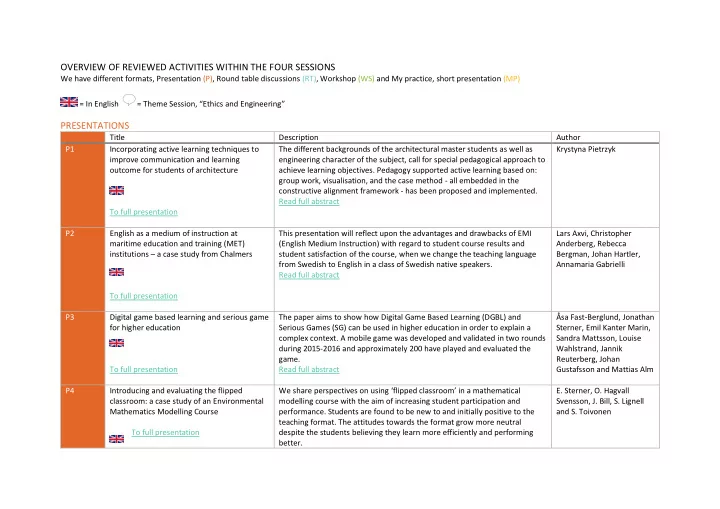
SLIDE 1 OVERVIEW OF REVIEWED ACTIVITIES WITHIN THE FOUR SESSIONS
We have different formats, Presentation (P), Round table discussions (RT), Workshop (WS) and My practice, short presentation (MP) = In English = Theme Session, “Ethics and Engineering”
PRESENTATIONS
Title Description Author P1 Incorporating active learning techniques to improve communication and learning
- utcome for students of architecture
To full presentation The different backgrounds of the architectural master students as well as engineering character of the subject, call for special pedagogical approach to achieve learning objectives. Pedagogy supported active learning based on: group work, visualisation, and the case method - all embedded in the constructive alignment framework - has been proposed and implemented. Read full abstract Krystyna Pietrzyk P2 English as a medium of instruction at maritime education and training (MET) institutions – a case study from Chalmers To full presentation This presentation will reflect upon the advantages and drawbacks of EMI (English Medium Instruction) with regard to student course results and student satisfaction of the course, when we change the teaching language from Swedish to English in a class of Swedish native speakers. Read full abstract Lars Axvi, Christopher Anderberg, Rebecca Bergman, Johan Hartler, Annamaria Gabrielli P3 Digital game based learning and serious game for higher education To full presentation The paper aims to show how Digital Game Based Learning (DGBL) and Serious Games (SG) can be used in higher education in order to explain a complex context. A mobile game was developed and validated in two rounds during 2015-2016 and approximately 200 have played and evaluated the game. Read full abstract Åsa Fast-Berglund, Jonathan Sterner, Emil Kanter Marin, Sandra Mattsson, Louise Wahlstrand, Jannik Reuterberg, Johan Gustafsson and Mattias Alm P4 Introducing and evaluating the flipped classroom: a case study of an Environmental Mathematics Modelling Course To full presentation We share perspectives on using ‘flipped classroom’ in a mathematical modelling course with the aim of increasing student participation and
- performance. Students are found to be new to and initially positive to the
teaching format. The attitudes towards the format grow more neutral despite the students believing they learn more efficiently and performing better.
Svensson, J. Bill, S. Lignell and S. Toivonen
SLIDE 2
Read full abstract P5 Alternerande föreläsningar- ett undervisningsexperiment där föreläsande varvas med studentaktivitet To full presentation Vi fokuserar på tre didaktiska utmaningar för föreläsare: förkunskaper, studentfokus och studentaktivitet och genomför ett experiment där studenterna återkommande löser uppgifter under föreläsningarna. Mittkursutvärdering har använts för att mäta studenternas mottagande av föreläsningsmodellen. De alternerande föreläsningarnas huvudsakliga verktyg, arbetsbladen, är en aspekt som kommenteras av flest studenter. Read full abstract Samuel Bengmark P6 Fermatpedagogik To full presentation Vi har utvecklat, implementerat och gjort en jämförande studie av en föreläsningsanteckningsteknik kallad Fermatpedagogik. Pilotstudien indikerar att metoden kan hjälpa de mer motiverade studenterna att få ett överbetyg, men att de svagare inte lyckas så bra på tentamen. Indikationen är högst osäker och kräver mer studier, men kan ändå lägga en grund för en diskussion om hur vi kan se på våra förläsningar. Read full abstract Torbjörn Lundh, Samuel Bengmark P7 How to help first year students to appreciate learning To full presentation The learning approaches and strategies many students arrive with at the university might not be suitable for the new teaching methods in engineering education. Therefore, it is crucial for educators to help students to advance their approaches and strategies towards learning through active discussions and open dialogues Read full abstract Patric Wallin, Lisa Rundberg and Erica Sandström P8 Especially challenging issues for courses in environment and sustainable development To full presentation There are three issues that are especially challenging for and that seems to be important for the students’ overall impression of courses in environment and sustainable development at Chalmers: 1) relevance for the study programme and the profession, 2) level of learning, and 3) clearness of content. Read full abstract Ulrika Lundqvist
SLIDE 3
ROUND TABLE DISCUSSIONS
Title Description Author RT1 Learning plan before single-student final re-exam To full presentation Frustrated over a request for an extra exam for only one student? Is “your” course all that’s left for this student? Here’s a suggestion to help both you and the student, before creating this final re-exam. Let’s discuss how else we can help, without an unreasonable workload for the teachers. Read full abstract Sheila Galt RT2 Peer review for increased course quality To full presentation We propose to introduce peer review as a supplement to the current course evaluation process. Such a review might include that a teacher "visits" a course, reads the literature, attends lectures, visits tutorials and exercise sessions, and at the end of the course discusses their impressions with the course teacher. Read full abstract Peter Ljunglöf, Alex Gerdes RT3 Creating global perspectives and fostering intercultural cooperation: how can this be done in Master's programs? To full presentation One prioritized goal for development at Master’s level is establishing an international environment through creating global perspectives and fostering intercultural cooperation. With examples from two Master programs we will discuss possible strategies for future work, both at a student and staff level. This round table is aimed particularly at those working with Master’s students. Read full abstract Rebecca Bergman RT4 Roundtable on flipped classroom Several Chalmers teachers have taken on the task to flip parts of their courses, and have gained a better understanding of what works and not. We will address the benefits and challenges hitherto and from the literature; exchange experiences, identify best practices, overcome concerns, and learn about support opportunities. Interested teachers without own experience are also welcome. Read full abstract Christian Stöhr
SLIDE 4 WORK SHOPS
Title Description Author WS1 Tools for improving communication, co- action and feedback skills in a master-level project course To full presentation To increase master students’ knowledge about and skills in communication, co-action and feedback in project teams, I have developed a fishbowl communication exercise and a related team feedback form with rubrics. In this workshop I discuss these tools with Lars Marmgren, and you get to experience the fishbowl exercise yourselves Read full abstract Lena Peterson WS2 Academic socialization; a discussion on help and support during the different phases of being a doctoral student in order to maintain focus on academic achievements and quality To full presentation How can we help and support doctoral students to focus on their academic quality and achievements in their professional development of becoming researchers instead of feeling lost and alone? We will discuss this, and how support can be directed to the different phases of the doctoral studies in
- rder to achieve the goals.
Read full abstract Karin Ekman WS3 Entrepreneurial experiences in engineering programs – what is it and why should we do it? To full presentation Chalmers aims to offer entrepreneurial experiences to half of its students within three years. But what are ‘entrepreneurial experiences’ in engineering education? Through this workshop, perceptions of entrepreneurship are explored and learning activities that might be ‘entrepreneurial’ are identified. Anyone interested in student engagement, active learning or development of entrepreneurial competencies is invited to participate. Read full abstract
Brunnegård, T Faxheden, M. Kjellberg, M. Lackéus, O. Hagvall Svensson WS4 En diskussion om MTS-förväntningar på Chalmers Denna workshop vill bjuda lärare och forskare på Chalmers att diskutera hur ingenjörsetik och ingenjörens yrkesroll och ansvar för en hållbar samhällsutveckling speglas i utbildningar på Chalmers, med avstamp i det nuvarande kursutbudet inom Chalmers MTS-obligatorium Read full abstract Annamaria Gabrielli WS5 Etik och teknik – undervisning och betygsättning I denna workshop kommer vi att undersöka hur vi kan undervisa och hur examinera studenter i etik. Först kommer Karl de Fine Licht, doktor i praktisk filosofi och gästlärare vid Chalmers, att hålla en kortare presentation hur vi Karl de Fine Licht
SLIDE 5 kan undervisa och examinera sedan kommer konkreta exempel på inlämningsuppgifter att diskuteras. Read full abstract
MY PRACTICE, SHORT PRESENTATION
Title Description Author MP1 Chemical Engineering Assignments with MapleTA To full presentation The online software can be used for designing course assignments. It offers the possibility to reduce the need for teaching resources. To our experience, it may even improve student learning. This presentation will share our experiences with the use of this software and how it has been mostly a help, but in some cases a hinder. Read full abstract Derek Creaser MP2 Exploring Strategies for Increasing Response Rates of Online Student Evaluations of Teaching Student evaluations of teaching are important feedback tools for assessing the quality of teaching and courses. However, with evaluations now predominantly performed online, response rates are generally lower compared to pencil-and-paper data collections. Aimed at instructors and administrators, this presentation explores a variety of strategies for increasing student response rates. Read full abstract Steven C. Mallam MP3 Maximizing the quality and utility of computer-aided quizzing To full presentation It is relatively easy to use computer/smartphone-based quizzes to make students more active and accessary during lectures, but the effect on learning is not always as clear. The aim is to discuss how the design of the quiz questions affects the possibilities to stimulate higher-level thinking among the students. Read full abstract Henrik Ström MP4 Undervisa och examinera akademisk hederlighet To full presentation Vi har lagt till en obligatorisk föreläsning om Akademisk hederlighet, plagiering och otillåtet samarbete i en obligatorisk kurs på vårt
- mastersprogram. I slutet får studenterna bedöma huruvida åtta påståenden
är sanna eller falska. Utav 26 studenter svarade endast två rätt på samtliga påståenden, och elva studenter hade två eller fler fel. Read full abstract Hans Hjelmgren, Sheila Galt
SLIDE 6 MP5 New Online Learning Resources at Chalmers Division for Language and Communication To full presentation The Division of Language and Communication will present newly developed and improved online learning resources that can be used as support in writing and communication assignments, and in courses for writing activities. They comprise three key areas: a Chalmers writing guide; a grammar guide; and films on writing and grammar. Read full abstract Becky Bergman, Fia Börjesson, Andreas Eriksson, Anna-Lena Fredriksson MP6 Informationskompetent med blended learning och Chalmers Library Education Online - CLEO To full presentation Hur kan biblioteket, genom att förändra sin undervisning, göra kandidatarbetarna mer informationskompetenta? Med en onlinemodul i edX Edge i kombination med handledning har vi kommit en bra bit på väg. Vi kommer att presentera våra erfarenheter av blended learning och arbetet med att utveckla onlinemodulen Chalmers Library Education Online (CLEO). Read full abstract Mona Wernbro, Liza Nordfeldt MP7 Kan samverkansskicklighet räknas som meriterande? To full presentation ”Individens meritering” är ett av sex pilotprojekt inom MuCh-projektet. Syftet är att lyfta och värdera samverkan som del av kvalitetsutveckling inom utbildning, forskning och nyttiggörande och skapa förutsättningar för att samverkan blir meriterande vid rekrytering, kompetens- och karriärutveckling. Målet är att synliggöra individens samverkansskicklighet. Read full abstract Annika Orvarson, Charlotte Emlind Vahul, Angela Hillemyr MP8 Uppföljning och utveckling av arbetslivssamverkan inom grundutbildningen To full presentation I MuCh-projektet har en modell för uppföljning och utveckling av arbetslivssamverkan inom grundutbildningen tagits fram. Förutom kartläggningen, är tanken att bidra till ordinarie kvalitetsarbete på kurser och program med fokus på kvalitativa aspekter. Arbetslivssamverkan kan vara ett medel att nå olika lärandemål. Under passet kommer bl. a. modellen, metodstöd och exempel på utvecklingsarbete att presenteras. Read full abstract
MP9 Ethics course module – a do-it-yourself guide for teachers, with a specific example To full presentation Do you wish your students could get some subject-relevant training in ethical reasoning? Got an idea for a learning goal? Any lesson plans? Ever wondered how to examine such learning? Would you like a DIY guide? Come and get one teacher’s take on all this! Read full abstract Sheila Galt MP10 Att utveckla ingenjörsstudenters förmåga att resonera kring komplexa hållbarhetsproblem I detta bidrag kommer vi att presentera en forskningsbaserad undervisningsenhet och bedömningsmatris som kan användas för att utveckla och bedöma studenters förmåga att resonera kring komplexa Johanna Lönngren, Tom Adawi, Magdalena Svanström
SLIDE 7 – en forskningsbaserad undervisningsenhet
To full presentation hållbarhetsproblem i olika typer av kurser och program på Chalmers. Vi avser att tillgängliggöra allt undervisningsmaterial som behövs för att genomföra modulen. Read full abstract MP11 Software Ecosystem in the Classroom To full presentation We present our experiences running a project course aimed at promoting a conscious approach to cooperation and competition via an exercise mimicking software ecosystems. The question we are investigating is to what extent such course can alter habits limiting cooperation that have been learned at high school. Read full abstract Imed Hammouda, Michał H. Pałka MP12 Students’ own collective criteria - influence on peer feedback and lab report quality To full presentation What happens when you let the students collectively decide together what’s meant by “good quality” for example in a lab report? Will this adequately guide their own learning as shown by their written lab reports and peer feedback comments? Or is it better to just tell them what you expect? Read full abstract Sheila Galt and Hans Hjelmgren
SLIDE 8 OTHER ACTIVITIES
Title Description Author Discussion with keynote speaker After the coffee break there will be an opportunity to discuss further with
- Prof. Jeroen van den Hoven. For the discussion there will be a panel as well
as room for questions from KUL-participants. The panel will consist of Anna Dubois, Vice president for Chalmers Areas of advance; Cecilia Berlin, supervisor and teacher at Product and production development; Karl de Fine Licht, guest lecturer in philosophy at Chalmers; and Daniel Schoepe, PhD student at Computer science and engineering; moderated by programme director for the mechanical engineering programme, Mikael Enelund Jeroen van den Hoven with the panel Chalmers pedagogical prize 2016: “Experiences of using active learning” The laureates - Ulf Gran, Anette Larsson and Mikael Odenberger - discuss how they have implemented active learning, why and with what results. The session consists of three short presentations followed by a panel moderated by Tom Adawi. Supervision to promote learning Research supervision is to support learning processes in doctoral education. To create aclear communication and to build up a good relationship with the student are some of the key areas for successful supervision. It may sound simple but is not always easy. Welcome to listen to, be inspired by and discuss some aspects of supervision with three of Chalmers award winners of "Supervisor of the year": Erik Agrell, Martin Andersson and Henk Wymeersch. Erik Agrell, Martin Andersson and Henk Wymeersch Moderated by Sofia Månsson Blended Learning på Chalmers – Vad kan jag få för hjälp? Utställning och presentation hela dagen i Volvofoajén Chalmers har sedan ett par år ett Stöd för Blended Learning som erbjuder både praktiskt stöd med utrustning, programvaror och hjälp att komma igång samt pedagogiskt stöd med kursdesign, olika metoder (t.ex. flipped classroom, olika sätt att få ett aktiv klassrum mm) i form av konsultationer
Hugo Landgren, Magnus Axelsson, Erik Malmsköld
SLIDE 9 Session#1
10.20-11.20
= In English = Theme Session, “Ethics and Engineering” Room Title Description Author Valdemar & Ledningsrummet Discussion with keynote speaker After the coffee break there will be an opportunity to discuss further with
- Prof. Jeroen van den Hoven. For the discussion there will be a panel as well
as room for questions from KUL-participants. The panel will consist of Anna Dubois, Vice president for Chalmers Areas of advance; Cecilia Berlin, supervisor and teacher at Product and production development; Karl de Fine Licht, guest lecturer in philosophy at Chalmers; and Daniel Schoepe, PhD student at Computer science and engineering; moderated by programme director for the mechanical engineering programme, Mikael Enelund Jeroen van den Hoven with the panel Scaniasalen (MP1) Chemical Engineering Assignments with MapleTA The online software can be used for designing course assignments. It offers the possibility to reduce the need for teaching resources. To our experience, it may even improve student learning. This presentation will share our experiences with the use of this software and how it has been mostly a help, but in some cases a hinder. Read full abstract Derek Creaser Scaniasalen (MP2) Exploring Strategies for Increasing Response Rates of Online Student Evaluations of Teaching Student evaluations of teaching are important feedback tools for assessing the quality of teaching and courses. However, with evaluations now predominantly performed online, response rates are generally lower compared to pencil-and-paper data collections. Aimed at instructors and administrators, this presentation explores a variety of strategies for increasing student response rates. Read full abstract Steven C. Mallam Scaniasalen (MP3) Maximizing the quality and utility of computer-aided quizzing It is relatively easy to use computer/smartphone-based quizzes to make students more active and accessary during lectures, but the effect on learning is not always as clear. The aim is to discuss how the design of the quiz questions affects the possibilities to stimulate higher-level thinking among the students. Henrik Ström
SLIDE 10
Read full abstract RunAn (P1) Incorporating active learning techniques to improve communication and learning outcome for students of architecture The different backgrounds of the architectural master students as well as engineering character of the subject, call for special pedagogical approach to achieve learning objectives. Pedagogy supported active learning based on: group work, visualisation, and the case method - all embedded in the constructive alignment framework - has been proposed and implemented. Read full abstract Krystyna Pietrzyk RunAn (P2) English as a medium of instruction at maritime education and training (MET) institutions – a case study from Chalmers This presentation will reflect upon the advantages and drawbacks of EMI (English Medium Instruction) with regard to student course results and student satisfaction of the course, when we change the teaching language from Swedish to English in a class of Swedish native speakers. Read full abstract Lars Axvi, Christopher Anderberg, Rebecca Bergman, Johan Hartler, Annamaria Gabrielli Ascom (RT1) Learning plan before single- student final re-exam Frustrated over a request for an extra exam for only one student? Is “your” course all that’s left for this student? Here’s a suggestion to help both you and the student, before creating this final re-exam. Let’s discuss how else we can help, without an unreasonable workload for the teachers. Read full abstract Sheila Galt Catella (WS1) Tools for improving communication, co-action and feedback skills in a master-level project course To increase master students’ knowledge about and skills in communication, co-action and feedback in project teams, I have developed a fishbowl communication exercise and a related team feedback form with rubrics. In this workshop I discuss these tools with Lars Marmgren, and you get to experience the fishbowl exercise yourselves Read full abstract Lena Peterson
SLIDE 11 Session#2
11.30-12.30
= In English = Theme Session, “Ethics and Engineering” Room Title Description Author Valdemar & Ledningsrummet Chalmers pedagogical prize 2016: “Experiences of using active learning” The laureates - Ulf Gran, Anette Larsson and Mikael Odenberger - discuss how they have implemented active learning, why and with what results. The session consists of three short presentations followed by a panel moderated by Tom Adawi. Scaniasalen (MP4) Undervisa och examinera akademisk hederlighet Vi har lagt till en obligatorisk föreläsning om Akademisk hederlighet, plagiering och otillåtet samarbete i en obligatorisk kurs på vårt
- mastersprogram. I slutet får studenterna bedöma huruvida åtta påståenden
är sanna eller falska. Utav 26 studenter svarade endast två rätt på samtliga påståenden, och elva studenter hade två eller fler fel. Read full abstract Hans Hjelmgren, Sheila Galt Scaniasalen (MP5) New Online Learning Resources at Chalmers Division for Language and Communication The Division of Language and Communication will present newly developed and improved online learning resources that can be used as support in writing and communication assignments, and in courses for writing
- activities. They comprise three key areas: a Chalmers writing guide; a
grammar guide; and films on writing and grammar. Read full abstract Becky Bergman, Fia Börjesson, Andreas Eriksson, Anna-Lena Fredriksson Scaniasalen (MP6) Informationskompetent med blended learning och Chalmers Library Education Online - CLEO Hur kan biblioteket, genom att förändra sin undervisning, göra kandidatarbetarna mer informationskompetenta? Med en onlinemodul i edX Edge i kombination med handledning har vi kommit en bra bit på väg. Vi kommer att presentera våra erfarenheter av blended learning och arbetet med att utveckla onlinemodulen Chalmers Library Education Online (CLEO). Read full abstract Mona Wernbro, Liza Nordfeldt RunAn (P3) Digital game based learning and serious game for higher education The paper aims to show how Digital Game Based Learning (DGBL) and Serious Games (SG) can be used in higher education in order to explain a complex context. A mobile game was developed and validated in two rounds during 2015-2016 and approximately 200 have played and evaluated the game. Åsa Fast-Berglund, Jonathan Sterner, Emil Kanter Marin, Sandra Mattsson, Louise Wahlstrand, Jannik
SLIDE 12 Read full abstract Reuterberg, Johan Gustafsson and Mattias Alm RunAn (P4) Introducing and evaluating the flipped classroom: a case study of an Environmental Mathematics Modelling Course We share perspectives on using ‘flipped classroom’ in a mathematical modelling course with the aim of increasing student participation and
- performance. Students are found to be new to and initially positive to the
teaching format. The attitudes towards the format grow more neutral despite the students believing they learn more efficiently and performing better. Read full abstract
Svensson, J. Bill, S. Lignell and S. Toivonen Ascom (RT2) Peer review for increased course quality We propose to introduce peer review as a supplement to the current course evaluation process. Such a review might include that a teacher "visits" a course, reads the literature, attends lectures, visits tutorials and exercise sessions, and at the end of the course discusses their impressions with the course teacher. Read full abstract Peter Ljunglöf, Alex Gerdes Catella (WS2) Academic socialization; a discussion on help and support during the different phases of being a doctoral student in order to maintain focus on academic achievements and quality How can we help and support doctoral students to focus on their academic quality and achievements in their professional development of becoming researchers instead of feeling lost and alone? We will discuss this, and how support can be directed to the different phases of the doctoral studies in
- rder to achieve the goals.
Read full abstract Karin Ekman
SLIDE 13 Session#3
13.30-14.30
= In English = Theme Session, “Ethics and Engineering” Room Title Description Author Valdemar & Ledningsrummet Supervision to promote learning Research supervision is to support learning processes in doctoral education. To create aclear communication and to build up a good relationship with the student are some of the key areas for successful supervision. It may sound simple but is not always easy. Welcome to listen to, be inspired by and discuss some aspects of supervision with three of Chalmers award winners of "Supervisor of the year": Erik Agrell, Martin Andersson and Henk Wymeersch. Erik Agrell, Martin Andersson and Henk Wymeersch Moderated by Sofia Månsson Scaniasalen (MP7) Kan samverkansskicklighet räknas som meriterande? ”Individens meritering” är ett av sex pilotprojekt inom MuCh-projektet. Syftet är att lyfta och värdera samverkan som del av kvalitetsutveckling inom utbildning, forskning och nyttiggörande och skapa förutsättningar för att samverkan blir meriterande vid rekrytering, kompetens- och karriärutveckling. Målet är att synliggöra individens samverkansskicklighet. Read full abstract Annika Orvarson, Charlotte Emlind Vahul, Angela Hillemyr Scaniasalen (MP8) Uppföljning och utveckling av arbetslivssamverkan inom grundutbildningen I MuCh-projektet har en modell för uppföljning och utveckling av arbetslivssamverkan inom grundutbildningen tagits fram. Förutom kartläggningen, är tanken att bidra till ordinarie kvalitetsarbete på kurser
- ch program med fokus på kvalitativa aspekter. Arbetslivssamverkan kan
vara ett medel att nå olika lärandemål. Under passet kommer bl. a. modellen, metodstöd och exempel på utvecklingsarbete att presenteras. Read full abstract
Scaniasalen (MP9) Ethics course module – a do-it- yourself guide for teachers, with a specific example Do you wish your students could get some subject-relevant training in ethical reasoning? Got an idea for a learning goal? Any lesson plans? Ever wondered how to examine such learning? Would you like a DIY guide? Come and get one teacher’s take on all this! Read full abstract Sheila Galt
SLIDE 14 RunAn (P5) Alternerande föreläsningar- ett undervisningsexperiment där föreläsande varvas med studentaktivitet Vi fokuserar på tre didaktiska utmaningar för föreläsare: förkunskaper, studentfokus och studentaktivitet och genomför ett experiment där studenterna återkommande löser uppgifter under föreläsningarna. Mittkursutvärdering har använts för att mäta studenternas mottagande av föreläsningsmodellen. De alternerande föreläsningarnas huvudsakliga verktyg, arbetsbladen, är en aspekt som kommenteras av flest studenter. Read full abstract Samuel Bengmark RunAN (P6) Fermatpedagogik Vi har utvecklat, implementerat och gjort en jämförande studie av en föreläsningsanteckningsteknik kallad Fermatpedagogik. Pilotstudien indikerar att metoden kan hjälpa de mer motiverade studenterna att få ett överbetyg, men att de svagare inte lyckas så bra på tentamen. Indikationen är högst osäker och kräver mer studier, men kan ändå lägga en grund för en diskussion om hur vi kan se på våra förläsningar. Read full abstract Torbjörn Lundh, Samuel Bengmark Ascom (RT3) Creating global perspectives and fostering intercultural cooperation: how can this be done in Master's programs? One prioritized goal for development at Master’s level is establishing an international environment through creating global perspectives and fostering intercultural cooperation. With examples from two Master programs we will discuss possible strategies for future work, both at a student and staff level. This round table is aimed particularly at those working with Master’s students. Read full abstract Rebecca Bergman Catella (WS3) Entrepreneurial experiences in engineering programs – what is it and why should we do it? Chalmers aims to offer entrepreneurial experiences to half of its students within three years. But what are ‘entrepreneurial experiences’ in engineering education? Through this workshop, perceptions of entrepreneurship are explored and learning activities that might be ‘entrepreneurial’ are identified. Anyone interested in student engagement, active learning or development of entrepreneurial competencies is invited to participate. Read full abstract
Brunnegård, T Faxheden,
- M. Kjellberg, M. Lackéus, O.
Hagvall Svensson
SLIDE 15 Session#4
14.50-15.50
= In English = Theme Session, “Ethics and Engineering” Room Title Description Author Valdemar & Ledningsrummet (WS5) Etik och teknik – undervisning
I denna workshop kommer vi att undersöka hur vi kan undervisa och hur examinera studenter i etik. Först kommer Karl de Fine Licht, doktor i praktisk filosofi och gästlärare vid Chalmers, att hålla en kortare presentation hur vi kan undervisa och examinera sedan kommer konkreta exempel på inlämningsuppgifter att diskuteras. Karl de Fine Licht Scaniasalen (MP10) Att utveckla ingenjörsstudenters förmåga att resonera kring komplexa hållbarhetsproblem – en forskningsbaserad undervisningsenhet
I detta bidrag kommer vi att presentera en forskningsbaserad undervisningsenhet och bedömningsmatris som kan användas för att utveckla och bedöma studenters förmåga att resonera kring komplexa hållbarhetsproblem i olika typer av kurser och program på Chalmers. Vi avser att tillgängliggöra allt undervisningsmaterial som behövs för att genomföra modulen. Read full abstract Johanna Lönngren, Tom Adawi, Magdalena Svanström Scaniasalen (MP11) Software Ecosystem in the Classroom We present our experiences running a project course aimed at promoting a conscious approach to cooperation and competition via an exercise mimicking software ecosystems. The question we are investigating is to what extent such course can alter habits limiting cooperation that have been learned at high school. Read full abstract Imed Hammouda, Michał H. Pałka Scaniasalen (MP12) Students’ own collective criteria - influence on peer feedback and lab report quality What happens when you let the students collectively decide together what’s meant by “good quality” for example in a lab report? Will this adequately guide their own learning as shown by their written lab reports and peer feedback comments? Or is it better to just tell them what you expect? Read full abstract Sheila Galt and Hans Hjelmgren RunAn (P7) How to help first year students to appreciate learning There are three issues that are especially challenging for and that seems to be important for the students’ overall impression of courses in environment and sustainable development at Chalmers: 1) relevance for the study Patric Wallin, Lisa Rundberg and Erica Sandström
SLIDE 16
programme and the profession, 2) level of learning, and 3) clearness of content. Read full abstract RunAN (P8) Especially challenging issues for courses in environment and sustainable development There are three issues that are especially challenging for and that seems to be important for the students’ overall impression of courses in environment and sustainable development at Chalmers: 1) relevance for the study programme and the profession, 2) level of learning, and 3) clearness of content. Read full abstract Ulrika Lundqvist Ascom (RT4) Roundtable on flipped classroom Several Chalmers teachers have taken on the task to flip parts of their courses, and have gained a better understanding of what works and not. We will address the benefits and challenges hitherto and from the literature; exchange experiences, identify best practices, overcome concerns, and learn about support opportunities. Interested teachers without own experience are also welcome. Read full abstract Christian Stöhr Catella (WS4) En diskussion om MTS- förväntningar på Chalmers Denna workshop vill bjuda lärare och forskare på Chalmers att diskutera hur ingenjörsetik och ingenjörens yrkesroll och ansvar för en hållbar samhällsutveckling speglas i utbildningar på Chalmers, med avstamp i det nuvarande kursutbudet inom Chalmers MTS-obligatorium Read full abstract Annamaria Gabrielli