Presentations in Session VI Overview of recent impact studies by - - PowerPoint PPT Presentation

presentations in session vi
SMART_READER_LITE
LIVE PREVIEW

Presentations in Session VI Overview of recent impact studies by - - PowerPoint PPT Presentation

Presentations in Session VI Overview of recent impact studies by NIES AIM/Impact team and introduction to ICA-RUS project, Dr. Kiyoshi Takahashi (NIES) Recent research on climate change impacts assessment and adaptation policies in


slide-1
SLIDE 1
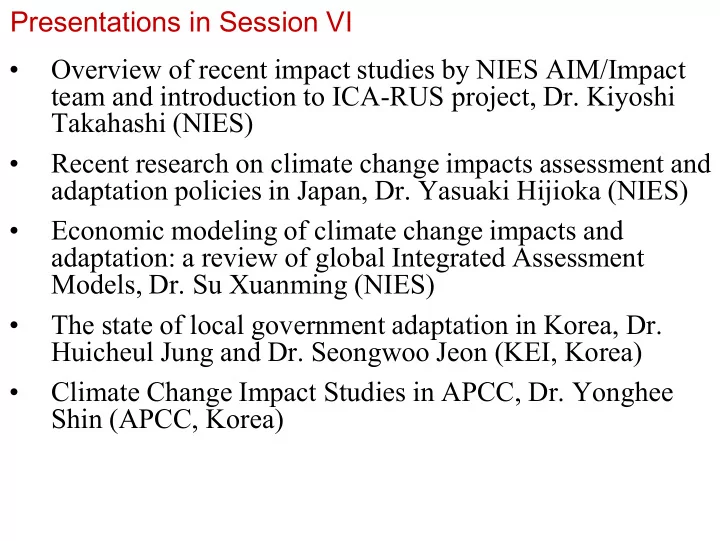
  • Overview of recent impact studies by NIES AIM/Impact

team and introduction to ICA-RUS project, Dr. Kiyoshi Takahashi (NIES)

  • Recent research on climate change impacts assessment and

adaptation policies in Japan, Dr. Yasuaki Hijioka (NIES)

  • Economic modeling of climate change impacts and

adaptation: a review of global Integrated Assessment Models, Dr. Su Xuanming (NIES)

  • The state of local government adaptation in Korea, Dr.

Huicheul Jung and Dr. Seongwoo Jeon (KEI, Korea)

  • Climate Change Impact Studies in APCC, Dr. Yonghee

Shin (APCC, Korea) Presentations in Session VI

slide-2
SLIDE 2

Overview of recent impact studies by NIES AIM/Impact team and introduction to ICA-RUS project

Kiyoshi Takahashi, Hideo Harasawa, Yasuaki Hijioka, Naota Hanasaki, Yoshimitsu Masaki, Yuko Onishi, Xuanming Su, Akemi Tanaka

The 19th AIM workshop 13-14 Dec 2013: Tsukuba

slide-3
SLIDE 3
  • New team members and other internal transfer
  • Enhanced participation in international academic activities
  • Increase in the number of peer-reviewed papers
  • Revisit to the Impact Function approach
  • Analyses of climate change impacts at global scale utilizing the new

scenarios (CMIP5 based on RCPs and/or SSPs).

  • Adaptation analyses at global scale
  • Contribution to the development process of Japanese National

Adaptation Plan

News and Noteworthy Activities

slide-4
SLIDE 4
  • New team members and other internal transfer
  • Enhanced participation in international academic activities
  • Increase in the number of peer-reviewed papers
  • Revisit to the Impact Function approach
  • Analyses of climate change impacts at global scale utilizing the new

scenarios (CMIP5 based on RCPs and/or SSPs).

  • Adaptation analyses at global scale
  • Contribution to the development process of Japanese National

Adaptation Plan

News and Noteworthy Activities

slide-5
SLIDE 5
  • Dr. Hideo Harasawa, Vice president of NIES, Integrated assessment
  • Dr. Yasuaki Hijioka, National-scale integrated impact assessment
  • Dr. Yuko Onishi, National-scale impact assessment (Vegetation)
  • Dr. Naota Hanasaki, Global-scale impact assessment (Water)
  • Dr. Yoshimitsu Masaki, Global-scale impact assessment (Water)
  • Dr. Kiyoshi Takahashi, Global-scale integrated impact assessment
  • Dr. Xuanming Su, Integrated assessment model for adaptation analyses
  • Ms. Akemi Tanaka, Global-scale impact assessment (Agriculture)
  • Collaborators:

– Ex-members: Dr. Yuji Masutomi, Dr. Huicheul Jung, Dr. Yonghee Shin, Dr. Takahiro Yamamoto – In NIES: Dr. Tomoko Hasegawa, Dr. Shinichiro Fujimori and other emission team members

NIES Climate change impact modeling team in 2013

slide-6
SLIDE 6
  • New team members and other internal transfer
  • Enhanced participation in international academic activities
  • Increase in the number of peer-reviewed papers
  • Revisit to the Impact Function approach
  • Analyses of climate change impacts at global scale utilizing the new

scenarios (CMIP5 based on RCPs and/or SSPs).

  • Adaptation analyses at global scale
  • Contribution to the development process of Japanese National

Adaptation Plan

News and Noteworthy Activities

slide-7
SLIDE 7

NIES Climate Change Research Program

  • Project 2: Climate change and global risk assessment [Takahashi,

Hijioka, Hanasaki, Masaki, Su, Tanaka; 2011.4-2016.3] The Environment Research & Technology Development Fund (ERTDF) funded by the MoE, Japan

  • S-10: Integrated research on the development of global climate risk

management Strategies [Takahashi, Hanasaki, Hijioka, Su, Tanaka; 2012.4-2017.3]

  • S-8: Comprehensive research on climate change impact assessment

and adaptation policies [Harasawa, Hijioka, Hanasaki, Takahashi; 2009.4-2014.3] – Assessment of climate change impacts in Japan considering feasibility of realizing a safe and secure climate change adaptive society

Ongoing Research Projects on Impacts and Adaptation

slide-8
SLIDE 8

Grants-in-Aid for Scientific Research funded by Japan Society for Promotion of Science

  • Detecting drought and flood risks by real time simulation using a global

water resources model [Hanasaki]

  • Initiative of global water sustainability risk assessment using integrated

hydrological and water resources model [Hanasaki] Science and Technology Research Partnership for Sustainable Development (SATREPS) funded by the Japan Science and Technology Agency (JST) and the Japan International Cooperation Agency (JICA)

  • Integrated study on hydro-Meteorological Prediction and Adaptation to

Climate change in Thailand [Hanasaki] Core Research for Evolutional Science and Technology (CREST)

  • Development of long term vision for sustainable water use of the world

process [Hanasaki]

Ongoing Research Projects on Water Resource

slide-9
SLIDE 9
  • Agricultural Model Inter-comparison and Improvement Project

(AgMIP) [Fujimori, Hasegawa, Masui, Takahashi]

  • Inter-Sectoral Impact Model Intercomparison Project (ISI-MIP)

[Hanasaki, Masaki]

  • Impacts and Risks from High-End Scenarios: Strategies for

Innovative Solutions (IMPRESSIONS) [Takahashi, Hanasaki, Masui]

  • IPCC

– AR5 (WGII)

  • LA of Ch. 19 (Emergent risks and key vulnerabilities)

[Takahashi]

  • CLA and CS of Ch. 24 (Asia) [Hijioka and Onishi]

Contribution to International Academic Activities

slide-10
SLIDE 10
  • New team members and other internal transfer
  • Enhanced participation in international academic activities
  • Increase in the number of peer-reviewed papers
  • Revisit to the Impact Function approach
  • Analyses of climate change impacts at global scale utilizing the new

scenarios (CMIP5 based on RCPs and/or SSPs).

  • Adaptation analyses at global scale
  • Contribution to the development process of Japanese National

Adaptation Plan

News and Noteworthy Activities

slide-11
SLIDE 11
  • Davie, J. C. S., P. D. Falloon, R. Kahana, R. Dankers, R. Betts, F. T. Portmann, D. Wisser, D. B. Clark, A. Ito, Y. Masaki, K. Nishina, B. Fekete, Z. Tessler, Y. Wada,
  • X. Liu, Q. Tang, S. Hagemann, T. Stacke, R. Pavlick, S. Schaphoff, S. N. Gosling, W. Franssen and N. Arnell, 2013, Comparing projections of future changes in runoff

from hydrological and biome models in ISI-MIP, Earth System Dynamics, 4, 359--374, doi:10.5194/esd-4-359-2013

  • Davie, J. C. S., P. D. Falloon, R. Kahana, R. Dankers, R. Betts, F. T. Portmann, D. B. Clark, A. Itoh, Y. Masaki, K. Nishina, B. Fekete, Z. Tessler, X. Liu, Q. Tang, S.

Hagemann, T. Stacke, R. Pavlick, S. Schaphoff, S. N. Gosling, W. Franssen, N. Arnell, 2013, Comparing projections of future changes in runoff from hydrological and ecosystem models in ISI-MIP for the “aggressive mitigation” scenario RCP2.6, compared with the high-end scenario RCP8.5, Impacts World 2013 Conference Proceedings, Potsdam Institute for Climate Impact Research, pp: 350--361, DOI: 10.2312/pik.2013.001

  • Flörke, M., S. Eisner, N. Hanasaki, Y. Masaki, Y. Wada and M. Bierkens, 2013, A multi-model ensemble for identifying future water stress hotspots, Impacts World

2013 Conference Proceedings, Potsdam Institute for Climate Impact Research, pp: 254--260, DOI: 10.2312/pik.2013.001

  • Hagemann, S., Chen, C., Clark, D. B., Folwell, S., Gosling, S. N., Haddeland, I., Hanasaki, N., Heinke, J., Ludwig, F., Voss, F., and Wiltshire, A. J.: Climate change

impact on available water resources obtained using multiple global climate and hydrology models, Earth Syst. Dynam., 4, 129-144, 10.5194/esd-4-129-2013, 2013.

  • Hanasaki, N., S. Fujimori, T. Yamamoto, S. Yoshikawa, Y. Masaki, Y. Hijioka, M. Kainuma, Y. Kanamori, T. Masui, K. Takahashi and S. Kanae, 2013, A global

water scarcity assessment under Shared Socio-economic Pathways – Part 1: Water use, Hydrology and Earth System Sciences, 17, 2375–2391, DOI: 10.5194/hess-17- 2375-2013

  • Hanasaki, N., S. Fujimori, T. Yamamoto, S. Yoshikawa, Y. Masaki, Y. Hijioka, M. Kainuma, Y. Kanamori, T. Masui, K. Takahashi and S. Kanae, 2013, A global

water scarcity assessment under Shared Socio-economic Pathways – Part 2: Water availability and scarcity, Hydrology and Earth System Sciences, 17, 2393–2413, DOI: 10.5194/hess-17-2393-2013

  • Hanasaki, N., Y. Masaki and T. Yamamoto, 2013, Adaptation measures for the impact of climate change on global water resources— Option 2: Adding storage

capacity, Impacts World 2013 Conference Proceedings, Potsdam Institute for Climate Impact Research, pp: 433--437, DOI: 10.2312/pik.2013.001

  • Honda Y, Kondo M, McGregor G, Kim H, Guo YL, Hijioka Y, Yoshikawa M, Oka K, Takano S, Hales S, Kovats RS. (2013) Heat-related mortality risk model for

climate change impact projection. Environ Health Prev Med. 2013

  • Konar, M., Hussein, Z., Hanasaki, N., Mauzerall, D. L., and Rodriguez-Iturbe, I.: Virtual water trade flows and savings under climate change, Hydrol. Earth Syst. Sci.,

17, 3219-3234, 10.5194/hess-17-3219-2013, 2013.

  • Kurane, I., Shibasaki, K., Kotaki, A., Hijioka, Y. and Takasaki, T. (2013) The Effect of Precipitation on the Transmission of Japanese Encephalitis (JE) Virus in Nature:

A Complex Effect on Antibody-Positive Rate to JE Virus in Sentinel Pigs. Int. J. Environ. Res. Public Health 2013, 10, 1831-1844; doi:10.3390/ijerph10051831

  • Masaki, Y. and N. Hanasaki, 2013, Adaptation measures for the impact of climate change on global water resources— Option 1: Reducing water use, Impacts World

2013 Conference Proceedings, Potsdam Institute for Climate Impact Research, pp: 516--521, DOI: 10.2312/pik.2013.001

  • Mateo, C. M. R., Hanasaki, N., Komori, D., Yoshimura, K., Kiguchi, M., Champathong, A., Yamazaki, D., Sukhapunnaphan, T., and Oki, T.: A simulation study on

modifying reservoir operation rules: tradeoffs between flood mitigation and water supply, IAHS Publication, 362, 33-40, 2013.

  • Ogawa-Onishi, Y., Berry, P.M., 2013. Ecological impacts of climate change in Japan: The importance of integrating local and international publications. Biological

Conservation, Vol.157, p.361-371.

  • van Huijgevoort, M. H. J., Hazenberg, P., van Lanen, H. A. J., Teuling, A. J., Clark, D. B., Folwell, S., Gosling, S. N., Hanasaki, N., Heinke, J., Koirala, S., Stacke, T.,

Voss, F., Sheffield, J., and Uijlenhoet, R.: Global Multimodel Analysis of Drought in Runoff for the Second Half of the Twentieth Century, J. Hydromet., 14, 1535- 1552, 10.1175/jhm-d-12-0186.1, 2013.

  • Wada, Y., Wisser, D., Eisner, S., Flörke, M., Gerten, D., Haddeland, I., Hanasaki, N., Masaki, Y., Portmann, F. T., Stacke, T., Tessler, Z., and Schewe, J.: Multi-model

projections and uncertainties of irrigation water demand under climate change, Geophys. Res. Lett., 40, 4626-4632, 10.1002/grl.50686, 2013.

  • Other 10 or more publications in Japanese

Publications (Refereed; Published in 2013)

slide-12
SLIDE 12
  • Dankers, R., N. W. Arnell, D. B. Clark, P. D. Falloon, B. M. Fekete, S. N. Gosling, J. Heinke, H. Kim, Y. Masaki, Y. Satoh, T. Stacke, Y. Wada and D. Wisser, XXXX,

A first look at changes in flood hazard in the ISI-MIP ensemble, Proceedings of the National Academy of Sciences of the United States of America, (accepted)

  • Elliott J., D. Deryng, C. Müller, K. Frieler, M. Konzmann, D. Gerten, M. Glotter, M. Flörke, Y. Wada, N. Best, S. Eisner, B. M. Fekete, C. Folberth, I. Foster, S. N.

Gosling, I. Haddeland, N. Khabarov, F. Ludwig, Y. Masaki, S. Olin, C. Rosenzweig, A. C. Ruane, Y. Satoh, E. Schmid, T. Stacke, Q. Tang and D. Wisser, XXXX, Constraints and potentials of future irrigation water availability on agricultural production under climate change, Proceedings of the National Academy of Sciences of the United States of America, (accepted)

  • Haddeland, I., J. Heinke, H. Biemans, S. Eisner, M. Flörke, N. Hanasaki, M. Konzmann, F. Ludwig, Y. Masaki, J. Schewe, T. Stacke, Z. D. Tessler, Y. Wada and D.

Wisser, XXXX, Global water resources affected by human interventions and climate change, Proceedings of the National Academy of Sciences of the United States of America, (accepted)

  • Hasegawa, T., Fujimori, S., Shin, Y., Takahashi, K., Masui, T., Tanaka, A. (XXXX) Climate Change Impact and Adaptation Assessment on Food Consumption

Utilizing a New Scenario Framework. Environmental Science and Technology, in press.

  • Ishizaki Y., Yokohata T., Emori S., Shiogama H., Takahashi K, Nakaegawa T., Hanasaki N., Nozawa T., Ogura T., Yoshimori M. (2013) Verification of a pattern

scaling approach for determining the maximum available renewable freshwater resource, Journal of Hydrometeorology, in press

  • Ishizaki Y., Shiogama H., Emori S., Yokohata T., Nozawa T., Takahashi K., Ogura T., Yoshimori M. Nagashima T. (2013) Dependence of precipitation scaling

patterns on emission scenarios for representative concentration pathways. Journal of Climate, in press

  • Kundzewicz Z.W., Kanae S., Seneviratne S.I., Handmer J., Nicholls N., Peduzzi P., Mechler R., Bouwer L.M., Arnell N., Mach K., Muir-Wood R., Brakenridge G.R.,

Kron W., Benito G., Honda Y., Takahashi K., Sherstyukov B. (2013) Flood risk and climate change – global and regional perspectives. Hydrological Sciences Journal, in press

  • Nelson G.C., van der Mensbrugghe D., Blanc E., Calvin K., Hasegawa T., Havlik P., Kyle P., Lotze-Campen H., von Lampe M., Mason d'Croz D., van Meijl H., Muller

C., Reilly J., Robertson R., Sands R.D., Schmitz C., Tabeau A., Takahashi K., Valin H. (2013) Agriculture and Climate Change in Global Scenarios: Why Don't the Models Agree. Agricultual economics, in press

  • Piontek, F., C. Müller, T. A. M. Pugh, D. B. Clark, D. Deryng, J. Elliott, F. J. Colón-González, M. Flörke, C. Folberth, W. Franssen, K. Frieler, A. D. Friend, S. N.

Gosling, D. Hemming, N. Khabarov, H. Kim, M. R. Lomas, Y. Masaki, M. Mengel, A. Morse, K. Neumann, K. Nishina, S. Ostberg, R. Pavlick, A. C. Ruane, J. Schewe, E. Schmid, T. Stacke, Q. Tang, Z. Tessler, A. M. Tompkins, L. Warszawski, D. Wisser and H. J. Schellnhuber, XXXX, Leaving the world as we know it: Hotspots of global climate change impacts, Proceedings of the National Academy of Sciences of the United States of America, (accepted)

  • Prudhomme, C., I. Giuntoli, E. L. Robinson, D. B. Clark, N. W. Arnell, R. Dankers, B. Fekete, W. Franssen, D. Gerten, S. N. Gosling, S. Hagemann, D. M. Hannah, H.

Kim, Y. Masaki, Y. Satoh, T. Stacke, Y. Wada and D. Wisser, XXXX, Hydrological droughts in the 21st century: hotspots and uncertainties from a global multi-model ensemble experiment, Proceedings of the National Academy of Sciences of the United States of America, (accepted)

  • Schewe, J., J. Heinke, D. Gerten, I. Haddeland, N. W. Arnell, D. B. Clark, R. Dankers, S. Eisner, B. Fekete, F. J. Colón-González, S. N. Gosling, H. Kim, X. Liu, Y.

Masaki, F. T. Portmann, Y. Satoh, T. Stacke, Q. Tang, Y. Wada, D. Wisser, T. Albrecht, K. Frieler, F. Piontek, L. Warszawski and P. Kabat, XXXX, Multi-model assessment of water scarcity under climate change, Proceedings of the National Academy of Sciences of the United States of America, (accepted)

  • Shen, Y., Oki, T., Kanae, S., Hanasaki, N., Utsumi, N., and Kiguchi, M.: Projection of future world water resources under SRES scenarios: An integrated assessment,
  • Hydrolog. Sci. J., 10.1080/02626667.2013.862338, 2013, accepted.

Publications (Refereed; Accepted/in press)
slide-13
SLIDE 13
  • New team members and other internal transfer
  • Enhanced participation in international academic activities
  • Increase in the number of peer-reviewed papers
  • Revisit to the Impact Function approach
  • Analyses of climate change impacts at global scale utilizing the new

scenarios (CMIP5 based on RCPs and/or SSPs).

  • Adaptation analyses at global scale
  • Contribution to the development process of Japanese National

Adaptation Plan

News and Noteworthy Activities

slide-14
SLIDE 14
  • The impact function is a look-up-table of country-averaged results of

sensitivity analyses using a process-based detailed model.

  • We developed an impact function for maize, wheat, and paddy-rice

productivity with two explanatory variables, change in annual mean temperature (ΔT) and change in annual mean precipitation (ΔP), using the M-GAEZ model. the M GAEZ model.

Base period: 1961-1990

percentage of productivity [%] against base period

Impact Function development in AIM/Impact [Policy] (An example of Impact Function for crop productivity)

Tanaka et al. (to be submitted)

slide-15
SLIDE 15
  • New team members and other internal transfer
  • Enhanced participation in international academic activities
  • Increase in the number of peer-reviewed papers
  • Revisit to the Impact Function approach
  • Analyses of climate change impacts utilizing the new scenarios

(CMIP5 based on RCPs and/or SSPs).

  • Adaptation analyses at global scale
  • Contribution to the development process of Japanese National

Adaptation Plan

News and Noteworthy Activities

slide-16
SLIDE 16

SSP

  • SSP is a global socio-economic scenario, the

successor of SRES. Five different views of the world are depicted.

  • SSP doesn’t include scenarios on water. We

developed a compatible water use scenario. We also developed a scenario matrix of SSP and RCP. We analyzed the results with/without climate policy.

Global water scarcity assessment

Hanasaki et al. 2013a,b, Hydrology and Earth System Sciences

slide-17
SLIDE 17

Water resources assessment

  • Water availability and use was simulated at

daily interval, at spatial resolution of 0.5 deg x 0.5 deg.

  • A new index was used to evaluate whether

water is available when it is needed. Hanasaki et al. 2013a,b, Hydrology and Earth System Sciences

  • Ten sets of comprehensive global water scenarios have been developed.

2041-2070, difference from present

Water stressed pop. climate policy

SSP1 no policy with policy SSP2 no policy with policy SSP3 no policy with policy SSP4 no policy with policy SSP5 no policy with policy

Global water scarcity assessment

slide-18
SLIDE 18

Water resources assessment

  • Water availability and use was simulated at

daily interval, at spatial resolution of 0.5 deg x 0.5 deg.

  • A new index was used to evaluate whether

water is available when it is needed. Hanasaki et al. 2013a,b, Hydrology and Earth System Sciences

  • Ten sets of comprehensive global water scenarios have been developed.

2041-2070, difference from present

Water stressed pop. SSP1 no policy with policy SSP2 no policy with policy SSP3 no policy with policy SSP4 no policy with policy SSP5 no policy with policy SSP1 no policy

  • licy

with policy with policy SSP4 no policy

  • licy with policy

SSP5 no policy SSP5 no policy

  • licy with policy

Worst scenario (Red)

  • Low technological change and low

environmental consciousness

  • High birth rate and low income
  • Water stress heavily increases (stressed

population triples at the end of 21C)

Water resources assessment

  • Water availability and use was simulated at

daily interval, at spatial resolution of 0.5 deg x 0.5 deg.

  • A new index was used to evaluate whether

water is available when it is needed. Best scenario (Blue)

  • Sustainable society
  • Efficient climate policy
  • Water stress stabilizes except Africa

BAU scenario (Green)

  • Middle of the road
  • Moderate climate policy
  • Water stress increases (stressed population

doubles at the end of 21C)

Global water scarcity assessment

slide-19
SLIDE 19
  • Annual-mean discharge will

change, but…

– Seasonal pattern will also change – Inhomogeneous changes are seen within the same river basin

  • Problems: how to perceive

future impacts on flow regimes at a global scale?

– Hydrographs and flow-duration curves are suitable for ONE site – A scalar quantity is favorable Introducing an index expressing seasonal distribution of river discharge

Change in index of river flow regimes

  • Gini coefficient (variability) G

– Originally used in evaluating inequalities among household incomes in economics

  • Lorenz asymmetry coefficient

(inequality) S

Large var.

RCP2.6

Increase var. Decrease var.

RCP8.5 historical

Global distributions of (a) Gini coefficient of historical (1960-1989) data and future changes in Gini coefficient under (b) RCP 2.6 and (c) RCP 8.5 climate scenarios for 2070-2099 with respect to the historical values.

Masaki et al. Global-scale analysis on future changes in flow regimes using Gini and Lorenz asymmetry coefficients (under review)

slide-20
SLIDE 20

Population at risk of hunger

Hasegawa et al: Climate Change Impact and Adaptation Assessment on Food Consumption Utilizing a New Scenario

  • Framework. Environmental Science and Technology, in press.
slide-21
SLIDE 21

Aim: To investigate spatial variability of phenological responses within species To project phenological changes in the 21st century under climate change scenarios Data: Phenology observation (1961-2008)

  • Flowering
  • Budding

Climate model outputs Method: Generalised Additive Mixed Models (GAMM) Phenology=s(SprT)+s(WinT)+RanEf SprT: Spring temperature WinT: Winter temperature RanEf: Random Effects Results (e.g. 4 species by MIROC):

Spatial variability in phenological responses to climate change in the 21st century

Onishi et al. (to be submitted soon)

slide-22
SLIDE 22
  • New team members and other internal transfer
  • Enhanced participation in international academic activities
  • Increase in the number of peer-reviewed papers
  • Revisit to the Impact Function approach
  • Analyses of climate change impacts at global scale utilizing the new

scenarios (CMIP5 based on RCPs and/or SSPs).

  • Adaptation analyses at global scale
  • Contribution to the development process of Japanese National

Adaptation Plan

News and Noteworthy Activities

slide-23
SLIDE 23

NIES Climate Change Research Program

  • Project 2: Climate change and global risk assessment [Takahashi,

Hijioka, Hanasaki, Masaki, Su, Tanaka; 2011.4-2016.3] The Environment Research & Technology Development Fund (ERTDF) funded by the MoE, Japan

  • S-10: Integrated research on the development of global climate risk

management Strategies [Takahashi, Hanasaki, Hijioka, Su, Tanaka; 2012.4-2017.3]

  • S-8: Comprehensive research on climate change impact assessment

and adaptation policies [Harasawa, Hijioka, Hanasaki, Takahashi; 2009.4-2014.3] – Assessment of climate change impacts in Japan considering feasibility of realizing a safe and secure climate change adaptive society

Ongoing Research Projects on Impacts and Adaptation

slide-24
SLIDE 24

ICA-RUS (FY2012-16)

Integrated Climate Assessment – Risks, Uncertainties and Society

  • Objective

– To propose strategies of global climate risk management

  • ‘Integration’ in ICA-RUS

– Coherent consideration of mitigation and adaptation for managing global climate risks

  • Risk management in ICA-RUS

– Comprehensive assessment of climate change risks – Explicit consideration of uncertainties – Consideration of every possible

  • ptions
slide-25
SLIDE 25

25

Research system of ICA-RUS project

slide-26
SLIDE 26
  • End-to-end scenario analyses

– Sector risk analyses using full- scale impact model based on limited number of mitigation scenarios [Theme 2 and Theme 3] – Exploration of policies to achieve the assumed mitigation scenarios in the sector risk analyses. [Theme 4]

  • Integrated analyses tool

– Development of ‘Impact Functions’ for each sector impact [Theme 2 and 3] – Probabilistic analyses of multi- sector climate risks [Theme 1] – Mitigation policy analyses [Theme 4]

26

2 way approach for quantitative analysis of risk management strategies in ICA-RUS project

mm k g 人 mm k g person

$ $ $

Analyzed common scenarios Sector impact models Sector risks Mitigation cost/Emission paths [Monetize] CMIP5(RCP)/SSP/SPA k g 人 k g

person 回 times

$ $

$

Various analyzed scenarios Mitigation cost/Emission paths Integrated analyses tool with Impact Functions Sector Impact Functions Aggregated economic impact function Aggregated economic risk CMIP5(RCP)/SSP/SPA

kg PDF perso PDF times PDF
slide-27
SLIDE 27
  • Title

– ICA-RUS/CCRP-PJ2 international workshop

  • Date and Place

– 4-6 December 2013 – Time 24 Building (Tokyo)

  • Presentation files will be publicly

available by the end of this month.

– http://www.nies.go.jp/ica-rus/workshop/program.html

ICA-RUS Report 2013 / ICA-RUS/CCRP-PJ2 international workshop

  • Annual report (English

version) was published at the end of October.

http://www.nies.go.jp/ica-rus/en/index.html

slide-28
SLIDE 28
  • New team members and other internal transfer
  • Enhanced participation in international academic activities
  • Increase in the number of peer-reviewed papers
  • Revisit to the Impact Function approach
  • Analyses of climate change impacts at global scale utilizing the new

scenarios (CMIP5 based on RCPs and/or SSPs).

  • Adaptation analyses at global scale
  • Contribution to the development process of Japanese National

Adaptation Plan

News and Noteworthy Activities