A Brief History of Physical Modeling Synthesis, Leading up to - - PowerPoint PPT Presentation

a brief history of physical modeling synthesis leading up
SMART_READER_LITE
LIVE PREVIEW

A Brief History of Physical Modeling Synthesis, Leading up to - - PowerPoint PPT Presentation

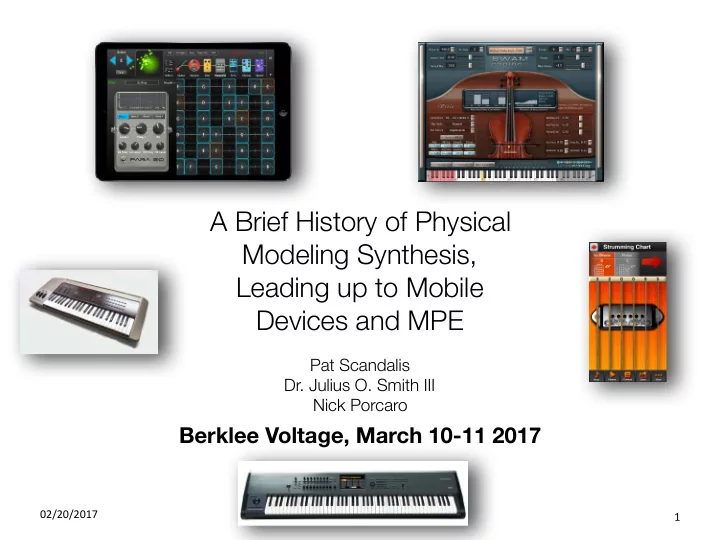
A Brief History of Physical Modeling Synthesis, Leading up to Mobile Devices and MPE Pat Scandalis Dr. Julius O. Smith III Nick Porcaro Berklee Voltage, March 10-11 2017 02/20/2017 1 Overview The story of physical modeling stretches


slide-1
SLIDE 1

02/20/2017

A Brief History of Physical Modeling Synthesis, Leading up to Mobile Devices and MPE

Pat Scandalis


  • Dr. Julius O. Smith III


Nick Porcaro

1
Berklee Voltage, March 10-11 2017

slide-2
SLIDE 2

02/20/2017

The Full Presentation Can Be Found at:

moforte.com/berklee-voltage-physical-modeling/ It’s also posted in the news section

  • f the moForte website

2

  • Demo
  • A few high points from the history
  • Questions, possibly from the FAQ

Overview

The story of physical modeling stretches back nearly 1000 years (yup)! We now find ourselves in a place where each of us can be Jimi Hendrix with just a small device in the palm of our hands. Its a fun and deeply technical topic drawing on many fields including physics, acoustics, digital signal processing and music.

slide-3
SLIDE 3

02/20/2017

Physical Modeling Was Poised to be the “Next Big Thing” in 1994 So What Happened?

3

slide-4
SLIDE 4

02/20/2017

For Context, what is Physical Modeling Synthesis?

  • Methods in which a sound is

generated using a mathematical model of the physical source of sound.

  • Any gestures that are used to

interact with a real physical system can be mapped to parameters yielded an interactive an expressive performance experience.

  • Physical modeling is a collection
  • f different techniques.

4

slide-5
SLIDE 5

02/20/2017

  • Chordaphones - Guitars
  • Aerophones - Woodwinds
  • Membranophones - Drums

5

  • Idiophones - Mallet Instruments
  • Electrophones - Virtual Analog
  • Game Sounds
  • Voice

Taxonomy of Modeling Areas


Hornbostel–Sachs Classification

slide-6
SLIDE 6

02/20/2017

First a Quick Demo!

6

Geo Shred Preview and Europa Demo Modeled Guitar Features and Demo Reel

slide-7
SLIDE 7

02/20/2017


 Brief (though not complete) History of Physical Modeling Synthesis

As well as a some commercial products using the technology

7

slide-8
SLIDE 8

02/20/2017

Early Mechanical Voice Synthesis

  • 1000 -1200 ce - Speech

Machines, Brazen Heads

  • 1791 - Wolfgang Von

Kempelin, speaking machine.

  • 1857 - Joseph Faber,

Euphonia (pictured)

8

Its been know for a long time that the vocal tract can be modeled with a bellows, a reed, a number of different size resonators and special elements for the tongue, the mouth. See Exploratorium Vocal Vowels.

slide-9
SLIDE 9

02/20/2017

The Voder (1937-39) - Homer Dudley

  • Analog Electronic

Speech Synthesis

  • Analog model of the

vocal tract

  • Develop from

research on voice compression at Bell Labs.

  • Featured at the 1939

Worlds fair

  • YouTube

9

slide-10
SLIDE 10

02/20/2017

Kelly-Lochbaum Vocal Tract Model (1961)

10

slide-11
SLIDE 11

02/20/2017

Daisy Bell (1961)

  • Daisy Bell (MP3)
  • Vocal part by Kelly and Lochbaum (1961)
  • Musical accompaniment by Max Mathews
  • Computed on an IBM 704
  • Based on Russian speech-vowel data from

Gunnar Fant’s book

  • Probably the first digital physical-modeling

synthesis sound example by any method

  • Inspired Arthur C. Clarke to adapt it for “2001:

A Space Odyssey” the Hal 9000’s “first song”

11

slide-12
SLIDE 12

02/20/2017

Karplus-Strong (KS) Algorithm (1983)

12

  • Discovered (1978) as “self-modifying wavetable synthesis”
  • Wavetable is preferably initialized with random numbers
  • Licensed to Mattel
  • The first musical use of the algorithm was in the work “May All

Your Children Be Acrobats” written in 1981 by David A. Jaffe. (MP3)

slide-13
SLIDE 13

02/20/2017

EKS Algorithm (Jaffe-Smith 1983)

13

  • Musical Example “Silicon Valley Breakdown” (Jaffe 1992) (MP3)
  • Musical Example BWV-1041 (used to intro the NeXT machine 1988) YouTube
slide-14
SLIDE 14

02/20/2017

Digital Waveguide Models (Smith 1985)

  • Equivalent to d'Alembert's Solution to the Partial Differential Equation for a

string (1747)

  • Useful for efficient models of

– Strings – Bores – plane waves – conical waves

14

slide-15
SLIDE 15

02/20/2017

Sheila Vocal Track Modeling (Cook 1990)

15

Perry Cook’s SPASM "Singing Physical Articulatory Synthesis Model”

  • Diphones: (MP3)
  • Nasals: (MP3)
  • Scales: (MP3)
  • “Sheila”: (MP3)
slide-16
SLIDE 16

02/20/2017 16

Commuted Synthesis (Smith) (1994)

slide-17
SLIDE 17

02/20/2017 17

  • Electric guitar, different pickups and bodies (Sondius)

(MP3)

  • Mandolin (STK) (MP3)
  • Classical Guitar (Mikael Laurson, Cumhur Erkut, and

Vesa Välimäki) (MP3)

  • Bass (Sondius) (MP3)
  • Upright Bass (Sondius) (MP3)
  • Cello (Sondius) (MP3)
  • Piano (Sondius) (MP3)
  • Harpsichord (Sondius) (MP3)

Commuted Synthesis Examples

slide-18
SLIDE 18

02/20/2017

Yamaha VL Line (1994)

  • Yamaha Licensed “Digital Waveguide

Synthesis” for use in its products including the VL line (VL-1, VL-1m, VL-70m, EX-5, EX-7, chip sets, sound cards, soft-synth drivers)

  • Shakuhachi: (MP3)
  • Oboe and Bassoon: (MP3)
  • Tenor Saxophone: (MP3)

18

slide-19
SLIDE 19

02/20/2017

Korg SynthKit Line (1994)

  • SynthKit (1994)
  • Prophecy (1995)
  • Trinity (1995)
  • OASYS PCI (1999)
  • OASYS (2005)
  • Kronos (2011)

19

slide-20
SLIDE 20

02/20/2017

“The Next Big Thing” (1994)

20

The Next Big Thing 2/94 The History of PM 9/94

slide-21
SLIDE 21

02/20/2017

Stanford Sondius Project (1994-1997)

  • Stanford OTL/CCRMA created the Sondius

project to assist with commercializing physical modeling technologies.

  • The result was a modeling tool known as

SynthBuilder, and a set of models covering about two thirds of the General MIDI set.

  • Many modeling techniques were used including

EKS, Waveguide, Commuted Synthesis, Coupled Mode Synthesis, Virtual Analog.

21

slide-22
SLIDE 22

02/20/2017

SynthBuilder (Porcaro, et al) (1995)

  • SynthBuilder was a user-

extensible, object-oriented, NEXTSTEP Music Kit application for interactive real-time design and performance of synthesizer patches, especially physical models.

  • Patches were represented

by networks consisting of digital signal processing elements called unit generators and MIDI event elements called note filters and note generators.

22

slide-23
SLIDE 23

02/20/2017

STK (1995)

  • Synthesis Tool Kit (STK) by Perry Cook, Gary Scavone,

et al. distributed by CCRMA

  • The Synthesis Toolkit (STK) is an open source API for real

time audio synthesis with an emphasis on classes to facilitate the development of physical modeling synthesizers.

  • Versions of the STK instrument classes have been

integrated into ChucK, Csound, Real-Time Cmix, Max/ MSP (as part of PeRColate), SuperCollider and FAUST.

  • Pluck example (MP3)
  • STK Clarinet (MP3)

23

slide-24
SLIDE 24

02/20/2017

  • Opcodes for a number of PM algorithms
  • Plucks,
  • Waveguide,
  • Woodwinds,
  • Brass,
  • Bowed
  • Bars
  • Flute

24

slide-25
SLIDE 25

02/20/2017

The Frankenstein Box (1996)

  • The Frankenstein box was

an 8 DSP 56k compute farm build by Bill Putnam and Tim Stilson

  • There was also a single

card version know as the “Cocktail Frank”

  • Used for running models

developed with SynthBuilder

  • The distortion guitar ran on

6 DSPs with an additional 2 DSPs used for outboard effects.

25

slide-26
SLIDE 26

02/20/2017

The Sondius Electric Guitar (1996)

  • Pick model for different guitars/pickups (commuted synthesis, Scandalis)
  • Feedback and distortion with amp distance (Sullivan)
  • Wah-wah based on cry baby measurements (Putnam, Stilson)
  • Reverb and flanger (Dattorro)
  • Hybrid allpass delay line for pitchBend (Van Duyne, Jaffe, Scandalis)
  • Performed using a 6-channel MIDI guitar controller.
  • With no effects, 6 strings ran at 22k on a 72 Mhz Motorola 56002 DSP

.

  • Waveguide Guitar Distortion, Amplifier Feedback (MP3)

26

slide-27
SLIDE 27

02/20/2017

Sondius Sound Examples (1996)

  • Waveguide Flute Model (MP3)
  • Waveguide Guitar Model, Different Pickups (MP3)
  • Waveguide Guitar Distortion, Amplifier Feedback (MP3)
  • Waveguide Guitar Model, Wah-wah (MP3)
  • Waveguide Guitar Model, Jazz Guitar (ES-175) (MP3)
  • Harpsichord Model (MP3)
  • Tibetan Bell Model (MP3)
  • Wind Chime Model (MP3)
  • Tubular Bells Model (MP3)
  • Percussion Ensemble (MP3)
  • Taiko Ensemble (MP3)
  • Bass (MP3)
  • Upright Bass (MP3)
  • Cello (MP3)
  • Piano (MP3)
  • Harpsichord (MP3)
  • Virtual Analog (MP3)

27

slide-28
SLIDE 28

02/20/2017

Coupled Mode Synthesis (CMS) 
 (Van Duyne) (1996)

  • Modeling of percussion sounds
  • Modal technique with coupling
  • Tibetan Bell Model (MP3)
  • Wind Chime Model (MP3)
  • Tubular Bells Model (MP3)
  • Percussion Ensemble (MP3)

28

slide-29
SLIDE 29

02/20/2017

Virtual Analog (Stilson-Smith) (1996)

  • Alias-Free Digital Synthesis of Classic Analog

Waveforms

  • Digital implementation of the Moog VCF. Four

identical one-poles in series with a feedback loop.

  • Sounds great! (MP3) (youTube)

29

slide-30
SLIDE 30

02/20/2017

Seer Systems “Reality” (1997)

  • Stanley Jungleib, Dave Smith (MIDI, Sequential

Circuits)

  • Ring-0 SW MIDI synth. Native Signal Processing.
  • Offered a number of Sondius Models.

30

slide-31
SLIDE 31

02/20/2017

Aureal ASP 301 Chip (1995-1997)

  • Targeted for Sound Cards
  • Hardware implementation of Digital

Waveguide

  • A version of the electric guitar ran on this chip

31

slide-32
SLIDE 32

02/20/2017

Staccato SynthCore (1999)

  • Staccato Systems spun out of Sondius in 1997 to

commercialize Physical Modeling technologies.

  • SynthCore was a ring-0 synthesis driver that supported both

DLS (Down Loadable Sounds) and Staccato’s proprietary Down Loadable Algorithms (DLAs). It was distributed in two forms.

  • Packaged as a ring-0 “MIDI driver”, SynthCore could replace

the wavetable chip on a sound card, as a software based XG-lite/DLS audio solution (SynthCore-OEM) (SigmaTel, ADI)

  • Packaged as a DLL/COM service, SynthCore could be

integrated into game titles so that games could make use of interactive audio algorithms (race car, car crashes, light sabers) (SynthCore-SDK) (Electronic Arts, Lucas Arts…)

32

slide-33
SLIDE 33

02/20/2017

SynthCore Game Models (2000)

33

  • Jet (Stilson) (MP3)
  • Race Car (Cascone, et al) (MP3)
  • Example models from Staccato ~1999 (windows only)
slide-34
SLIDE 34

02/20/2017

SynthCore Wavetable Chip Replacement

  • About half of the General MIDI set was implemented with

physical models though few existing MIDI scores could make use of the expression parameters.

  • Staccato was purchased by Analog Devices in 2000. ADI

combined Staccato’s ring-0 software based XG-lite/DLS MIDI synth with a low cost AC97 codec and transformed the PC audio market from sound cards to built-in audio.

34

slide-35
SLIDE 35

02/20/2017

Smule Magic Fiddle (2010)

35

Smule | Magic Fiddle for iPad [St. Lawrence String Quartet] (youTube)

slide-36
SLIDE 36

02/20/2017

Faust-STK (2011)

  • FAUST [Functional Audio Stream] is a

synchronous functional programming language specifically designed for real- time signal processing and synthesis.

  • The FAUST compiler translates DSP

specifications into equivalent C++ programs, taking care of generating efficient code.

  • The FAUST-STK is a set of virtual

musical instruments written in the FAUST programming language and based on waveguide algorithms and on modal

  • synthesis. Most of them were inspired by

instruments implemented in the Synthesis ToolKit (STK) and the program SynthBuilder.

36

slide-37
SLIDE 37

02/20/2017

Sample Modeling Swam Engine

Bowed Strings and Reeds

37

  • YouTube
slide-38
SLIDE 38

02/20/2017

Compute for String Models Over Time

  • NeXT Machine (1992)

– Motorola DSP56001 25MHz 128k dram, 22k sample rate

  • 6 plucks
  • r 2-4 Guitar Strings
  • Frankenstein, Cocktail Frank (1996)

– Motorola DSP56301 72MHz 128k dram, 22k sample rate

  • 6 guitar strings, feedback and distortion,
  • Reverb, wah-wah, flange running on a additional DSPs
  • Staccato (1999)

– 500MHz Pentium, native signal processing, 22k sample rate – 6 strings, feedback and distortion used around 80% cpu

  • iPhone 4S (2013)

– 800 MHz A5, 44k sample rate – 6 strings, feedback and distortion use around 40% cpu

  • iPad Air 2 (2014)

– 1.5 GHz A8X, 44k sample rate

– 6 strings, feedback and distortion use around 22% cpu


  • iPad Pro (2015)

– 2.2 GHz ARMv8-A, 44k sample rate

– 6 strings, feedback and distortion use around 13% cpu

38

slide-39
SLIDE 39

02/20/2017

Physical Modeling Was Poised to be the “Next Big Thing” in 1994 So What Happened?

  • Expressivity was not the only factor

driving PM.

  • By 1994, FM was the standard for PC

Game Music, in part due to it’s small memory footprint.

  • PM was seen as the successor to FM.
  • However by 1997 memory was cheap

and sampling became common.

  • Further, voicing PM is difficult, voicing

samples is more direct.

39

slide-40
SLIDE 40

02/20/2017

So Why is PM Back!

  • Ubiquitous handheld mobile

computing devices are packed with sensors that are great for parametrically controlled, physically modeled, virtual musical instruments.

  • There is a new generation of

MIDI Polyphonic Expression (MPE) controllers

40

slide-41
SLIDE 41

02/20/2017

And What About the Future?

  • Many different types of

expressive “traditional” instruments will become available.

  • Lots of possibilities with

hybrid PM and Sampling.

  • New types expressive
  • instruments. Expressivity

in many new forms.

41

slide-42
SLIDE 42

02/20/2017

Thanks!

  • Mary Albertson
  • Chris Chafe
  • John Chowning
  • Perry Cook
  • Jon Dattorro
  • David Jaffe
  • Joe Koepnick
  • Scott Levine
  • Fernando Lopez-Lezcano
  • Stanford OTL
  • Danny Petkevich
  • Nick Porcaro
  • Bill Putnam
  • Kent Sandvik
  • Gregory Pat Scandalis
  • Julius Smith
  • Tim Stilson
  • David Van Brink
  • Scott Van Duyne
  • Stanford CCRMA
  • Romain Michon
  • Yamaha
  • Korg

42

and CCRMA

slide-43
SLIDE 43

02/20/2017

About Pat…

  • 34 years in the Silicon Valley as

an Engineer

  • Built my first monophonic

electronic instrument in 1970 from a Radio Shack kit.

  • Gigged with an Arp Avatar guitar

synth (1978)

  • Computer Modeling of strings

and membranes (1981)

  • Researcher in Physical Modeling

at Stanford/CCRMA (1994)

  • CEO/CTO of moForte

43

slide-44
SLIDE 44

02/20/2017

Technology FAQs

44

slide-45
SLIDE 45

02/20/2017

Disrupting the Uncanny Valley

  • Aiming toward “Suspension of Disbelief”.
  • Use modeling to get close to the real

physical sound generation experience.

  • Sometimes “go over the top”. Its expressive

and fun!

  • Use statistical variances to disrupt repetitive

performance.

45

slide-46
SLIDE 46

02/20/2017

Controls With Statistical Variance

  • velocity
  • pickPosition
  • brightness
  • t60
  • keyNum
  • strumSeparationTime
  • strumVariation (in auto strum mode)

46

DEMO: Strum Variations

slide-47
SLIDE 47

02/20/2017

So what about Android?

  • The Latency Situation with Android has

improved.

  • At the moment a small percentage of

Android Devices support “Low Latency Audio”.

  • This will certainly improve over time.

47

slide-48
SLIDE 48

02/20/2017

Can users jam together across the internet? (1 of 2)

  • moForte has investigated this area but is NOT currently working on

creating a platform for jamming across the internet. 


  • Latency is a significant issue.

– see http://en.wikipedia.org/wiki/Latency_(audio) 


  • The shared performance experience is particularly sensitive to

perceived latency. Within the MI (Musical Instrument) industry its a rule of thumb that if key->sound latency is much larger than 11ms, the performer will need to "play ahead" leading to a performance that is “loose”, error prone and even frustrating. 


  • Audio latency facts:

– Audio Latency in air at sea level/room temp ~1ms/ft – Using the speed of light the fastest round trip around the earth is 135ms (vacuum) - 200ms (FO cable). – Real inter-network latencies can be much greater and more variable.

48

slide-49
SLIDE 49

02/20/2017

Can users jam together across the internet? (2 of 2)

  • Some types of performances are possible:

– Slow performances – Cascaded – Side by side (one player after the other) – Electrifying, tight duets, or real ensembles are less likely to work. 


  • For consumers an experience like a band jamming across the internet

is not likely be a good experience

49

  • In Flamenco music the interaction between two

players is referred to as Duende "It comes from inside as a physical/emotional response to art. It is what gives you chills, makes you smile or cry as a bodily reaction to an artistic performance that is particularly expressive". These players are performing and syncing with around 3ms of air latency. This is typical of many performance situations.

slide-50
SLIDE 50

02/20/2017

What about Latency?

  • The largest source of latency (for ios) appears to between

screen interaction and the guitar model. Note that the audio buffer latency is about 5ms.

  • We started at 180ms screen to audio out.
  • We brought this down to 25-35ms by replacing Apple's

gesture handlers with a custom gesture handler. This makes sense. Gesture handling requires analysis of a moderate amount of state to initiate an action.

  • MIDI to Audio Latency is about 20-30ms.
  • PowerStomp which is audio-in/effects chain/audio out is

around 18ms.

50

slide-51
SLIDE 51

02/20/2017

What about wireless audio out of the device?

  • We've looked a number of wireless audio
  • solutions. Most are intended for playback of

recorded music and have significant latency; some as much as 1 second.

  • We've not found a solution yet with reasonable

latency.

  • We've also looked a number of "legacy" wireless

FM transmitters. None of what we have tried have good audio performance.

  • We may need to build our own technology in this

area.

51

slide-52
SLIDE 52

02/20/2017

What about wireless synchronized performances (virtual orchestras)?

  • We have been experimenting with the idea of wireless

conductor/performer.

  • One device is the conductor and the source of time.
  • Each device (performer) has its own part.
  • The performers receive temporal corrections from the

conductor using techniques similar to NTP .

  • These temporal corrections can be very minimal data

in the wireless network. We estimate that temporal corrections can be as infrequent as once every 30 seconds.

  • This will enable a large number of devices in a wireless

network to coordinate a performance.

52

slide-53
SLIDE 53

02/20/2017

Can the app listen to your music library and automatically generate charts to play?

  • We've been looking at various MIR 


(Music Information Retrieval) technologies to 
 support this idea. 


  • There are a number of products on the market that 


try to do harmonic context recognition (the chords) with various degrees of success.

– CAPO an assisted/manual transcription program used by music transcribers has some support to recognize chords using spectral techniques. 
 – A website called chordify.net that works to recognize the chords for a song using MIR techniques.

  • This is an active area of research. 

  • We may partner with other companies that work in this area. The goal

would be to get them to generate our chart XML based on MIR techniques.

53

slide-54
SLIDE 54

02/20/2017

Physical Models for Games?

  • At Staccato we did physical models for games: 


 http://www.scandalis.com/Jarrah/PhysicalModels/ index.html#Staccato


– We had adoption success (1997-2000): The race car and crashes in the EA Nascar line of games, a light sabre for Lucas Arts. – The monetization opportunity was not there. The studios wanted to pay as little as $5k/title for a buyout of the technology. 


  • In 1999 games were selling upwards of $50/seat. Today a

game is a few dollars and we don't think that there is a reasonable monetization opportunity.

54

slide-55
SLIDE 55

02/20/2017

How accurate is the timing in moForte Guitar?

  • In iOS for audio we are using CoreAudio

with 5ms buffers.

  • The sequencer is very accurate. In iOS we

are using a CoreAnimation timer which is tied to the graphics refresh rate.

  • We are using standard techniques to

manage jitter (~2ms on average).

55

slide-56
SLIDE 56

02/20/2017

Why even model a guitar, don't samples sound great?

  • Sampled guitars do sound great.

But they are not interactive, and they can have a flat repetitive playback experience.

  • By modeling the guitar its

possible to make interactive features like, feedback, harmonics, pick position, slides brightness, palm muting part of a performance.

  • moForte has identified a list of

around 70 guitar articulations that can be used by players. The physicality of the model makes it possible for these articulations to be used in performances.

56

Currently implement Articulations Apagado Arpeggio strum Bend Bend by distressing the neck Burn or destroy guitar Feedback harmonics Finger picking Glissando Hard dive with the whammy bar Harmonic Muted strum Pinch harmonic Play harmonics with tip of finger and Polyphonic bend Polyphonic slide, Polyphonic slide + Scrape Slide Staccato Steinberger trans- trem Strum Surf apagado Surf quick slide up the neck Tap time Vibrato Walk bass Whammy bend Whammy spring restore

Future Articulations Bottleneck (portamento Slide) Bowing Bridge/neck short strings ebowing Finger Style (Eddie Van Halen) Hammer, polyphonic hammer Individual String Pitch Bend Legato Pluck, sharp or soft pick Pop Prepared string (masking tape) Pull, polyphonic pull Rasqueado Reverb spring Bang. Scrape+ (ala Black Dog) Slap Strum and body tap Strum and string tap Touching Ungrounded Cable Trill Trill up the neck into echo Vibrato onset delay Volume pedal swell Volume pedal swell into delay device

slide-57
SLIDE 57

02/20/2017

Do you model all oscillation modes of the string, x-y-torsional. Coupling, multi stage decay?

  • We are modeling one of the primary modes.
  • We are looking at adding bridge coupling
  • As available compute increases we may add

a second primary mode as well as other features.

57

slide-58
SLIDE 58

02/20/2017

What about acoustic guitars and all the

  • ther chordophones?
  • Yes we are working on

many different types of electric and acoustic chordophones.

  • moForte is developing

a calibration process that will allow us to generate model data for these different instruments.

  • These instruments will

be offered as in-app purchases for moForte Guitar.

58

slide-59
SLIDE 59

02/20/2017

When will moForte offer a Ukulele?

  • We are working on modeling a ukulele along

with a number of other chordophones.

  • These instruments will be offered as in-app

purchases for moForte Guitar.

  • The ukulele is one of the most requested

instruments that we are asked about ;-)

59