Presentation to Registrars of Title Conference Edinburgh, Scotland - - PDF document

presentation to registrars of title conference edinburgh
SMART_READER_LITE
LIVE PREVIEW

Presentation to Registrars of Title Conference Edinburgh, Scotland - - PDF document

Presentation to Registrars of Title Conference Edinburgh, Scotland 25 October 2017 Thank you for the kind introduction and thank you to Registrars of Scotland for their wonderful hospitality and inspiring presentation yesterday afternoon. As


slide-1
SLIDE 1

1

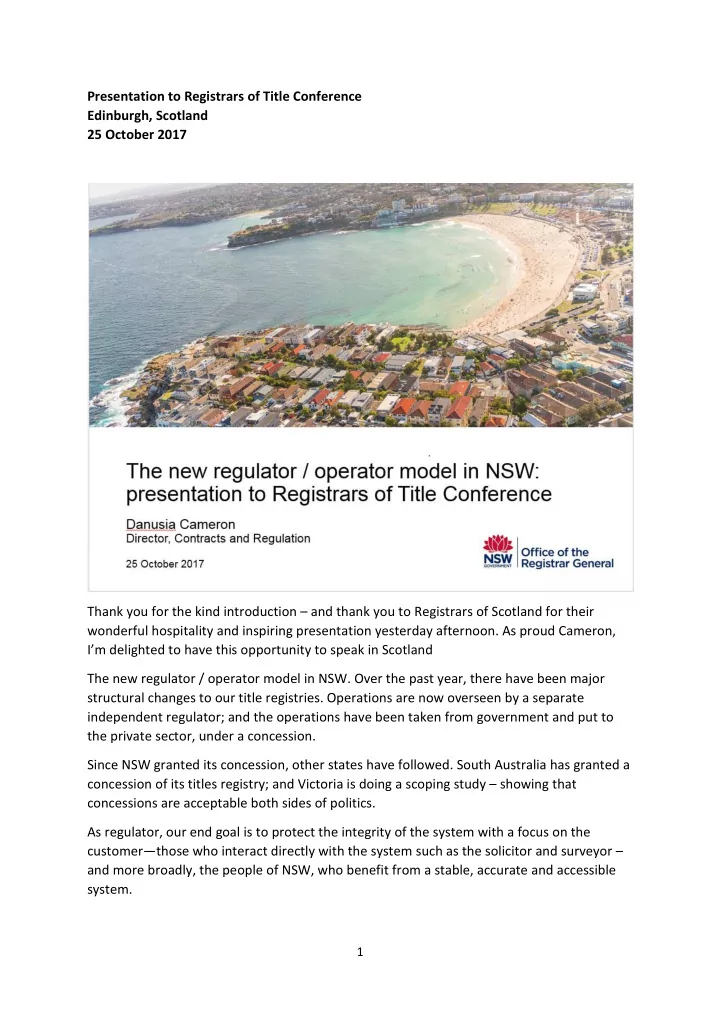
Presentation to Registrars of Title Conference Edinburgh, Scotland 25 October 2017 Thank you for the kind introduction – and thank you to Registrars of Scotland for their wonderful hospitality and inspiring presentation yesterday afternoon. As proud Cameron, I’m delighted to have this opportunity to speak in Scotland The new regulator / operator model in NSW. Over the past year, there have been major structural changes to our title registries. Operations are now overseen by a separate independent regulator; and the operations have been taken from government and put to the private sector, under a concession. Since NSW granted its concession, other states have followed. South Australia has granted a concession of its titles registry; and Victoria is doing a scoping study – showing that concessions are acceptable both sides of politics. As regulator, our end goal is to protect the integrity of the system with a focus on the customer—those who interact directly with the system such as the solicitor and surveyor – and more broadly, the people of NSW, who benefit from a stable, accurate and accessible system.

slide-2
SLIDE 2

2

I’ll spend a few moments talking about the reform, splitting regulation from operations – and then the impact of the new concession on these arrangements. I’ll describe how we, as Office of Registrar General, intend to act, as a regulator – and what a start-up regulator looks like. We’ll take a quick look at some of the innovations going on in NSW. And I’ll finish with some reflections on the first few months of the concession. I’ll start with some context. Before 1 July last year, titling and registry, regulation, valuation services and spatial services were part of a single government entity. On 1 July 2016, the Office of Registrar General was split from the titling and registry services

  • we were specifically established to regulate those services. At the same time, the Spatial

Services team, and Valuation Services, were also split off into separate units. Over the following months, NSW’s Treasury Department ran a competitive bidding process, to grant a concession over the titling and registry services. As you’ll know, a concession is effectively like a long-term lease. In April, the Treasury Department awarded the bid to Australian Registry Investments, or ARI. The State and ARI signed a concession deed, which sets out ARI’s obligations as the

  • perator.

ARI paid A$2.6bn for the right to operate the land titles registry, and receive the revenue from dealings and lodgments. The State retains ownership of the data.

slide-3
SLIDE 3

3

Then on 1 July, the concession commenced, and ARI became the operator of NSW’s titling and registry services. The concession runs for 35 years. Above the concession, the governance structure is very simple.

  • The government is still responsible for the administrative, legislative and regulatory

framework of land titling and conveyancing

  • The Minister still has policy and portfolio responsibility for the Registry and
  • Concession. He retains statutory powers.
  • The RG is responsible for monitoring and overseeing the operation of the
  • Concession. We also oversee the operator’s dealings with customers
  • And ARI, as the private operator, must comply with the relevant legislation,

associated regulations, Lodgement Rules etc. Structural reform Turning to theory - even without taking the concession into account, even if operations stayed in government, the split in regulation and operation is a substantial reform. As I’ve said, in the past, title registry operations and the Registrar General were entwined in

  • ne public sector organisation.

Under this old structure, a staff member would find themselves walking into one meeting as ‘an operator’, and the next ‘as a regulator’. The boundaries were vague. It was difficult to make independent decisions about performance. For example, in the past, where there was a delay in a dealing or plan being processed, it created an obvious inconvenience to a customer. This might have meant someone not being able to move into their house, or a developer not being able to settle sales of new apartments. While the former agency had good ways in which to manage such delays, these were internally managed within the same organization. Under the new regulator-operator model, we as regulator hold the operator to its

  • performance. The operator must meet specific KPIs and reports to us – as the regulator –

whether or not such KPIs are met. We’ll talk a little more about KPIs later. Independent oversight is now build into the system. How do we regulate? How would we regulate this new arrangement? Like many regulators, I suspect, we say: we will focus on the big issues. But what did this mean? Preparing for the new concession meant the Government needed to think about the foundational, fundamental requirements for titling and registry services. What is absolutely critical for land titles in NSW?

slide-4
SLIDE 4

4

In NSW, these requirements were distilled into 6 objectives – which then form the

  • bjectives of the concession deed with the private operator. And for us, at ORG, these
  • bjectives point to what’s important as we regulate ARI, as the new operator.

The 6 objectives are:

  • 1. Maintain integrity, security, performance and availability of registers, core services

and systems Integrity, security, performance and availability – this is the critical phrase, almost a mantra. A moment on terminology - the ‘core services’ are everything that the titling and registry services were doing before the concession commenced. A little later, we’ll talk about ‘non- core services’, and innovations by the new operator. This objective says: we need a strong system, and the operator must maintain existing services. This second objective -

  • 2. Ensure registers are accurate and up to date

Builds on the concept of integrity. It’s so critical, it is a separate objective. Thirdly, the concession has an explicit objective to:

slide-5
SLIDE 5

5

  • 3. Maintain confidence with customers and NSW public

This objective acknowledges that the concession is a new step – that the private operator will need to build confidence its customers. ‘Customers’ is drawn widely and captures anyone who uses or relies on the register. These first 3 objectives look at the current state. The 4th objective looks into the future.

  • 4. Promote improvements, innovation and increased efficiency using greater

expertise and investment in technology This objective reflects that the registries are built on IT systems, which will need regular and substantial capital investment, over the next 35 years. It says that we expect to see technology upgrades and refreshes; at the same time, we are looking for innovations, new types of services and new ideas. The purpose of the final 2 objectives is to protect existing structures in NSW. The fifth

  • bjective – to
  • 5. Minimise errors and frauds

is intended to support the State’s guarantee of title. Land titles will continue to be guaranteed by the State, backed by the Torrens Assurance Fund. This objective says: efficiency shouldn’t come at the expense of accuracy. We shouldn’t see more claims on the Torrens Assurance Fund, as a consequence of the concession. And the 6th objective protects information brokers, who provide title searches to retail

  • customers. The objective is to:
  • 6. Protect current competition in downstream services

These objectives are ranked in order of priority – so integrity of the registers is paramount. And integrity of the registers comes ahead of efficiencies and improvements. The rest of the concession deed – and it’s around 750 pages long – flows from these 6

  • bjectives. And the objectives themselves can be summarised: to protect the integrity of the

system with a focus on the customer. Having established the objectives, the issue for us – as a regulator – is: how do we ensure the operator achieves them? KPIs One way is to dive from these high level objectives to very granular detail. You’ll note the

  • bjectives of availability and performance. As I mentioned earlier, one of the major

initiatives arising from the split of regulation from operation was to bring in key performance indicators – KPIs – that focus on timeliness and availability of services. There are around 55 KPIs set out in the concession deed. The KPI regime is one of the most detailed and complicated parts of the concession.

slide-6
SLIDE 6

6

KPIs help us hold the operator to account. They give us certainty. They mean we can compare like-for-like during the concession. And we can compare performance now to performance when the registry was in State hands.

  • So – when we, as regulator, receive the KPI reports, our first question is – have the

the KPIs been met?

  • The next question is: how is the operator measuring them? As regulator, we can

audit the process, to make sure that we – and the operator – have the same expectation on how they are measured.

  • If the KPIs are being met, all the time – we need to ask: did we set the KPIs at the

right level? And so under our concession, ORG does have the power to raise KPIs, when better service levels become the ‘new normal’. But KPIs of themselves are not a sufficient assurance that service levels are being maintained – or improving. Put another way – we can’t stay at the level of granular detail of the KPIs.

  • We need to step back and ask: are these the right KPI's? Does the story the KPIs are

telling us – a reassuring page of green boxes – match the story we are hearing from customers and stakeholders? Are the KPIs reflecting the real state of play – or do we have a watermelon, green on the outside and red inside?

  • Are the KPIs focusing on the right metrics?
  • Is the operator meeting these KPIs – to the detriment of other operations?

These are questions we’ll continue to ask over the coming years. And under the concession deed, we – as regulator - have the powers to adjust the operator’s KPIs, and bring in new

  • nes, if the KPIs we have are not useful measures.

Objectives and risks To summarise, the process I’ve just described starts with an objective – performance and availability – and sets KPIs to test whether those objectives been met. Starting with

  • bjective is optimistic: it asks - can service levels improve? By contrast, the risk-based

approach says: but what if service levels drop? Under the concession deed, ORG has the power to impose substantial financial penalties if the operator does not meet the KPIs. There are multipliers for repeated breaches. The purpose of the concession is not to make money from penalties. We’d much rather the

  • perator meets the KPIs. But having this penalty regime means there are consequences for

a fall in service levels. So I started with objectives – but every objective can be reframed as a host of risks.

slide-7
SLIDE 7

7

This list is a small sample of our list of risks – all of which will be familiar to you.

  • Data may become corrupted – because of cyber attack, or an internal tech issues.
  • IT outages may cause shut down, delays for customers and loss of confidence
  • Fraud or errors can result in loss of confidence and more claims on the State

guarantee These risks apply to any operator, whether in public hands or private. During the concession, a number of other issues were identified. The community was worried about a private sector monopoly. Eg they were worried that prices would go up and that service levels would go down, as we see with other monopoly arrangements. These issues were dealt with as part of the concession. For example:

  • Under the concession deed, the operator can only raise prices by CPI.
  • As discussed earlier, we’re regulating service levels through the KPI regime.
  • Another issue was privacy. The new private operator must comply with privacy

legislation that applies to State and Federal entities, as if it were a public sector entity itself. But the risks go beyond those listed here. And over the coming years, we’ll encounter risks and issues that we haven’t dreamed of today.

slide-8
SLIDE 8

8

How do we deal with risk, as a regulator? The concession deed gives us a wide range of powers.

  • The operator must comply with a detailed reporting regime – both periodic, as with

the KPIs, and ad hoc.

  • As regulator, we have extensive powers of audit; powers to conduct penetration

testing and quality assurance regimes.

  • Aspects of the concession deed are very prescriptive. We’re worried about data –

and so we get back-up copies of the registers, on a daily and weekly basis. I won’t speak to each power on the slide. But as regulator, we are equipped to identify issues before they manifest. The most extreme powers are not listed on the slide – but they are the ability to terminate the concession, and require the operator to hand it back to the state. This power – the nuclear option – is supported by a range of other requirements – from putting software materials in escrow, to prescribing clauses for subcontracts – to facilitate handback, should that ever occur.

slide-9
SLIDE 9

9

The challenge for us, as a new regulator, is to work out which risks we are worried about, and focus our energy on those. On the flight from Sydney, I was reading a book by Malcom Sparrow, who writes about risk. He summarised our challenge well: ‘we need to pick the most important tasks and then select appropriate tools, rather than deciding on the most appropriate tools and picking the tasks to fit’. If we pick the tasks to fit all of these tools, this will be a huge effort in time and resources – and this is only for ORG. I can only imagine how challenging it would be for the operator. Instead, in working out what matters, what is material – again, we circle back to those 6

  • bjectives. In dealing with the operator, we will make clear the scenarios we think are
  • important. And in return, we ask the operator to be open about mistakes.

So to summarise, as regulator, we will be optimistic, fair and customer focused. At the same time, we will exercise a critical mindset when it comes to defending the integrity of the system. Moving to how we are structured as a regulator. ORG comprises 4 teams, led by Jeremy Cox as Registrar General. I lead the team that has primary responsibility for the concession. But this designation is slightly misleading. The concession hovers across all of ORG. A better distinction would be between those who provide specialist assistance – the lawyers and the surveyors - and the generalists in my team.

slide-10
SLIDE 10

10

Our legal team does policy work: they advise on the real property and conveyancing

  • legislation. They are also litigators, and administer the Torren Assurance Fund. As I

mentioned earlier, this fund underpins the State guarantee of title. Our surveying team has 2 functions: they audit the cadastre; they also are the last stop for boundary disputes, before court. We also have a separate team focusing on the eConveyaning reform. The focus of this reform is to move lodgements online, and away from paper channels. Our Minister has mandated timeframes: by mid-2019, most dealings – 85% of volume – will have to be through electronic channels, paper won’t be an option. As we look at this structure – all of the functions, other than my team, were previously part

  • f the former government agency. In the Office of Registrar General, I’m one of the rare few

who came from outside, my background is private sector law firms. For those working in Office of Registrar General who came from the former government agency, the separation of regulation from operations has been a massive cultural change.

  • For many months, my colleagues in ORG used the word ‘we’ when talking about
  • perations – as in ‘we would deal with this issue by doing that’.
  • And when, as regulator, we saw issues, my colleagues would look for solutions –

which often meant delving into operations – which are the purview of the operator. Instead, as regulator, we have to focus on the outcome – again, I refer to the 6 objectives. It’s up to ARI to work out how best to get there. As I watched colleagues gradually shift their perspective, I would say what really helped was to focus on our role – to protect the integrity of the system – and position ourselves from there. Turning to innovations: Office of Registrar General and ARI, as the operator, are working together on existing innovations, which were started by the state.

slide-11
SLIDE 11

11

  • ORG is managing a project to digitise our State records – making sure important

historic documents are available to customers online.

  • I’ve mentioned our eConveyancing project.
  • We also have a project to move survey plans to digital formats. This will bring a

number of benefits – certainty, fewer errors, faster registration and richer data. This is a major shift for surveyors. Unlike the eConveyancing reform, the Minister has not mandated timeframes. But he made his views very clear recently when he said to a group of surveyors: ‘paper is for origami’. These are specific projects – we also look forward to see the innovations and fresh ideas that Australian Registry Investments will bring. In particular, the private operator can bring in ‘non core services’, services developed in consultation with the ORG. Critically, the operator can set a market price for these non-core

  • services. They are not capped by the CPI regime. We believe this creates incentives for new

ideas and products. At the same time, if over the coming years, we find that these non-core services are critical for customers, under the concession deed, we can bring these non-core services into the CPI regime.

slide-12
SLIDE 12

12

Observations on the last few months In these final minutes, I’ll turn to some observations on our first few months. The first is – the concession deed is a highly detailed document of around 750 pages. For us as regulator, the concession deed, and the legislation, are our rule book. From the operator’s perspective, this complicated document has been overlaid on an existing business. So this first year is particularly interesting, as we work through the first cycles of reporting and compliance. In these early months, we are all learning the discipline of viewing issues through the lens of the concession deed. New issues come up and we find ourselves delving into different parts

  • f this long and complex document.

Another aspect is that the Concession Deed describes the titles registry business at a point in time – in some cases, the processes; in other cases, the technology. We’ve very aware that things will change over time. In the future, we need to regulate for sound industry practice at that point in time – not for 5 years ago. The concession deed includes provisions to refresh. But this is also why the

  • bjectives are so helpful, so that we focus on these key outcomes.

Another observation is – as regulator, we have come to play an important role as the interface between operations and the rest of government.

slide-13
SLIDE 13

13

  • Some state agencies provide data to the land titles registry – and so the operator

relies on them to run its business –

  • and a large number of agencies receive data from the land registry business..
  • But ORG is the only entity that signed the concession deed. Our role is to hold the
  • perator to account, on behalf of all these agencies.

One very practical issue is technology changes. In future, both the operator and the agencies will want to make IT changes. We all want technology improvements. And we at ORG need to make sure IT changes at the operator do not cause issues for agencies, and that IT changes at agencies do not cause issues with the operator. Our role here is not so much to influence outcomes – we don’t prescribe technology – but we do want to make sure the right process is followed. Our role is to be the umpire. Looking at stakeholders more broadly - I mentioned the objective for the operator to work with customers; and also ORG’s meetings with stakeholders. This is critical for both ARI and

  • ORG. At ORG, we rely on them – particularly the legal and surveying industry bodies – to tell

us what’s important and their experience of the registry operations. During the bidding phase for the concession, there was some community pressure against the concession; and key stakeholders made public statements against it. But those same stakeholders welcomed us as a regulator. Our role as a separate regulator was also supported by the way that the transaction was

  • run. NSW Treasury essentially managed the deal. We had some input – but only limited.

As final observations – since the concession began, you could say there has been a proliferation of committees between the operator and the regulator. 2 committees are mandated under the concession deed – a strategy committee, at CEO level with the Registrar General, and an operations committee that I chair. But others have sprung up to deal with specific subject matter. We have a legal and surveying committee; and IT committee. I fully expect by the time I return to Sydney that there will be even more. And this is positive. Other regulators talk about the challenge they have of knowing what’s going on; and the need for visibility. I think these committees show that both we – and ARI – are serious about working together, being open about problems and solving them. In this regard, I wanted to acknowledge the leadership of the CEO of the new operator, Des

  • Mooney. He’s here today – and will be speaking on Friday morning.

I don’t want to steal all his best stories. But Des has steered the registry through some significant challenges.

  • A massive IT separation, taking the registries out of government.
  • A very intense bidding process, which involved answering hundreds of very detailed

questions from bidders, with tight timeframes.

slide-14
SLIDE 14

14

  • Perhaps the biggest challenge was to bring the registry staff with him, along this

period of great change.

  • Now Des is reporting to us as a regulator – and to the investors in the concession.

All the while, he and his staff continue to provide services to customers. To conclude We are 4 months in to a 35 year concession. It feels like we’re in the midst of launching a huge ship – an ocean liner - once you’ve set it on a course, it’s very hard to change direction. We are making sure, at the outset, we are on the right course. So as regulator, we are working to make our expectations clear. We want to make sure the right process is in place – without causing unnecessary regulatory burden for the new

  • perator. We believe that good regulation contributes to a stronger system and better

services. In the end – the risks that the system and the operator face will keep changing. But our

  • bjectives will stay the same. Above all, our goal is to protect the integrity of the registers

and improve outcomes for customers, over the months and the years ahead. Thank you. I’m very happy to take questions. * * *