Presentation Content 1. Thesis question 2. Current work achieved - - PDF document

presentation content
SMART_READER_LITE
LIVE PREVIEW

Presentation Content 1. Thesis question 2. Current work achieved - - PDF document

Journe annuelle Clmentine Cornu de prsentation des travaux des 16 th June, 2010 doctorants du ETZCR / C.CORNU / 16/06/2010 LGI2P EUROCOPTER UNCLASSIFIED 1 Presentation Content 1. Thesis question 2. Current work achieved ETZCR /


slide-1
SLIDE 1

ETZCR / C.CORNU / 16/06/2010

1

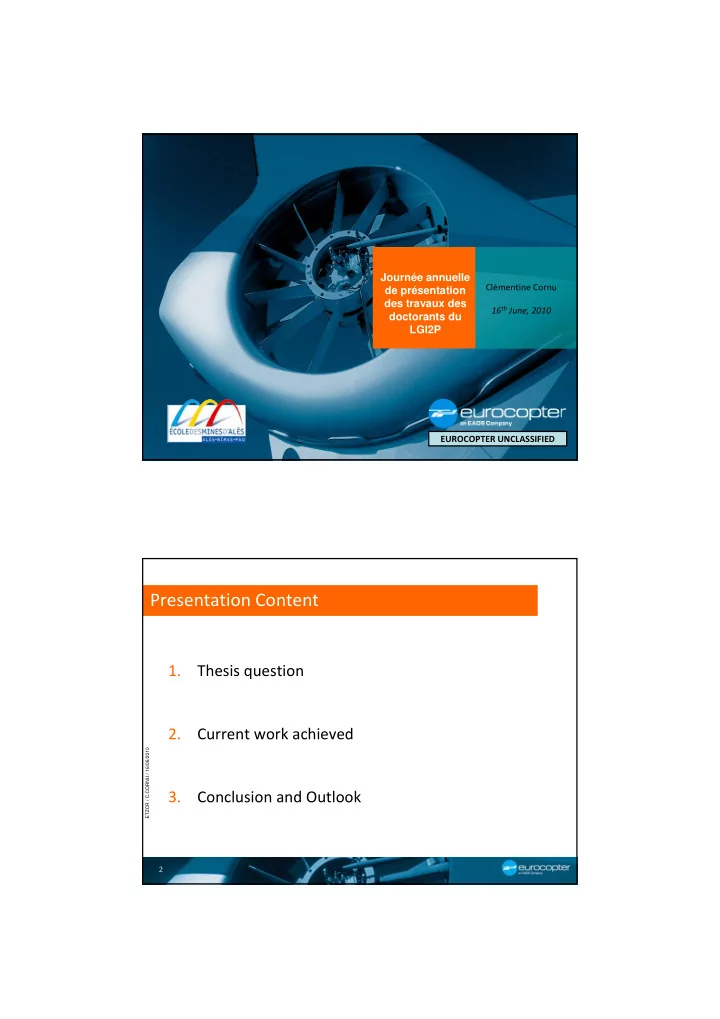
Journée annuelle de présentation des travaux des doctorants du LGI2P

Clémentine Cornu 16th June, 2010 EUROCOPTER UNCLASSIFIED

ETZCR / C.CORNU / 16/06/2010

2

Presentation Content

1. Thesis question 2. Current work achieved 3. Conclusion and Outlook

slide-2
SLIDE 2

ETZCR / C.CORNU / 27/05/2010

  • 1. Thesis question
  • 2. Current work achieved
  • 3. Conclusion & Outlook
  • 1. Thesis question

ETZCR / C.CORNU / 16/06/2010

  • 1. Thesis question
  • 2. Current work achieved
  • 3. Conclusion & Outlook

4

Thesis statement

How to deploy System Engineering processes in a multi cultural and multi sites industry, in a multi‐disciplinary context, dealing with different factors like interoperability

slide-3
SLIDE 3

ETZCR / C.CORNU / 16/06/2010

  • 1. Thesis question
  • 2. Current work achieved
  • 3. Conclusion & Outlook

Meaning of « to deploy » for this study

  • Definition

– To put in place an organization and a way of working which meet the applicable standards within the company

  • Stages

– Background analysis – Definition & implementation of the deployment process – Definition of the deployment methodology – Definition of processes to deploy – Implementation of the deployment – Deployment control & Continuous improvement – Decommissioning of the deployment process

5

ETZCR / C.CORNU / 16/06/2010

  • 1. Thesis question
  • 2. Current work achieved
  • 3. Conclusion & Outlook

System Engineering (SE) Overview

Companies’ needs: phasing out

Customer dissatisfaction Origins of a product lack of profitability Cost and deadlines overruns …

Origins: lack of systems’ control

  • Needs not sufficiently expressed / listened
  • Lifecycle not considered entirely
  • Resources not available at the right time
  • Miscommunication

6

slide-4
SLIDE 4

ETZCR / C.CORNU / 16/06/2010

  • 1. Thesis question
  • 2. Current work achieved
  • 3. Conclusion & Outlook

System Engineering Overview

SE definition

“General methodological approach that includes all the appropriate activities to design, develop and test a system which both provides an economical and competitive solution to the needs of a customer and also satisfies all stakeholders.”

SE Stakes

7

  • Better complexity control
  • Better match between products needs/quality
  • Better cost control
  • Better anticipation of problems and risks
  • Better respect of deadlines
  • Better multi‐disciplinary and multi‐actors cooperation
  • Shorter development time
  • Increasing the satisfaction of all stakeholders

ETZCR / C.CORNU / 16/06/2010

  • 1. Thesis question
  • 2. Current work achieved
  • 3. Conclusion & Outlook

System Engineering

System Engineering Overview

Realization : business engineering

Needs End product

System integration

Tailored from an AFIS pattern To qualify the system To qualify the system To verify the integration To verify the integration To assembly To assembly To get the components To get the components To developp To developp To manufacture To manufacture To reuse To reuse To buy To buy To analyze & define the need To analyze & define the need To define technical requirements To define technical requirements To design organic architecture To design organic architecture To design functionnal architecture To design functionnal architecture To verify & validate & optimize To verify & validate & optimize

slide-5
SLIDE 5

ETZCR / C.CORNU / 16/06/2010

  • 1. Thesis question
  • 2. Current work achieved
  • 3. Conclusion & Outlook

Interoperability Overview

Interoperability definition

“Aptitude and capacity of the entities to interact in a harmonious and efficient way without having to call into question whole or part of their behavior or their structure” [Pingaud 2009]

9

ETZCR / C.CORNU / 16/06/2010

  • 1. Thesis question
  • 2. Current work achieved
  • 3. Conclusion & Outlook

Interoperability barriers & SE processes deployment

10

Interoperability barriers

Tailored from EIF Framework [Chen 2006]

process process service business data service business data

INTEROPERABILITY

process business service data

slide-6
SLIDE 6

ETZCR / C.CORNU / 16/06/2010

  • 1. Thesis question
  • 2. Current work achieved
  • 3. Conclusion & Outlook

Entreprise Dynamic environment SE process SE process SE process SE process

Eurocopter Interoperability interpretation

11

Customer Certification authorities Other stakeholders

SE processes SE processes SE SE

Realization Integration

actors actors methods tools tools methods System of interest … …

INTEROPERABILITY MATTERS

ETZCR / C.CORNU / 16/06/2010

  • 1. Thesis question
  • 2. Current work achieved
  • 3. Conclusion & Outlook

Deployment difficulties

  • What does the company have to

deploy ?

  • How to practically deploy the SE

process ?

  • How to make the design office

staff adhere to the SE approach ?

Interoperability difficulties

How to make the elements to deploy be interoperable

– Between them – With the actual organization within Eurocopter

12

How to get over the obstacles which prevent the SE deployment within the company ?

Eurocopter question

slide-7
SLIDE 7

ETZCR / C.CORNU / 16/06/2010

  • 1. Thesis question
  • 2. Current work achieved
  • 3. Conclusion & Outlook
  • SE processes

definitions/specifications

  • SE process deployment rules

considering and improving its interoperability

  • Company interoperability maturity

model

13

Thesis expected deliverables

Methodological guide Demonstrator

Workflow engine for the deployment of 2 processes

  • Requirements Management
  • Configuration Control

ETZCR / C.CORNU /16/06/2010

  • 1. Thesis question
  • 2. Current work achieved
  • 3. Conclusion & Outlook
  • 2. Current work

achieved

State of the Art in System Engineering applied to Avionics

slide-8
SLIDE 8

ETZCR / C.CORNU /16/06/2010

  • 1. Thesis question
  • 2. Current work achieved
  • 3. Conclusion & Outlook

Improvement of the analysis of [Sheard et al. 1998]

  • MIL‐STD‐499B
  • IEEE 1220
  • EIA/IS 632
  • EIA 632
  • ISO/IEC 15288
  • ISO/IEC TR 19760
  • ISO/IEC TR 90005
  • ISO/IEC TR 24766
  • Découvrir et comprendre l'IS
  • INCOSE SE Handbook
  • NASA SE Handbook
  • BNAE RG.Aéro 000 77
  • BNAE RG.Aéro 000 40
  • ECSS‐E‐ST‐10C
  • Guide for ITS

15

Comparison of System Engineering definitive texts

Updated

Wide Scope Business specific

ETZCR / C.CORNU /16/06/2010

  • 1. Thesis question
  • 2. Current work achieved
  • 3. Conclusion & Outlook

Improvement of the analysis of [Sheard et al. 1998]

  • Scope
  • Level of abstraction
  • System Life Cycle
  • SEMP Guidance
  • Definition of system
  • Definition of System

Engineering

16

Comparison of System Engineering definitive texts

Global System Engineering Relationships / Compatibility with other System engineering documents Project level Project management System life cycle System Life Cycle Stages Project reviews System engineering process by project phase System Engineering process level System Engineering processes Relationships between System Engineering processes Recommendations/Tips for each System Engineering process System Engineering processes inputs System Engineering processes outcomes System Engineering processes actors System Engineering processes controls System Engineering processes enablers System Engineering processes activity level Relationships between System Engineering processes activities Detail information about System Engineering processes activities System Engineering processes activities task level Detail information about System Engineering processes activities tasks Document level Indications about System Engineering plan System Engineering plan template Indications about other documents Documents to provide for reviews

slide-9
SLIDE 9

ETZCR / C.CORNU /16/06/2010

  • 1. Thesis question
  • 2. Current work achieved
  • 3. Conclusion & Outlook

Improvement of the analysis of [Sheard et al. 1998]

SWOT Analysis

17

Comparison of System Engineering definitive texts

Strengths Weaknesses Opportunities Threats

Highlights the cons of each document Highlights what may be risky for Eurocopter in each document Highlights the pros of each document Highlights what may be useful for Eurocopter and thus create a competitive advantage in each document

ETZCR / C.CORNU /16/06/2010

  • 1. Thesis question
  • 2. Current work achieved
  • 3. Conclusion & Outlook

Improvement of the analysis of [Sheard et al. 1998]

SWOT Analysis

18

Comparison of System Engineering definitive texts

slide-10
SLIDE 10

ETZCR / C.CORNU /16/06/2010

  • 1. Thesis question
  • 2. Current work achieved
  • 3. Conclusion & Outlook

Relevancy of the SWOT analysis for the deployment

19

Comparison of System Engineering definitive texts

Strengths Weaknesses Opportunities Threats

to define, control & manage the process to develop the Eurocopter abilities to create and take advantage of its competitive advantage to define, control & manage the process to adapt / to develop the Eurocopter abilities to adapt to these threats

ETZCR / C.CORNU /16/06/2010

  • 1. Thesis question
  • 2. Current work achieved
  • 3. Conclusion & Outlook

Comparison of System Engineering definitive texts

SWOT analysis objectives

– To identify those abilities (competitive advantage/adaptation) – To identify the derived requirements for the Eurocopter organization – To characterize how interoperability may allow to better meet these requirements or may influence compliance with these requirements?

In the knowledge that

– Dynamic & Multi‐disciplinary environment – Open processes (new tools, …)

Study continuation

– Definition of SE process deployment rules and requirements – Definition of a maturity model for each organization level concerned by the deployment

slide-11
SLIDE 11

ETZCR / C.CORNU /16/06/2010

  • 1. Thesis question
  • 2. Current work achieved
  • 3. Conclusion & Outlook
  • 2. Current work

achieved

State of the Art in Interoperability

ETZCR / C.CORNU /16/06/2010

  • 1. Thesis question
  • 2. Current work achieved
  • 3. Conclusion & Outlook

22

Reference documents (to be continued)

Standards

– Technical standards about specific components or computer languages – No normative document explaining how to improve interoperability within companies

European Projects deliverables

– IDEAS – INTEROP‐NoE – ATHENA – ABILITIES – FUSION – GENESIS – Commius

slide-12
SLIDE 12

ETZCR / C.CORNU /16/06/2010

  • 1. Thesis question
  • 2. Current work achieved
  • 3. Conclusion & Outlook

23

Reference documents (upcoming studies)

Interoperability Frameworks

“An interoperability framework can be defined as a set of standards and guidelines that describes the way in which organisations have agreed, or should agree, to interact with each other.” [ATHENA 2007a]

Name Reference IDEAS interoperability Framework [IDEAS 2003] European Interoperability Framework [IDABC 2004] & [IDABC 2008] INTEROP‐NOE European Interoperability Framework [INTEROP‐NOE 2007] ATHENA Interoperability Framework [ATHENA 2007a] ATHENA Business Interoperability Framework [ATHENA 2007b] E‐Health Interoperability Frameworks [NEHTA 2007]

ETZCR / C.CORNU /16/06/2010

  • 1. Thesis question
  • 2. Current work achieved
  • 3. Conclusion & Outlook

24

Reference documents (upcoming studies)

Interoperability Maturity Models

“The purpose of a maturity model of the CMMI type is to improve the efficiency of the company by identifying, analysing and optimising the processes ruling the work.” [AFIS 2002 – Sheet n°1] Comparison made in [Guédria et al. 2008]

Name Reference SPICE [ISO 2004] LISI [C4ISR 1998] OIM [Clark et al. 1999] LCIM [Tolk et al. 2003] EIMM [ATHENA 2007c]

slide-13
SLIDE 13

ETZCR / C.CORNU / 16/06/2010

  • 1. Thesis question
  • 2. Current work achieved
  • 3. Conclusion & Outlook
  • 3. Conclusion and

Outlook

ETZCR / C.CORNU / 16/06/2010

  • 1. Thesis question
  • 2. Current work achieved
  • 3. Conclusion & Outlook

Outlook : Deployment guide

  • Definition & explanations of the Eurocopter’s strategy
  • Taking stock

– Stakeholders – Organization – Tools – Data and models

  • Formalization

– Deployment requirements – Cartography of the SE processes to deploy – Process used to manage the deployment

  • Company Interoperability Maturity Model
slide-14
SLIDE 14

ETZCR / C.CORNU / 27/05/2010

Thank you for your attention !

ETZCR / C.CORNU / 27/05/2010

Extra slides

slide-15
SLIDE 15

ETZCR / C.CORNU / 16/06/2010

Automatisation cognitive

  • Automatisation

– « Suppression totale ou partielle de l'intervention humaine dans l'exécution de tâches diverses » [Larousse]

  • Cognitive

– « Qui se rapporte à la faculté de connaître » [Larousse]

  • Ma compréhension

– Suppression totale ou partielle de l'intervention humaine dans l'exécution de tâches liées à la connaissance, au raisonnement – Identifier les tâches de raisonnement répétitives et supporter ainsi l’utilisateur dans leur exécution en les anticipant, en les formalisant, en les simplifiant, en en les outillant et en supprimant celles qui sont inutiles

29

ETZCR / C.CORNU / 16/06/2010

Automatisation cognitive

  • Contribution de ma thèse à l’automatisation cognitive

– Les processus d’IS, de part leur nature, vise à « automatiser » les tâches de conception en y apposant un cadre, des méthodes, … Or cette thèse vise non seulement à les définir mais aussi à apporter des solutions viables pour les déployer. Elle contribue donc à l’automatisation cognitive. – Sans interopérabilité, ces processus fonctionneront « en mode dégradé » ou non optimal. La prise en compte de l’interopérabilité sert donc encore l’automatisation cognitive. – Enfin, le workflow sur lequel doit aboutir la thèse est un outil concret d’automatisation cognitive

30

slide-16
SLIDE 16

ETZCR / C.CORNU / 27/05/2010

Appendixes

ETZCR / C.CORNU / 16/06/2010

32

References

  • [AFIS 2001] Fanmuy, G., Levy, G., Foisseau, J., Lamothe, P., Hermans, B., De Chazelles, P. and Choveau, E.

"Recommandations pour l'élaboration d'un référentiel d'exigences techniques", Association Française d'Ingénierie Système (AFIS), 2001.

  • [AFIS 2002] "Sheet No. 1 : Maturity Model", Association Française d’Ingénierie Système, 2002
  • [AFIS 2009] Meinadier, J.‐P. "Découvrir et comprendre l'ingénierie système ‐ Version expérimentale ‐

Version 3", Association Française d'Ingénierie Système (AFIS), 2009.

  • [ATHENA 2007a] "Deliverable D.A4.2 ‐ Specification of Interoperability Framework and Profiles, Guidelines

and Best Practices", ATHENA, 2007.

  • [ATHENA 2007b] "Deliverable D.B3.1 ‐ Business Interoperability Framework", ATHENA, 2007.
  • [ATHENA 2007c] "Deliverable D.A1.4 ‐ Framework for the Establishment and Management Methodology",

ATHENA, 2005.

  • [BNAE 1999] "RG AERO 000 40 A ‐ General recommendation for the programme management

specification", Bureau de normalisation de l'aéronautique et de l'espace (BNAE), 1999.

  • [BNAE 2005] "RG AERO 000 77 ‐ Programme management ‐ Guide for the management of Systems

Engineering", Bureau de normalisation de l'aéronautique et de l'espace (BNAE), 2005.

  • [C4ISR 1998] "Final Report", C4ISR Architecture Working Group, 1998.
  • [Chen 2006] Chen, D. "Enterprise Interoperability Framework"'Proceedings of Enterprise Modelling and

Ontologies for Interoperability, EMOI‐Interop', 2006.

slide-17
SLIDE 17

ETZCR / C.CORNU / 16/06/2010

33

References

  • [Clark et al. 1999] Clark, T. and Jones, R. "Organisational Interoperability Maturity Model for C2"'1999

Command and Control Research Technology Symposium. United States Naval War College, Newport', 1999.

  • [DoD 1994] "MIL‐STD‐498, Software Development and Documentation", Department of Defense (DoD),

1994.

  • [ECSS 2009] "ECSS‐E‐ST‐10C ‐ Space engineering ‐ System engineering general requirements", European

Cooperation on Space Standardization(ECSS), 2009.

  • [EIA 1994] "EIA/IS 632, Interim Standard: Systems Engineering", Electronic Industries Alliance (EIA), 1994.
  • [EIA 2003] "ANSI/EIA‐632:2003 ‐ Processes for Engineering a System", Electronic Industries Alliance (EIA),

2003.

  • [Guedria et al. 2008] Guedria, W., Naudet, Y. and Chen, D. "Interoperability Maturity Models ‐ Survey and

Comparison," On the Move to Meaningful Internet Systems: OTM 2008 Workshops, 2008

  • [IDABC 2004] "European Interoperability Framework for pan‐European eGovernment services ‐ Version

1.0", Interoperable Delivery of European eGovernment Services to public Administrations, Businesses and Citizens (IDABC), 2004.

  • [IDABC 2008] "Draft document as basis for EIF 2.0", Interoperable Delivery of European eGovernment

Services to public Administrations, Businesses and Citizens (IDABC), 2008.

  • [IDEAS 2003] "Delivrable D.1.1 ‐ State of the Art (introduction)", IDEAS, 2003.

ETZCR / C.CORNU / 16/06/2010

34

References

  • [IEEE 2005] "IEEE 1220:2005, Standard for application and Management of the Systems Engineering

Process", Institute of Electrical and Electronics Engineers (IEEE), 2005.

  • [INCOSE 2010] "Systems Engineering Handbook ‐ A Guide for System Life Cycle Processes and Activities ‐

version 3.2", International Council on Systems Engineering (INCOSE), 2010.

  • [INTEROP‐NOE 2007] “Deliverable DI.3_‐ Enterprise Interoperability Framework and knowledge corpus”
  • [ISO 2002] "ISO/IEC 15288:2002, Systems engineering ‐ System life cycle processes", International

Organization for Standardization (ISO), 2002.

  • [ISO 2003] "ISO/IEC TR 19760:2003 ‐ Systems engineering ‐ A guide for the application of ISO/IEC 15288

(System life cycle processes)", International Organization for Standardization (ISO), 2003.

  • [ISO 2004] “ISO/IEC 15504:2004 ‐‐ Information technology ‐‐ Process assessment, ", International

Organization for Standardization (ISO), 2002.

  • [ISO 2008] "ISO/IEC TR 90005:2008 ‐ Systems engineering ‐ Guidelines for the application of ISO 9001 to

system life cycle processes", International Organization for Standardization (ISO), 2008.

  • [ISO 2009] "ISO/IEC TR 24766:2009 ‐ Technologies de l'information ‐‐ Ingénierie des systèmes et du

logiciel ‐‐ Guide pour les capacités d'outil d'ingénierie des exigences", International Organization for Standardization (ISO), 2009.

  • [NASA 2007] Shishko, R. and Chamberlain, R. "Nasa Systems Engineering Handbook", Technical report,

National Aeronautics and Space Administration (NASA), 2007.
slide-18
SLIDE 18

ETZCR / C.CORNU / 16/06/2010

35

References

  • [NEHTA 2007] "Interoperability Framework v2.0", Technical report, National E‐Health Transition Authority Limited (NEHTA),

2007.

  • [Pingaud 2009] Pingaud, H. "Rationalité du développement de l’interopérabilité dans les organisations"'8ème congrès

international de Génie Industriel, CIGI09', 2009.

  • [Sheard et al. 1998] Sheard, S. and Lake, J. "Systems engineering standards and models compared"'Proceedings of the

Eighth International Symposium on Systems Engineering, Vancouver, Canada', 1998

  • [Tolk et al. 2003] Tolk, A. and Muguira, J. A. "The Levels of Conceptual Interoperability Model"'2003 Fall Simulation

Interoperability Workshop, Orlando, Florida', 2003.

  • [USDT 2009] "Systems Engineering Guidebook for Intelligent Transportation Systems", California Department of

Transportation, 2009.

ETZCR / C.CORNU / 16/06/2010

Pictures references

Pictures have been picked from internet :

– http://richardwiseman.wordpress.com/2009/05/21/its‐the‐friday‐puzzle‐9/ – http://www.marketingwords.com/images/question_mark_dead.jpg – http://www.crystalxp.net/forum/fr/entraide‐graphique/Tux‐Mascottes‐amp‐ Personnages/sujet_14189_1.htm – The rest of the pictures come from http://www.icons‐gallery.com/

36

slide-19
SLIDE 19

ETZCR / C.CORNU / 16/06/2010

About the author

Clémentine Cornu is a PhD student on a CIFRE contract with Eurocopter at the the Mines ParisTech research center for computer science (CRI). Her work is under the supervision of Vincent CHAPURLAT (LGI2P, Ecole des Mines d’Alès) and François IRIGOIN (CRI, Mines ParisTech) Contact : Clementine (dot) Cornu (at) Eurocopter (dot) com

37