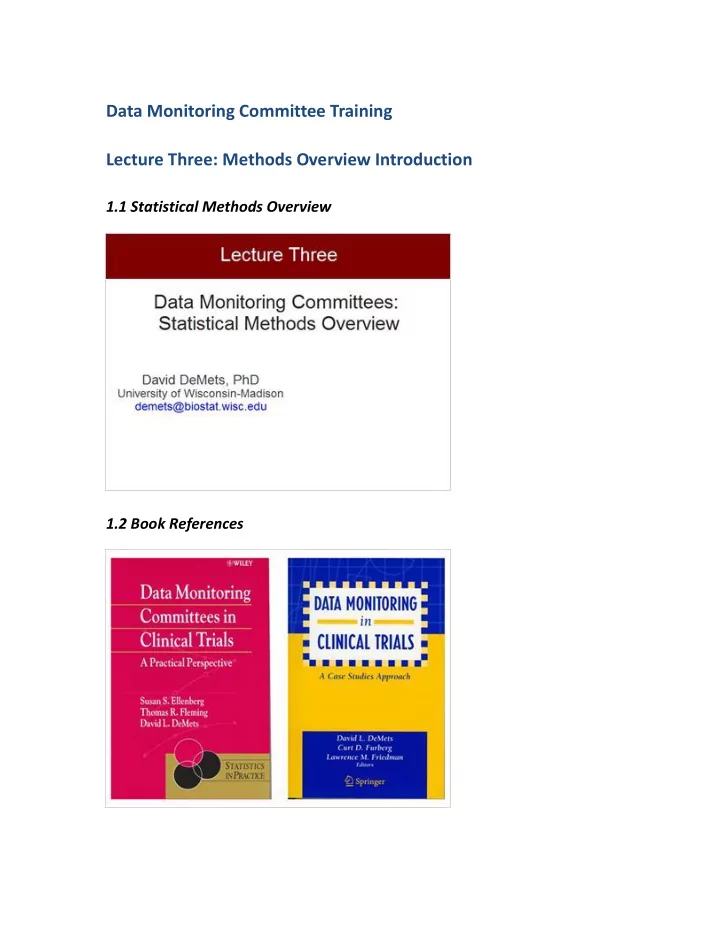
SLIDE 1
Data Monitoring Committee Training Lecture Three: Methods Overview Introduction
1.1 Statistical Methods Overview 1.2 Book References
SLIDE 2
1.3 DMC Structure and Function Review 1.4 Data Monitoring Rationale
SLIDE 3
1.5 DMC Recommendations 1.6 Reasons for Early Termination
SLIDE 4
1.7 DMC Decision Factors 1.8 DMC Summary - NIH Model
SLIDE 5
1.9 DMC Summary - Independence 1.10 Statistical Challenges
SLIDE 6
2.1 Statistical Methods - Motivating Example 2.2 The Beta-blocker Heart Attack Trial
SLIDE 7
2.3 BHAT: Accumulating Survival Data 2.4 BHAT: Mortality Curves
SLIDE 8
2.5 BHAT: Baseline Comparisons 2.6 BHAT: Total Mortality by Subgroup
SLIDE 9
2.7 BHAT: Total Mortality by Risk Group 2.8 DMC Interim Analysis Challenge
SLIDE 10
2.9 Coronary Drug Project 2.10 Coronary Drug Project Research Group
SLIDE 11 2.11 Repeated Significance Testing
- 3. Two Monitoring Methods
3.1 Statistical Methods Overview
SLIDE 12
3.2 Group Sequential Boundaries 3.3 Three Common Boundaries
SLIDE 13
3.4 Haybittle-Peto 3.5 Armitage-Pocock
SLIDE 14
3.6 Group Sequential Model 3.7 Summary Statistics Explained
SLIDE 15
3.8 Sample Size Implications 3.9 Pocock Group Sequential Boundaries
SLIDE 16
3.10 Sample Size Example for Pocock 3.11 O’Brien-Fleming Group Sequential Boundary
SLIDE 17
3.12 O’Brien-Fleming Group Sequential Boundaries cont'd 3.13 Fixed Design Sample Size
SLIDE 18
3.14 Defining Assessment Target 3.15 International Use of Boundaries
SLIDE 19
3.16 Boundary Parameter ∆ for Pocock & OBF 3.17 Selection of Group Sequential Boundaries
SLIDE 20
3.18 Group Sequential Boundaries 3.19 BHAT Example
SLIDE 21
3.20 BHAT GSB 3.21 Timing of Data Reviews
SLIDE 22
3.22 Using Alpha Spending Function 3.23 Information and Calendar Time
SLIDE 23
3.24 Alpha Spending 3.25 Boundary Crossing Probability
SLIDE 24
3.26 Alpha Spent For 5 Interim Analyses 3.27 OBF Alpha Spending Function
SLIDE 25
3.28 Examples of a*(t) 3.29 Why Is Flexibility Important?
SLIDE 26
3.30 CAST GSB 3.31 CAST Interim Data: Sudden Death
SLIDE 27
3.32 CAST Sequential Boundaries 3.33 Lessons of CAST
SLIDE 28 3.34 Symmetric or Asymmetric GSBs
4.1 Statistical Methods Overview
SLIDE 29
4.2 Methods for Assessing Negative Trends 4.3 Group Sequential Boundaries For Negative Trends
SLIDE 30
4.4 Motivating Example: VEST 4.5 Vesnarinone (VEST) in Heart Failure
SLIDE 31
4.6 Vesnarinone Doses 4.7 Vesnarinone Mortality and Morbidity
SLIDE 32
4.8 Vesnarinone Second Trial 4.9 VEST NEJM 1998
SLIDE 33
4.10 VEST: Survival in the Three Groups 4.11 VEST: Mortality By Subgroups
SLIDE 34
4.12 VEST: Accumulating Mortality Results 4.13 VEST Mortality High Dose vs. Placebo
SLIDE 35
4.14 Why Did VEST Continue? 4.15 Conditional Power
SLIDE 36
4.16 Conditional Power cont'd 4.17 Conditional Power In General
SLIDE 37
4.18 A Method for Computing 4.19 Visual Aid
SLIDE 38
4.20 Conditional Power Parameter ϴ 4.21 Conditional Power Parameter cont'd
SLIDE 39
4.22 Conditional Power Table 4.23 Conditional Power Boundaries
SLIDE 40 4.24 Symmetric Vs. Asymmetric Boundaries
5.1 Sequential Methods Summary
SLIDE 41
5.2 Group Sequential Software 5.3 References page 1
SLIDE 42
5.4 References page 2 5.5 References page 3
SLIDE 43
5.6 End of Lecture Three