Presentation by Wendy Dennys, Co-chair, Urban Lanes Committee, - - PDF document

presentation by wendy dennys co chair urban lanes
SMART_READER_LITE
LIVE PREVIEW

Presentation by Wendy Dennys, Co-chair, Urban Lanes Committee, - - PDF document

Presentation by Wendy Dennys, Co-chair, Urban Lanes Committee, Overbrook Community Association, Thursday, 16 October 2014: Co-chair Robb Wainwright, and Researcher Steve McNamee sent their regrets that they were unable to attend meeting


slide-1
SLIDE 1

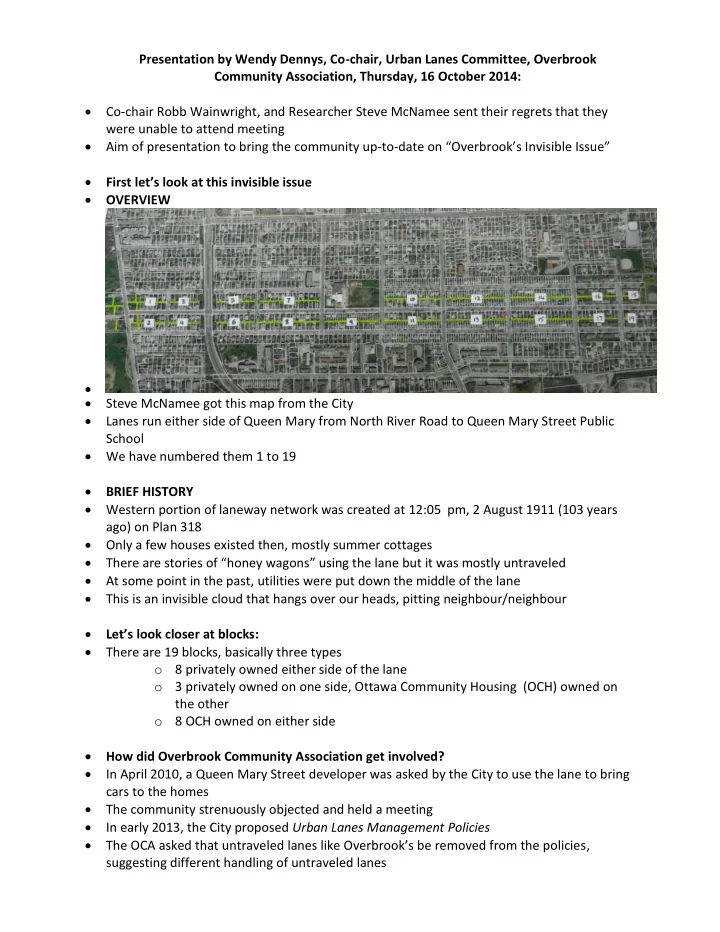
Presentation by Wendy Dennys, Co-chair, Urban Lanes Committee, Overbrook Community Association, Thursday, 16 October 2014:  Co-chair Robb Wainwright, and Researcher Steve McNamee sent their regrets that they were unable to attend meeting  Aim of presentation to bring the community up-to-date on “Overbrook’s Invisible Issue”  First let’s look at this invisible issue  OVERVIEW   Steve McNamee got this map from the City  Lanes run either side of Queen Mary from North River Road to Queen Mary Street Public School  We have numbered them 1 to 19  BRIEF HISTORY  Western portion of laneway network was created at 12:05 pm, 2 August 1911 (103 years ago) on Plan 318  Only a few houses existed then, mostly summer cottages  There are stories of “honey wagons” using the lane but it was mostly untraveled  At some point in the past, utilities were put down the middle of the lane  This is an invisible cloud that hangs over our heads, pitting neighbour/neighbour  Let’s look closer at blocks:  There are 19 blocks, basically three types

  • 8 privately owned either side of the lane
  • 3 privately owned on one side, Ottawa Community Housing (OCH) owned on

the other

  • 8 OCH owned on either side

 How did Overbrook Community Association get involved?  In April 2010, a Queen Mary Street developer was asked by the City to use the lane to bring cars to the homes  The community strenuously objected and held a meeting  In early 2013, the City proposed Urban Lanes Management Policies  The OCA asked that untraveled lanes like Overbrook’s be removed from the policies, suggesting different handling of untraveled lanes

slide-2
SLIDE 2

 In March 2013, City Council approved the new policies.  In April 2013, OCA canvassed residents and set up a legal fund.  In June 2013, the Urban Lanes ad hoc committee was formed formed  In August 2013, a survey/questionnaire was delivered to 160 homes; 57 responded; 88% said they would buy land

Therefore the mandate of the committee became:

 To pursue the closure of Overbrook’s lanes

  • as soon as possible
  • at minimum cost to homeowners

 What has Committee accomplished?  Here was a watershed moment:  What led up to this aha moment?  With support from Councillor Clark, a pilot block was chosen  In January 2014, he put a motion to Council to instruct staff to produce a report on a purchase price for pilot block  In order to prepare the report, City required:

  • An application to close lane
  • An application fee of $4,657 (paid from Councillor’s discretionary fund)
  • Signatures of all homeowners on “petition of interest to purchase”
  • Sketch and photos of block

 This was submitted on 24 June 2014  After internal and external circulation of the application  On Friday, 3 October 2014  The lane was officially closed!  Now what?  Closure of pilot block is the first step, purchase is next!  We are waiting for the City’s report on the price  Councillor contends land holds no value for City – we agree  In London, ON, the city charged $1 for similar lane; In Hamilton, ON, $100  We suggest $100 be the limit.  Then we negotiate the survey cost; we contend it’s City property, therefore they should pay.

“Overbrook’s Invisible Issue” became visible!

slide-3
SLIDE 3

 There are many issues to be worked out – we need to stay steady and patient  Purchase of the land on the pilot block has to be completed by 3 October 2015 or closure

  • f the lane is nulled.

 Life after Pilot Block purchased?  Recommend start preparation for 7 remaining Type 1 Blocks applications  Applications will only be submitted once the pilot block lanes are purchased.  Files have been prepared for each block, and block captains and helpers are sought.  A meeting will be arranged to share the experienced gained through the pilot block closure process.  Pilot Block experience: It takes time, patience and diplomacy to gather the signatures.  Down the road?  We need to research how to proceed with Type 2 blocks  We need patience, one step at a time  Be assured we will get there  Reaching the end goal?  Closure of Type 3 blocks  City transfers land to OCH  This move might be welcomed by both parties!