Preparing young people for the real world: what does it really take? - - PowerPoint PPT Presentation

preparing young people for the real world
SMART_READER_LITE
LIVE PREVIEW

Preparing young people for the real world: what does it really take? - - PowerPoint PPT Presentation

Preparing young people for the real world: what does it really take? Professor Guy Claxton Kings College London, UK 5 good reasons why we have to rethink education 1. The successes are often 1. Unable to think on their feet 2.

slide-1
SLIDE 1

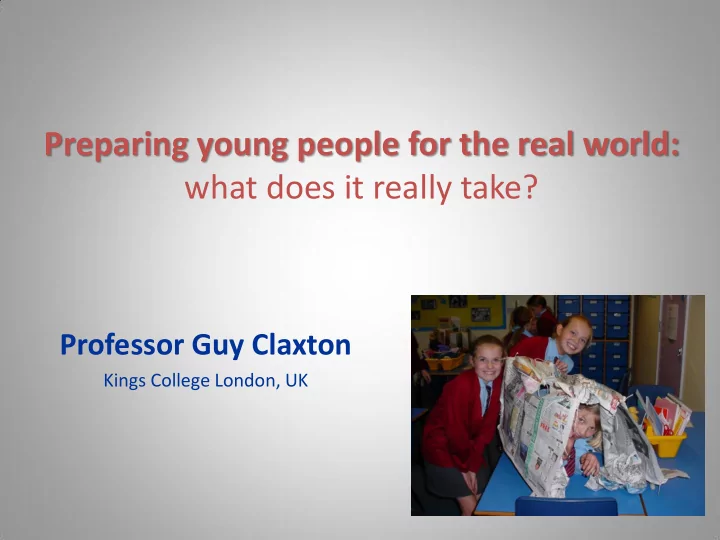
Preparing young people for the real world: what does it really take?

Professor Guy Claxton

Kings College London, UK

slide-2
SLIDE 2

5 good reasons why we have to rethink education

slide-3
SLIDE 3

1.The ‘successes’ are often

  • 1. Unable to think on their feet
  • 2. Success-oriented, not learning-oriented
  • 3. Lacking resilience and resourcefulness
  • 4. Mercenary and expedient
slide-4
SLIDE 4
  • 2. The ‘failures’ are defeated in learning
  • 1. Passive and hopeless
  • 2. Uninquisitive
  • 3. Turned off reading
  • 4. Find dignity in anti-social ways
slide-5
SLIDE 5

3.Exams require substantial numbers of failures

  • so there has to be

AN ANOT OTHER HER WA WAY Y OF OF WI WINNI NNING NG

slide-6
SLIDE 6

4.Knowledge can be gained online

  • faster
  • more up-to-date
  • more reliably (if you know where and how to look)
  • more interestingly
  • cheaper
slide-7
SLIDE 7
  • 5. Groups of children can teach

themselves (almost) anything…

…unless there is a ‘teacher’ about Professor Sugata Mitra (watch his TED talks)

slide-8
SLIDE 8

Attitudes for life?

  • Being right
  • Creating ideas
  • Listening to teachers
  • Questioning things
  • Working alone
  • Remembering facts
  • Showing initiative
  • Following instructions
  • Self-evaluating
  • Being adventurous
  • Copying down
  • Discussing with peers
  • Accepting what you’re told
  • Working with others
  • Imagining possible solutions
  • Showing deference
  • Taking responsibility
  • Being evaluated
slide-9
SLIDE 9
  • Being right
  • Creating ideas
  • Listening to lectures
  • Questioning things
  • Working alone
  • Remembering facts
  • Showing initiative
  • Following instructions
  • Self-evaluating
  • Being adventurous
  • Copying down
  • Discussing with peers
  • Accepting what you’re told
  • Working with others
  • Imagining possible solutions
  • Showing deference
  • Taking responsibility
  • Being evaluated
slide-10
SLIDE 10

Learning habits in school?

  • Being right
  • Creating ideas
  • Listening to teacher
  • Questioning things
  • Working alone
  • Remembering facts
  • Showing initiative
  • Following instructions
  • Self-evaluating
  • Being adventurous
  • Copying down
  • Discussing with peers
  • Accepting what you’re told
  • Working with others
  • Imagining possible solutions
  • Showing deference
  • Taking responsibility
  • Being evaluated
slide-11
SLIDE 11
  • Being right
  • Creating ideas
  • Listening to teacher
  • Questioning things
  • Working alone
  • Remembering facts
  • Showing initiative
  • Following instructions
  • Self-evaluating
  • Being adventurous
  • Copying down
  • Discussing with peers
  • Accepting what you’re told
  • Working with others
  • Imagining possible solutions
  • Showing deference
  • Taking responsibility
  • Being evaluated
slide-12
SLIDE 12

What kind of “mind training”?

19th century clerk?

  • Being right
  • Copying down
  • Listening to teacher
  • Accepting what you’re told
  • Working alone
  • Remembering facts
  • Showing deference
  • Following instructions
  • Being evaluated

21st century explorer?

  • Being adventurous
  • Creating ideas
  • Discussing with peers
  • Questioning things
  • Working with others
  • Imagining possible solutions
  • Showing initiative
  • Taking responsibility
  • Self-evaluating
slide-13
SLIDE 13

Good intentions are global

  • Our vision is for young people:

– who will be creative, enterprising, confident, connected lifelong learners – develop the values and competencies that will enable them to live full and satisfying lives (New Zealand)

  • The curriculum must ensure that schools meet the challenges of the 21st

century… adaptable and resilient, independent and critical, questions and reflects, works well in teams, takes risks, is innovative, appreciates beauty… (Singapore)

  • The key skills of the Junior Cycle [include]: being flexible, imagining,

exploring options, taking risks, discussing and debating, learning with

  • thers, being curious, reflecting and evaluating… (Irish Junior Cycle, Key

Skills)

slide-14
SLIDE 14

Nationally they fizzle out…

  • UK ‘personal learning and thinking skills’
  • NZ ‘key competencies’
  • Singapore ‘desired outcomes of education’
  • Australia ‘general capabilities’

– Tasmania ‘essential learnings’ – Queensland ‘new basics’ – South Australia ‘teaching to learn’ ???

slide-15
SLIDE 15

BUT many schools are doing it

  • Argentina – Ushuaia, Rosario
  • New Zealand – Auckland, Hamilton
  • Australia – Toorak, Bankstown
  • Singapore, Jakarta – UWC, BIS, JIC
  • Poland, Finland, Dubai
  • Ireland, Jersey, Isle of Man,
  • Newcastle, Birmingham, Ashburton, London…

– Eton, Wellington, Marlborough, Gordonstoun

slide-16
SLIDE 16

Who’s doing it?

  • Building learning power
  • Visible thinking / thinking routines

(Perkins)

  • Habits of mind (Costa)
  • Visible learning (Hattie)???
  • Assessment for learning???XX
  • Thinking skills??????
  • Accelerated learning ??XXX
slide-17
SLIDE 17

What goes wrong?

1. Politicians – dysfunctional democracy 2. Either / or thinking

Results OR Habits for Life

3. Fixed intelligence 4. Bad language

academic - ‘metacognitive awareness’, ‘managing impulsivity’ vague aspirations – ‘excellence’, ‘world-class’, ‘best practice’… ambiguous – e.g. ‘improving learning’

5. Bolt-ons and quick fixes 6. Teacher inertia / control / anxiety 7. Just another bloody initiative

slide-18
SLIDE 18

Just another passing initiative

slide-19
SLIDE 19

Re Resu sults lts PLUS US Dis ispos position itions

  • Better grades all round

– All students benefit – Low achievers disproportionately more

  • Students are better prepared for

– Further independent study – Work and life

  • Teaching is more enjoyable and rewarding
slide-20
SLIDE 20
slide-21
SLIDE 21

Gordonstoun

35 40 45 50 55 60 2007 2008 2009 2010 2011 2012 average % students

%A*-B grades

slide-22
SLIDE 22

Changing conceptions of intelligence

  • A response to uncertainty

– “Intelligence is knowing what to do when you don’t know what to do” Jean Piaget

  • Malleable

– “The idea that intelligence is a fixed quantity is deplorable…a brutal pessimism…Before learning subjects, learners should be given lessons in mental orthopedics: in a word, they must learn how to learn” Alfred Binet

  • Componential

– “Intelligence is the sum total of your habits of mind” Lauren Resnick

  • Balanced

– “The essence of intelligence is knowing when to think and act quickly, and when to think and act slowly” Robert Sternberg

slide-23
SLIDE 23

A new metaphor – the Mind Gym

  • Brains are like muscles
  • Subjects are like exercise

machines

  • Each lesson is a mental

work-out

  • The curriculum is a broad

and appropriate fitness regime

  • Bright slackers are

wasting their time

slide-24
SLIDE 24

What goes right?

  • 1. Politicians
  • 2. Either / or thinking
  • 3. Fixed intelligence
  • 4. Bad language
  • 5. Bolt-ons and quick fixes
  • 6. Teacher control/anxiety
  • 7. Just another initiative
  • 1. Small scale pedagogy
  • 2. Results PLUS
  • 3. Learned habits of mind
  • 4. Precise, accessible language
  • 5. Gradual culture change
  • 6. Small steps
  • 7. Deep embedding
slide-25
SLIDE 25

Building Learning Power

  • A series of small, subtle, significant habit shifts by teachers

and school leaders in – How we talk and think about students – What we model about learning – How we design lessons – What we display and how we use resources – What we record and report – How we work together as learners – How a school plans and develops its LP culture

  • NOTHING LESS WILL DO… SO ARE WE SERIOUS???
slide-26
SLIDE 26

Students’ comments

  • ‘If you’ve been focusing on one of the learning muscles in school,

when I go home I think, ‘How could I use that here?’ Like when I go to swimming club I think maybe I could persevere more, or ask more questions, or use imitating’ (Madeleine, 12)

  • ‘In my old school they just gave you harder and harder worksheets.

But here they really stretch you to learn in different ways. You get lots

  • f encouragement so you learn to keep going and ‘dig deep’ when

things get difficult. Now I always like to see if I can take things one step further’ (Tom,15)

  • ‘If something’s hard you don’t want to say ‘Oh this is hard, this is hard,

I’ll just skip it’. You try because the best thing is, if you don’t try what’s the point? Because when you grow up you might come to some answer you’ll still not know, and you can’t skip it then’ (Daneisha, 6)

slide-27
SLIDE 27

We know how to do it

slide-28
SLIDE 28

What do we need?

  • Understanding
  • Imagination
  • Will
  • It’s not centrally

about permission

  • r resources
slide-29
SLIDE 29
  • www.buildinglearningpower.co.uk
  • www.expansiveeducation.net
  • guy.claxton@winchester.ac.uk