PREPARATION AND PROPERTIES OF NANO-ATP/ TiO 2 / PP COMPOSITES Q.Wang - - PDF document

preparation and properties of nano atp tio 2 pp composites
SMART_READER_LITE
LIVE PREVIEW

PREPARATION AND PROPERTIES OF NANO-ATP/ TiO 2 / PP COMPOSITES Q.Wang - - PDF document

PREPARATION AND PROPERTIES OF NANO-ATP/ TiO 2 / PP COMPOSITES Q.Wang 1 , J .Tao 1* ,X.Q. Su 1 , C. Han 2 , Y..H. Cui 1 P.T. He 1 (1.College of Material Science and Technology, Nanjing University of Aeronautics and Astronautics, Nanjing


slide-1
SLIDE 1

1 Introduction Polypropylene are widely used in many applications due to its excellent mechanical properties and low

  • cost. Polymer/inorganic composite nanoparticles are
  • f great interest in a wide range of applications in

polymer-based nanocomposite materials [1,2,3] .The attapulgite (ATP) has large relative surface area and well disperse characteristics ,as well as a good absorption of silver ion or TiO2 nanoparticles. However, few attention has been paid on the adsorption mechanism of nanoparticles to the mineral and the kinetics of acid-dissolution of ATP

[1-6]. In this study ATP/ TiO2/ PP antibacterial

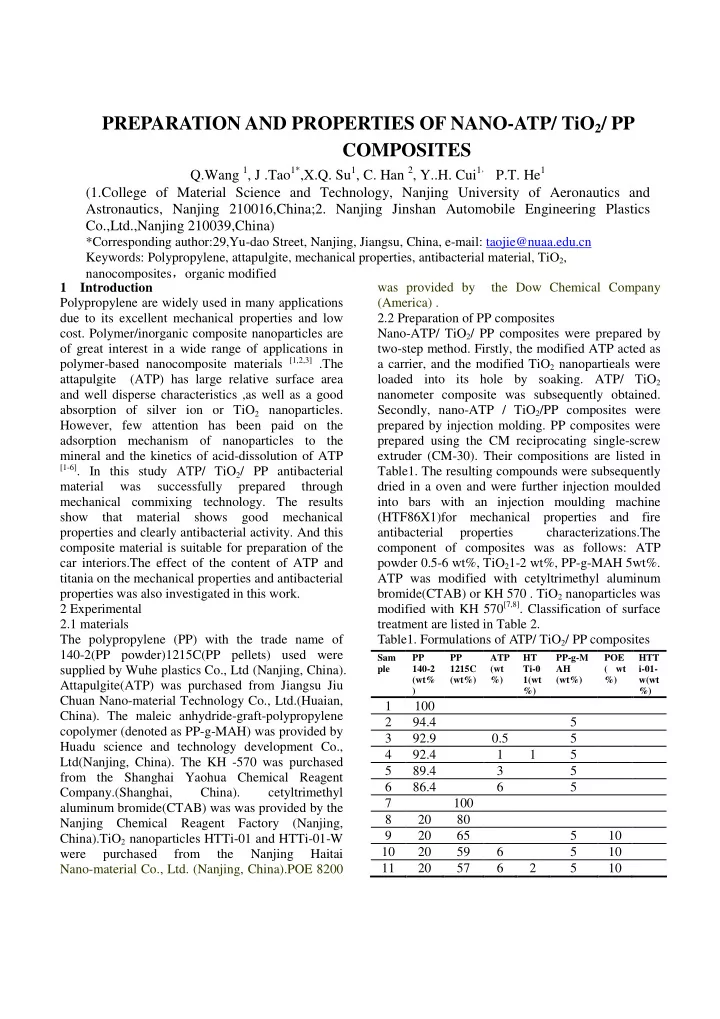
material was successfully prepared through mechanical commixing technology. The results show that material shows good mechanical properties and clearly antibacterial activity. And this composite material is suitable for preparation of the car interiors.The effect of the content of ATP and titania on the mechanical properties and antibacterial properties was also investigated in this work. 2 Experimental 2.1 materials The polypropylene (PP) with the trade name of 140-2(PP powder)1215C(PP pellets) used were supplied by Wuhe plastics Co., Ltd (Nanjing, China). Attapulgite(ATP) was purchased from Jiangsu Jiu Chuan Nano-material Technology Co., Ltd.(Huaian, China). The maleic anhydride-graft-polypropylene copolymer (denoted as PP-g-MAH) was provided by Huadu science and technology development Co., Ltd(Nanjing, China). The KH -570 was purchased from the Shanghai Yaohua Chemical Reagent Company.(Shanghai, China). cetyltrimethyl aluminum bromide(CTAB) was was provided by the Nanjing Chemical Reagent Factory (Nanjing, China).TiO2 nanoparticles HTTi-01 and HTTi-01-W were purchased from the Nanjing Haitai Nano-material Co., Ltd. (Nanjing, China).POE 8200 was provided by the Dow Chemical Company (America) . 2.2 Preparation of PP composites Nano-ATP/ TiO2/ PP composites were prepared by two-step method. Firstly, the modified ATP acted as a carrier, and the modified TiO2 nanopartieals were loaded into its hole by soaking. ATP/ TiO2 nanometer composite was subsequently obtained. Secondly, nano-ATP / TiO2/PP composites were prepared by injection molding. PP composites were prepared using the CM reciprocating single-screw extruder (CM-30). Their compositions are listed in

  • Table1. The resulting compounds were subsequently

dried in a oven and were further injection moulded into bars with an injection moulding machine (HTF86X1)for mechanical properties and fire antibacterial properties characterizations.The component of composites was as follows: ATP powder 0.5-6 wt%, TiO21-2 wt%, PP-g-MAH 5wt%. ATP was modified with cetyltrimethyl aluminum bromide(CTAB) or KH 570 . TiO2 nanoparticles was modified with KH 570[7,8]. Classification of surface treatment are listed in Table 2.

  • Table1. Formulations of ATP/ TiO2/ PP composites

Sam ple PP 140-2 (wt% ) PP 1215C (wt%) ATP (wt %) HT Ti-0 1(wt %) PP-g-M AH (wt%) POE ( wt %) HTT i-01- w(wt %)

1 100 2 94.4 5 3 92.9 0.5 5 4 92.4 1 1 5 5 89.4 3 5 6 86.4 6 5 7 100 8 20 80 9 20 65 5 10 10 20 59 6 5 10 11 20 57 6 2 5 10

PREPARATION AND PROPERTIES OF NANO-ATP/ TiO2/ PP COMPOSITES

Q.Wang 1, J .Tao1*,X.Q. Su1, C. Han 2, Y..H. Cui1, P.T. He1 (1.College of Material Science and Technology, Nanjing University of Aeronautics and Astronautics, Nanjing 210016,China;2. Nanjing Jinshan Automobile Engineering Plastics Co.,Ltd.,Nanjing 210039,China)

*Corresponding author:29,Yu-dao Street, Nanjing, Jiangsu, China, e-mail: taojie@nuaa.edu.cn Keywords: Polypropylene, attapulgite, mechanical properties, antibacterial material, TiO2, nanocomposites,organic modified

slide-2
SLIDE 2

2

12 20 57 6 5 10 2 Table 2. Classification of surface treatment of ATP and titanium

Sample ATP HTTi-01 HTTi-01-w 3 4(1) 4(2) KH-570 KH-570 4(3) CTAB KH-570 5(1) 5(2) KH-570 5(3) CTAB 6 CTAB 10 CTAB 11 CTAB KH-570 12 CTAB

2.3 Characterization and testing

The crystal phase and purity of commercial ATP and TiO2 nanopowder were analyzed by TEM,XRD and EDX. The effect of the content of

ATP and titania on the mechanical properties and antibacterial properties was also studied. The tensile strength was measured according to GB/T1040.

Bending strength and modulus measurements were measured according to GB/T9341. Izod

notched impact strength was measured based on

GB/T1843. Antibacterial performance test was measured

  • n

GB/T2150-2008 with sheet dimensions of 50×50×3mm. Thermogravimetric analysis (TGA) was carried out under nitrogen at a heating rate of 10℃/min by means of a Pyris 1 TGA thermal analyzer. and the composition was characterized by FTIR spectrometer (NEXUS 670).

3 Results and discussion 3.1 Characteration of commercial ATP and TiO2 nanopowder

The crystal phase and purity of commercial ATP and TiO2 nanopowder were shown in Fig.1.- Fig.5. Fig. 1- Fig.5 show that the raw materials of ATP and titanium dioxide has a very high purity and good crystallinity and morphology.HTTi-01-W is W doped titanium

  • dioxide. The average size of two titanium

dioxide particles are all 10nm. ATP showed a long rod-like structure, rod length 500-1500nm, rod diameter 20-50nm.

  • Fig1. XRD patterns of ATP nanopowder

Fig.2.FTIR patterns of ATP nanopowder Fig.3.TEM micrograph of ATP nanopowder

slide-3
SLIDE 3

3

Fig.4. TEM micrograph and EDAX of TiO2 (HTTi-01)nanopowder Fig.5. TEM micrograph and EDAX of TiO2 (HTTi-01-W)nanopowder 3.2 Mechanical properties

Mechanical properties of ATP/ TiO2/ PP composites were shown in Table3. From the results it can be seen that with the addition of ATP

and titanium oxide, the mechanical properties of composite materials have an improved trend. However, the degree of improvement of impact strength is not obvious. Samples 4 (1), 4 (2) and 4 (3) show that the ATP effect by CTAB surface treatment, and titanium dioxide surface modified with silane coupling agent KH570 have remarkable effect to improve the mechanical properties of the composite . The results sample 5 (1) to sample 5 (3) also show that the mechanical properties of composites prepared by ATP modified with CTAB and the titanium dioxide surface modified with silane coupling agent KH570 are good .Table 3 also shows that with the addition of POE elastomer, the mechanical properties of composite is very good, this composite material is suitable for preparation of the car interiors. Table 3. Mechanical properties of ATP/ TiO2/ PP composites Sampl e Tensile strengt h (MPa) Charpy impact strength(k J/m2) Bendin g modulu s (MPa) Bendin g strengt h 1 44.65 1.58 1452 47.34 2 41.68 1.48 1655.08 48.79 3 43.58 1.77 1506.27 43.98 4(1) 44.14 1.32 1448.06 45.24 4(2) 42.96 1.51 1600.2 47.17 4(3) 44.26 2.28 1843.09 51.23 5(1) 40.23 2.09 1375.93 45.66 5(2) 42.15 1.49 1538.59 46.69 5(3) 51.73 2.45 1629.09 51.7346 6 49.56 2.39 1711.25 49.56 7 23.77 22.63 775.16 22.77 8 27.19 10.995 842.09 24.58 9 25.85 20.43 701.95 23.38 10 26.59 8.83 761.36 24.81 11 25.08 14.36 836.24 25.03 12 24.60 10.50 811.78 22.46 3.3 Characterization of XRD and FTIR patterns of nano-powder and composites To further analyze how the ATP and Surface treatment agent affect mechanical properties of composite, the FTIR spectrum of nano-powder and ATP/TiO2/PP composites are given in Fig. 6. It indicates that the CTAB modified ATP present the

  • CH2-stretching vibration absorption peak at 2923

cm−1and 2851cm−1 .these are just caused by the Methyl and long-chain alkyl in CTAB. Which indicates that has CTAB in the treated ATP . Meanwhile the absorption peak near 1634cm−1 get weak, Which indicattes that adsorbed water

  • decreased. This is as the role of quaternary

ammonium cation and attapulgite get recation generate Attapulgite stone - Organic surface-active agent complex.Large molecular weight organic groups substituted the original inorganic cations.The surface of ATP particles are also absorptted part of the organic matter due to the existence of various active centers. At the same time part of the crystal water and adsorbed water inside and outside the lattice was replaced by organic[7-8].

slide-4
SLIDE 4

4

Fig.6. FTIR spectra of nano-powder and ATP/ TiO2/ PP composite XRD patterns of nano-powder and ATP/ TiO2/ PP composite were shown in Fig.7. It shows that the addition of nanoparticles in PP did not form a new

  • phase. But The ATP molecules interlayer distance

get larger after being surface treated by CTAB , ATP/ TiO2/ PP composites prepared by titanium dioxide surface modified by silane coupling agent KH570 and ATP treated by CTAB has relatively wide FWHM. Thus this composite has good mechanical properties. Fig.7. XRD patterns of nano-powder and ATP/ TiO2/ PP composite 3.4 Thermal stability

  • Fig. 8 shows the TG and DSC curves of PP(140-2)

and PP/ATP in nitrogen atmosphere. As can be seen from Fig.8, PP and PP / ATP in both weight loss below 100℃ which is due to a small amount of inorganic soil moisture, evaporation causes weight loss when heated. When the temperature is higher than 100 ℃, PP / ATP at temperatures higher than300 ℃ a significant weight loss occurs. Because the CATB treated ATP has adsorption layer of organic matter decomposition due to

  • xidation at high temperatures. The results indicate

that organic modifiers ATP has reacted, replaced the non-organic cation Machine metal cation into the bentonite and attapulgite film layer. The results show that under the same conditions, PP / ATP in the weight loss percentage (3.5%) is higher than PP (1.3%). PP and composites from the melting curve of aggregates can be seen, the addition of ATP for the melting process of the blends was less

  • affected. Narrow crystallization peak, and the

crystallization temperature increased. ATP content

  • f 3wt% for the composite material when the

maximum degree of crystallinity, crystallization temperature gradually increased with the increase of

  • content. Crystallization behavior change will have

some impact on its performance, DSC results indicate that ATP has played the role of heterogeneous nucleation and improved the PP crystallization temperature and crystallinity.The improvement of mechanical properties is also because ATP going into nuclear nature of the contribution the film makes the PP grain size decreases, the molecular motion in favor of the movement of lamellae to improve the mechanical properties of composites. In comparison, the silane coupling agent KH570 modified ATP can not be grafted onto the surface perfectly. But it grafted intact to the surface of titanium dioxide verywell. 3.4 antibacterial performance Antibacterial effect of the composite was shown in Table 4.The control sample was prepared with sanitary grade high density polyethylene(HDPE). The number of colonies represented antibacterial

  • effect. The less the average number of colonies, on

behalf of the antibacterial effect of the composites is

  • better. Table 4 shows that with the increasement
  • f titanium content, the antibacterial properties
  • f composite materials has improved. But at the

same condition the composite prepared by W doped titanium dioxide has good antibacterial performance.

Table 4. antibacterial performance of ATP/ TiO2/ PP composites

slide-5
SLIDE 5

5

Sample The average number

  • f

colonies(Unit: cfu / piece)

HDPE 2.4×10⁵ 4(3) 5.0×10⁴ 10 8.8×10⁴ 11 2.1×10⁴ 12 1.9×10⁴

Conclusions In summary, we have found that with the addition of ATP and titanium oxide, the mechanical properties

  • f PP composites improved . After CTAB surface

treated ,The ATP molecules interlayer distance get larger . ATP/ TiO2/ PP composite prepared by titanium dioxide surface modified by silane coupling agent KH570 and ATP treated by CTAB has good mechanical properties.With the improvement of titanium dioxide content, the antibacterial properties

  • f composite materials improved. But at the same

condition the composite prepared by W doped titanium dioxide has good antibacterial performance . And with the addition of POE elastomer, the mechanical properties of composite is very good, this composite material is suitable for preparation of the car interiors. Acknowledgments The authors gratefully acknowledge Ford URP Project (Preparation and properties of thermoplastics modified by nanomaterials for injection molded auto parts) and “Peak of six major human resources plan”

  • f Jiangsu province (Preparation of halogen-free FR

PP with high impact grade and low smell for cars) for financial supports. References [1]F. Montezin, J.M. Lopez-Cuesta, A. Crespy, P. Georlette , “Flame retardant and mechanical properties of a copolymer PP/PE containing brominated compounds/ antimony trioxide blends and magnesium hydroxide or talc” Fire Mater. Vol. 21, pp 245–252, 1997. [2]Y.Kurokawa,H.Yashuda,M.Kashiwagi,.A Oya.,Strueture and properties of a montmorillonite /polypropylene nanocomposites[J]. J mater Sei Lett, 1997,16(20):1670-1672 [3]Y.Kurokawa,H.Yashuda,M.Kashiwagi, A Oya.,Prepatation of a nanacomposites of polypropylene and smectite[J] .J Mater Sci Lett, 1996,15(17):1481 一 1483 [4]N. Haseguwa,M.Kawasumi,M. Kato etal,Preparation and meehanical properties of Polypropylene clay hybrids using a maleic-anhydride modified Polypropylene

  • ligomer[J]. PolymSei,1998,67(1):87 一 92

[ [5]M. Kato,A.Usuki,Synthesis of Polypropylene

  • ligomer-

clay intercalation compounds[J] PolymSci,1997,66(9):1781 一 1785 [6]M. Kawasumi,H.Naoki,K.Makoto etal, Prepatation and mechanical proerties of /polypropylene-clay hybrids, Maeroleeules,1997, 30(20):6333 一 6338. [7]Y.H. Liu, P. Liu and Z.X. Su“ Morphological analysis

  • f

bead–string shapedand core–shell attapulgite@polystyrene (ATP@PS)particles via emulsion polymerization” Polym. Adv. Technol.

  • Vol. 18, No. 4, pp 433–438, 2007.

[8]P. Armitage, J.R. Ebdon, B.J Hunt “Chemical medication of polymer to improve flame retardance-I. The influenceof boron-containing groups”Polymer Degradation and Stablity . Vol. 54, No. 2, pp 387-393, 1996