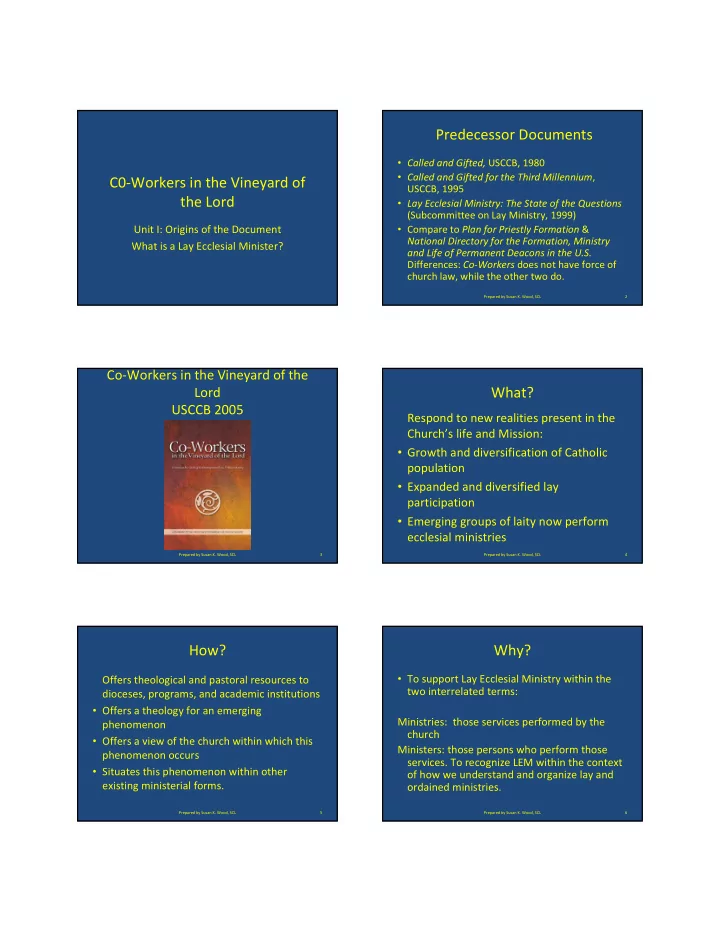
Predecessor Documents Called and Gifted, USCCB, 1980 Called and - - PDF document

predecessor documents
SMART_READER_LITE
LIVE PREVIEW

Predecessor Documents Called and Gifted, USCCB, 1980 Called and - - PDF document

Predecessor Documents Called and Gifted, USCCB, 1980 Called and Gifted for the Third Millennium , C0-Workers in the Vineyard of USCCB, 1995 the Lord Lay Ecclesial Ministry: The State of the Questions (Subcommittee on Lay Ministry,


slide-1
SLIDE 1

C0-Workers in the Vineyard of the Lord

Unit I: Origins of the Document What is a Lay Ecclesial Minister?

Predecessor Documents

  • Called and Gifted, USCCB, 1980
  • Called and Gifted for the Third Millennium,

USCCB, 1995

  • Lay Ecclesial Ministry: The State of the Questions

(Subcommittee on Lay Ministry, 1999)

  • Compare to Plan for Priestly Formation &

National Directory for the Formation, Ministry and Life of Permanent Deacons in the U.S. Differences: Co-Workers does not have force of church law, while the other two do.

Prepared by Susan K. Wood, SCL 2

Co-Workers in the Vineyard of the Lord USCCB 2005

Prepared by Susan K. Wood, SCL 3

What?

Respond to new realities present in the Church’s life and Mission:

  • Growth and diversification of Catholic

population

  • Expanded and diversified lay

participation

  • Emerging groups of laity now perform

ecclesial ministries

Prepared by Susan K. Wood, SCL 4

How?

Offers theological and pastoral resources to dioceses, programs, and academic institutions

  • Offers a theology for an emerging

phenomenon

  • Offers a view of the church within which this

phenomenon occurs

  • Situates this phenomenon within other

existing ministerial forms.

Prepared by Susan K. Wood, SCL 5

Why?

  • To support Lay Ecclesial Ministry within the

two interrelated terms: Ministries: those services performed by the church Ministers: those persons who perform those

  • services. To recognize LEM within the context
  • f how we understand and organize lay and
  • rdained ministries.

Prepared by Susan K. Wood, SCL 6

slide-2
SLIDE 2

For Whom?

  • Diocesan bishop
  • Those who educate and form LEM
  • Lay ministers: see Romans 16:3-16 “my co-

workers”

Prepared by Susan K. Wood, SCL 7

For What?

Guiding, educating, forming, employing, evaluating, and sustaining those laity called to collaborate with priests and deacons.

Prepared by Susan K. Wood, SCL 8

Lay Ecclesial Ministry

  • Lay: Service done by lay persons. The

sacramental basis in the Sacraments of Initiation, not the Sacrament of Ordination.

  • Ecclesial: This ministry is the ministry of the

church.

  • Ministry: Participates and continues the

ministry of Christ, who is priest, prophet, and king.

Prepared by Susan K. Wood, SCL 9

Lay Ecclesial Ministry

  • A way of serving the mission of Christ
  • that flows from baptism and the gifts of

the Spirit

  • involving a stable commitment
  • responsibility for ecclesial leadership

10 Prepared by Susan K. Wood, SCL

Lay Ecclesial Ministry, cont.

  • Requiring appropriate formation
  • And authorization
  • To collaborate with the ordained
  • In the work of pastoring the people of

God.

11 Prepared by Susan K. Wood, SCL

Two perspectives

  • The ministry – new set of roles and

responsibilities that need to be identified and

  • rdered, requiring ecclesial authorization and

coordination.

  • The minister – needing to be acknowledged,

affirmed, supported through public recognition, and clarity about their rights and responsibilities.

12 Prepared by Susan K. Wood, SCL

slide-3
SLIDE 3

Ministry: Serving the Church and its Mission

  • Whose ministry is it anyway?
  • Announce the reign of God
  • Transform the world in the light of Christ

13 Prepared by Susan K. Wood, SCL

Baptism and Gifts of the Spirit

  • Particular way of responding to the baptismal

call to further the mission of Christ

  • Flows from the charisms given to the Holy

Spirit and needed by the church

  • Sacramental basis in baptism and

confirmation

  • Does not require sacramental gifts of holy
  • rders

14 Prepared by Susan K. Wood, SCL

Three degrees of involvement

  • All laity – witness in secular area
  • Direct ministries which require short-term

preparation, are volunteered, under supervision of the pastor’s delegate

  • Further call to make a significant life

commitment to work in collaboration with the ordained in their pastoral ministry

15 Prepared by Susan K. Wood, SCL

Responsibility for Ecclesial Leadership

  • Public activity directed toward building up the

body of Christ for its mission in the world

  • Recognized and affirmed by the church

community

  • Involves a leadership responsibility for some

area of ministry, usually with a relationship of coordination and direction of others in the community

16 Prepared by Susan K. Wood, SCL

Stable Commitment

  • Significant and long-term commitment, not

necessarily life-long

  • Often marked by employment (full- or part-

time) on parish staffs, in diocesan offices, or within church –related organization

17 Prepared by Susan K. Wood, SCL

A Distinction

  • Ministries ordinarily entrusted to the laity

because of their baptismal call

  • Ministries, ordinarily reserved to the
  • rdained, delegated to the laity by exception

in case of need

18 Prepared by Susan K. Wood, SCL

slide-4
SLIDE 4

Characteristics of Lay Ecclesial Ministry

  • Authorization by the hierarchy to serve publicly in

the local church

  • Leadership in a particular area of ministry
  • Close mutual collaboration with the pastoral

ministry of bishops, priests, and deacons

  • Preparation and formation appropriate to the

level of responsibilities that are assigned to them

  • Vocation personally and ecclesially discerned
  • Stability because it is on-going ministry rather

than occasional ministry

Prepared by Susan K. Wood, SCL 19

Discipleship vs. Ministry

  • Discipleship: Gospel living and a following of

Jesus required of all Christians by virtue of their baptism

  • Ministry: The work of some Christians who are

continue the ministry of Jesus as individuals. May be occasional, does not receive ecclesial authorization

  • Lay ecclesial ministry: public ministry in the

name of the church, authorized by the church

Prepared by Susan K. Wood, SCL 20

Church vs. World???

  • The Lay Faithful are marked by their place in

the secular world.

  • Ministry to the church is not a retreat by the

laity from their role in the secular realm. They build ecclesial communion precisely to strengthen the community for its mission in the world.

21 Prepared by Susan K. Wood, SCL

Application of the term LEM

  • Not a specific position title
  • Responsibility of the bishop to identify the

roles that most clearly exemplify lay ecclesial ministry

  • Application of the term may vary diocese to

diocese

Prepared by Susan K. Wood, SCL 22

Vocation

  • Personal discernment
  • Ecclesial discernment and ratification

23 Prepared by Susan K. Wood, SCL

Discernment of Vocation

  • Full communion with the Catholic Church
  • Desire to serve the Church and its mission,

love of God and God’s people

  • Commitment to regular personal prayer,

Mass, and sacraments

  • Zeal to live a Christian life, live and teach

according to the magisterium

  • Emotional maturity

Prepared by Susan K. Wood, SCL 24

slide-5
SLIDE 5

Discernment, cont.

  • Needed intellectual gifts
  • Commitment to good communication and

conflict resolution skills

  • Knowledge of and adherence to church

doctrine

  • Respect and appreciation for Tradition and

the traditions of the church

  • Ability or potential to direct others in their

service

Prepared by Susan K. Wood, SCL 25

Discernment, cont.

  • Chaste living as a single, celibate, or married

person.

  • Friendships and collegial relationships that lead

to personal and professional growth

  • Mature emotional balance, respect for all,

freedom from personal agenda

  • Willingness and ability to engage in disciplined

study

  • Appreciation of new ideas, critical thinking

ability, and ability to manage stress

Prepared by Susan K. Wood, SCL 26

Discernment

What talents, virtues, and limits do I possess that indicate my ability to serve God’s people through a commitment to lay ecclesial ministry?

Prepared by Susan K. Wood, SCL 27

Vocation

  • Discerned within the Church and

authenticated by the bishop, or his delegate, who is alone able to authorize someone to service in ecclesial ministry.

  • Vocation to build up the church from within in

addition to engagement with the world.

  • This does not mean that the ministries of LEM

are distinctive to lay persons alone.

Prepared by Susan K. Wood, SCL 28

Appropriate Formation

Lay ecclesial ministry requires a ministerial competence that comes from formation and preparation through a formal degree, certification, informal training, or pastoral experience.

29 Prepared by Susan K. Wood, SCL

Authorization to Collaborate with the Ordained

  • Lay Ecclesial ministry involves such a

substantial collaboration with the ordained in their pastoral ministry that it requires authorization by the bishop or his delegate.

  • This can take a variety of forms, including a

public ritual.

30 Prepared by Susan K. Wood, SCL

slide-6
SLIDE 6

Collaboration

To “collaborate” is not only to work together to get things done, but to be an effective sign of the Trinity of divine persons, whose “co-labor” in creating, redeeming and sanctifying the world is the font of the Church’s identity and mission.

“Working Together in Preparation for Service” Archdiocese of Milwaukee, 2004

31 Prepared by Susan K. Wood, SCL

Unit II: Theological Foundations of LEM

  • Triune God
  • Ecclesiology

Prepared by Susan K. Wood, SCL 32

Trinity

  • Fundamentally relational
  • Source of the church’s mission
  • Christians baptized in the name of the Trinity
  • Grammar of Christian Life

– Journey to the Father – Incorporated into the Son by baptism & eucharist – Empowered by the Spirit, gifted with charisms for the upbuilding of the church

Prepared by Susan K. Wood, SCL 33

Church: A Community for Mission

  • Communion ecclesiology

Prepared by Susan K. Wood, SCL 34

The Term “Communion” Koinonia

  • Participation
  • Association
  • Fellowship
  • Sharing in

35 Prepared by Susan K. Wood, SCL

Use of the Term

  • Extraordinary Synod of Bishops, 1985
  • Congregation of Doctrine and Faith:

“very suitable for expressing the core of the mystery of the church, key for renewal of Catholic ecclesiology”

  • Ecumenically fruitful category
  • Theme of 5th world conference on Faith

and Order, Santiago de Compostela, 1993

slide-7
SLIDE 7

Scriptural Use

Christians are called into koinonia with Christ and one another through faith (Phlm 6) and baptism (1 Cor 1:9).

The Eucharist is a koinonia in the body and blood of Christ (1 Cor 10: 16-17). In sharing their material goods (Acts 2:42) and contributing financially to the relief of the poor (2 or 8:4; 9:13) Christians engage in koinonia.

39 Prepared by Susan K. Wood, SCL

The faithful have koinonia with the Son (1 Cor 1:9), with the Holy Spirit (2 Cor 13:13), and with the Father himself (1 John 1:3).

40 Prepared by Susan K. Wood, SCL

The koinonia that the faithful already experience on earth is a foretaste of the perfect unity to be enjoyed in heaven (1 Cor 1:7-9).

41 Prepared by Susan K. Wood, SCL

Church Structure: Relational

  • No individual exercising a direct

communion with God

  • The way to God passes through the

neighbor

  • Absolute interdependence among all

members of the community

42 Prepared by Susan K. Wood, SCL

slide-8
SLIDE 8

Basic Ecclesial Principle

  • A church can never exist in

isolation

  • A church is only a church in

communion with other churches

43 Prepared by Susan K. Wood, SCL

Universal Church Universal Church

Bishop Bishop Bishop Bishop Bishop Bishop

  • f Rome

Particular Churches

44 Prepared by Susan K. Wood, SCL

Corresponding Ministerial Principle

  • Ministry serves the communion
  • f the church
  • Ministry exists to create

communion Ministry Fosters Connections with the Larger Church

46 Prepared by Susan K. Wood, SCL

Church: Oriented To Mission Rather Than Self- Maintenance

47 Prepared by Susan K. Wood, SCL

Retreat House?

48 Prepared by Susan K. Wood, SCL

slide-9
SLIDE 9

Campaign Headquarters for Mission?

49 Prepared by Susan K. Wood, SCL

Ministers are formed for the sake of this world, for its transformation and salvation. For this attitudes are needed that go out toward and embrace the world, with all its varieties of peoples and their aspirations and gifts, not those that would foster a kind of separateness and exclusivism, or a mentality of privilege and clericalism.

50 Prepared by Susan K. Wood, SCL

Challenges to the Communion Model of Church (and Ministry!)

51 Prepared by Susan K. Wood, SCL

FIEFDOMS AND LONE RANGERS

52 Prepared by Susan K. Wood, SCL

DISENGAGEMENT

  • From official church teaching
  • From presence to a faith

community

  • Compartmentalization of faith

and life

53 Prepared by Susan K. Wood, SCL

Future Topics

  • Questions concerning formation for lay ecclesial

ministry

  • Questions concerning a theology of authorization
  • Relationship between authorization and

certification

  • The relationship between a lay ecclesial minister

and the bishop, priests, and deacons

  • Differences between LEM and ordained ministry

Prepared by Susan K. Wood, SCL 54

slide-10
SLIDE 10

Questions??

Prepared by Susan K. Wood, SCL 55