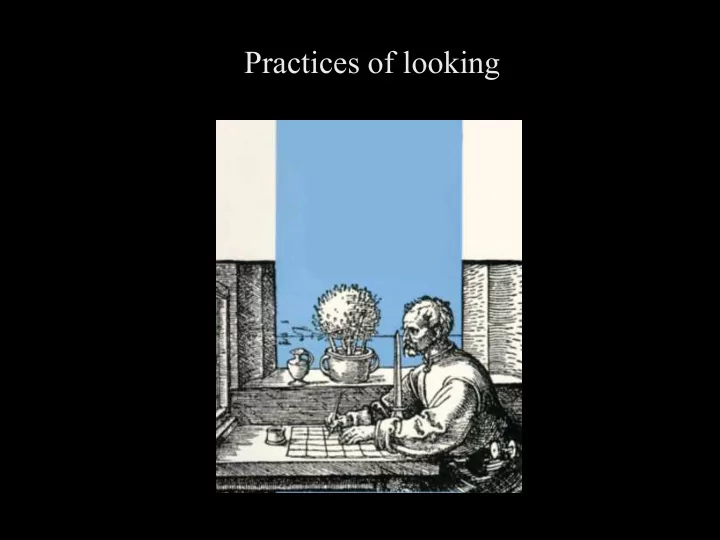
SLIDE 1
Practices of looking
SLIDE 2 Practices of looking
- Introduction to practices of looking
- Discuss theories of “representation”
- Discuss facets of “ideology”
- Discuss the myth of the photographic truth
(see sample response paper)
SLIDE 3
Practices of looking
To look is an act of choice where we negotiate social relationships and meanings. Looking is a practice much like speaking, writing, or signing. To engage in the exchange of looks, to see and be seen, entails the play of power.
SLIDE 4
SLIDE 5 Theories of representation
“Representation refers to the use of language and images to create meaning about the world around us” (p. 12) Language and systems of representation do not reflect an already existing reality as much as they organize, construct, and mediate
- ur understanding or reality, emotion, and imagination
“The world is not simply reflected back to us through representations that stand in for things by copying their appearance. We construct the meaning of things through the process of representation.” (p. 12)
SLIDE 6 Henri-Horace Roland De La Porte Still Life c.1765 Marion Peck, Still Life with Dralas, 2003
SLIDE 7 deconstructing systems of representation
- R. Magritte, The Treachery of Images 1928-29
- M. Tansey, The Innocent Eye 1981
SLIDE 8
The myth of photographic truth
SLIDE 9
No matter what social role an image plays, “the creation of an image through a camera lens always involves some degree of subjective choice through selection, framing, and personalization.” (p. 16)
SLIDE 10 All camera-generated images. . . bear the cultural legacy of still photography, which historically has been regarded as a more
- bjective practice then paining or drawing. The is combination
- f the subjective and the objective is a central tension in camera
generated images.” (p. 17)
Nikki S Lee The Hispanic Project (25), 1998 Nikki S Lee - Hip Hop Project #36, 2002
SLIDE 11
SLIDE 12
SLIDE 13
SLIDE 14
Images and Ideology
Ideology is “the broad but indispensable, shared set of values and beliefs through which individuals live out their complex relations to a range of social networks” (p. 23).
SLIDE 15 “Ideology is manifested in widely shared social assumptions about the not only the way things are but also about the way things should
- be. Images and media representations are some of the forms through
which we engage or enlist others to share certain views or not” (p. 23).
SLIDE 16
“Ideology is the means that by which certain values, such as individual freedom, progress, and the importance of home, are made to seem like natural, inevitable aspects of everyday life” (p. 23)
SLIDE 17
“Practices of looking are intimately tied to ideology. . . The most important aspect of ideologies in the modernist period was that they appeared to be natural or given, rather than part of a system of belief that a culture produces in order to function in a particular way” (p. 23).
SLIDE 18
SLIDE 19
SLIDE 20
SLIDE 21
SLIDE 22
SLIDE 23 http://www.thedailynarrative.com/2014/10/19/media-coverage-of- pumpkin-festival-riots-vs-ferguson-video/.html
SLIDE 24
SLIDE 25
SLIDE 26
SLIDE 27
SLIDE 28
SLIDE 29
SLIDE 30
SLIDE 31
SLIDE 32
SLIDE 33
“what can be created of what we have been conditioned to be”? (Pinar et al., 1996)