
Photography by Jay Carlson
04
www.martindale.com
profiles in partnership
merica’s electric power industry has literally been turned inside out
- ver the last decade. In many parts
- f the country, competition is now the
- watchword. Access to electric transmission
is open, making it easier for sellers and end users to deal directly with one another. Nobody knows that better than Alex Glenn, deputy general counsel for Progress Energy Service Company, a subsidiary of Raleigh, N.C.-based Progress Energy, Inc. “I came here in 1996 and there have been changes impacting our operations virtually every year since,” Glenn says. “In the 1990s, Florida considered and then rejected a plan to deregulate its electricity markets. In 2000, Florida Power merged with Carolina Power & Light to form Progress Energy. And now, to keep up with Florida’s population growth, we’re facing major transmission and power plant construction projects.” As a result, Progress Energy Florida, Inc.’s near-50-year legal partnership with outside counsel Carlton Fields, P .A. has changed as well. “I’m no longer on the front lines, but it’s interesting how different the issues are today compared to when I represented Florida Power in 1965,” says Sylvia H. Walbolt, who chairs Carlton Fields’ board of directors. “Back then our defense in most cases involved Public Services Commission regulations, which were designed to protect the utility. Now, with regulatory change and environmental concerns, the business has evolved to a whole new level.” “The partnership has grown in parallel with the complexity of the industry,” adds Gary
- L. Sasso, a Carlton Fields shareholder and
the firm’s relationship partner who will become president and CEO of the firm in February 2006. “When the relationship began in the early 1960s, the regulatory landscape was pretty stable. But it’s changed dramatically in the last 10 years. Every matter we work on involves some type of legislative, regulatory or technological change.”
Rapid Growth Brings Big Changes
Progress Energy is a Fortune 250 diversified energy company with more than 24,000 megawatts of generation capacity and $9 billion in annual revenues. Progress Energy Service Company’s legal department provides legal services to Progress Energy, Inc., and its subsidiaries—including Progress Energy Florida, Inc. The country’s fourth most populous state, Florida continues to grow by leaps and
- bounds. According to the U.S. Census
By Scott M. Gawlicki
Progress Energy Florida, Inc. and Carlton Fields, P.A.
A
Powering Through Industry Flux
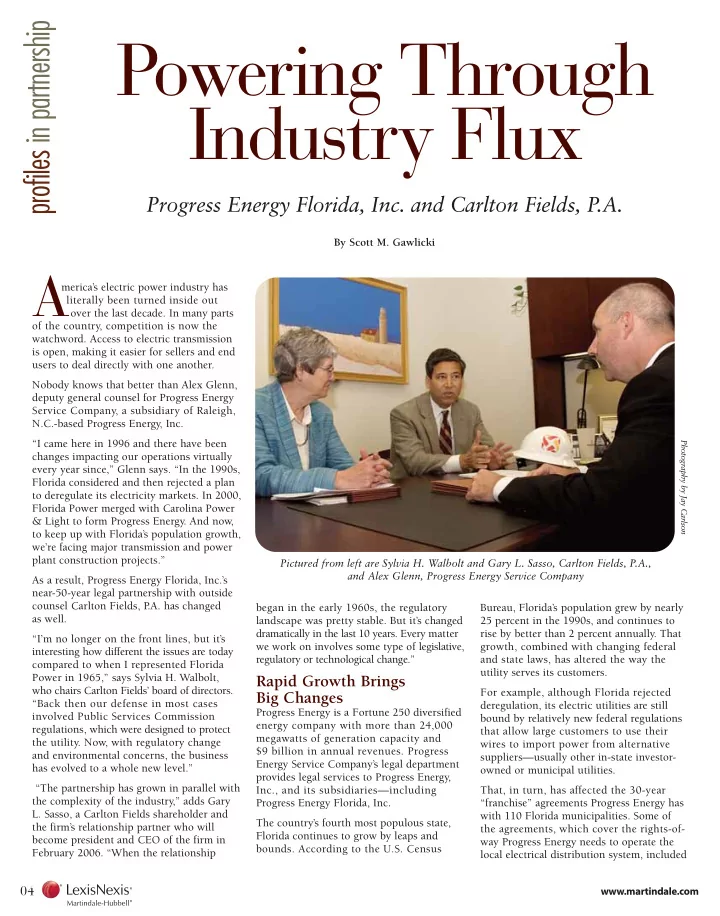
Pictured from left are Sylvia H. Walbolt and Gary L. Sasso, Carlton Fields, P.A., and Alex Glenn, Progress Energy Service Company Bureau, Florida’s population grew by nearly 25 percent in the 1990s, and continues to rise by better than 2 percent annually. That growth, combined with changing federal and state laws, has altered the way the utility serves its customers. For example, although Florida rejected deregulation, its electric utilities are still bound by relatively new federal regulations that allow large customers to use their wires to import power from alternative suppliers—usually other in-state investor-
- wned or municipal utilities.
That, in turn, has affected the 30-year “franchise” agreements Progress Energy has with 110 Florida municipalities. Some of the agreements, which cover the rights-of- way Progress Energy needs to operate the local electrical distribution system, included