SLIDE 1
Post Correspondence Problem
[Section 5.2]
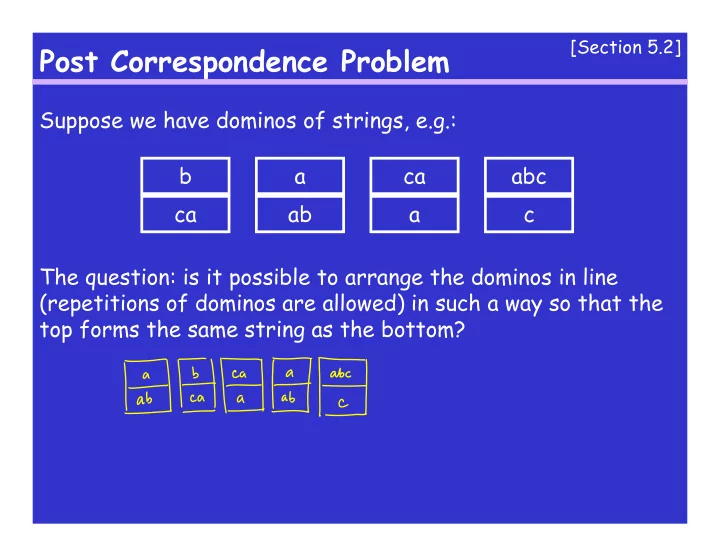
Suppose we have dominos of strings, e.g.: The question: is it possible to arrange the dominos in line (repetitions of dominos are allowed) in such a way so that the top forms the same string as the bottom? b ca abc c ca a a ab
SLIDE 2
Post Correspondence Problem
[Section 5.2]
Formally, given is a collection P of dominos: P = { (t1,b1), (t2,b2), …, tk,bk) } A match is a sequence i1,i2,…,is, where ti1ti2…tis = bi1bi2…bis. The Post Correspondence Problem (PCP) asks if there is a match for P. Thm 5.15: PCP is undecidable.
SLIDE 3
Post Correspondence Problem
[Section 5.2]
First, we’ll consider MPCP where we are looking for instances that have a match that starts with the first domino. MPCP = { <P> | P = { (t1,b1), (t2,b2), …, tk,bk) } is a PCP that has match starting with (t_1,b_1) } Claim: PCP is equivalent to MPCP.
SLIDE 4
Post Correspondence Problem
[Section 5.2]
Thm 5.15: PCP is undecidable.