SLIDE 1
F-conf. Nihon-u. Juli. 2010
Portraits of manifolds
福田拓生先生に、感謝を込めて
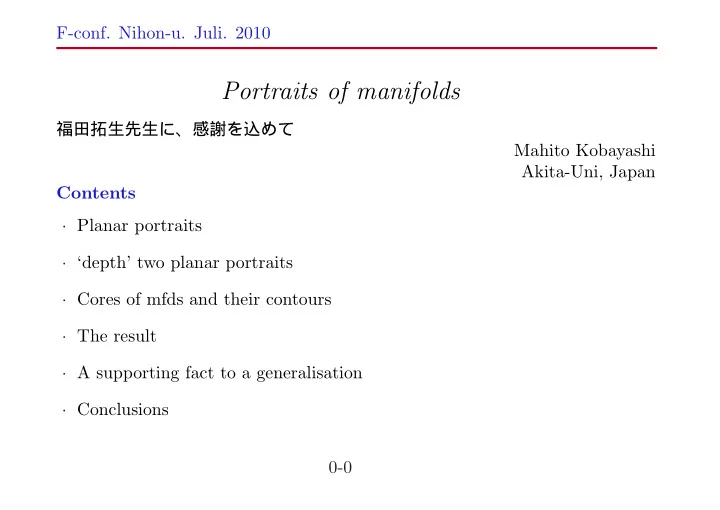
Mahito Kobayashi Akita-Uni, Japan Contents · Planar portraits · ‘depth’ two planar portraits · Cores of mfds and their contours · The result · A supporting fact to a generalisation · Conclusions 0-0
SLIDE 2
- 1. Planar portraits of mfds
Definition: For a stable map f : M → N a stable map of a smooth, closed manifold M of dim M ≥ 2, to a smooth manifold (not necessarily closed) N, the portrait of M in N through f is the pair P = (f(M), f(Sf)) up to diffeomorphism of N, where Sf = singular points = {x ∈ M; dfx is not surjective}. In this talk, we consider the case where N = R2 throughout. The portrait P is referred to as a planar portrait (pl.ptr). 0-1
SLIDE 3
known results example: The second factor f(Sf) of P is called the critical locus. It is a curve, not necessarily connected, possibly with a finite num. of cusps and normal crossings. A pl.ptr can be considered a geometric representation of a mfd. But few are known on its general relation to M except the two below: · A classical relation of R.Thom that; χ(M) ≡ ♯Cusps mod 2. · H.Levine’s observation that; For a submersion γ : R2 → R with γ ◦ f a Morse function, one can know the Morse indices of crit. pts of γ ◦ f from the indices of folds of f. 0-2
SLIDE 4
We are interested in why a planar portrait is so shaped. Below is a pl.ptr shared by all and only by Σ-bundles over S1, where Σ = Dn−1 ∪ Dn−1 is a homotopy sphere. · How the common properties of mfds are reflected in this critical locus ? The two general results do not answer to the question. In this talk, we point out for P in a special class its relation to the contours
- f a set of sub manifolds projected into R2.
It helps us to consider what kind of properties of M can or can not be extracted from P. 0-3
SLIDE 5
The depth of a region of P is the min. num. of intersections of transverse arcs from the region to the outside (∞-)region. The depth of P is the max. of them for all regions. A crossing of the critical locus of P is the (−, −)-crossing if it is the image of a pair of indefinite folds. We consider P of depth two and no (−, −)-crossings. Examples
( - , - )-cross. depth = 2 (excluded)
0-4
SLIDE 6
Lem: For our P, the closure of the depth two region is homeomorphic to D2. Hence P is the polygon (it may be 0- or 1-gon) possibly with loops and arcs between vertices, and a circle enclosing them attached. · If ♯cusps ≥ 2, then any ‘abstractly’ considered P in the above class can be realised by a mfd M. · Abstractly considered P with ♯cusps = 1 can not be realised. · Some are realised, while others are not, in case ♯cusps = 0. · Sn, RP 2, CP 2, orthogonal Sp-bdles / Sq with cross-sections, their connected sums, have P of this class. 0-5
SLIDE 7
- 3. Circle decomp. of the crit.locus
Lem: Let P be as before (depth two, no (-,-)-cross). Its critical locus can be decomposed into the union of circles possibly with normal crossings, through the procedure below: Procedure: Connect each cusp with a boundary point of P through an arc. Then modify the locus in a nbhd of the arc as in Fig. so that two normal crossings
- appear. We put a vertex to the crossing nearer to the boundary of P.
example: 0-6
SLIDE 8
more examples By construction, these system of circles ‘span’ P. We study the nature of them, in relation to M. 0-7
SLIDE 9
- 4. Cores of mfds and their contours
Definition: A set of sub-mfds F = {Si} of a mfd M is a core system if · At each intersection p of Si1, · · · , Sik, TpM is the direct sum of TpSij’s, and if ∃H : M → R, a Morse function s.t.; · Each critical point of H is an intersection of some Si’s, and · H|Si is a Morse function only with maximums and minimums as critical points. We put a vertex to µ(p) for each intersection p of Si’s (gray colored, if p ∈ Crit(H), and white colored otherwise). 0-8
SLIDE 10
A projection of F is the map µ : ∪Si → R2 with the properties that; · µ|Si is an immersion if dim Si = 1, or a stable map onto D2 (definite fold map) otherwise. · If p ∈ Si1 ∩ · · · ∩ Sik, then it is a singular point of any µ|Sij. · Intersections of components are mapped to distinct points. example
S x S p 1 Sp S1 a projection of the core sys.
0-9
SLIDE 11
a net of crit.pts contours (lines and vertices)
The lines and vertices of a µ-image of F are called the contours of µ. By replacing each disc image with an arc between vertices, we obtain a graph representation ΓH,F, from a µ-image. It represents a graph whose nodes are intersections of Si’s, and whose pairs of nodes are linked if they are connected by a monotonous arc in ∃Si. The representation ΓH,F is called the Net of crit.pts of H through F. 0-10
SLIDE 12
Assume that P is a pl.ptr of a mfd, of depth =2 with no- (-,-)-crossings. We add vertices and boundaries of 2-discs to the circle decomp. of the crit. locus of P by the procedure below: Procedure: For each looped component of the circle decomp. of the critical locus, add pairs of vertices and boundary of discs as illustrated. Pairs of the white and gray vertices are added. This system of circles and vertices are built from curves in R2, with no regard to M. Our result is to give it a geometric nature, in relation to M, as mentioned. 0-11
SLIDE 13 Theorem: Assume that ♯cusps ≥ 2. Then the above system of vertices and circles are contours of a core system F = {Si}. Cor: Assume that ♯cusps ≥ 2. The pl.ptr P can be obtained from contours of a core system F by the modification below:
gray or white
Cor: Assume that ♯cusps ≥ 2. A net of crit.pts for a Morse function can be
0-12
SLIDE 14
Example
p=n-1 p-2 p p p p p p p=n-1 n p 1 p 1 planar portrait contours net of crit.pts p p
The middle one gives an answer to the question “why P is so shaped”. Other than this, these figures will help us · to understand the projection, · to know the homological structure of M, · to find the homology generator... etc. 0-13
SLIDE 15 Remarks
- 1. There is no such P of ♯ cusps = 1, as mentioned.
- 2. In the case where ♯cusps = 0, the same statement holds, after modifications
to the procedure to take additional contours.
- 3. ‘depth’ and the number of (−, −)-crossings define a filtration on the set of
all pl.ptrs. ‘depth one’ pl.ptrs are the first class, where ♯cusps is always
- zero. In the class, we can also find cores and contours in the corollaries.
0-14
SLIDE 16 A supporting fact to a generalisation Let P be a pl.ptr. of a mfd M of dim M ≥ 2. Problem: Can P be obtained from contours of a core sys. F = {Si} of M ? A supporting fact The projective 3-spaces RP 3, CP 3 have the pl.ptr below. It has depth two and three (−, −)-crossings. It is obtained from contours of a core sys. F = {Si}, through a modified procedure, where Si = P 1, i = 1, . . . , 6. One can obtain ΓH,F = K4 (the complete graph of 4-nodes) from the contours.
p= n / 3 p p p p p p p 2p n=3p planar portrait contours net of crit.pts depth =2
0-15
SLIDE 17
Difficulty of the circle decomp. in general cases We have at this moment no nice idea of it. The projective planes RP 2, CP 2 have e.g. the pl.ptrs as below. They have decompositions as below; which are obtained in an ad hoc way. 0-16
SLIDE 18 Conclusions
- 1. We are interested in how the pl.ptrs of mfds are shaped.
- 2. We have pointed out that they are shaped by the contours of cores, for a
class of portraits.
- 3. It is an open problem whether this is the case in general.
Thank you 0-17