
SLIDE 1
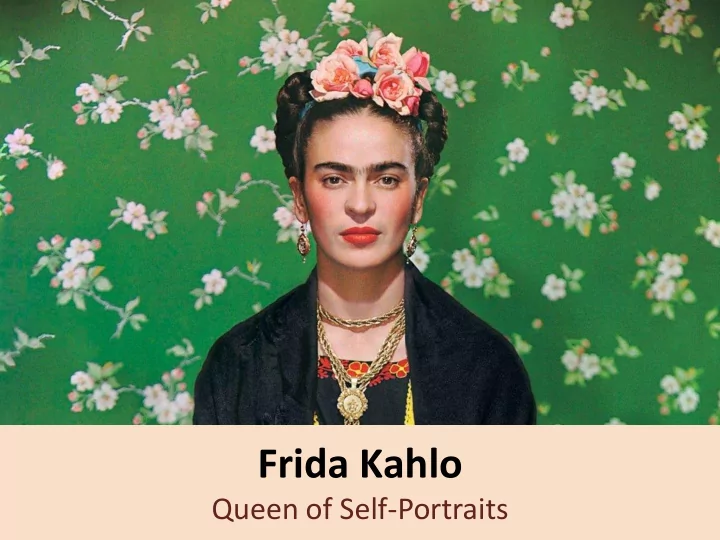
Frida Kahlo Queen of Self-Portraits Frida Kahlo was a Mexican - - PowerPoint PPT Presentation
Frida Kahlo Queen of Self-Portraits Frida Kahlo was a Mexican artist known for her self- portraits. Her paintings were influenced by the Mexican folk culture and the bright and vibrant colors that surrounded her. As a young child she loved
Frida Kahlo was a Mexican artist known for her self-
influenced by the Mexican folk culture and the bright and vibrant colors that surrounded her.
As a young child she loved to draw. When she was 6 years old, she contracted the polio virus, which damaged her leg. Frida was bedridden for 9 months. When she was 18 years old she was in a bus accident. This left her with many broken bones. She spent 3 months in bed to recover. After the initial recovery, she suffered from severe pain, which left her bedridden for months at a time. In total, she underwent 35 surgeries.
Her parents made her a special easel and her father gave her his oil paints and brushes. While bedridden, she took up painting to occupy her time. She expressed the pain she was feeling in her paintings.
Can you find Coyoacan on the map? Frida Kahlo was born in Coyoacán, Mexico on July 6, 1907. She grew up in a house called La Casa Azul (the Blue House) with her parents and 6
Frida was very proud of her
by traditional Mexican art, which is patterned, colorful and bright.
In her self-portraits, she featured animals such as parrots, monkeys, dogs and deer. Frida also loved to paint gardens and vibrant colored fruits.
Self-portrait, 1922 (Age 15) Self-portrait, 1925 (Age 18)
Self-portrait, 1926 (Age 19) Self-portrait, 1937 (Age 30)
Self-portrait, 1940 (Age 33) Self-portrait, 1945 (Age 38)
Frida’s unibrow is important. She stated “I won’t curb my self-expression to meet your expectations of how a woman should look.” Her striking dark brow is a expression rejecting stereotypes about what is and isn’t attractive. Frida celebrated her identity with Mexican features, upper lip and the shocking unibrow.
Draw an oval Lightly draw a T Draw the eyes on the middle line. Leave one “eye” in between, then erase. Divide the lower space ½ & draw a line Draw a triangle nose down to 2nd line Line up nostrils with the inside corner of the eye For brow line, draw a line above the eyes. Draw eyebrows by beginning at the inside corner
at outside corner
Split lower part of face and draw lips
extended to width of nostrils. Draw ears between eye brow line and nose line. Add hair – hairline can extend above and lower hair line!
Draw an oval Lightly draw a T Draw the eyes on the middle line. Leave one “eye” in between, then erase. Divide the lower space ½ & draw a line Draw a triangle nose down to 2nd line Line up nostrils with the inside corner of the eye For brow line, draw a line above the eyes. Draw eyebrows by beginning at the inside corner of eye and arch at outside corner of eye Split lower part of face and draw lips on the
width of nostrils. Draw ears between eye brow line and nose line. Add hair – hairline can extend above and lower hair line!