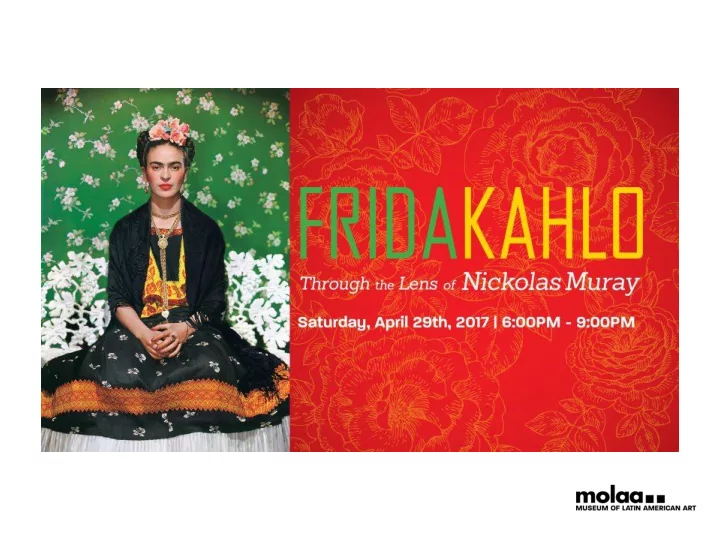
SLIDE 1
SLIDE 2 Introduction In May 1931 photographer Nickolas Muray (1892-1965) traveled to Mexico on vacation where he met Frida Kahlo (1907-1954), a woman he would never forget. The two started a romance that continued on and off for the next ten years and a friendship that lasted until her death in 1954. Approximately fifty photographic portraits taken by Nickolas Muray of Frida Kahlo comprise the exhibition Frida Kahlo: Through the Lens of Nickolas Muray. The photographs, dating from 1937 to 1946, explore Muray’s unique perspective; in the 1930s and 1940s he was Frida Kahlo's friend, lover and
- confidant. Muray's photographs bring to light Kahlo's deep
interest in her Mexican heritage, her life and the people significant to her with whom she shared a close friendship.
SLIDE 3 Born in Hungary, Nickolas Muray became a successful New York fashion and commercial photographer known for his portraits of celebrities, politicians, socialites and artists. Having experimented with color in his work from early
- n, he found his most colorful model in Frida Kahlo. Muray was a prolific
photographer, his archives containing over 25,000 images. Muray photographed Kahlo more than any of his other subjects. These portraits of Kahlo have made their way into a variety of media and popular culture, and are integral to the world’s understanding of who Frida Kahlo was as an individual behind her artwork.
SLIDE 4 Nickolas Muray and Frida Kahlo In 1923 Nickolas Muray met the Mexican artist Miguel Covarrubias who had come to New York with a six-month grant from the Mexican Government. Soon after his arrival, Covarrubias started working for Vanity Fair magazine where the two became friends. In 1931 Muray traveled to Mexico to vacation with Covarrubias and his wife,
- Rosa. Since Covarrubias had been a student
- f Diego Rivera it was inevitable that Frida
Kahlo and Nickolas Muray would meet. From that meeting came a lifelong friendship and ten-year long love affair. Frida with Nick, (detail) Coyoacán, 1939 Digital pigment print on Hahnemuhle Photo Rag paper
SLIDE 5
SLIDE 6
SLIDE 7
SLIDE 8
SLIDE 9
Frida with Diego and Miguel Covarrubias, Tizapán, 1937 Digital pigment print on Hahnemuhle Photo Rag paper Miguel Covarrubias at Easel, 1940 Digital pigment print on Hahnemuhle Photo Rag paper
SLIDE 10 Miguel Covarrubias at Easel, 1940 Digital pigment print on Hahnemuhle Photo Rag paper Miguel Covarrubias and Nickolas Muray became friends when they met in New York in 1923. After Muray's third divorce in 1931, he went to Mexico where Covarrubias and his wife Rosa introduced him to many of their artist friends, including Frida Kahle, wife of Miguel's former teacher Diego
- Rivera. Largely self-taught, Covarrubias published
his first illustration in 1920. By the time he went to New York in 1923, his drawings had been widely published in Mexico and Cuba as well as in South and Central America. In New York, he earned prompt recognition as a brilliant illustrator, stage designer and caricaturist. His work has been shown at the Guggenheim Museum and the Whitney Museum of American Art.
SLIDE 11
- When visiting Mexico, Muray stayed at the home
- f Miguel and Rosa Covarrubias. They lived in the
small town of Tizapán, today part of Mexico City.
- By the time Muray shot these photographs of
Frida in the Covarrubias home, he was very much in love. Frida's gaze as she looks at him suggests that she too had fallen in love with him.
SLIDE 12
Frida, Tizapán, 1937 Digital pigment print on Hahnemuhle Photo Rag paper
SLIDE 13
Miguel Covarrubias Print of Caricature of Nickolas Muray, c. 1927 In the 1920s, Muray was a well-known celebrity photographer and active participant in New York's Bohemian art scene. In the following decades, he focused successfully on commercial photography, eventually becoming a master of the emerging color processes. Muray was a champion fencer; he represented the United States at the Olympic Games in 1928 and 1932. However, in this caricature portrait drawn by Miguel Covarrubias, he is not really portrayed as an Olympic fencer but rather as a lady-killer. Nick stands above the woman he has just conquered not with his sword, but with his heart.
SLIDE 14 Frida and Diego, Tizapán, 1937 Digital pigment print on Hahnemuhle Photo Rag paper
- Frida Kahlo and Diego Rivera remarried in
the summer of 1941 after nearly two years
- f separation.
- Regarding her marital relationship, Kahlo
- nce told French photographer Gisèle
Freund: "I suffered two grave accidents in my life. One in which a streetcar knocked me down. The other accident is Diego."
SLIDE 15 Frida within Picture Frame, Coyoacán, 1938 Digital pigment print on Hahnemuhle Photo Rag paper Frida places her face within the frame she will use for the self-portrait hanging on the wall to her left, Remembrance
- f an Open Wound, 1938. At
age 18, Frida was involved in a gruesome traffic accident that left her severely debilitated. She began painting during her recovery the following year. Much of her art references the physical and emotional pain she suffered all of her adult life.
SLIDE 16
Frida, Countryside, 1938 Digital pigment print on Hahnemuhle Photo Rag paper Diego with gas mask, Coyoacán, 1938 Digital pigment print on Hahnemuhle Photo Rag paper
SLIDE 17 Diego with gas mask, Coyoacán, 1938 Digital pigment print on Hahnemuhle Photo Rag paper Toward the end of 1938, talk of war compelled people to buy gas masks. If war were to break
- ut people thought these masks would protect
them from breathing toxic fumes.
SLIDE 18
Frida Icon, San Angel, 1938 Silver gelatin print Frida in Pink and Green Blouse, Coyoacán, 1938 Carbon process print
SLIDE 19
Frida and Diego, kissing, Coyoacán, 1938 Digital pigment print on Hahnemuhle Photo Rag paper Frida and Diego, Coyoacán, 1938 Silver gelatin print
SLIDE 20
Frida in Front of the Cactus Organ Fence, San Angel, 1938 Digital pigment print on Hahnemuhle Photo Rag paper Frida, Coyoacán, 1938 Digital pigment print on Hahnemuhle Photo Rag paper
SLIDE 21
Frida, Countryside, 1938 Digital pigment print on Hahnemuhle Photo Rag paper Frida with her sister Cristina, Nickolas Muray, and Rosa Covarrubias, Coyoacán, 1939 Digital pigment print on Hahnemuhle Photo Rag paper
SLIDE 22
Frida with Nick, (detail) Coyoacán, 1939 Digital pigment print on Hahnemuhle Photo Rag paper Frida painting The Two Fridas, Coyoacán, 1939 Silver gelatin print
SLIDE 23
Frida painting The Two Fridas, Coyoacán, 1939 Silver gelatin print After she returned from France in 1939, Diego Rivera asked Frida for a divorce. During the first year of their separation she produced The Two Fridas. In it she portrays herself twice: on the right is the Frida who lives sustained by Diego's love, and on the left is the Frida he no longer loves. Painting in photograph: Frida Kahlo The Two Fridas, 1939 Oil on canvas Collection Museo de Arte Moderno, Consejo Nacional para la Cultura y las Artes - Instituto Nacional de Bellas Artes, Mexico City, Mexico
SLIDE 24
Frida with Olmeca Figurine, Coyoacán 1939 Carbon process print
SLIDE 25
Frida, Coyoacán, 1939 Digital pigment print on Hahnemuhle Photo Rag paper Frida with Picasso Earrings, Coyoacán, 1939 Digital pigment print on Hahnemuhle Photo Rag paper
SLIDE 26
Frida with Picasso Earrings, Coyoacán, 1939 Digital pigment print on Hahnemuhle Photo Rag paper The hand-shaped earrings Frida wears in the photograph were a gift to her from Pablo Picasso, who she met in 1939 when her work was exhibited in Paris. Picasso, along with artists Kandinsky, Miró, Paalen and Tanguy among others, praised Frida's paintings. While in Paris, her small self-portrait The Frame was purchased by the Louvre.
SLIDE 27
Frida with Blue Satin Blouse, New York, 1939 Carbon process print
SLIDE 28 In 1930 Muray traveled to Europe after deciding he would begin photographing in color. In Germany he purchased a Jos-pe camera. With its three glass plates and filters, it captured delicate colors and true flesh tones. He began to work with color photography against the advice of critics and other photographers who believed the technique would never be good enough to attract the
- public. He proved everyone wrong.
His innovative work became a sensation following the publication
- f the first color advertisement
ever: a color photograph cover for the June 1931 issue of Ladies' Home Journal.
SLIDE 29
Frida on White Bench, New York, 1939 Digital pigment print on Hahnemuhle Photo Rag paper In the fall of 1939, during her long visit to New York for a solo exhibition, Nick and Frida were at the height of their love affair. One Sunday morning, Muray photographed Frida sitting on a white bench in his studio. A few days later, she left for Paris where she was to participate in a group exhibition.
SLIDE 30
Frida Kahlo, The Breton Portrait, 1939 Carbon process print Frida with Magenta Rebozo, New York, 1939 Digital pigment print on Hahnemuhle Photo Rag paper
SLIDE 31 Frida Kahlo, The Breton Portrait, 1939 Carbon process print In the spring of 1938, Nickolas Muray visited Mexico, where he and his wife Jacqueline were guests
- f Diego Rivera; there he met
André Breton, the famed Surrealist. Breton commissioned a portrait of Kahlo from Muray, and “The Breton Portrait”, a black and white variant
- f the portrait of Frida Kahlo in
Magenta Rebozo, was the result. Muray made only one print of this image, Breton’s copy.
SLIDE 32
Classic Frida (with Magenta Rebozo), New York, 1939 Carbon print
SLIDE 33 This photograph is considered Muray's masterpiece and is likely his most famous image. It has been reproduced more often than any
- ther. Muray shot it in his studio in
New York City shortly before Frida's departure for France. When the photograph arrived in Mexico and Diego Rivera saw it, he remarked in awe that it was as beautiful as a painting by Italian Renaissance artist Piero della
- Francesca. This portrait hung for
years over Frida and Diego's bed. On the back, she signed: Nick, with all my heart, with all my love, with all my memory, I think of
SLIDE 34
Frida with Blue Satin Blouse, New York, 1939 Digital pigment print on Hahnemuhle Photo Rag paper Frida, Coyoacán, 1939 Digital pigment print on Hahnemuhle Photo Rag paper
SLIDE 35
Frida with her pet eagle, Coyoacán , 1939 Digital pigment print on Hahnemuhle Photo Rag paper Frida with Granizo, Coyoacán 1939 Silver gelatin print
SLIDE 36 Frida with Granizo, Coyoacán 1939 Silver gelatin print Frida loved animals. In the garden of her home she sheltered a menagerie of Mexican hairless dogs, cats, monkeys, parrots and ducks. She even owned a pet deer named Granizo, or "hail" in Spanish, so named because of the white spots on his back. Frida included many
- f these animals in her paintings.
SLIDE 37
Frida with Granizo, Coyoacán 1939 Silver gelatin print Print of Self-portrait with Thorn Necklace and Hummingbird by Frida Kahlo 1940, Digital pigment print on Hahnemuhle Photo Rag paper
SLIDE 38 Print of Self-portrait with Thorn Necklace and Hummingbird, 1940 Nick acquired this self-portrait from Frida in 1940, the year she and Diego Rivera divorced. Nick believed they would marry but Frida had no intention of marrying him; she could only think of Diego. Frida turned 33 in
- 1940. During that year she painted herself like Jesus
Christ at the same age when he was betrayed and
- crucified. She used attributes of Christ's crucifixion to
describe her own experience. The unfurled crown of thorns she wears as a necklace digs deep into her flesh, wounding her until she bleeds. The butterflies in her hair refer to Christ's
- resurrection. Other symbols include a dead
hummingbird hanging from her neck. Hummingbirds were used by indigenous peoples in Mexico as amulets to attract love from a lover who had lost interest.
SLIDE 39
Frida leaning on a sculpture by Mardonio Magaña, Coyoacán, 1940 Digital pigment print on Hahnemuhle Photo Rag paper
SLIDE 40 In 1929 Diego Rivera discovered that Mardonio Magaña, caretaker at an art school in Coyoacán, was actually an extraordinary sculptor who carved his wood sculptures with a
- penknife. Rivera arranged
Magaña's first exhibition at the Palacio de Bellas Artes in Mexico
- City. The show was a great success.
Frida and Diego acquired several of Magaña's works and kept them around the garden of their home in Coyoacán. Their home, today a museum, is known as the Casa Azul, or blue house in Spanish.
SLIDE 41
Frida in Yellow Chair, San Angel, 1941 Digital pigment print on Hahnemuhle Photo Rag paper
SLIDE 42 As a child, Frida wore double socks to hide her right leg, which was thinner due to a bout with polio at age six. When they were married, Diego Rivera encouraged Frida to dress in traditional Tehuana costume. The long Tehuana skirts more readily hid her leg. In her self-portraits, Frida often represented herself wearing a Tehuana braided hairdo and
- clothing. However, she liked to joke she had
never even visited the Tehuantepec region in Southern Mexico; Frida said she wore the Tehuana costume because she liked it and because Diego liked to see her wear it.
SLIDE 43
Frida with Nick in her Studio, Coyoacán, 1941 Silver gelatin print
SLIDE 44
In August of 1941, as their affair ended, Muray captured their visit on film. In this complex composition Frida sits next to her easel, her mirror and her self-portrait Me and My Parrots. Muray included objects that exposed their affair as well as her relationship to Diego Rivera. Painting in photograph: Frida Kahlo Me and My Parrots 1941, Oil on canvas 32" x 24 1/2" Private Collection
SLIDE 45
Frida, San Angel, 1941 Digital pigment print on Hahnemuhle Photo Rag paper Frida and Diego, San Angel, 1941 Silver gelatin print
SLIDE 46
Frida with Diego, San Angel, 1941 Digital pigment print on Hahnemuhle Photo Rag paper Frida in the dining area, Coyoacán, 1941 Digital pigment print on Hahnemuhle Photo Rag paper
SLIDE 47 Frida with Arija, Coyoacán, 1941 Digital pigment print
Photo Rag paper
SLIDE 48 During the summer of 1941, Arija, Muray's daughter by his second wife, traveled to Mexico City to study art with
traveled to Vera Cruz where she caught a deadly infection. She died less than a month after returning to New York, devastating her father.
SLIDE 49 Frida in her wheelchair, Coyoacán, 1945 Digital pigment print Cristina and Frida, New York, 1946 Digital pigment print Diego Rivera and Frida wed for the first time in 1929: her first marriage, his third. Diego had numerous affairs both before and during his marriages. Frida, too, had passionate love affairs with both men and women. After Diego and Frida returned from New York in 1934, he began an affair with her younger sister
- Cristina. The two sisters were
estranged and the couple separated for a time, but Frida eventually reconciled with both.
SLIDE 50 Frida in her wheelchair, Coyoacán, 1945 Digital pigment print Even after their love affair had ended, Nick returned to Mexico nearly every December, each time paying a visit to Frida. On this
- ccasion he found her suffering from back
- trouble. Shortly thereafter, she would travel to
New York for a spinal fusion operation that would fail to relieve her pain.
SLIDE 51 In 1946, while in New York for a spinal fusion
- peration, Frida visited Nick. She arrived with
her sister Cristina and her new lover, artist and Spanish refugee Joseph Bartoli. When Muray photographed Frida on the rooftop of his duplex, she was no longer in love with him, which is evident in the way her face turns away from his gaze as opposed to the times when he photographed her while they were lovers.
SLIDE 52
Frida, New York 1946 Digital pigment print on Hahnemuhle Photo Rag paper Frida on Rooftop, New York 1946 Carbon process print
SLIDE 53
Print of What the Water Gave Me by Frida Kahlo 1938 Digital pigment print on Hahnemuhle Photo Rag paper In exchange for helping Frida pay her expenses in Paris, Nick received her painting What the Water Gave Me. It is Frida's metaphorical self- portrait of what life had given her. Events from her chaotic life, rather than her face, float in the bathtub while she bathes. This painting is full of symbols that relate to other paintings and to incidents in Frida's life. André Breton, the French Surrealist artist, was so riveted by the painting when he saw it on her easel that he reproduced it in Minotaure, a French surrealist publication. Breton asked Frida to go to Paris to exhibit her work. It is likely she chose this painting for Nick because it had been the best and most complex one she exhibited. The painting was also the most telling; it informed him that her life was shaped by destruction—a warning he should have heeded.
SLIDE 54
Print of The Dream by Frida Kahlo 1940 Digital pigment print on Hahnemuhle Photo Rag paper Print of Still life with Parrot by Frida Kahlo 1951 Digital pigment print on Hahnemuhle Photo Rag paper
SLIDE 55 Print of The Dream by Frida Kahlo 1940 Digital pigment print on Hahnemuhle Photo Rag paper Frida painted this during the year in which she and Diego Rivera were
- divorced. She portrayed herself
dreaming of her death and reaching the heavens in the company of a paper mache Judas figure lying flat above the canopy of her bed. In her personal life the figure represents Diego, the traitor. Nick had this painting in his home for a while, but eventually decided to return it to Frida.
SLIDE 56 Print of Still life with Parrot by Frida Kahlo 1951 Digital pigment print on Hahnemuhle Photo Rag paper In December of 1951 Nick visited Frida at the Casa Azul with his wife Peggy and their two young children, Mimi and
- Chris. As a parting gift, Frida gave Nick
this still-life painting of a watermelon and a parrot. This was the last time Nick and Frida saw each other. Nick kept the painting until his death in 1965.
SLIDE 57
Copy of letter Frida sent to Nick. February 16, 1939, Paris
SLIDE 58
Photo of a page of a love letter Frida sent Nick, and the trinkets she included in the envelope. February 16, 1939, Paris After their first encounter Kahlo sent Muray a note: Nick, I love you like I would love an angel. You are a Lillie of the valley my love. I will never forget you, never, never. You are my whole live I hope you will never forget this. Frida May 31, 1931 Coyoacán
SLIDE 59
Below a lipstick print of a kiss was written: Please come to Mexico as you promised me! We will go together to TEHUANTEPEC- in August- This is specially for the back of your neck. In spite of the passion expressed, Kahlo sent this note with a drawing showing her holding hands with Diego Rivera. This ambivalence would continue to haunt their relationship. Over the next ten years Muray continued to visit Mexico and Frida Kahlo. In between visits they kept up a lively correspondence.