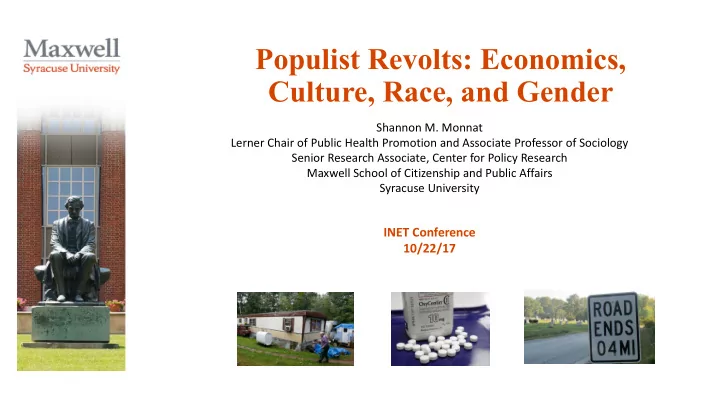
Populist Revolts: Economics, Culture, Race, and Gender Shannon M. - - PowerPoint PPT Presentation

populist revolts economics culture race and gender
SMART_READER_LITE
LIVE PREVIEW

Populist Revolts: Economics, Culture, Race, and Gender Shannon M. - - PowerPoint PPT Presentation

Populist Revolts: Economics, Culture, Race, and Gender Shannon M. Monnat Lerner Chair of Public Health Promotion and Associate Professor of Sociology Senior Research Associate, Center for Policy Research Maxwell School of Citizenship and Public


slide-1
SLIDE 1

Populist Revolts: Economics, Culture, Race, and Gender

Shannon M. Monnat Lerner Chair of Public Health Promotion and Associate Professor of Sociology Senior Research Associate, Center for Policy Research Maxwell School of Citizenship and Public Affairs Syracuse University

INET Conference 10/22/17

slide-2
SLIDE 2

Common Th Themes across Papers

  • Factors driving revolts are inherently economic
  • Education, historical dependence on manufacturing, low income, high

unemployment main drivers of Brexit vote in both Britain and France (Becker, Fetzer, Novy)

  • Extreme right parties increased in regions facing more import competition

and labor market turmoil (Dippel, Gold, Heblich, and Pinto)

  • We didn’t get here all of a sudden. Long-term drivers at play
  • The role of racial resentment
  • Played a role in US Republican primary election, but has for a long time

(Ferguson)

slide-3
SLIDE 3

A Rur ural Revolt?

slide-4
SLIDE 4
  • “Output” based on GDP
  • Undervalues raw

materials that go into food, energy; military personnel; natural amenity recreation; retirement destinations – things “high output” America depends on.

“L “Low-ou

  • utput” a

as a a p proxy f for

  • r r

rural

slide-5
SLIDE 5

Ru Rural Revolt?

Source: Dave Leip’s Atlas of U.S. Elections.

slide-6
SLIDE 6

Tr Trump Overperformance

Trump (16) vs. Romney (12) county vote share

slide-7
SLIDE 7

Ch Change i in E Economic D Distress, 2 2000 t to 2 2011-15 15 “L “Landscapes of Despair”

Based on prime-age poverty, not working (unemployed/nilf), public assistance receipt, disability, single-parent families; county-to-state median HH income ratio, county-to-state median owner-occupied home value ratio

slide-8
SLIDE 8

Data Source: CDC WONDER, Multiple Cause of Death Files, 1999-2015

Dr Drug-Re Related Mortality, 2006-15 15

slide-9
SLIDE 9

100 150 200 250 300 350 400 450 1999 2000 2001 2002 2003 2004 2005 2006 2007 2008 2009 2010 2011 2012 2013 2014 2015 Deaths per 100,000 population

All-Cause Mortality (ages 25-64) by Metro Status, 1999-2015

Large Central Metro Large Fringe Metro Medium/Small Metro Nonmetro

Data Source: U.S. Centers for Disease Control and Prevention. CDC Wonder. Multiple Cause of Death Files. Note: Rates are age-adjusted.

slide-10
SLIDE 10

Tr Trump over-performance by y distress quartile

  • 5

5 10 15 20 25 Economic Distress Poor Health DAS Mortality % <4-year College Degree % Separated/Divorced Economic Distress Poor Health DAS Mortality % <4-year College Degree % Separated/Divorced Urban Rural Trump Overperformance (%) Q1 Q2 Q3 Q4

DAS = drug, alcohol, suicide

slide-11
SLIDE 11

Economic Distress Family Distress Social Capital Shortage

Lands ndscape pes of Despa pair

slide-12
SLIDE 12

Lo Long-te term drive vers at at play

“This was not new; it had been happening for fifteen years. And there was more to it than drugs. This scourge was…connected to the conflation of big forces: economics and marketing, poverty and prosperity. Forgotten places of America acted like the canaries in those now-shuttered Appalachian coal

  • mines. Just no one in the country listened

much until more respectable types sounded the same alarm.” – Sam Quinones, Dreamland

slide-13
SLIDE 13

Non Non-Co College Educated Wh Whites are Far Less Positive about their Relative Standard of Living than are Black cks and Hispanics cs

Source: Cherlin, Andrew. “Why are White Death Rates Rising? The New York Times. Feb 22, 2016.

“Years of decline in the blue-collar economy manifested themselves in the material prospects of Middletown’s

  • residents. The Great Recession, and the

not-great recovery that followed, has hastened Middletown’s downward

  • trajectory. But there was something

almost spiritual about the cynicism of the community at large, something that went much deeper than a short-term recession… There is no group of Americans more pessimistic than working-class whites.” ” – J.D. Vance, Hillbilly Elegy

slide-14
SLIDE 14

Lo Long-te term Drive vers at at Play

“Looking back at my previous research, I see that the scene had been set for Trump’s rise, like kindling before a match is lit. Since 1980, virtually all those I talked with felt on shaky economic ground. It was a story of unfairness and anxiety, stagnation and slippage—a story in which shame was the companion to need.” – Arlie Hochschild, Strangers in their Own Land

slide-15
SLIDE 15
slide-16
SLIDE 16

So Social Ca Capital is also Imp mport rtant

slide-17
SLIDE 17

Go Goin ing Forwar ard

  • Consider spatial heterogeneity in the strength of “populist

revolt”

  • Race/ethnicity and social class are inherently intersectional

(very difficult to disentangle)

  • It’s not just the economy – family and social relationships are

wrapped up in it.