Sunflower Production and Market Opportunities Lake Region Roundup - - PowerPoint PPT Presentation

sunflower production and market opportunities
SMART_READER_LITE
LIVE PREVIEW

Sunflower Production and Market Opportunities Lake Region Roundup - - PowerPoint PPT Presentation

Sunflower Production and Market Opportunities Lake Region Roundup 2019 Alison Pokrzywinski Technical Agronomist Market Pyramid Confections Hullers High Oleic & NuSun Birdfood Market Changes 1998 2016 First commercial


slide-1
SLIDE 1

Sunflower Production and Market Opportunities

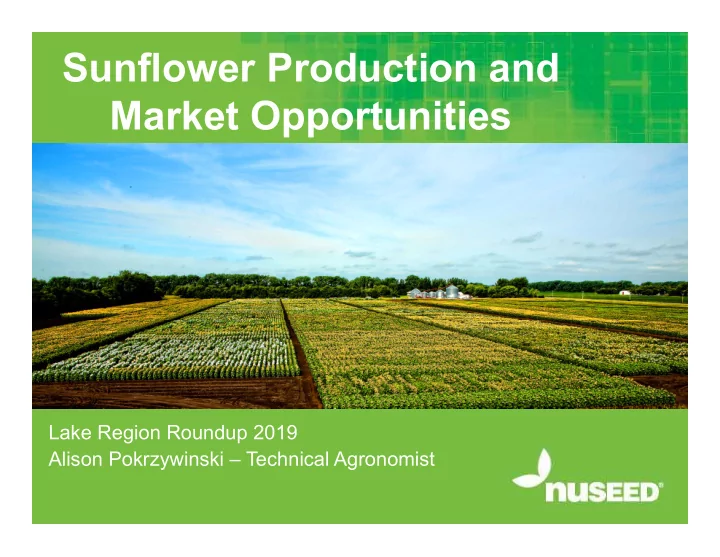
Lake Region Roundup 2019 Alison Pokrzywinski – Technical Agronomist
slide-2
SLIDE 2

Market Pyramid

Confections Hullers High Oleic & NuSun Birdfood

slide-3
SLIDE 3
  • 1998

– First commercial NuSun available – Replaced hybrids with Traditional Oil

  • 2003

– 55% of acres were NuSun

  • 2007

– 85% of acres were NuSun – The remaining High Oleic and Traditional

  • 2016

– Last year of true premiums seen for HO – Growers had $1-$2 premium

  • Shift to more HO acres

resulting in no more premium

  • Over 50% of hybrids now

are High Oleic

Market Changes

slide-4
SLIDE 4

Market Changes

  • How does this affect the grower?

– No more premium for High Oleic vs NuSun – Lower oleic content requirements: 82% vs 85% – Many of the new genetics are High Oleic – Keep bins separate with NS/HO to maintain integrity of the crop

slide-5
SLIDE 5

2019 Crop Insurance Changes

  • Add 5 days to ND final planting date for full

coverage.

– June 5 counties would have June 10 – June 10 counties would have June 15 – Earliest and late planting dates would remain the same

  • Provide insurability for Sclerotinia and dark

roast quality loss in Con-oils & Hullers in 2020

slide-6
SLIDE 6
slide-7
SLIDE 7

Company Dynamics

  • Mycogen and Pioneer = Corteva

– No more US breeding program

  • Syngenta sunflowers sold to Winfield

(Croplan)

  • NuTech and Thunder Seed have exited

the sunflower business

slide-8
SLIDE 8

Fertility

  • Updated in recent years through research

conducted in the Dakotas

– Dr. Dave Franzen, NDSU – Dr. Christopher Graham, SDSU

  • Previously using recommendations that

were over 40 years old

– Fallow, conventional tillage – Disease resistance has improved – Herbicide systems in place

slide-9
SLIDE 9

Fertility

  • New Nitrogen recommendations factor:

– Price of the grain – Price of Nitrogen

  • Sunflower yields increase with additional N

up to a point, then plateau and decrease

– Yield loss from too much N

  • Lodging and disease
  • New Phosphorous recommendation

– Sunflower have been unresponsive to a P application

slide-10
SLIDE 10
slide-11
SLIDE 11
slide-12
SLIDE 12

Diseases

  • Phomopsis Stem Canker

– Not even on the radar in 2005 – Started to take notice in 2010 – Major issue now throughout the region – Complex trait (many genes involved)

  • Like Sclerotinia/White Mold

– No molecular markers available (yet)

slide-13
SLIDE 13

Phomopsis Stem Canker

  • No solid solution yet

– Integrated approach – Rotation, Genetics, Fungicides (R1?)

  • Prediction model in the

future

  • High priority within our

company

slide-14
SLIDE 14

Downy Mildew

  • Plenaris

– Seed treatment – New mode of action that works differently than

  • ther fungicides
  • Genetics

– Working with advanced DM traits

  • Best defense against the disease is an

integrated approach

  • Plenaris + Dynasty (2 modes of action)
  • Genetics
slide-15
SLIDE 15

Rust

  • Updated in the past 5 years
  • Both oilseed and confection

show a yield decrease

– Confections are more susceptible

  • Pays to manage

– 1% severity at R5 or sooner on upper 4 leaves – Triazoles, Strobularins

slide-16
SLIDE 16

Herbicides – BASF

  • Zidua

– Pyroxasulfone – Pre and post emerge – Waterhemp, cocklebur, pigweed, foxtail

  • Clearfield System

– Imazamox

  • Clearfield Plus

– Imazamox + MSO

slide-17
SLIDE 17

Herbicides – FMC

  • Spartan (sulfentrazone)

– Kochia, Lambsquarter, Russian Thistle

  • Aim (carfentrazone)
  • Spartan Charge (Spartan + carfentrazone)
  • Authority Elite (Spartan + s-metolachlor)
  • Authority Supreme (Spartan +

pyroxasulfone)

  • Express (tribenuron)
slide-18
SLIDE 18
slide-19
SLIDE 19

Insecticides

  • In-furrow label

– Mustang Maxx – Cutworms, wireworms

  • Prevathon (Rynaxypyr)

– Short re-entry (4 hrs) – Safer for bees – Long-lasting (21 days) – Excellent on Banded Sunflower Moth – Weaker on Seed Weevil

slide-20
SLIDE 20

Desiccation

  • More growers are desiccating to take

advantage of an earlier harvest

– Roundup, Sharpen, Valor SX (or EZ), Gramoxone – Increase yields and decrease drying costs

  • Late season lodging, seeds rubbing out,

blackbirds, slow-down sclerotinia head rot, early drydown can minimize artificial drying costs

slide-21
SLIDE 21
slide-22
SLIDE 22

Blackbirds

  • Not forgotten about
  • USDA-APHIS

conducting research

– Anthraquinone based repellents – UAS as frightening devices

slide-23
SLIDE 23
  • Help protect against

shatter loss

  • Aid in less than ideal

situations (downed sunflowers)

  • G3 Sunflower

headers by Fantini

  • Sunmaster by

Sheyenne Manufacturing

Better Combines

slide-24
SLIDE 24

Vertical Tillage

  • Can sometimes aid sunflower growers

with higher yields

– Improving drought tolerance – Less wind lodging due to inadequate root base

Roots tend to find the least resistance. Layers caused by smearing can cause horizontal root expression.

slide-25
SLIDE 25

Molecular labs

  • Accelerate the advancement of key

traits

  • Clearfield, Express, DMR, etc
  • Cuts time in half for conversions
  • Developing markers for other traits
  • Color on confections, oil content
  • Predicting diversity and heterosis
slide-26
SLIDE 26

Genetics

  • Advanced Downy Mildew traits
  • XXL Confections (export market)
  • Clearfield Plus
  • High Oleic Conoils
  • Earlier hybrids without sacrificing yield
  • Better phomopsis tolerance
  • Higher oil and oleic contents
  • RSSW genetic resistance
slide-27
SLIDE 27

Sunflowers should not be treated like the runt of the litter!