POPULATION PRESENTATION NOTES More than 7 billion people now life - - PDF document

population
SMART_READER_LITE
LIVE PREVIEW

POPULATION PRESENTATION NOTES More than 7 billion people now life - - PDF document

POPULATION PRESENTATION NOTES More than 7 billion people now life on the earth and that number is growing rapidly. What factors lead people to live where they do? -More than 2/3 of the earth is covered in water. -About of the land area is


slide-1
SLIDE 1

POPULATION

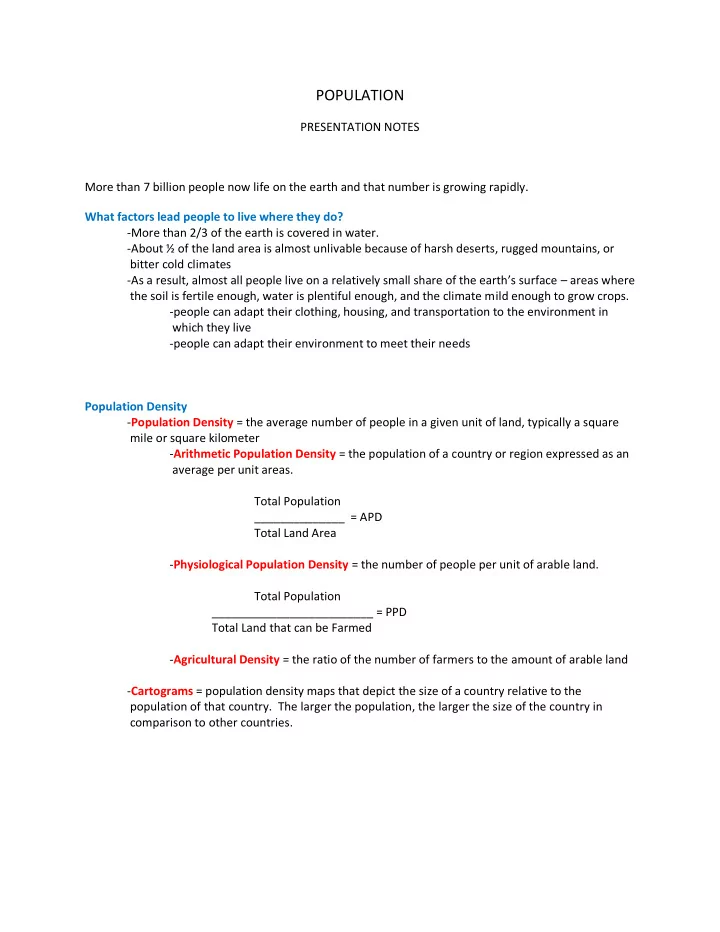
PRESENTATION NOTES More than 7 billion people now life on the earth and that number is growing rapidly. What factors lead people to live where they do?

  • More than 2/3 of the earth is covered in water.
  • About ½ of the land area is almost unlivable because of harsh deserts, rugged mountains, or

bitter cold climates

  • As a result, almost all people live on a relatively small share of the earth’s surface – areas where

the soil is fertile enough, water is plentiful enough, and the climate mild enough to grow crops.

  • people can adapt their clothing, housing, and transportation to the environment in

which they live

  • people can adapt their environment to meet their needs

Population Density

  • Population Density = the average number of people in a given unit of land, typically a square

mile or square kilometer

  • Arithmetic Population Density = the population of a country or region expressed as an

average per unit areas. Total Population ______________ = APD Total Land Area

  • Physiological Population Density = the number of people per unit of arable land.

Total Population _________________________ = PPD Total Land that can be Farmed

  • Agricultural Density = the ratio of the number of farmers to the amount of arable land
  • Cartograms = population density maps that depict the size of a country relative to the

population of that country. The larger the population, the larger the size of the country in comparison to other countries.

slide-2
SLIDE 2

Patterns of Settlement

  • Population Distribution = description of location on Earth’s surface where population lives.
  • Population Clusters = Two-thirds of the world’s population are concentrated in four regions:
  • 1. East Asia (East China, Japan, South Korea, Taiwan)
  • 2. South Asia (India, Pakistan, Bangladesh)
  • bound by the Himalayas and a desert in Pakistan and ocean to the south
  • 3. Europe
  • population is concentrated in cities
  • 4. North America
  • megalopolis/agglomerations
  • Dot Maps = Maps where one dot represents a certain number of phenomenon such as

population.

  • Census = A periodic and official count of a country’s population.
  • Megalopolis = The term used to refer to large urban agglomerations.

Place Characteristics That Produce Low Population Densities Extreme climate Too hot, cold, arid, or wet Antarctica (too cold and too arid) Extreme relief Too high or too steep Himalaya Mountain peaks Extreme remoteness Too hard to access The island of Tristan da Cunha (the world’s remotest inhabited island) Infertile land Unproductive land supports fewer farmers Amazon River Basin (tropical rainforest

  • r selva)

Place Characteristics That Produce High Population Growth Moderate climate Not too hot or too cold England Adequate water supply Ample rainfall year-round Thailand Fertile farmland Many small farms feed many people France Mineral resources Provision of jobs, raw materials, and energy for industries Germany Lowlands and river valleys Flat or gently rolling land provides easier transportation and communication China, Western Europe Coastlines 60% of the world’s population live within 60 miles of the ocean US Eastern Seaboard, South America

slide-3
SLIDE 3

Population Growth

  • Population Explosion = the rapid growth of the world’s human population (past 2 centuries)

attended by even shorter doubling rates and accelerated rates of increase.

  • Doubling Times = the time required for a population to double in size.
  • Natural Increase rate = the difference between the number of births and the number of

deaths.

  • Crude Birth Rate = the number of live births per year per thousand people in

Population

  • Total Fertility Rate = average number of children a woman will have during her child-

bearing years (15-49 yrs of age)

  • Crude Death Rate = the number of deaths per year per thousand people in population

**Natural Increase rate (NIR), Crude Birth Rate (CBR), and Total Fertility Rate (TFR) will almost always mirror each other.**

  • 95% of Global NIR (Natural Increase Rate) is taking place in Lower Development

Countries in areas such as Sub-Saharan Africa and South Asia. Population Trends

  • Population Pyramid = a graphic illustration that shows the distribution of various age groups in

a population.

  • There are three population indicators that are taken into account for the various stages of a

population pyramid:

  • Birth Rate (see Crude Birth Rate)
  • Death Rate (see Crude Death Rate)
  • Life Expectancy = the expected number of years of life remaining at a given age.
  • Because Life Expectancy is an average, a particular person may well die many

years before or after the “expected” survival.

slide-4
SLIDE 4

Migration

  • Periodic Movement:
  • Transhumance= a system of pastoral farming in which ranchers move livestock

according to the seasonal availability of pastures.

  • Migrant Labor= migrants who cross borders to a new location in search of work.
  • Military Service= moving to a new location due to service relocation.
  • Types of Migration:
  • International & Internal Migration: movement of location inside a country’s borders,
  • r moving from one country to another.
  • Voluntary Migration: moving of one’s own free will, after observing and analyzing the

choices, then choosing to migrate.

  • Push Factors- conditions which help a migrant decide to leave a place
  • Pull Factors- condition which successfully attract migrants to a location
  • Forced Migration: migration that is imposed by authorities and leaves the migrant no

choice.