
SLIDE 1
Given a point cloud: – how do you detect and localize objects? – how do you map terrain?
Point Cloud Processing
Has anyone seen the toothpaste?
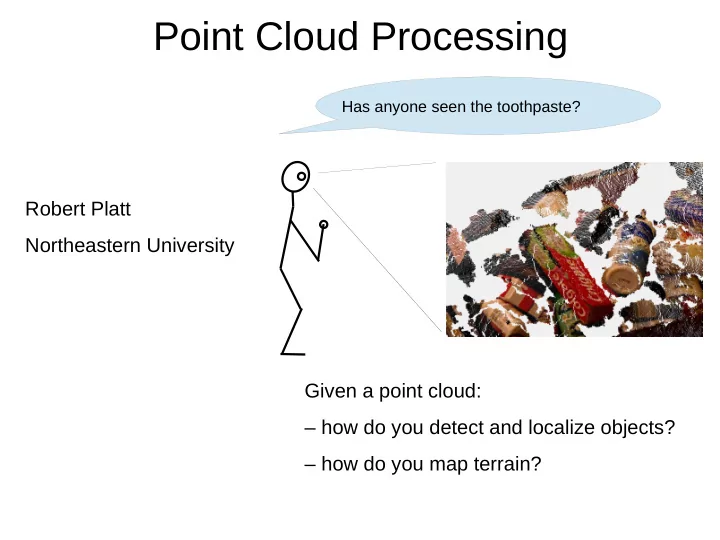
Point Cloud Processing Has anyone seen the toothpaste? Robert Platt - - PowerPoint PPT Presentation
Point Cloud Processing Has anyone seen the toothpaste? Robert Platt Northeastern University Given a point cloud: how do you detect and localize objects? how do you map terrain? What is a point cloud? Point cloud: a set of points in
Has anyone seen the toothpaste?
Point cloud: a set of points in 3-D space – just a set of 3-d points Mesh: each point is a vertex of a triangulated face – a set of vertices AND connectivity information Point cloud Mesh
Images from Course INF 555 slides, Ecole Polytechnique, Paris
Point cloud: a set of points in 3-D space – just a set of 3-d points Mesh: each point is a vertex of a triangulated face – a set of vertices AND connectivity information Point cloud Mesh But, a mesh contains a lot more information Many depth sensors produce point clouds natively
Images from Course INF 555 slides, Ecole Polytechnique, Paris
Hokuyo UTM-30LX-EW Scanning Laser Range Finder
Slide from Course INF 555 slides, Ecole Polytechnique, Paris
Slide: John MacCormick, Dickinson University
Slide: John MacCormick, Dickinson University
Slide: John MacCormick, Dickinson University
Slide: John MacCormick, Dickinson University
Slide: John MacCormick, Dickinson University
Slide: John MacCormick, Dickinson University
Point cloud Point cloud w/ surface normals (normals are subsampled)
Question: How do we calculate the surface normal given only points? Answer:
a local neighborhood of the surface normal
Eigenvalues of Length = Principle axes of ellipse point in directions of corresponding eigenvectors Length =
So: surface normal is in the direction of the Eigenvector corresponding to the smallest Eigenvalue of
How large a point neighborhood to use when calculating ? Because points can be uneven, don't use k-nearest neighbor. – it's important to select a radius r and stick w/ it. – which what value of r to use?
Images from Course INF 555 slides, Ecole Polytechnique, Paris
Images from Course INF 555 slides, Ecole Polytechnique, Paris
Images from Course INF 555 slides, Ecole Polytechnique, Paris
If points lie on a line, then is small If points are uniformly random, then is close to 1 Outlier removal: delete all points for which is above a threshold
Images from Course INF 555 slides, Ecole Polytechnique, Paris
Images from Course INF 555 slides, Ecole Polytechnique, Paris
Find an affine transformation that aligns two partially overlapping point clouds
This slide from: Burgard, Stachniss, Bennewitz, Arras, U. Freiburg
This slide from: Burgard, Stachniss, Bennewitz, Arras, U. Freiburg
This slide from: Burgard, Stachniss, Bennewitz, Arras, U. Freiburg
This slide from: Burgard, Stachniss, Bennewitz, Arras, U. Freiburg
This slide from: Burgard, Stachniss, Bennewitz, Arras, U. Freiburg
This slide from: Burgard, Stachniss, Bennewitz, Arras, U. Freiburg
Input: two point sets, X and P Output: translation t and rotation R that best aligns pt sets
– Converges if the point sets are initially well aligned – Besl and McKay, 1992
This slide from: Burgard, Stachniss, Bennewitz, Arras, U. Freiburg
This slide from: Burgard, Stachniss, Bennewitz, Arras, U. Freiburg
This slide from: Burgard, Stachniss, Bennewitz, Arras, U. Freiburg
This slide from: Burgard, Stachniss, Bennewitz, Arras, U. Freiburg
This slide from: Burgard, Stachniss, Bennewitz, Arras, U. Freiburg
This slide from: Burgard, Stachniss, Bennewitz, Arras, U. Freiburg
This slide from: Burgard, Stachniss, Bennewitz, Arras, U. Freiburg
This slide from: Burgard, Stachniss, Bennewitz, Arras, U. Freiburg
This slide from: Burgard, Stachniss, Bennewitz, Arras, U. Freiburg
This slide from: Burgard, Stachniss, Bennewitz, Arras, U. Freiburg
This slide from: Burgard, Stachniss, Bennewitz, Arras, U. Freiburg
This slide from: Burgard, Stachniss, Bennewitz, Arras, U. Freiburg
This slide from: Burgard, Stachniss, Bennewitz, Arras, U. Freiburg
This slide from: Kavita Bala, Cornell U.
This slide from: Kavita Bala, Cornell U.
This slide from: Kavita Bala, Cornell U.
This slide from: Kavita Bala, Cornell U.
This slide from: Kavita Bala, Cornell U.
This slide from: Kavita Bala, Cornell U.
This slide from: Kavita Bala, Cornell U.
This slide from: Kavita Bala, Cornell U.
This slide from: Kavita Bala, Cornell U.
This slide from: Kavita Bala, Cornell U.
This slide from: Kavita Bala, Cornell U.
This slide from: Kavita Bala, Cornell U.
This slide from: Kavita Bala, Cornell U.
How generate candidate spheres? How score spheres?
How generate candidate spheres?
How score spheres?
How generate candidate spheres?
How score spheres?
How generate candidate spheres?
radius How score spheres?
How generate candidate spheres?
from sampled point along surface normal radius How score spheres?
How generate candidate spheres?
from sampled point along surface normal radius How score spheres?
candidate sphere surface
How generate candidate cylinders?
How generate candidate cylinders?
How generate candidate cylinders?
How generate candidate cylinders?
between two normals
How generate candidate cylinders?
between two normals
did for the sphere.
How generate candidate cylinders?
between two normals
did for the sphere. 3x1 unit vector in direction of axis 3xn matrix of pts in 3d space 3xn matrix of pts projected onto plane
This slide from: Kavita Bala, Cornell U.
This slide from: Kavita Bala, Cornell U.
This slide from: Kavita Bala, Cornell U.
This slide from: Kavita Bala, Cornell U.
This slide from: Kavita Bala, Cornell U.
This slide from: Kavita Bala, Cornell U.
This slide from: Kavita Bala, Cornell U.
This slide from: Kavita Bala, Cornell U.
This slide from: Kavita Bala, Cornell U.