PMRA Environmental Risk Assessment Scientific Evaluation and - - PDF document

pmra environmental risk
SMART_READER_LITE
LIVE PREVIEW

PMRA Environmental Risk Assessment Scientific Evaluation and - - PDF document

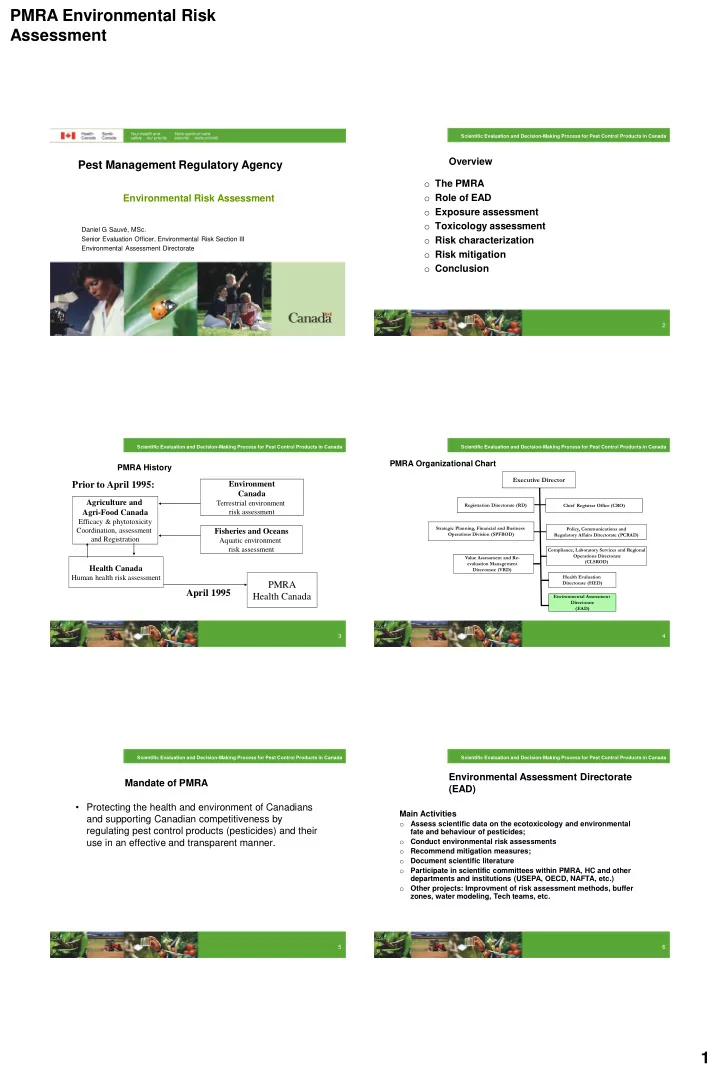
PMRA Environmental Risk Assessment Scientific Evaluation and Decision-Making Process for Pest Control Products in Canada Overview Pest Management Regulatory Agency o The PMRA o Role of EAD Environmental Risk Assessment o Exposure assessment o


slide-1
SLIDE 1

PMRA Environmental Risk Assessment 1

Environmental Risk Assessment

Daniel G Sauvé, MSc. Senior Evaluation Officer, Environmental Risk Section III Environmental Assessment Directorate

Pest Management Regulatory Agency

Scientific Evaluation and Decision-Making Process for Pest Control Products in Canada

2

Overview

  • The PMRA
  • Role of EAD
  • Exposure assessment
  • Toxicology assessment
  • Risk characterization
  • Risk mitigation
  • Conclusion

Scientific Evaluation and Decision-Making Process for Pest Control Products in Canada

3

PMRA History Agriculture and Agri-Food Canada

Efficacy & phytotoxicity Coordination, assessment and Registration

Health Canada

Human health risk assessment

Environment Canada

Terrestrial environment risk assessment

Fisheries and Oceans

Aquatic environment risk assessment

PMRA Health Canada April 1995 Prior to April 1995:

Scientific Evaluation and Decision-Making Process for Pest Control Products in Canada

4

PMRA Organizational Chart

Executive Director

Chief Registrar Office (CRO) Registration Directorate (RD) Compliance, Laboratory Services and Regional Operations Directorate (CLSROD) Policy, Communications and Regulatory Affairs Directorate (PCRAD) Environmental Assessment Directorate (EAD) Strategic Planning, Financial and Business Operations Division (SPFBOD) Health Evaluation Directorate (HED) Value Assessment and Re- evaluation Management Directorate (VRD) Scientific Evaluation and Decision-Making Process for Pest Control Products in Canada

5

Mandate of PMRA

  • Protecting the health and environment of Canadians

and supporting Canadian competitiveness by regulating pest control products (pesticides) and their use in an effective and transparent manner.

Scientific Evaluation and Decision-Making Process for Pest Control Products in Canada

6

Main Activities

  • Assess scientific data on the ecotoxicology and environmental

fate and behaviour of pesticides;

  • Conduct environmental risk assessments
  • Recommend mitigation measures;
  • Document scientific literature
  • Participate in scientific committees within PMRA, HC and other

departments and institutions (USEPA, OECD, NAFTA, etc.)

  • Other projects: Improvment of risk assessment methods, buffer

zones, water modeling, Tech teams, etc.

Environmental Assessment Directorate (EAD)

slide-2
SLIDE 2

PMRA Environmental Risk Assessment 2

Scientific Evaluation and Decision-Making Process for Pest Control Products in Canada

7

Objectives of environmental risk assessment

  • Evaluate the likelihood that adverse ecological effects

may occur (or are occurring) following exposure to pesticides and/or their transformation products

  • Determine if changes in the use pattern (or proposed

use pattern) are required to better protect the environment

Scientific Evaluation and Decision-Making Process for Pest Control Products in Canada

8

Risk assessment framework

Exposure assessment Hazards assessment Risk characterization Risk mitigation

  • ptions

Problem formulation

Scientific Evaluation and Decision-Making Process for Pest Control Products in Canada

9

Environmental exposure assessment

  • Evaluate the potential exposure (direct and indirect) to plants,

insects and other animals of pesticide residues in water, food, soil and air;

  • Includes information on the quantity of pesticides to which an
  • rganism can be exposed and the frequency and duration of

exposure;

  • Based on data on the fate and behaviour in the environment,

modelling and monitoring in the field;

  • Information on the active ingredient and the end-use product(s)
  • For new chemicals and older already registered products

Scientific Evaluation and Decision-Making Process for Pest Control Products in Canada

10

Fate and Behaviour in the Environment

Applied Pesticide Foliar Interception and dissipation Wash-off Plant uptake Volatilisation Transformation microbial (biotic) chemical (abiotic) Sorption / Retention Leaching Surface Runoff Lateral flow Phototransformation air, surfaces, soil, water

Scientific Evaluation and Decision-Making Process for Pest Control Products in Canada

11

Data that may be required to assess exposure

  • Physical-chemical properties
  • Solubility, vapour pressure, Kow, pKa, UV absorption.
  • Transformation (abiotic and biotic)
  • Hydrolysis, phototransformation, biotransformation (soil and water)

aerobic/anaerobic.

  • Mobility
  • Leaching, volatilization.
  • Field Dissipation (DIR2006-01)
  • Fate and mobility at sites representative of pesticide use in various regions

in Canada

  • Bioaccumulation

Ref:

  • 1. Guidelines for Determining Environmental Chemistry and Fate of Pesticides (T-1-255).
  • 2. Harmonization of environmental chemistry and fate data requirements for chemical pesticides under NAFTA(DIR2003-03).

Scientific Evaluation and Decision-Making Process for Pest Control Products in Canada

12

Exposure Assessment

Abiotic Transformation

  • Phototransformation
  • Soil
  • Water
  • Air
slide-3
SLIDE 3

PMRA Environmental Risk Assessment 3

Scientific Evaluation and Decision-Making Process for Pest Control Products in Canada

13

Exposure Assessment

Abiotic Transformation

  • Hydrolysis
  • The pH can significantly influence the rate of hydrolysis (half-

life)

50 100 150 200 250 300 350 400 450 500 4.5 7 9 pH Days 0.5 1 1.5 2 2.5 3 3.5 4 days Chemical a Chemical b

Scientific Evaluation and Decision-Making Process for Pest Control Products in Canada

14

Exposure Assessment

Biotransformation (20-30°C)

  • Soil
  • Aerobic
  • Anaerobic (flooded)
  • Aquatic systems
  • Aerobic water
  • Water/sediment anaerobic
  • Provides information on the identity, formation

and persistence of transformation products

Scientific Evaluation and Decision-Making Process for Pest Control Products in Canada

15

Exposure Assessment

Mobility

  • Adsorption/desorption
  • Leaching in soil column
  • Thin layer soil Chromatography
  • Volatilization

Scientific Evaluation and Decision-Making Process for Pest Control Products in Canada

16

Exposure Assessment

Adsorption/desorption

  • The tendency of a pesticide to be adsorbed on soil

particles can be expressed as the soil water-organic carbon coefficient (Koc)

  • Koc = Kd ÷ % OC
  • Kd = distribution coefficient between

soil and water

  • % OC= % organic carbon

A high Koc = strong affinity to soil particle; A low Koc = highly mobile in the soil

Scientific Evaluation and Decision-Making Process for Pest Control Products in Canada

17

Exposure Assessment

Terrestrial field Dissipation Studies

  • Shows the fate and mobility of pesticides and their

transformation products on sites representative of areas where the proposed product is to be used in Canada.

Scientific Evaluation and Decision-Making Process for Pest Control Products in Canada

18

Exposure Assessment

Terrestrial field Dissipation Studies

Applicants MUST consider the ecological regions

  • f Canada
slide-4
SLIDE 4

PMRA Environmental Risk Assessment 4

Scientific Evaluation and Decision-Making Process for Pest Control Products in Canada

19

Exposure Assessment

Dissipation (aquatic environment)

Scientific Evaluation and Decision-Making Process for Pest Control Products in Canada

20

Characteristics of a chemical that has the potential to leach into the soil, Cohen et al. 1984

  • Water solubility > 30 ppm
  • Kd < 5 and most often < 1 or 2 mL/g
  • Koc < 300 to 500 mL/g
  • Henry’s Law Constant < 10-2 atm· m3/mole
  • Negatively charged (either completely or partially) at

environmentally relevant pH

  • Hydrolysis half-life > 25 weeks
  • Photolysis half-life > 1 week
  • Soil half-life > 2 to 3 weeks

Scientific Evaluation and Decision-Making Process for Pest Control Products in Canada

21

  • GUS: Groundwater Ubiquity Score
  • t½ soil = time required for the chemical to decline by 50% under

field conditions;

  • Koc = soil water-organic carbon coefficient

Calculated GUS score classification system (Gustafson, 1989)

(DIR2006-01)

K log t log

OC 10 10

4 2 1 GUS

soil

GUS Leaching potential > 2.8 Leacher >1.8 and < 2.8 Borderline leacher < 1.8 Non leacher

Scientific Evaluation and Decision-Making Process for Pest Control Products in Canada

22

Assessment of the potential for leaching We consider:

  • The Cohen et al. 1984 criteria;
  • The GUS scores;
  • Field dissipation studies and modelling;
  • Studies conducted with lysimeters;
  • Other field studies
  • e.g.: Prospective groundwater studies
  • And, for re-evaluations, ground water monitoring

data.

Scientific Evaluation and Decision-Making Process for Pest Control Products in Canada

23

Risk assessment framework

Exposure assessment Hazards assessment Risk characterization Risk mitigation

  • ptions

Problem formulation

Scientific Evaluation and Decision-Making Process for Pest Control Products in Canada

24

Environmental Hazards Assessment

  • Describes the types of effects that a pesticide

may elicit on organisms and how these effects may vary according to the exposure;

  • Based on internationally accepted guidelines and

surrogate species;

  • Determine ecotoxicological endpoints and dose-

response (e.g.: LD50, NOEC, EC25)

  • Identifies the most sensitive organisms and helps

predict the potential adverse effects to non-target

  • rganisms
slide-5
SLIDE 5

PMRA Environmental Risk Assessment 5

Scientific Evaluation and Decision-Making Process for Pest Control Products in Canada

25

Toxicity Tests

  • Short term (acute)
  • e.g.: LC50, LD50, LR50

LD50= dose at which 50% of the population dies

  • Long term (chronic)
  • e.g.: NOEC, LOEC, NOEL, LOEL

NOEL= No adverse effect level

  • Lab vs. Field

Scientific Evaluation and Decision-Making Process for Pest Control Products in Canada

26

Non-Target Organisms: Terrestrial Invertebrates Earth worms (Eisenia sp) Honey bee (Apis mellifera)

Scientific Evaluation and Decision-Making Process for Pest Control Products in Canada

27

Non-Target Organisms: Terrestrial Invertebrates

Beneficial Predators and parasites

The Ladybird beetle predator of aphids and scale insects

Harmonia axyridis

The Crab spider, predator of aphids

Misumena vatia

Wasps: Tricogramma – (parasitic wasp)

Scientific Evaluation and Decision-Making Process for Pest Control Products in Canada

28

Non-Target Organisms: Terrestrial vertebrates

  • Birds

Mallard duck (Anas platyrhynchos) Bobwhite quail (Colinus virginianus) Zebra finch (Taeniopygia guttata)

Scientific Evaluation and Decision-Making Process for Pest Control Products in Canada

29

Non-Target Organisms: Terrestrial vertebrates

Mammals

  • Mammalian toxicity studies are assessed by the Health

Evaluation Directorate for human safety

  • The typical endpoints used by EAD to

assess the risk to wild mammals are the acute oral toxicity and 2-generation Reproduction.

  • Studies conducted with rats and/or mice

Scientific Evaluation and Decision-Making Process for Pest Control Products in Canada

30

Non-Target Organisms: Terrestrial Vascular plants

  • Seedling emergence
  • Vegetative vigour
slide-6
SLIDE 6

PMRA Environmental Risk Assessment 6

Scientific Evaluation and Decision-Making Process for Pest Control Products in Canada

31

Non-Target Organisms: Freshwater

  • Invertebrates

Crustaceans: Daphnia (Acute toxicity and reproduction)

  • Fish
  • Warm water (Blue-gill sunfish)
  • Cold water (Rainbow trout)

(Acute toxicity, Early life stage (ELS) and full life cycle)

  • Amphibian
  • Often, fish study is used as a surrogate

Bluegill Sunfish (Lepomis macrochirus) Rainbow Trout (Oncorhynchus mykiss) Water flea (Daphnia magna) Scientific Evaluation and Decision-Making Process for Pest Control Products in Canada

32

Non-Target Organisms: Freshwater Algae Green alga (Selenastrum capricornutum) Cyanobacteria (Anabaena sp.)

Scientific Evaluation and Decision-Making Process for Pest Control Products in Canada

33

Non-Target Organisms: Freshwater vascular plants

  • Duckweed

(Lemna gibba)

Scientific Evaluation and Decision-Making Process for Pest Control Products in Canada

34

Non-Target Organisms: Estuarine / marine

  • Crustaceans: Acute toxicity and Chronic
  • Mollusc embryo Larvae or shell deposition
  • Fish
  • Acute toxicity
  • Salinity challenge test
  • Algae (1 species)
  • Marine diatom

Sheepshead minnow

Cyprinodon variegatus

Scientific Evaluation and Decision-Making Process for Pest Control Products in Canada

35

Risk assessment framework

Exposure assessment Hazards assessment Risk characterization Risk mitigation

  • ptions

Problem formulation

Scientific Evaluation and Decision-Making Process for Pest Control Products in Canada

36

Risk Characterization

  • Compare the exposure (Estimated Environmental

Concentration – EEC) in the environment, according to the existing or proposed use pattern to the level at which adverse effects are observed in laboratory or field studies.

  • If the EEC exceeds the level at which adverse effects

are likely to occur (Level of concern – LOC), mitigative measures can be proposed to reduce the expected risk.

slide-7
SLIDE 7

PMRA Environmental Risk Assessment 7

Scientific Evaluation and Decision-Making Process for Pest Control Products in Canada

37

Risk Characterization :

Screening level or refined assessment?

  • Screening level risk assessment (triage)
  • Is to identify :
  • Pesticides and/or specific uses that do not pose a risk to non-

target organisms ;

  • Groups of organisms that are not expected to be at risk;
  • Pesticides and groups of organisms where there may be a

potential for concern and for which further characterization of the risk is required

  • Based on conservative scenarios and simple methods.
  • Further risk characterization
  • Objective : Refine the risk characterization with more detailed exposure

scenarios.

  • Refinement steps to further characterize and understand the risks

Scientific Evaluation and Decision-Making Process for Pest Control Products in Canada

38

Expected Environmental Concentrations

(EEC) – Terrestrial species

  • Screening assessment
  • Soil : g ai/kg soil (Earthworms)
  • Application rate : g ai/ha (honey bees, beneficial

arthropods, plants)

  • Food source : g ai/kg food (birds and small mammals)
  • Consumption of contaminated food items

estimated according to the Hoerger and Kenaga (1972) and Fletcher et al. (1994)

Scientific Evaluation and Decision-Making Process for Pest Control Products in Canada

39

Risk Characterization– Terrestrial species

(Toxicity endpoints used)

  • Earthworms
  • LC50 (Acute) or NOEC (Reproduction)
  • Beneficial Arthropods
  • µg a.i./bee (oral or contact)
  • LR50
  • Birds/mammals
  • LD50 (Acute oral toxicity)
  • LC50 (Dietary)
  • NOEC (Reproduction)
  • Vascular Plants
  • EC25 for the most sensitive species (Seedling emergence or vegetative

vigour)

  • Application of uncertainty factor
  • Inter- and intra-species variation
  • Protection of the community, the population and the individual

Scientific Evaluation and Decision-Making Process for Pest Control Products in Canada

40

Risk Characterization – Screening

assessment for terrestrial species

  • Integrates exposure and effects to determine risk

using a Risk Quotient (RQ) for the most sensitive group of organisms.

  • RQ = [EEC / Toxicity Endpoint]
  • RQ ≥ 1 environmental concerns may exist
  • RQ < 1 indicates margin of safety

Scientific Evaluation and Decision-Making Process for Pest Control Products in Canada

41

Risk Characterization – Refinement options

for terrestrial species

  • More realistic exposure scenario
  • Use pattern
  • Information on fate and persistence
  • Consideration of spray drift deposition
  • Deposition attenuates with distance from spray equipment
  • Specific scenario
  • Crop specific scenario, pertinent species, species-specific feed

guild, species behaviour

  • Supplemental options
  • Other ecotoxicity endpoints;
  • Monitoring data and incident reports;
  • Probabilistic risk assessment (SSD vs. exposure distribution).

Scientific Evaluation and Decision-Making Process for Pest Control Products in Canada

42

Risk Characterization– Aquatic species

(Toxicity endpoints used)

  • Aquatic plants and invertebrates (pelagic and benthic)
  • Acute toxicity : EC50
  • Chronic toxicity : NOEC
  • Fish
  • Acute toxicity : LC50
  • Chronic toxicity and early life stages : NOEC
  • Amphibians (aquatic stages) : Fish endpoint used as surrogate

when amphibian data is not available.

  • Acute toxicity : LC50
  • Chronic toxicity : NOEC
  • Application of uncertainty factor
  • Inter- intra-species variation
  • Protection of the community, the population and the individual
slide-8
SLIDE 8

PMRA Environmental Risk Assessment 8

Scientific Evaluation and Decision-Making Process for Pest Control Products in Canada

43

Aquatic Risk Characterization – Screening

assessment

  • Water : g ai/L
  • 15 cm deep: forest and/or seasonal water body
  • 80 cm deep: permanent water body
  • Conservative hypotheses : Maximum yearly application rate,

shortest application interval, Adjusting for transformation for multiple applications, direct application

  • RQ ≥ 1 environmental concerns may exist
  • RQ < 1 indicates margin of safety

Scientific Evaluation and Decision-Making Process for Pest Control Products in Canada

44

Aquatic Risk Characterization

Refined risk assessement

  • Spray drift
  • If RQ ≤ 1 – Default 1 m buffer zones are required
  • If RQ > 1 – Appropriate bufferzones are determined
  • Aerial spray – AgDISP v.8.15 (2005);
  • Ground boom application (Wolf et Caldwell, 2001);
  • Ground Airblast application – (Ganzelmeier et coll., 1995).
  • Run-off
  • EEC obtained by the models PRZM-EXAMS :
  • If RQ < 1 – minimal risk is expected
  • If RQ ≥ 1 – potential risk due to by run-off has been identified;

May characterize further – risk mitigation measures may be required

Scientific Evaluation and Decision-Making Process for Pest Control Products in Canada

45

Aquatic Risk Characterization– Other

  • ptions for risk refinement
  • Further characterize input to the modelling to more

realistic scenarios.

  • Other ecotoxicity endpoints;
  • Monitoring data and incident reports;
  • Probabilistic risk assessment (SSD vs. exposure

distribution).

Scientific Evaluation and Decision-Making Process for Pest Control Products in Canada

46

Water modelling

  • EAD runs the drinking water modelling. These values are used

by HED for the human health risk assessment

  • PRZM and EXAMS Models : EEC in drinking water from

surface run-off

  • Leaching Estimation and Chemistry Model (LEACHM) :

EEC in drinking water from ground water (contamination from leaching)

  • Ground water monitoring data may also be used for

drinking water assessment if available

SPN2004-01, Estimating the Water Component of a Dietary Exposure Assessment

Scientific Evaluation and Decision-Making Process for Pest Control Products in Canada

47

Risk assessment framework

Exposure assessment Hazards assessment Risk characterization Risk mitigation

  • ptions

Problem formulation

Scientific Evaluation and Decision-Making Process for Pest Control Products in Canada

48

Risk mitigation measures – examples

  • Reduce the number of applications per season;
  • Establish buffer zones to reduce adverse effects caused by

spray drift to sensitive habitats;

  • Only allow ground applications (no aerial applications);
  • Limit application for consecutive years;
  • Use lower application rate (Supported by VSAD);
  • Modify application timing (time of day or season);
  • Use only some types of product formulations;
  • Require immediate soil incorporation;
  • Limit certain uses or active ingredient (ai);
  • Adding hazard statements on the label
slide-9
SLIDE 9

PMRA Environmental Risk Assessment 9

Scientific Evaluation and Decision-Making Process for Pest Control Products in Canada

49 49

Buffer Zones

  • Distance between the point of

direct application and the closest downwind edge of a sensitive terrestrial and/or aquatic habitat

  • Calculated by spray drift

models

  • Risk based (i.e., RQ →

buffer zone)

  • Pesticide specific

Scientific Evaluation and Decision-Making Process for Pest Control Products in Canada

50 50

Maximum Drift Deposition Table

Maximum Spray Drift Deposition % Drift at 1 m downwind Mode of Application Spray Quality (ASAE) Drift (% of applied) Ground Boom Sprayer Coarse 3% Ground Boom Sprayer Medium 6% Ground Boom Sprayer Fine 11% Airblast - Early Season Fine 74% Airblast - Late Season Fine 59% Aerial - Agricultural Crops Coarse 17% Aerial - Agricultural Crops Medium 23% Aerial - Agricultural Crops Fine 26% Aerial - Non-Crops Coarse 60% Aerial - Non-Crops Medium 60% Aerial - Non-Crops Fine 44% Aerial - Forestry Coarse 77% Aerial - Forestry Medium 85% Aerial - Forestry Fine 90% Note: RQs should be calculated for all uses on the label in order to characterize the risk.. For field and aerial applications use a Fine and Medium droplet sizes for insecticides and herbicides, respectively, unless otherwise stated on the label Scientific Evaluation and Decision-Making Process for Pest Control Products in Canada

51

Habitats to be protected

Scientific Evaluation and Decision-Making Process for Pest Control Products in Canada

52

Protect the environment

Scientific Evaluation and Decision-Making Process for Pest Control Products in Canada

53