Plastic marine litter Costas Velis David Lerpinier Maria Tsakona - - PowerPoint PPT Presentation

plastic marine litter
SMART_READER_LITE
LIVE PREVIEW

Plastic marine litter Costas Velis David Lerpinier Maria Tsakona - - PowerPoint PPT Presentation

Plastic marine litter Costas Velis David Lerpinier Maria Tsakona Leader of ISWA Marine Litter Task Force Environmental Engineer Msc. Waste Management Consultant ISWA MLTF School of Civil Engineering, University of Leeds Waste Management


slide-1
SLIDE 1

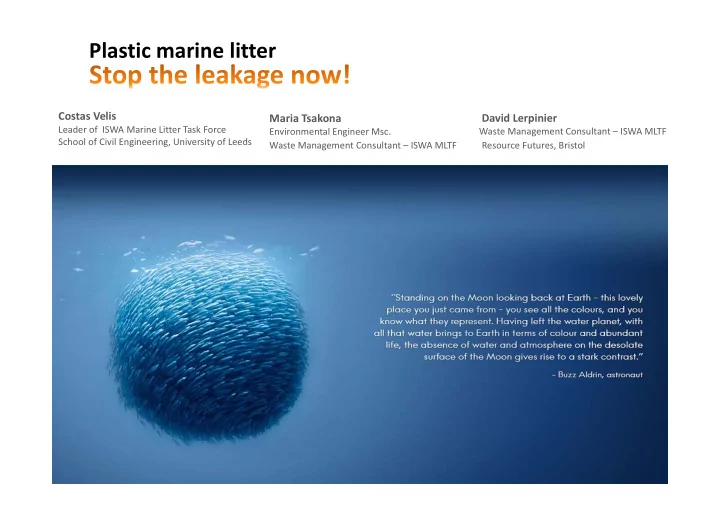
Plastic marine litter

Maria Tsakona

Environmental Engineer Msc. Waste Management Consultant – ISWA MLTF

Costas Velis

Leader of ISWA Marine Litter Task Force School of Civil Engineering, University of Leeds

David Lerpinier

Waste Management Consultant – ISWA MLTF Resource Futures, Bristol

slide-2
SLIDE 2

http://marinelitter.iswa.org/

Define the role of waste & resource management sector to tackle marine litter

slide-3
SLIDE 3

A GLOBAL CHALLENGE

For the 21 economies of the Asia- Pacific rim marine debris-related damage to marine industries costs US$1.26bn per annum (Greyer, et al. 2017)

Destroying ecosystems & marine-based economic sectors

slide-4
SLIDE 4
slide-5
SLIDE 5

Sources, Pathways, Transformation & Fates

slide-6
SLIDE 6

Key land‐based sources

  • f Plastic Marine Litter

Uncontrolled Dumping

Generally global dumpsites receive

roughly 40% of the world’s waste and

they serve about 3-4 billion people

(Mavropoulos et al., 2016)

Around 2 billion people do not share any waste collection services.

(D-Waste, 2014)

38 of the world’s biggest dumpsites

located close to the sea (D-Waste, 2014)

Littering

In the UK, fly-tipping is a worsening cause of environmental damage that has cost for local authorities in 2015/16 £49.8 million (DEFRA, 2017)

Tourism, major public events, busy areas of cities

slide-7
SLIDE 7

Escape of plastics from mis-managed waste management activities – low- tech, uncontrolled treatment plants

Waste Management Industries

Agriculture

More than 1 million tons of mulch film is used worldwide every year

(Kasirajan et al, 2012)

86% of the Danube River’s plastic load originates from the activities of plastic manufacturing and processing companies near the banks Application of sewage sludge and compost with plastic impurities in agriculture Extensive use of polyethylene films – 80% of the agricultural plastic waste

Fisheries and shipping in waterways

River-fish related items from commercial and recreational fishermen (e.g. nets and fishing lines)

slide-8
SLIDE 8

PATHWAYS

Rivers Between 1.2 and 2.4 million tonnes

  • f plastic litter currently flows from

the world’s rivers into the oceans every year (Lebreton et al., 2017)

Citarum River, Indonesia The Citarum has been called the world's most polluted river. Around 5 million people live in the river's basin

slide-9
SLIDE 9

Plastic waste disposed on sidewalks and streets and in gutters flows directly into streams and rivers during rain events.

PATHWAYS

Drainage systems and flooding events Sewers Overflow

In the River Thames, there are 57 ‘combined sewer overflow’ sites which overflow approximately 60 times a year, resulting in approximately 39 million tonnes of raw sewage entering the watercourse

Wind blown litter Atmospheric Inputs During heavy rainfall episodes untreated wastewater can find its way, via combined sewer outfall into rivers/sea.

slide-10
SLIDE 10

MACROPLASTICS TRANSFORM INTO MICROPLASTICS

slide-11
SLIDE 11

Sinks

Plastic litter has four main sinks: 1) sink and buried in the sediments, 2) trapped on riverside vegetation and degraded on river banks; or 3) transported to the estuary and then deposited on beach 4) flow in the ocean

slide-12
SLIDE 12

GLOBAL SYSTEMIC FAILURES

MATERIALS AND CONSUMPTION KNOWLEDGE GAPS ON TECHNOECONOMIC

SUSTAINABILITY ASPECTS OF PLASTICS LIFE CYCLE

1 4

INSUFFICIENT INFRASTRUCTURE

2 3

PUSH MARKETS

slide-13
SLIDE 13

Marine litter and the Sustainable Development Goals (SDG) ‐UN.

One of SDG 14’s component targets is to prevent and significantly reduce marine debris. This cannot be achieved without implementing effective waste and resource management for all, which is also a key requirement for achieving SDG 11 (creating sustainable cities and communities) and SDG 12 (achieving responsible consumption and production).

slide-14
SLIDE 14

DIFFERENT INTERVENTIONS - DIFFERENT TIMESCALES

slide-15
SLIDE 15

Actions‐ Now!

Investing in effective waste management in low‐income countries is likely to represent the most cost‐effective and immediately practicable solution to reducing marine litter in the short term.

  • Prevent uncontrolled dumping by providing

collection services for all

  • Prevent littering and stop fly‐tipping
  • Close dumpsites and provide waste treatment

and disposal facilities for all communities

  • Work with the maritime sector to establish

effective take‐back systems for recovering waste and recyclable materials from the fishing, shipping and touristic activities.

slide-16
SLIDE 16

Mid‐Term Actions

  • Capturing and enhancing the value of waste

plastic ‐ developing effective collection systems that maximise and stabilise the value of secondary plastics

  • Properly functioning markets for recycled plastics.

‐ Address issues associated with global supply chains and social‐ environmental justice ‐ Better data and information sharing on waste and recycled waste at all stages of their use and end‐of‐life cycle.

slide-17
SLIDE 17

Long‐Term Actions

A step‐change from the linear use of plastics to a sustainable and proven circular and cascading system is needed ‐ Sustainable and effective circularity ‐ Clean material cycles

slide-18
SLIDE 18

Innovate and invent at the materials, design and processing level

‐ design products for recyclability and value retention after the use phase ‐ replace plastics with new materials (bio‐plastics)

slide-19
SLIDE 19

A radical shift from today’s practices, based on a cross‐sector and intra‐disciplinary collaboration

  • f the industries and the scientific sector.
slide-20
SLIDE 20

Stop the leakage now!

maria.tsakona@qadvisors.gr