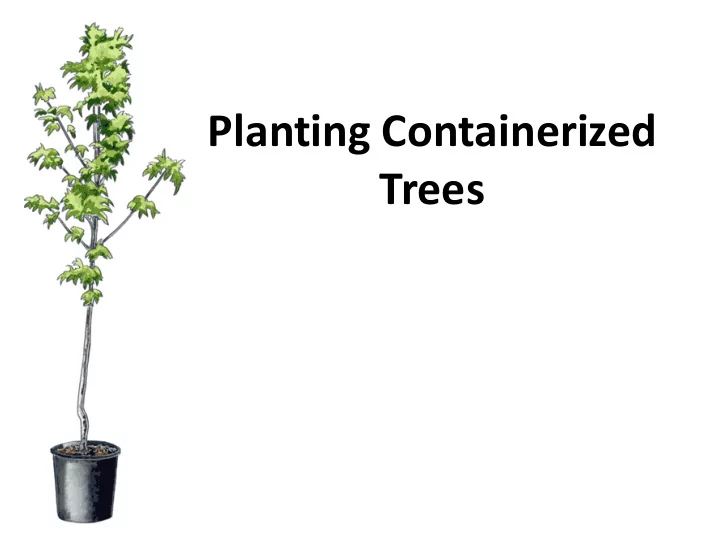
Planting Containerized Trees Dig a hole Dig a hole 3 to 4 times - - PowerPoint PPT Presentation
Planting Containerized Trees Dig a hole Dig a hole 3 to 4 times wider than the container and only as deep as the existing root ball. The hole should have sloping sides like a saucer to allow for proper root growth. In heavy clay or
Dig a hole
- Dig a hole 3 to 4 times wider than the container and
- nly as deep as the existing root ball. The hole should
have sloping sides like a saucer to allow for proper root
- growth. In heavy clay or compacted soils, square holes
are better than round holes.
- If your planting hole has slick sides, roughen the sides
and bottom with a pick or shovel. This makes it easier for root tips to penetrate into the native soil.
Check for Good Drainage (Percolation)
- Soil must drain properly to
keep the tree from drowning and developing root diseases. To check for proper drainage:
- Fill the hole completely with
water and wait for all of the water to drain away.
- Fill the hole completely with
water a second time and time how long it takes for all of the water to drain away.
- All of the water must drain away within 8-12 hours after the second
filling (or at a rate of 1 to 2 inches per hour.) to result in the survival
- f your tree.
Gopher Cages
- ½ inch poultry wire can be formed
into gopher cages to help protect trees where gophers are a risk.
- Keep the top of the basket 2”-6”
above the top of the soil.
Remove the tree from the container
- Carefully remove the
tree from the container keeping the soil around the roots intact. It helps to tap the outside of the container to loosen the edge. Carefully slide the tree from the
- container. Don't yank
the tree out of the container as this can separate the roots from the tree.
Cut or Remove Circling Roots
- Sometimes containerized trees become root-
bound or the roots look like they're about to circle the root ball. If your tree is like this, cut an X across the bottom of the root ball and four vertical slices along the sides of the root ball with a sharp knife
Mycorrhizae
Benefits of Mycorrhiza
- Enhanced plant efficiency in absorbing water and
nutrients (especially phosphorous) from the soil.
- Reduces fertility and irrigation requirements.
- Enhances plant health, vigor and drought
resistance and minimizes stress.
- Increased pathogen resistance/protection.
- Enhances seedling growth, rooting of cuttings, and
plant transplant establishment.
- Improved phytoremediation of petroleum and
heavy metal contaminated sites.
- Adding a product which can introduce
mycorrhizae into the planting hole can benefit trees by adding to the planting hole and backfill soil.e
Organic Amendments
Mixing organic amendments into planting holes for trees and shrubs is generally not recommended or beneficial.
- At best, these amendments do no good as the root system on healthy plants will
develop well beyond the amended planting hole.
- At worst, amendments in a planting hole can:
– Restrict or inhibit the development of roots into the non-amended “native” soil. – Restrict the movement of water into the non-amended soil, forming a perched water table and causing the soil in the planting hole to become saturated and soggy. – Will decompose over time, causing the amended soil to compact and the crown of the plant to settle below surface of the non-amended soil. This settling frequently causes crown rot and can kill the plant.
Set the tree
- Set the tree in the middle of the
- hole. Avoid planting the tree too
- deep. If the root collar sits below
the top of the hole, compact some soil under the tree so that the root flare at the base of the trunk is slightly above ground level.
- Using some soil, secure the tree
in a straight position, then fill and firmly pack the hole with the original soil, making sure there aren't any air pockets. Keep backfilling until the soil is just below the root collar.
Create a water-holding basin
- Create a water-holding basin around the hole
and give the tree a good watering. After the water has soaked in, spread protective mulch 2–4 inches deep in a 3-foot diameter area around the base of the tree, but not touching the trunk.
Water Regularly
- The soil and mulch around your trees should
be kept moist but not soggy. During dry weather, generously water the tree in the basin every 4 to 7 days during the first three months.
- After thee months, water slowly at the
dripline every 7 to 10 days during the first year.
Remove any tags and labels
- Remove any tags and labels from the tree as
these will affect the tree as it grows. You may need to prune any broken or dead branches.
Pruning and Training
- Keep pruning to a minimum
for the 1st year. Limit your pruning to removing the four D’s (dead, damaged, diseased and dysfunctional) branches and remove or correct any co-dominant branches or branches with narrow crotch angles or included bark.
- Whenever possible, using
training techniques to shape the tree and to avoid pruning wounds.
Pruning and Training
REMEMBER
- More branches = more leaves = more food for the tree
by photosynthesis = more energy for growth = a faster growing, healthier tree.
Stake
- Remove the nursery stake that came tightly tied to the trunk after planting. Stake
the tree loosely for protection or support if needed.
- Use only soft, pliable tree ties at least 1” in width. Do not use wire, even if it's
inside a hose. Wire can cut into a trunk. If the trunk can’t stand up on its own, stake it so that it stands upright.
- One of the most common methods is
staking with two stakes used in conjunction with a wide, flexible tie material on the lower half of the tree. This will hold the tree upright, provide flexibility, and minimize injury to the
- trunk. The stakes should be placed
- utside of the root ball.
- Plan to remove stakes as soon as the
tree can support itself, in 6 to 12 months.
Fertilizer?
- Do not use fast release synthetic fertilizers,
potting soil, planting mix or chemicals on your newly planted trees. Such products can damage
- r kill your young trees.
- Slow release fertilizers
and organic fertilizers that have a higher ratio
- f phosphorous or that
also contain mycorrhizae can benefit newly planted trees and plants and can assist the development of the root system.
- These products should
be mixed into the soil in the planting site and backfill soil when planting.