Matson Navigation Company, Inc. (a wholly owned subsidiary of - - PowerPoint PPT Presentation

matson navigation company inc
SMART_READER_LITE
LIVE PREVIEW

Matson Navigation Company, Inc. (a wholly owned subsidiary of - - PowerPoint PPT Presentation

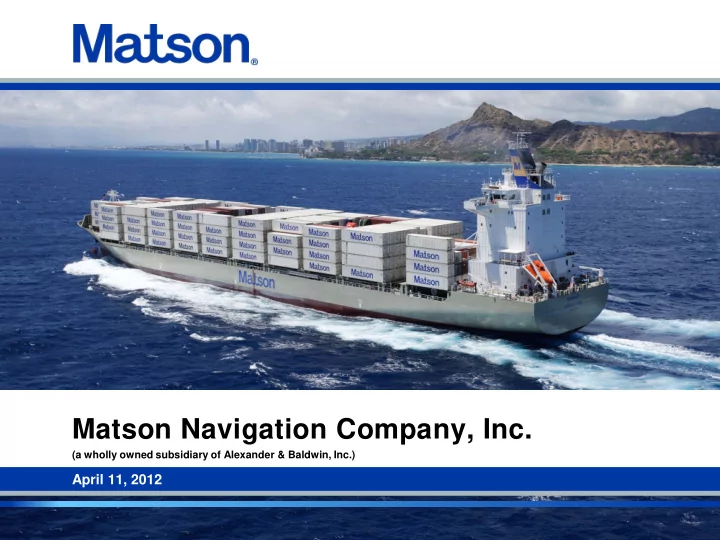
Matson Navigation Company, Inc. (a wholly owned subsidiary of Alexander & Baldwin, Inc.) April 11, 2012 Statements in this presentation that set forth expectations or predictions are based on facts and situations that are known to us as of

slide-1
SLIDE 1

Matson Navigation Company, Inc.

(a wholly owned subsidiary of Alexander & Baldwin, Inc.)

April 11, 2012

slide-2
SLIDE 2

Statements in this presentation that set forth expectations

  • r predictions are based on facts and situations that are

known to us as of the date of this filing. Actual results may differ materially, due to risks and uncertainties, such as those described on pages 19-29 of the Form 10-K in the Alexander & Baldwin 2011 Annual Report and other subsequent filings with the SEC. Statements in this presentation are not guarantees of future performance. We do not undertake any obligation to update our forward- looking statements.

2

slide-3
SLIDE 3

Agenda

Company Overview & Strategy ..……..... Matt Cox, President of Matson Navigation Separation Update ..... Joel Wine, Senior Vice President, CFO & Treasurer of ALEX Ocean Services ...…….….…………..…….... David Hoppes, Senior Vice President Operations .………………..……..…………... Ronald Forest, Senior Vice President Matson Logistics ………………………...…… Rusty Rolfe, Executive Vice President Financial Overview ……………………..……..…...……….…..………..……. Joel Wine Key Investment Highlights …………………...….…………….…..…..………. Matt Cox

3

slide-4
SLIDE 4

Company Overview

Matt Cox President Matson Navigation Company

slide-5
SLIDE 5

Matson Through the Ages

1882 1900s 1930s 1940s 1950s-1970s Currently

Years of Expansion Passenger Era World War II Containerization

  • 1882, Capt. Matson

sails schooner Emma Claudina to Hilo on first Matson voyage

From Sail to Steam

  • 1901, Matson

purchases first steamship, Enterprise

  • Fleet grows to

include freighters, passenger ships and sailing ships.

  • Built Royal

Hawaiian Hotel,

  • ne of the world’s

finest

  • 1980, launch Maui &

Kauai

  • 1992, launch first

diesel powered ship, R.J. Pfeiffer

  • 1996, bought six APL

ships

  • 1996, start Guam

Service

  • 2003-2006, launch

four new ships

  • 2006, start China

Service

  • Matson operates

six sailing ships before the turn of the century

  • Entire Matson organization –

personnel, ships, facilities, commandeered by U.S. government, full-scale war status

  • Four passenger liners and 35

freighters to U.S. Maritime Commission; passenger ships converted to troop transport vessels

  • Matson designated

government agent/operator of 172 vessels, including its own 39 ships

  • 11 Matson ships lost during

the war

  • “White ships” era
  • World-famous luxury

liners make Hawaii a world-class destination

  • 1956, Matson establishes

research department

  • 1958, first ship in the

Pacific to carry containers

  • n deck
  • 1960, world’s first all

container ship, first A- frame gantry crane, container handling equipment, container freight system

  • 1970, Hawaiian Enterprise,

Hawaiian Progress largest, most powerful ships under U.S. flag

The Modern Fleet

5

slide-6
SLIDE 6

Matson Today

Terminal Locations

Long Beach, Oakland, Honolulu & Seattle

Pacific Offices

Guam

Matson Logistics Offices

Concord – Headquarters

  • Miami
  • Jacksonville
  • Philadelphia
  • Metro NY/NJ
  • Akron
  • Seattle
  • Portland
  • Long Beach
  • Kansas City
  • Oklahoma City
  • Dallas
  • Indianapolis
  • Chicago
  • Columbus
  • West Bend
  • Birmingham
  • Atlanta
  • Ningbo
  • Shanghai
  • Xiamen
  • Hong Kong

Honolulu, Hawaii – Corporate Headquarters Mainland Offices

Oakland – Central Mainland Office Phoenix – Customer Support

  • Kansas City
  • Chicago
  • Detroit
  • Atlanta
  • Portland
  • Seattle
  • Oakland (Sales Operations)
  • Long Beach (Sales Operations)
  • Salt Lake City

China:

6

slide-7
SLIDE 7

7

Strong Management Team Upon Separation

Over 175 Years of Combined Transportation Experience

Walter A. Dods Chairman Rusty K. Rolfe EVP, Matson Logistics Matthew J. Cox President & CEO Joel M. Wine SVP & CFO Ronald J. Forest SVP, Operations David L. Hoppes SVP, Ocean Services Kevin C. O’Rourke SVP, General Counsel Vic S. Angoco SVP, Pacific

slide-8
SLIDE 8

Matson at a Glance

  • Number of employees: 1,101
  • The Matson Fleet: 17 vessels (nine active ships and three active barges)

– 10 containerships – 3 Ro-Cons (combination container / Ro-Ro vessels) – 3 container barges and 1 Ro-Ro barge Dollars in Millions 2011 Revenue 2011 Operating Profit

Ocean Transportation $ 1, 078 $ 74 Logistics Services $ 386 $ 5 Total $1,463 $79

Source: 2011 A&B 10-K which included other income and intercompany income

8

slide-9
SLIDE 9

Corporate Strategy

Matt Cox President Matson Navigation Company

slide-10
SLIDE 10

Strategic Vision

  • Building on historic island strengths in the Pacific
  • Leveraging the brand and our

capabilities into compatible new geographies and services

  • Enabling and rewarding

continuous improvement

  • Doing the right thing by
  • ur customers, employees

and the communities that we serve

To sustain and expand Matson’s market leadership and profitability in ocean transportation and logistics by:

10

slide-11
SLIDE 11

Strategies

  • Ocean Transportation

– Premium China strategy – Leverage leading market share to grow faster than the overall Hawaii economy – Maintain focus on Guam including military realignment – Network “bolt-ons” in compatible services and geographies

  • Logistics Services

– Organic expansion of brokerage and warehousing services – Initiate and expand 53-foot domestic container program – Develop China freight forwarding and consolidation offerings – Disciplined M&A

  • Build on world-class customer service differentiation

– Ocean transportation – Logistics

11

slide-12
SLIDE 12

Competitive Advantages

  • Powerful transportation brand identity
  • Strong market position in Hawaii
  • Sailing frequency
  • Dual head-haul economics in China service
  • Dedicated West Coast terminals
  • Strategically located facilities in Hawaii and

Guam

  • Ownership of neighbor island barge network
  • More modern ships than any other U.S. carrier
  • Strong balance sheet with investment grade

credit metrics

12

slide-13
SLIDE 13

Core Competencies

  • Strict Operating Discipline

– On-time arrivals – Equipment availability – Cargo availability

  • Intimate Customer Service
  • Delivering critical goods to island communities

13

slide-14
SLIDE 14

Challenges

  • Jones Act markets are mature

– Post recession recovery upside still significant – Alaska remains a potential market

  • Currently, Ro-Ro capacity only on older ships

– New ship construction may remedy

  • Continued legislative support
  • Potential for labor disruptions

– Relative labor peace expected to continue

  • Potential for increased competition from Jones Act

participants

– Competitor announced second vessel

14

slide-15
SLIDE 15

Jones Act Background

  • Federal law that ensures ocean carriers engaged in

domestic shipping meet certain requirements

– Owned by minimum of 75% U.S. citizens – Vessels must be built in U.S. shipyards – Crewed by U.S. citizens – Prevents foreign-flag vessels from carrying cargo between points in the U.S.

  • More than 50 maritime countries have similar laws,

including Australia, Canada, France, Germany, Russia and China

  • Important for national defense, environmental protection

and safety

15

slide-16
SLIDE 16

Separation Update

Joel Wine Senior Vice President CFO & Treasurer Alexander & Baldwin, Inc.

slide-17
SLIDE 17

Trading Statistics (based on closing price of $48.70 as of April 9, 2012)

Exchange/Ticker NYSE: ALEX Annualized Dividend Yield 2.6% Equity Market Capitalization $2.0B 3-Month Average Volume 242,000 Indices Dow Jones Composite, Dow Jones Transportation, S&P 400 MidCap, Russell 1000

Alexander & Baldwin, Inc. Overview

As of and for the year ended December 31, 2011 Revenue1

$1.7 Billion

Adjusted Operating Profit

$163 Million

Assets

$2.5 Billion

1 Includes revenue from discontinued real estate operations

Matson A&B Land Group

17

slide-18
SLIDE 18

Company Overview

  • Matson

– 18 Jones Act Vessels – 47,000 company-owned containers and equipment – Dedicated terminal facilities in Hawaii – 35 percent ownership in SSA Terminals – Top 10 domestic logistics company

  • A&B Land Group

– Approximately 88,000 acres of land in Hawaii – 4th-largest private land-owner in Hawaii – Portfolio of 45 commercial properties in Hawaii and 8 Mainland states (7.9 million square feet) – Resort, primary residential and commercial development portfolio – Largest agricultural operation in Hawaii – Significant producer of renewable energy on Maui and Kauai

18

slide-19
SLIDE 19

Separation Update

Announced on December 1, 2011

Rationale

  • Enhanced strategic

direction and focus

  • Growth oriented

capital structure

  • Separate stock
  • Greater

transparency

  • Sector-specific

investors and research coverage

  • Updates
  • Well-received by shareholders
  • Targeting 3rd quarter transaction

– IRS letter ruling request – Form-10 filing – S-4 merger proxy – Seeking shareholder approval for a merger structure to:

  • Better execute the separation from a

legal point of view

  • Ensure continued compliance with

Jones Act U.S. ownership requirements

– The separation is not conditioned in any way on the merger vote

19

slide-20
SLIDE 20

Matson Board of Directors After Separation

  • As previously announced, Walter Dods will be

Chairman of the Board

  • Matt Cox will be joining the board consistent with his

new role

  • The balance of the directors is expected to be a

subset of the current A&B board, providing continuity with previous governance

20

slide-21
SLIDE 21

Ocean Services

Dave Hoppes Senior Vice President Matson Navigation Company

slide-22
SLIDE 22

The Matson Brand

  • Premier Ocean Transportation and Logistics Provider
  • Delivering Innovation
  • Reliability Beyond the Norm
  • Financial Stability
  • Delivering Value to Our Customers

22

slide-23
SLIDE 23

Award-Winning Service

  • Toyota Logistics Presidential Award
  • Toyota Logistics Excellence award for

Outstanding Achievement

  • NDTA Quality Award
  • CIO magazine top 100 companies
  • GM Supplier of the Year
  • Q1 Award, Ford Motor Company
  • Carrier of the Year Award, U.S. Military

Traffic Management Command

23

  • Logistics Management magazine’s Quest for Quality Award
slide-24
SLIDE 24

Matson Today: Connecting the Pacific Unlike Anyone Else

24 Shanghai Ningbo Xiamen Guam Honolulu, Hawaii Long Beach Oakland Portland Seattle Micronesia

slide-25
SLIDE 25

Hawaii Service

  • Nine-ship base long-haul fleet, offering

three arrivals per week to Honolulu from West Coast ports

– 50% greater frequency than nearest competitor

  • Highly flexible Matson-owned and operated barge network

serves all Neighbor Islands

  • Principal carrier in the trade

25

Nawiliwili Kahululi Hilo Kawaihae Honolulu

Hawaii Neighbor Island Service

slide-26
SLIDE 26

Hawaii Containers East & West Combined

Matson Hawaii Total TEU Volumes

26

400,000 100,000 350,000 300,000 250,000 200,000 150,000 TEUs Footprint of Official Recessions in the U.S.

Source: Matson management estimates

slide-27
SLIDE 27

Diverse Customer Base

27

Hawaii Westbound Market Segments

  • Approx. % of

Matson’s Volume

Freight Forwarders 30~32% Food, Grocery, Produce 27~30% Paper products, Agriculture and Other 10~12% Retail 12~15% Building Materials 8~10% Government Agencies (Military, USPO) 5~7% Household Goods 3~5%

Source: Matson management estimates

slide-28
SLIDE 28

Hawaii Key Indicators – Annual Growth %

28

Segment 2010 2011 2012

Real GDP

  • 0.1%

+1.2% +2.3% Non-Farm Jobs

  • 0.8%

+1.2% +1.8% Unemployment % 6.6% 6.3% 6.2% Inflation +2.1% +3.5% +1.9% Visitor Arrivals +7.7% +3.5% +4.1% Construction Income

  • 5.8%
  • 5.6%

+5.2%

Source: University of Hawaii Economic Research Organization (UHERO)

slide-29
SLIDE 29

Pricing: Hawaii Service

  • Primarily published tariff market

– Tariffs are based on commodity value

  • Pricing components are:

– Ocean Freight Rate – Terminal handling charge – Wharfage – Fuel surcharge

  • Pricing increases designed

to cover cost escalation

  • Ocean Freight Rate increases are typically once a year
  • Increases are always dollar-denominated
  • Fuel Surcharge mechanism designed to efficiently

recover fuel costs

29

slide-30
SLIDE 30

Hawaii Market: How Do We Maximize Yield?

  • Maintain high vessel utilization

30

Volume Yield per container

Target Zone

slide-31
SLIDE 31

Fuel Surcharge Methodology

  • Matson seeks to recover up to 100% of fuel-related

costs from its customers in Hawaii and Guam

  • Surcharge rate is adjusted periodically during the year

to account for changes in fuel costs, consumption and freight volume

  • While surcharge mechanism

is very efficient over the course of a year, there are quarter-over-quarter lags

31

slide-32
SLIDE 32

History of Matson’s Fuel Surcharge in Hawaii Service

32 Source: Matson management estimates

Price per barrel $140 $20 $120 $100 $80 $40 $0 $60

Jan 99 Jul Jan 00 Jul Jan 01 Jul Jan 02 Jul Jan 03 Jul Jan 04 Jul Jan 05 Jul Jan 06 Jul Jan 07 Jul Jan 08 Jul Jan 09 Jul Jan 10 Jul Dec 10 Jul Dec 11 Mar

1999 2000 2001 2002 2003 2004 2005 2006 2007 2008 2009 2010 2011 2012

West Coast Average Bunker Fuel $ price per barrel (left scale) Matson’s Hawaii Fuel Surcharge (right scale)

70% 10% 60% 50% 40% 20% 0% 30% Matson’s fuel surcharge %

*West Coast average price is the average

  • f the monthly prices for Los Angeles, San

Francisco & Seattle for bunker fuel only and excludes delivery cost.

slide-33
SLIDE 33

Guam Service

  • Matson has historically carried over one-half of U.S.-origin freight
  • Currently serves entire market with the departure of the second

carrier from the trade

  • Easy connections from Oakland and Pacific Northwest to Guam via

terminal in Honolulu

  • Chartered Matson ship serves neighboring islands of Micronesia

33

Yap Guam

Guam Micronesia Island Service

Palau Saipan Rota Tinian Ebeye & Kwajalein Kosrae Pohnpei Chuuk

slide-34
SLIDE 34

Guam Containers East & West Combined

Matson Guam Total TEU Volumes

34

1997 1998 1999 2000 2001 2002 2003 2004 2005 2006 2007 2008 2009 2010 2011 37,000 25,000 35,000 33,000 31,000 29,000 27,000 TEUs

Source: Matson management estimates

Typhoon Pongsana Typhoon Paka Tourism Improved, Some new construction Competitor exits Guam Service 9-11 Eastbound Garment shipments declined dramatically Decline in westbound shipments after rebuilding of the infrastructure damaged by typhoon

slide-35
SLIDE 35

Guam Westbound Segments by Volume

35

Westbound Segment

  • Approx. % of

Matson’s Volume

Guam Commercial Dry 50~54% Guam Military Dry and Reefer 13~22% Guam Commercial Reefer 6~11% CNMI Commercial Dry and Reefer 5~9% Palau and Yap 5~8%

Source: Matson management estimates

slide-36
SLIDE 36

Pricing: Guam Service

  • Similar to Hawaii Service

– Tariff-based – Efficient fuel surcharge mechanism is similar to the one in Hawaii service – No plans to increase rates during 2012 beyond pass- throughs of any port charge increases

36

slide-37
SLIDE 37

CLX Service

  • Five ships connect Xiamen, Ningbo and Shanghai weekly to the Long Beach port
  • Matson’s share in historically established Ningbo-Shanghai to Southern California

is approximately 5-6%

  • Fastest transit time from Shanghai: 10 days vs. 12-14 (current trade standard)
  • 10-day transit together with next-day freight availability generates a 3-6 day

competitive advantage

37

Shanghai

CLX China Ports

Ningbo Xiamen

slide-38
SLIDE 38

China Service Characteristics

  • Multiple international carriers with activity in more than
  • ne intercontinental trade
  • Volume Seasonality: each annual cycle has distinctive

peak season starting late summer, and low season of January-February (associated with Lunar New Year)

  • China in general is much

more variable because of competitive nature of the business

38

slide-39
SLIDE 39

Pricing: CLX China Service

  • Prices are based on the individual contracts with shippers
  • Pricing structure is comprised of Base

Rate and Fuel Adjustment Factor (FAF)

  • Highly volatile pricing
  • Base Rate level is driven by demand/

capacity dynamics over which we have no control

  • However, our service levels have

allowed us to generate a rate premium

– As little as $200 in weak market / substantially higher in robust market

  • FAF is also market based

– Contemplate greater use of a “floating” FAF in upcoming contracts

39

slide-40
SLIDE 40

Transpacific Eastbound Freight Rates

40

$ per FEU $3,000 $500 $2,500 $2,000 $1,500

To U.S. West Coast Ports (2009-2011)

$1,000

Source: Shanghai Containerized Freight Index

slide-41
SLIDE 41

Shanghai-Ningbo to Southern California Market (Volume TEU)

2007- 2011

41

2007 2008 2009 2010 2011

2,000,000 1,800,000 1,400,000 1,200,000 1,000,000 200,000 400,000 1,600,000 800,000 600,000 Total TEUs

Source: Port Import Export Reporting Service (PIERS)

slide-42
SLIDE 42

China Eastbound Segments by Volume

42

Eastbound Segment

  • Approx. % of Matson’s

Volume

Freight All Kinds 33~37% Garments, Footwear, Fashion Accessories 29~31% General Department Store Merchandise 13~17% Furniture and Bedding 8~14% Laptop Computers, Consumer Electronics 4~7% Industrial Chemicals and Related 2~4% All Other 1~2%

Source: Matson management estimates

slide-43
SLIDE 43

Case Study: Matson’s Garment Market Penetration

Garment Market Share from Xiamen, Ningbo and Shanghai

43

2007 2008 2009 2010

25% 0% 20% 10% 5% 15%

2011

Source: Matson management estimates CLX1 only

slide-44
SLIDE 44

COST ($)

COST

(more $ = less value)

Matson: 10x less costly

1x 10x 5x

TIME (DAYS)

TRANSIT TIME

(more days = less value)

Matson: 10 days vs. 5 days

2 20 10

TOTAL COST/ TIME VALUE Matson: 5x the value of air freight

=

VALUE

0.5 5

_ :

The Next Target: Focus on Premium Freight with Delivery Precision

44

  • Most air freight carriers: 4 – 6 days
  • Matson: 10 days, next-day cargo availability
  • Sea – air option for premium service, premium value
slide-45
SLIDE 45

Operations

Ron Forest Senior Vice President Matson Navigation Company

slide-46
SLIDE 46

Drivers of Operational Discipline

  • Fleet Efficiency
  • Terminal Productivity
  • Equipment Optimization
  • Aggressive Cost Management
  • Environmental Leadership

46

slide-47
SLIDE 47

Fleet: Deployment

47

Shanghai Ningbo Xiamen Guam Honolulu, Hawaii Long Beach Oakland Portland Seattle

Base Nine-Ship Fleet

Maunalei, Manulani, Maunawili, Manukai, R.J. Pfeiffer Mahimahi, Mokihana Manoa, Maui

slide-48
SLIDE 48

Fleet: Deployment

  • Considerations for Adding Tenth Ship

– Freight volume – Dry-dockings – Unplanned vessel out-of-service

  • Impact of Tenth Ship

– Approximately $8 - $12 million (net of fuel) annual incremental operating costs – Bi-weekly fleet capacity increases by 650-850 slots or 8%-12% – Fleet utilization initially decreases approximately 6-10% – Exact amounts will depend on which vessel is added and its purpose – Can be deployed for part of year

48

slide-49
SLIDE 49

2007 2008 2009 2010 2011

Source: Matson management estimates

Fleet: Westbound Utilization

49

Number of Ships Fleet Utilization

100% 0% 80% 70% 60% 50% 30% Vessel Utilization 90% 40% 20% 10% Number of Ships 12 4 2 6 8 10

Vessel out-of-service Vessel out-of-service MKA DDX

slide-50
SLIDE 50

Fleet: Performance

  • Active Fleet: 19 years

average age

  • Achieve 75-85% on-time

arrivals

– Based on 59-minute window – Industry standard is 24 hours – Weather = 50% of misses – Amongst best in world

50

slide-51
SLIDE 51

Fleet: Maintenance Program

  • Reliability, longevity and

cost control

  • In-service maintenance
  • Dry-dockings

– Once in five years with Under Water Inspection in Lieu of Dry docking (UWILD) – Mix of foreign and domestic shipyards used

  • 2011 arrival delays

caused by mechanical failure: 3%

51

slide-52
SLIDE 52

Container Terminals

SSAT MTI

52

PAG SOE

Shanghai Ningbo Xiamen Guam Honolulu, Hawaii Long Beach Oakland Portland Seattle

slide-53
SLIDE 53

Benefit of Dedicated Terminals: West Coast and Hawaii

53

  • Guaranteed Berth/Cranes

– Work on arrival – Quick turn of vessel – Maintain vessel schedule

  • Fast Truck Turns

– Customer satisfaction – Considered best in class

  • Wheeled Operations

– Immediate cargo availability – Quick yard turns

  • Late Freight Receiving

– Customer satisfaction – Expected in domestic trade

slide-54
SLIDE 54

Terminals: Gate Turn Times

100 90 70 60 50 10 80 40 2005 30 20 2006 2007 2008 2009 2010 2011

Minutes

Industry Range Matson

Industry Range

54 Source: Matson management estimates

slide-55
SLIDE 55

Equipment: Management

  • Asset management

considerations

– Amount equipment – Size / type equipment – Own vs. lease – Repair vs. replace – Utilization / efficiency

  • Location management

considerations

– Port standards – Balancing – Repositioning

55

slide-56
SLIDE 56

Equipment: Inventory

56

Total Containers Drys 32,695 Reefers 4,610 Flat Racks 2,366 Other 1,058 Total: 40,729 Chassis 16,150 Reefer Gen-sets 1,433 GRAND TOTAL: 58,312 Matson Container Fleet as of 2/29/2012

Source: Matson management estimates

Approximately 80/20 Owned/Leased Portfolio

slide-57
SLIDE 57

Environmental: Principles

  • Meet or exceed applicable federal, state and

local legislative requirements

  • Where applicable establish and adhere to our
  • wn, more stringent standards
  • Minimize risk / improve environment

– Employ reasonably available technology – Reduce the amount of waste generated – Adhere to strict operating procedures – Be prepared for emergencies

57

slide-58
SLIDE 58

Environmental: Achievements

  • U.S. Coast Guard Benkert Award for Environmental

Excellence

  • First “green port” lease with SSA Marine and the Port
  • f Long Beach
  • Zero discharge policy – only one in the world
  • San Pedro Bay Ports Clean Air Action Plan Air

Quality Award for Air Quality Leadership

  • Long Beach Area Chamber of Commerce Eco Award
  • Port of Long Beach Green Flag, and Port of Seattle

Green Gateway

  • Ballast water treatment system: Moku Pahu was the

first approved in the USCG Shipboard Technology Evaluation Program (STEP)

58

slide-59
SLIDE 59

Financial: Operating Costs of Ocean Transportation Segment

Sales

Vessel Overhead

(Approx. 5-10%)

  • Repair & Maintenance
  • Dry Docking
  • Insurance

Cargo Handling

(Approx. 40-50%)

  • Terminal handling
  • Outside transportation
  • Tonnage Assessments

Operations Overhead

(Approx. 5-10%) Equipment:

  • Repair
  • Lease
  • Repositioning

Vessel Expense

(Approx. 30-40%)

  • Wage & Benefits
  • Fuel
  • Port Costs

Source: Matson management estimates

59

slide-60
SLIDE 60

Financial: Aggressive Cost Management

  • Stringent budget process and adherence
  • Comprehensive cost / service metrics
  • Cross functional teams / meetings

– Freight management – Equipment – Cars

  • Incentive programs around cost savings

60

slide-61
SLIDE 61

SSA Terminals Joint Venture

  • Formed July 1999 – SSA Marine (65%) and Matson (35%)
  • Service

– U.S. West Coast Stevedoring/Terminal Operator – Container Equipment Maintenance – Chassis Pools – On-Dock Rail

  • Locations

61

Terminals SSAT All others %SSAT* Lifts % SSAT* Long Beach/LA 2 12 14% 10-15% Oakland 2 6 33% 30-35% Seattle/Tacoma 2 7 29% 30-35% 6 25 24% 20-25%

Source: Matson management estimates *Represents percentage of total locations/volumes as appropriate

slide-62
SLIDE 62

SSAT: Strategic Value

  • SSA Marine: domestic & international

stevedoring company with complementary brand

  • Reduce Matson’s capital investment

– Terminal leases – Cranes

  • Participate in Pacific Rim growth
  • Control costs

– Economies of scale – Improve productivity – Convert fixed cost to variable

  • Maintain superior service

– Maintain schedule integrity – Gate turn time – Late receiving – Other services

62

slide-63
SLIDE 63

Logistics Solutions

Rusty Rolfe Executive Vice President Matson Logistics

slide-64
SLIDE 64

Overview

  • Matson Logistics is an integrated, asset-light, provider of logistics

services, with a strong brand identity and a reputation for superior customer service.

  • Established in 1987, Matson ranks in the Top 10 of U.S. third party logistics

brokers.

  • Core business segments include rail intermodal, highway brokerage and

warehousing.

  • Warehousing represents less than 10% of total revenue, while the Domestic,

International and Highway segments are each larger and, on a combined basis, represented over 90% of segment revenues.

64

slide-65
SLIDE 65

Core Business Proposition

65

Ocean Services Domestic & International Intermodal Highway TL and LTL Specialized Hauling Warehousing & Distribution China Supply Chain Services

slide-66
SLIDE 66

Matson Logistics Key Priorities

  • Further establish position as a national provider of

integrated logistics solutions

  • Expansion of highway and intermodal brokerage and

warehousing services, as well as the development of international freight forwarding, consolidation offerings and freight management solutions

  • Matson Logistics Shanghai positioned for growth in

freight forwarding and consolidation in China

  • Organically driven growth while maintaining active

acquisition awareness

  • Leveraging sales synergies across the various Matson

lines of business

66

slide-67
SLIDE 67

Strategic Growth Opportunities

  • Leverage the Matson customer base: Significant growth
  • pportunity from coordinated cross-selling
  • 53-foot domestic container program: Expands potential

customer base, differentiates Matson from smaller, non-asset based competitors

  • Focused team effort on large agent recruitment
  • Accelerate inside sales model to reach medium to smaller

accounts

  • Open additional warehouses with more effective sales and

marketing

  • China consolidation: new freight forwarding and NVOCC

services

67

slide-68
SLIDE 68

Seattle Portland Houston Reno St Paul Chicago Birmingham Dallas Philadelphia Atlanta Savannah Jacksonville Akron Indianapolis

Customer Service Center Logistics Sales International Intermodal Sales Warehousing and Distribution Matson Port Facility

Long Beach Phoenix Boston Columbus SF/ Oakland

National Coordination, Regional Operations, Local Representation

68

A National Network to Provide Customized Programs and Services

Source: Matson management

slide-69
SLIDE 69

Domestic Rail Segment

  • Current Environment

– Good rail service, high fuel costs, OTR driver shortages support intermodal growth – Asset-based providers outperforming non-asset based brokers – Traditional non-asset based players purchasing equipment (e.g., CH Robinson)

  • Strategic Growth Initiatives

– Use private 53s to overcome “non-asset” objections from some shippers and expand the customer base – Continue flexible use of rail container fleets and services from JB Hunt, Schneider National and others to provide multiple service and capacity options – Maintain excellent service to retain long-term key accounts and secure new business – Increase focus on growing Eastern market – Pricing engine will accelerate growth / support mode conversion – Target small and medium customers with inside sales, while growing national accounts footprint

69

slide-70
SLIDE 70

Sales

JB Hunt Hub Pacer Schneider Swift APL CH Other

53-Foot Container Program

  • Of those publicly reporting volume in 2011, asset-based providers like JB Hunt and Hub grew by

double digits, while those without assets typically had single digit growth

  • 53-foot container program will be on BNSF and CSX to provide greater rail carrier diversification

and routing options

  • 2012 entry is first phase in a planned multi-year growth strategy

70

Source: TTX and LoadMatch *Private fleet currently estimated at 120,000 units

Hub Group 20% Pacer 15% Schneider 11% Swift 5% Other 1% CH Robinson 1% APL Logistics 1%

Private Domestic Container Fleet Ownership

JB Hunt 46%

slide-71
SLIDE 71

International Rail Segment

  • Current Environment

– Consistently profitable segment and “resource light” – Matson Logistics is one of a few holders of Third Party International contracts with the railroads – Shrinking customer base as ocean carriers have consolidated – Discontinuation of CLX2 and the loss of a large ocean carrier customer negatively impacted 2011 results

71

  • Strategic Growth Initiatives

– Defend and grow existing business – Contend for larger carrier business as current contracts expire – Work closely with our rail partners to identify new opportunities – Pursue opportunities with smaller niche carriers / NVOCC’s / forwarders – Look for non-containerized freight: Over-dimensional, tanks, etc.

slide-72
SLIDE 72

Highway Segment

  • Current Environment:

– Proposed legislation could increase barrier to qualify for broker authority – Asset TL carriers expanding into brokerage – Brokerage accelerating through inside sales – Technology expanding for efficient execution and management – Motor carriers focused on broker’s reputation

  • Strategic Growth Initiatives:

– Retain above market yield, while achieving volume growth – Stabilized agent network, now poised for more consistent growth – Leverage new operating system and add future enhancements to drive growth – Accelerate inside sales with continual ability to recruit and hire blocks of employees – Maintain excellent service to customers and preferred position with carriers

72

slide-73
SLIDE 73

Logistics Warehouse Locations

Northern California (Hayward & Oakland, CA)

800,000 sq. ft.

Southern California (Rancho Dominguez, CA)

140,000 sq. ft.

Savannah (Pooler, GA)

1,170,000 sq. ft.

73

slide-74
SLIDE 74

Warehousing Segment

  • Current Environment

– Savannah campus: “Best in class” operation that sells itself – Expansion capability in Savannah with access to additional buildings – Northern California operation currently challenged with major customer losses, weak market and idle space – Los Angeles: Opened in 2010, developing new business pipeline

  • Strategic Growth Initiatives:

– Targeting new facilities or markets – Savannah: Major player in a key market well positioned for future growth – Earnings growth from NorCal improvement and higher utilization in L.A.

74

slide-75
SLIDE 75

Summary of Key Strengths

  • Consistent, high-quality customer service
  • Financial strength and stability
  • Strong brand identity, Matson name
  • Long-term relationships with large clients
  • Extensive customer reach: National accounts and

regional reps, inside sales, agency network

  • Strong vendor relationships
  • New operating system with advanced pricing engine
  • Strong, experienced management team

75

slide-76
SLIDE 76

Financial Overview

Joel Wine Senior Vice President CFO and Treasurer Alexander & Baldwin, Inc.

slide-77
SLIDE 77

Selected Unaudited Pro Forma Income Statement Data

$ Millions (Except per share) 2009 2010 2011 Revenues $1,209.1 $1,370.6 $1,462.7 Operating costs 1,037.0 1,146.1 1,281.41 Equity terminal joint venture (6.2) (12.8) (8.6) SG&A 113.6 112.8 112.2 Operating Income 64.7 124.5 77.7 Income from continuing operations before tax 56.0 117.8 64.3 Income tax 22.5 46.7 22.3 Income from Continuing Operations $33.5 $71.1 $42.0 Earnings per share Basic $0.82 $1.72 $1.01 Diluted $0.82 $1.71 $1.00

1 2011 included CLX2 related costs of $7.1 million primarily related to container repositioning that did not qualify for

discontinued operations treatment Matson estimates additional administrative expenses of approximately $8 to $10 million annually, not included in the pro forma financial statements, will be incurred in future periods related directly to costs associated with operating as a publicly traded company Refer to the attached exhibit 99.2 for a detailed discussion of the unaudited pro forma financial statements and pro forma adjustments

77

slide-78
SLIDE 78

CLX2

  • Started in August 2010
  • Route was Long Beach to

Hong Kong, Shenzhen and Shanghai

  • Not profitable due to

excess capacity in trade, downward pressure

  • n rates, and fuel
  • Discontinued September

2011

78

slide-79
SLIDE 79

Total current assets $ 207.9 Investments in affiliates 56.5 Property, net 800.5 Other assets 97.3 Total Assets $1,162.2 Total current liabilities $191.6 Current portion of LT debt $ 17.5 Total long-term liabilities 733.0 Long-term debt $340.1 Total shareholders’ equity 237.6 Total debt $357.6 Total Liabilities & Shareholders’ Equity $1,162.2

Selected Pro Forma Balance Sheet Data

As of December 31, 2011

Matson estimates additional administrative expenses of approximately $8 to $10 million annually, not included in the pro forma financial statements, will be incurred in future periods related directly to costs associated with operating as a publicly traded company Refer to the attached exhibit 99.2 for a detailed discussion of the unaudited pro forma financial statements and pro forma adjustments

79

Dollars in Millions

slide-80
SLIDE 80

Matson Ten-Year Financial Data

80

$0.9 $1.0 $1.2 $1.3 $1.4 $1.4 $1.5 $1.2 $1.4 $1.5

2002 2003 2004 2005 2006 2007 2008 2009 2010 2011

Revenue

(Dollars in Billions) $46 $98 $117 $142 $126 $148 $124 $65 $126 $79

  • 10

40 90 140 190 240 2002 2003 2004 2005 2006 2007 2008 2009 2010 2011

Operating Profit

(Dollars in Millions)

(2) 1 1

1Revenue and operating profit information extracted from previously filed Form10-Ks which include other income and

intercompany income

22011 expenses included CLX2 costs of $7.1 million primarily related to container repositioning that did not qualify for

discontinued operations treatment Matson estimates additional administrative expenses of approximately $8 to $10 million annually, not included in the pro forma financial statements, will be incurred in future periods related directly to costs associated with operating as a publicly traded company

slide-81
SLIDE 81

$97 $149 $175 $203 $186 $213 $193 $136 $198 $153

  • 10

40 90 140 190 240

2002 2003 2004 2005 2006 2007 2008 2009 2010 2011

EBITDA1

(Dollars in Millions)

2002 2003 2004 2005 2006 2007 2008 2009 2010 2011

New Vessels Other

$10 $133 $129 $175 $219 $68 $38 $13 $71 $47

Matson Ten-Year Financial Data

1 EDITDA and capital expenditure information extracted from previously filed

Form 10-Ks which include other income and exclude intercompany income

22011 expenses included CLX2 costs of $7.1 million primarily related to

container repositioning that did not qualify for discontinued operations treatment Matson estimates additional administrative expenses of approximately $8 to $10 million annually, not included in the pro forma financial statements, will be incurred in future periods related directly to costs associated with operating as a publicly traded company

81

Capital Expenditures1

(Dollars in Millions)

10-Year Average excluding new Vessels = $40 million

Other New Vessels

(2)

slide-82
SLIDE 82

Selected Annual Segment Data

$ Millions 2009 2010 2011

Revenues Ocean Transportation $ 888.6 $1,016.5 $1,077.6 Logistics Services 320.9 355.6 386.4 Operating Margin Ocean Transportation 6.6% 11.7% 6.9% Logistics Services 2.1% 2.0% 1.3%

More detailed information is available in the Form10-K filed with the SEC on February 28, 2012 Matson estimates additional administrative expenses of approximately $8 to $10 million annually, not included in the pro forma financial statements, will be incurred in future periods related directly to costs associated with operating as a publicly traded company

82

slide-83
SLIDE 83

Quarterly Unaudited Revenues From Continuing Operations

Ocean Transportation

$201.1 $218.5 $234.2 $234.8 $229.5 $257.2 $261.8 $268.0 $238.4 $274.8 $281.8 $282.6 $0 $50 $100 $150 $200 $250 $300

Q1 Q2 Q3 Q4 Q1 Q2 Q3 Q4 Q1 Q2 Q3 Q4

As reported in the Form10-Qs and 10-Ks previously filed with the SEC

83

$Millions

2009 2011 2010

slide-84
SLIDE 84

2011 expenses included CLX2 costs of $7.1 million primarily related to container repositioning that did not qualify for discontinued operations treatment. As reported in Form10-Qs and 10-Ks previously filed with the SEC Matson estimates additional administrative expenses of approximately $8 to $10 million annually, not included in the pro forma financial statements, will be incurred in future periods related directly to costs associated with

  • perating as a publicly traded company

Quarterly Unaudited Operating Profit From Continuing Operations

84

2009

$21.1 $24.2 $13.5 $10.4 $37.0 $42.5 $28.8 $5.4 $27.1 $28.6 $13.0

Q1 Q2 Q3 Q4 Q1 Q2 Q3 Q4 Q1 Q2 Q3 Q4

2010 2011

$45 $-5 $40 $35 $20 $10 $5

$Millions

$0 $30 $25 $15

9.7% 10.3% 5.7% 4.5% 14.4% 16.2% 10.7% 2.3% 9.9% 10.1% 4.6%

  • $0.5

Ocean Transportation

slide-85
SLIDE 85

$76.2 $80.3 $82.3 $82.1 $77.1 $88.6 $92.4 $97.5 $91.3 $103.1 $99.2 $92.8 $0 $20 $40 $60 $80 $100 $120

Q1 Q2 Q3 Q4 Q1 Q2 Q3 Q4 Q1 Q2 Q3 Q4

2009 2011 2010

Quarterly Unaudited Revenues

As reported in Form10-Qs and 10-Ks previously filed with the SEC

85

$Millions

Logistics Services

slide-86
SLIDE 86

Quarterly Unaudited Operating Profit

2.0% 2.2% 2.7% 1.5% 2.5% 1.7% 1.9% 2.1% 1.6% 2.0% 2.0% NM 86

$2.5

  • $1.0

$2.0 $1.5 $1.0 $0.5 $0

$Millions

  • $0.5

NM = Not meaningful As reported in Form10-Qs and 10-Ks previously filed with the SEC Matson estimates additional administrative expenses of approximately $8 to $10 million annually, not included in the pro forma financial statements will be incurred in future periods related directly to costs associated with operating as a publicly traded company

Q1 Q2 Q3 Q4 Q1 Q2 Q3 Q4 Q1 Q2 Q3 Q4

2009 2010 2011

$1.5 $1.8 $2.2 $1.2 $1.9 $1.5 $1.8 $2.0 $1.5 $2.1 $2.0

  • $0.6

Logistics Services

slide-87
SLIDE 87

2010 and 2011 results from continuing operations More detailed information is available in previously filed Form 10-Ks Matson estimates additional administrative expenses of approximately $8 to $10 million annually, not included in the pro forma financial statements, will be incurred in future periods related directly to costs associated with operating as a publicly traded company 0.0% 2.0% 4.0% 6.0% 8.0% 10.0% 12.0% 14.0% 16.0% $0 $200 $400 $600 $800 $1,000 $1,200 2002 2003 2004 2005 2006 2007 2008 2009 2010 2011

Ocean Transportation

87

Revenue Operating Profit Margin

Revenue Operating Profit Margin

Ten-year Average Annual Operating Profit: $96.1 million

$Millions

slide-88
SLIDE 88

Logistics Services

88

$Millions

0.0% 1.0% 2.0% 3.0% 4.0% 5.0% 6.0% $0 $50 $100 $150 $200 $250 $300 $350 $400 $450 $500 2002 2003 2004 2005 2006 2007 2008 2009 2010 2011 More detailed information is available in previously filed Form 10-Ks Matson estimates additional administrative expenses of approximately $8 to $10 million annually, not included in the pro forma financial statements, will be incurred in future periods related directly to costs associated with operating as a publicly traded company

Revenue Operating Profit Margin

Ten-year Average Annual Operating Profit: $11.1 million

Revenue Operating Profit Margin

slide-89
SLIDE 89

Pre-Tax Income (Loss) SSAT Investment

89

$Millions

  • $1.1

$3.4 $4.7 $17.1 $13.3 $10.7 $5.2 $6.2 $12.8 $8.6

  • $5

$0 $5 $10 $15 $20 2002 2003 2004 2005 2006 2007 2008 2009 2010 2011 Thousands More detailed information is available in previously filed Form 10-Ks Ten-year Average Annual Pre-tax Income: $8.1 million

slide-90
SLIDE 90

Selected Segment Data

More detailed information is available in previously filed Form 10-Ks

2002 2003 2004 2005 2006 2007 2008 2009 2010 2011

Capital Expenditures

Ocean Transportation $10.5 $133.2 $128.6 $173.9 $217.1 $65.8 $35.5 $12.7 $69.4 $44.2 Vessel Purchases $ 1.5 $100.1 $ 98.2 $148.8 $154.6 $ 1.9 $ 1.3 $ 0.2 Logistics Services

  • $ 0.2

$ 0.1 $ 1.3 $ 1.7 $ 2.0 $ 2.4 $ 0.6 $ 1.8 $ 3.0 Total CAPEX $10.5 $133.4 $128.7 $175.2 $218.8 $67.8 $37.9 $13.3 $71.2 $47.2

Depreciation & Amortization

Ocean Transportation $ 51.0 $ 51.0 $ 56.8 $ 59.5 $ 58.1 $63.2 $66.1 $67.1 $69.0 $70.6 Logistics Services

  • $ 0.9

$ 1.2 $ 1.4 $ 1.5 $ 1.5 $ 2.3 $ 3.5 $ 3.2 $ 3.2 Total D&A $51.0 $51.9 $58.0 $60.9 $59.6 $64.7 $68.4 $70.6 $72.2 $73.8

90

slide-91
SLIDE 91

Value Creation Drivers and Metrics

Business Statistical Drivers Performance Measures Ocean Transportation

  • Vessel on-time performance
  • Capacity utilization
  • Freight rates and volumes
  • EBITDA
  • Operating profit
  • Operating margin
  • Return on invested capital
  • EPS

Logistics

  • Volumes
  • Gross profit margin
  • Revenue growth
  • Operating profit
  • Operating margin
  • Return on invested capital

SSAT

  • Lifts
  • Profit by terminal
  • Stevedoring productivity
  • Interest in joint venture

earnings

91

Key Metrics

slide-92
SLIDE 92

Reconciliation of GAAP to Non-GAAP Measures

Dollars in Millions

Matson operating profit (transportation and logistics) $79.1 Depreciation and amortization $73.8 EBITDA $152.9 CLX2 shutdown losses that do not qualify for discontinued

  • perations treatment (i.e. container repositioning costs)

$7.1 Adjusted EBITDA $160.0 Alexander & Baldwin, Inc. and Matson report operating profit and EBITDA in accordance with GAAP and on a non-GAAP basis. The Company’s and Matson’s presentation of non-GAAP financial measures excludes certain losses related to the operation and shutdown of CLX2. Matson estimates additional administrative expenses of approximately $8 to $10 million annually, not included in the pro forma financial statements, will be incurred in future periods related directly to costs associated with operating as a publicly traded company.

Management’s Use of Non-GAAP Financial Measures – 2011

92

slide-93
SLIDE 93

Key Investment Highlights

Matt Cox President Matson Navigation Company

slide-94
SLIDE 94

Key Investment Highlights

  • Leading Market Share in Core Hawaii Shipping

Lane

– Jones Act Carrier providing shipping services to Hawaii and Guam – Strong brand, backed up by performance, drives customer support – Flexibility in deployment provides high vessel utilization – Integrated Neighbor Island network results in greater reliability

  • Significant advantages in China Service

– Benefits from round-trip economics – Matson provides 3 to 6 day time advantage and best- in-class service

94

slide-95
SLIDE 95

Key Investment Highlights

  • Superior Asset Quality and Fleet

– Average age of Matson’s active Jones Act fleet is 19 years vs. 32 years for Matson’s main competitor – Approximately 47,000 owned pieces of container equipment inventory

  • Diversified Revenue Segment Streams

– Strong and long-standing relationships with a very diversified customer base in ocean transportation – Synergies with logistics subsidiary – Highly strategic ownership in SSAT port joint venture

95

slide-96
SLIDE 96

Key Investment Highlights

  • Strong balance sheet and cash flow generation

– Low debt to EBITDA ratio – Income from continuing operations plus depreciation and amortization minus CAPEX last three years exceeded $230 million – Upside from additional growth opportunities in Matson Logistics

  • Experienced Management Team

– Six most senior executives have over 175 years of combined transportation industry experience

  • Attractive dividend between $0.50 and $0.70

per share annually

96

slide-97
SLIDE 97

Where to Find Additional Information

This communication does not constitute an offer to sell or the solicitation of an offer to buy any securities or a solicitation of any vote or approval. Alexander & Baldwin Holdings, Inc. (“Holdings”) has filed a registration statement that includes a preliminary proxy statement/ prospectus and other relevant documents in connection with the proposed reorganization. ALEXANDER & BALDWIN, INC. (“A&B”) SHAREHOLDERS ARE URGED TO CAREFULLY READ THESE DOCUMENTS AND THE DEFINITIVE PROXY STATEMENT/PROSPECTUS, WHEN FILED AND MAILED, BECAUSE THEY WILL CONTAIN IMPORTANT INFORMATION ABOUT THE PROPOSED REORGANIZATION. The definitive proxy statement/prospectus will be mailed to A&B shareholders prior to the shareholder meeting. In addition, investors may obtain a free copy of the preliminary proxy statement/prospectus and other filings containing information about A&B, Holdings, and the holding company reorganization, from the SEC at the SEC’s website at http:// www.sec.gov after such documents have been filed with the SEC. In addition, after such documents have been filed with the SEC, copies of the preliminary proxy statement/ prospectus and other filings containing information about A&B, Holdings, and the holding company reorganization can be obtained without charge by sending a request to Alexander & Baldwin, Inc., P.O. Box 3440, Honolulu, Hawaii 96801-3440, Attention: Investor Relations; by calling (808) 525-6611; or by accessing them on A&B’s web site at http://www.alexanderbaldwin.com.

97

slide-98
SLIDE 98

Participants in the Merger Solicitation

A&B, its directors, executive officers, certain other members of management, and employees may be deemed to be participants in the solicitation of proxies from the shareholders of A&B in favor of the proposed holding company reorganization. Additional information regarding the interests of potential participants in the proxy solicitation will be included in the preliminary proxy statement/prospectus and the definitive proxy statement/prospectus and other relevant documents that A&B and Holdings intend to file with the SEC in connection with the annual meeting of shareholders of A&B.

98