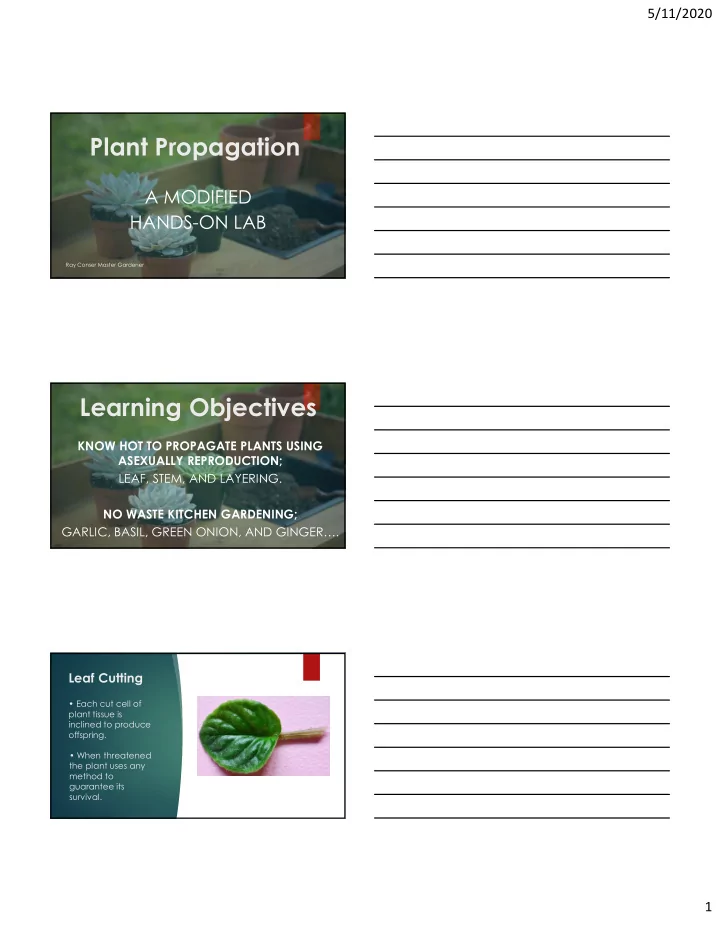
Plant Propagation A MODIFIED HANDS-ON LAB Ray Conser Master - - PDF document

plant propagation
SMART_READER_LITE
LIVE PREVIEW

Plant Propagation A MODIFIED HANDS-ON LAB Ray Conser Master - - PDF document

5/11/2020 Plant Propagation A MODIFIED HANDS-ON LAB Ray Conser Master Gardener Learning Objectives KNOW HOT TO PROPAGATE PLANTS USING ASEXUALLY REPRODUCTION; LEAF, STEM, AND LAYERING. NO WASTE KITCHEN GARDENING; GARLIC, BASIL, GREEN ONION,


slide-1
SLIDE 1

5/11/2020 1

Plant Propagation

A MODIFIED HANDS-ON LAB

Ray Conser Master Gardener

Learning Objectives

KNOW HOT TO PROPAGATE PLANTS USING ASEXUALLY REPRODUCTION; LEAF, STEM, AND LAYERING. NO WASTE KITCHEN GARDENING; GARLIC, BASIL, GREEN ONION, AND GINGER…. Leaf Cutting

  • Each cut cell of

plant tissue is inclined to produce

  • ffspring.
  • When threatened

the plant uses any method to guarantee its survival.

slide-2
SLIDE 2

5/11/2020 2

Propagation Media

  • The primary role of a propagation

medium is to provide support and moisture while the plant is developing. These requirements are quite different from those of a potting medium.

  • These are usually made up from

combinations of peat moss, perlite, vermiculite, sand, bark, clay pebbles or similar materials

  • Treat the cut with

a root hormone.

  • The cut/injured

tissue will likely generate new growth using propagation media.

  • Preparing the

leaf: using a sharp cleaned blade cut the petiole at a 45º angle.

Successful Leaf Cuttings

Okay Scott polling time

slide-3
SLIDE 3

5/11/2020 3

Stem cutting

  • Potatoes are the

thickened underground part of the stem also identified as tubers.

  • Potatoes are stem

cuttings.

Stem Cutting

The “eyes” of the potato are leaf nodes, which develop into new plants. Now you can see why they call it the eye of the potato / leaf scar. The bottom picture is a Plumeria. Now you can always tell which way to plant a cutting, when you see the smile, the cutting is right side up.

Leaf Scar Bud

slide-4
SLIDE 4

5/11/2020 4

There are many ways to grow potatoes in containers for easy no-dig harvesting.

Constructing a Potato Tower

  • Build the wire tower.
  • With each step you will

build a ring of straw or lawn clippings around the inside edge of the tower.

  • Fill with potting soil.
  • Place the potatoes and

cover with soil.

  • When the plants start to

grow cover the base stems with more soil. and repeat.

Polling Time The Tomato Dilemma

slide-5
SLIDE 5

5/11/2020 5

Adventitious Roots

Layering

Layering is when stems come into contact with the potting soil.

The development of roots on a stem while still attached to the parent plant is called layering. Bottom photo shows a wire “U” placed

  • ver the stem to

secure contact with the potting soil.

slide-6
SLIDE 6

5/11/2020 6

A layer is the rooted stem following the removal from the parent plant.

No Waste Kitchen Gardening Time to have some fun.

  • Here are a few kitchen scraps that

you can put into your garden and regrow;

  • Onions, Garlic, Leeks, Shallots
  • Celery
  • Bulb Fennel
  • Carrots
  • Turnips, Parsnips, Beets
  • Lettuce, Bok Choi
  • Cabbages.

Green Onions

slide-7
SLIDE 7

5/11/2020 7

Garlic, Leeks and Shallots

Veggies to Regrow

Using the basal plate of the vegetable set in water until you see short roots and sprouts. then plant it into your garden.

Hydroponic Herbs

After you have used your herb replant the root ball and short stems in a pot and enjoy more basil.

slide-8
SLIDE 8

5/11/2020 8

The Hands-on Lab

WOW, Look at the colors

  • n those roses!!!

When it looks to good to be true … it is.

  • The process for the hands-on

lab.

  • We will review the PowerPoint

presentation for the entire process for the rose cutting lab.

  • On completion, I will switch to

my screen and all of us will do the rose cutting lab together.

Let’s go!

Rose Stem Cutting

  • Clean the leaves off the

bottom of your cutting, leaving a couple of leaves on the top.

The process for your rose cutting

  • Remove the flower/bud
This image cannot currently be displayed.
slide-9
SLIDE 9

5/11/2020 9

  • Reduce the amount of

leaves by clipping the terminal leaf.

  • Cut the bottom of your

cutting at a sharp angle

  • Remove the thorns that will

be below the level of the soil.

  • Apply your root hormone. Dip

I into the container and tap the excess off. Be careful not to breath the powder.

  • Carefully insert your cutting

into the filled one-gallon container.

  • Tap the soil down to stabilize

your cutting. Cut the bottom off from your 2-quart soda bottle. Make the cut where the straight side starts to curve inwards to form the bottom. Place the soda bottle hot house over your cutting without the screw top.

slide-10
SLIDE 10

5/11/2020 10

Find an area outside with no sun, but bright light. Keep moist.

Now let’s get going and make your rose cutting.

When the “Shelter in Place” is gone and we are back to our ”New Normal” and If there is interest, I will be willing to offer the full hands-

  • n lab for Plant Propagation.

You guys deserve it! Plant Propagation Lab for the class of 2020