Plant Development Lecture 1: Plant architecture and embryogenesis. - - PowerPoint PPT Presentation

plant development
SMART_READER_LITE
LIVE PREVIEW

Plant Development Lecture 1: Plant architecture and embryogenesis. - - PowerPoint PPT Presentation

2018 CDB Part IB Plant Development Lecture 1 Plant architecture and embryogenesis Jim Haseloff Department of Plant Sciences (haseloff.plantsci.cam.ac.uk/education) Plant Development Lecture 1: Plant architecture and embryogenesis.


slide-1
SLIDE 1

2018 CDB Part IB

Plant Development

Jim Haseloff
 Department of Plant Sciences
 (haseloff.plantsci.cam.ac.uk/education)
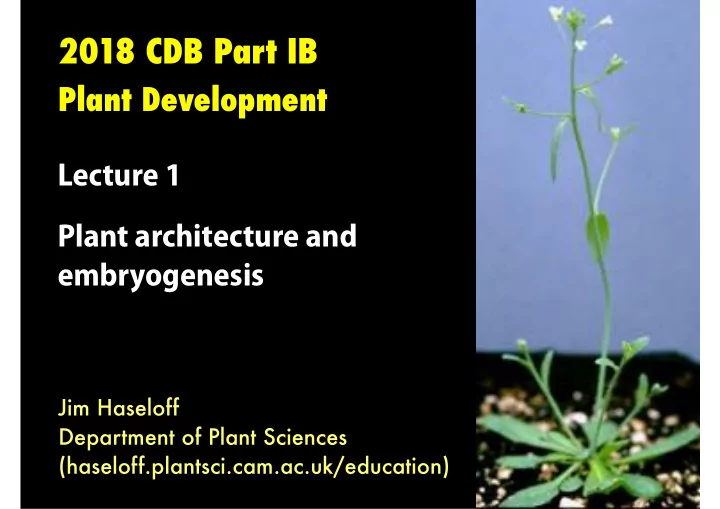
Lecture 1 Plant architecture and embryogenesis

slide-2
SLIDE 2

Plant Development

Lecture 1: Plant architecture and embryogenesis.
 Lecture 2: Polarity and auxin fmow.
 Lecture 3: Regulation of gene expression by auxin.
 Lecture 4: Patterning of indeterminate growth. 
 Lecture 5: Formation and specifjcation of lateral organs.
 Lecture 6: Morphogenesis. Web resources: An electronic version of the lecture slides, a colour version of these notes and additional teaching materials including review papers and essay topics can be found on the web site: http://haselofg.plantsci.cam.ac.uk (click the “education” menu choice and navigate to the CDB Part 1B resources section). Recommended Text books:

For an integrated overview of animal and plant development see:
 Principles of Development, Lewis Wolpert and Cheryll Tickle, Oxford University Press, 2011. Chapter 7 provides a concise overview of the lecture content. For coverage of plant development see:
 Mechanisms in Plant Development, Ottoline Leyser & Stephen Day, Blackwell Science, UK, 2002. For a general discussion of self-organisation across physical and biological systems see:
 Nature's patterns: a tapestry in three parts, Shapes, Flow and Branches, Phillip Ball, 
 Oxford University Press, 2009.

slide-3
SLIDE 3

Immobile and Branched

slide-4
SLIDE 4

Plant cells are encased in a semi- rigid extracellular matrix

slide-5
SLIDE 5
slide-6
SLIDE 6

BBC Natural History Unit

Plant Morphogenesis

slide-7
SLIDE 7

Cladophora

Origin of terrestrial plants

slide-8
SLIDE 8

8

Coleochaete

slide-9
SLIDE 9

Colonisation of the land by plants

slide-10
SLIDE 10

Different conditions faced by algae and plants

Supportive medium (water) Photosynthesis in most cells Direct access to minerals and water Non supportive medium (air) No photosynthesis in root cells Aerial parts not in direct contact with minerals and water

slide-11
SLIDE 11

!11 400 mya

slide-12
SLIDE 12

Aglaophyton major

Early terrestrial plants

slide-13
SLIDE 13

Distribution of terrestrial plants 390 million years ago

slide-14
SLIDE 14

Arabidopsis thaliana as a model plant system

slide-15
SLIDE 15

Arabidopsis thaliana has the best characterised plant genome.

slide-16
SLIDE 16
slide-17
SLIDE 17
slide-18
SLIDE 18
slide-19
SLIDE 19
slide-20
SLIDE 20
slide-21
SLIDE 21
slide-22
SLIDE 22
slide-23
SLIDE 23
slide-24
SLIDE 24
slide-25
SLIDE 25
slide-26
SLIDE 26

1 cell embryo

slide-27
SLIDE 27

4 cell embryo

slide-28
SLIDE 28

Octant stage embryo

slide-29
SLIDE 29
slide-30
SLIDE 30

Radial asymmetry in the 16-cell embryo

slide-31
SLIDE 31

Radial asymmetry in the 16-cell embryo Specification of shoot and root meristems

slide-32
SLIDE 32

Protoderm stage embryo

slide-33
SLIDE 33

Globular stage embryo

slide-34
SLIDE 34
slide-35
SLIDE 35
slide-36
SLIDE 36

20,000 cells after 10 days of development

slide-37
SLIDE 37
slide-38
SLIDE 38

Arabidopsis thaliana
 germinating seed

slide-39
SLIDE 39

Arabidopsis thaliana seeding
 4 days after germination

slide-40
SLIDE 40

A meristem is self-organising and renews itself.

slide-41
SLIDE 41

The shoot meristem is branched and indeterminate, capable of producing lateral primordia at the flanks of the meristem.

slide-42
SLIDE 42
slide-43
SLIDE 43

Modular growth and production of lateral organs

slide-44
SLIDE 44
slide-45
SLIDE 45

Indeterminate growth of the Arabidopsis root meristem

slide-46
SLIDE 46
slide-47
SLIDE 47
slide-48
SLIDE 48

Continued growth of shoot and root meristems produces the adult plant body

slide-49
SLIDE 49

How is an adult body plan built?

Precise sequence of divisions during early embryogenesis. Are plant cell fates controlled by (1) segregation of determinants? (2) positional information?

slide-50
SLIDE 50
slide-51
SLIDE 51
slide-52
SLIDE 52

Genetic screening for mutants in Arabidopsis development

slide-53
SLIDE 53
slide-54
SLIDE 54
slide-55
SLIDE 55

fass mutants have cytoskeletal defects, with altered patterns of cell division

slide-56
SLIDE 56
slide-57
SLIDE 57

fass alleles Wild type fass plants form organised tissues despite deranged cell divisions

slide-58
SLIDE 58
slide-59
SLIDE 59
slide-60
SLIDE 60

Exchange of positional information

slide-61
SLIDE 61

http://haseloff.plantsci.cam.ac.uk