
SLIDE 1
8
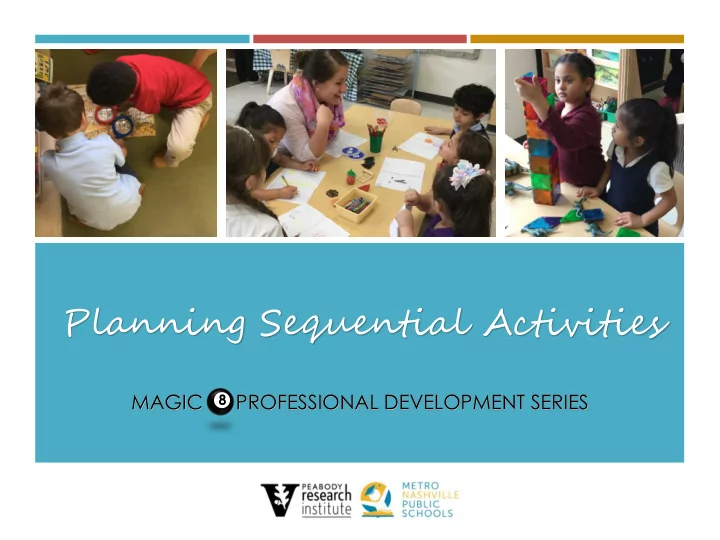
Planning Sequential Activities MAGIC PROFESSIONAL DEVELOPMENT - - PowerPoint PPT Presentation
Planning Sequential Activities MAGIC PROFESSIONAL DEVELOPMENT SERIES 8 THE MAGIC 8 CLASSROOM PRACTICES Reduce time spent in transition 1. Creating a positive climate 2. Increasing teacher listening to children 3. Improving level
8
Magic 8 Professional Development Series |
PLANNING SEQUENTIAL ACTIVITIES
8 2
1.
Reduce time spent in transition
2.
Creating a positive climate
3.
Increasing teacher listening to children
4.
5.
Promoting associative and cooperative interactions
6.
Planning sequential activities
7.
Providing math opportunities
8.
Fostering high levels of engagement 2017-18 Initiative: Focus on Literacy
Magic 8 Professional Development Series |
PLANNING SEQUENTIAL ACTIVITIES
8 3
Sequential activities require children to follow a logical order or sequence.
Scattering pieces from different puzzles on the floor; animating pieces Working on a puzzle together or alone; looking for pieces, rotating pieces to fit Scribbling with markers in the writing center Writing names, responding to a journal prompt, writing authentic messages
EXAMPLES: EXAMPLES:
Squishing Play-Doh in the art center Forming recognizable shapes, letters, or objects
Magic 8 Professional Development Series |
PLANNING SEQUENTIAL ACTIVITIES
8 4
WORKING MEMORY The ability to hold information in mind and use it. INHIBITORY CONTROL The ability to master thoughts and impulses so as to resist temptations, distractions, and habits, and to pause and think before acting. COGNITIVE FLEXIBILITY The capacity to switch gears and adjust to changing demands, priorities, or perspectives.
Children who spend more time engaged in Sequential activities make greater gains in:
Early Math Skills
Letter and Sight Word Recognition
Emergent Writing Skills
Children need opportunities to interact with materials and engage in activities that require them to think, plan, and reflect. Sequential activities provide important opportunities to practice executive function and self-regulation skills.
Which subject areas naturally lend themselves to more Sequential activities?
DISCUSSION POINT:
Magic 8 Professional Development Series |
PLANNING SEQUENTIAL ACTIVITIES
8 5
When setting up the classroom and choosing materials, teachers should strive to create opportunities for higher levels of cognition throughout the day, especially during center time. Strategies include:
Incorporating Sequential Materials (i.e., those that are self-correcting)
Previewing and modeling how to use materials in a Sequential way
Suggesting scenarios or goals to structure play
Magic 8 Professional Development Series |
PLANNING SEQUENTIAL ACTIVITIES
8 6
require children to follow a logical
children visual feedback about whether the task has been completed successfully, and promote children’s independent, sequential play. Can you identify which materials are sequential?
For materials that are not sequential, how can you support children’s use of them in a sequenced way?
DISCUSSION POINT:
Magic 8 Professional Development Series |
PLANNING SEQUENTIAL ACTIVITIES
8 7
While some materials are inherently sequential (e.g., puzzles), children may need suggestions or support from adults to use other materials in a sequenced way.
Be intentional and enthusiastic when introducing free choice center activities—this is an excellent way to spark children’s interest and give them ideas! Play alongside children and demonstrate using materials in sequenced ways:
I see the counting bears are having a birthday party! Should we count how many guests there are to make sure we have enough treats?
MODELING
Since I’m the waitress, I’ll write down your order. Hmm…I can’t remember how to spell “pizza”, but I know it starts with the /p/ sound. Which letter is that?!
PREVIEWING
I brought in a real MAILBOX for the Writing Center! You can write letters to your friends, put them in the mailbox, and the mail carrier will deliver them during our Afternoon Meeting.
Magic 8 Professional Development Series |
PLANNING SEQUENTIAL ACTIVITIES
8 8
Integrate topics from curriculum studies across daily activities
Suggest scenarios for children to act out during dramatic play
Help children develop plans for making specific structures in the block area How can you follow children’s interests to scaffold sequential activities? DISCUSSION POINT:
Non-Sequential Facilitation Sequential
Children scatter pieces from different puzzles on the floor T each strategies for putting together difficult puzzles (e.g., “Let’s look at the picture on the box…these three pieces are red like the firetruck. I wonder if they belong together.”) Children work on a puzzle together or alone— looking for pieces, rotating pieces to fit Children randomly and quickly flip through the pages
Use self-talk to model how they approach reading a new book. Model strategies for using pictures to “guess” what the story is about. Children “read” books, turning pages and making comments about pictures Children squish play-doh in the art center Introduce art center by suggesting the kinds of things children might want to try making. Children use play-doh to make shapes such as letters, leaves for a tree, or cookies for a bakery Children scribble with markers in the writing center Think about how written text can be related to a unit theme or study. Suggest that children write letters, make lists, or author stories. Children work on their names, a journal prompt,
Children play together with dinosaur counters, making sounds and talking like dinosaurs Prompt children to make comparisons about quantity (e.g., “Who has more dinosaurs? How can you tell? How can we make these groups equal?”) Children count the dinosaurs and/or sort them into groups based on size, color, or some other characteristic Children are knocking down structures in the block center Help children make plans or blueprints for buildings. Provide pictures or diagrams in the block center to help give children ideas. Children carefully stack blocks to make recognizable shapes and structures Children are using the dramatic play area as a “kitchen” Create variety in the dramatic play center by setting up different scenes. Discuss responsibilities of specific jobs in the community (e.g., “What do people do at the grocery store? How does a post office work?”) Children take on the different roles in an ice cream parlor or pretend to follow a recipe
10
Magic 8 Professional Development Series |
PLANNING SEQUENTIAL ACTIVITIES
8
We are grateful to the following MNPS Pre-K Instructional Coaches and Multi-Classroom Leaders for their invaluable feedback in developing these materials:
SeTara DeThrow Carrie Head Susan McClain Stephanie Mullins Holly Stone Ashley Aldridge Wilson Rhiannon Wilson
https://my.vanderbilt.edu/mnpspartnership/
Magic 8 Professional Development Series |
8
FREQUENTLY USED IMAGES*
Lightbulb | myiconfinder.com
Designed by Vexels.com:
Hand drawn magnifying glass Hand drawn bar graph Pie chart hand drawn doodle Hand drawn wall clock Hand drawn cloud bubble Hand drawn open book Cog wheel hand drawn icon
ADDITIONAL IMAGE SOURCES
Slide 3: writing center | weclipart.com Slide 3: puzzle | getcolorings.com Slide 4: child gear head | DeviantArt.com Slide 4: arrow | clipartstockphotos.com Slide 5: doctor | getcolorings.com
*These graphics are used as icons throughout the
beside most “Discussion Point” questions.