
SLIDE 1
1
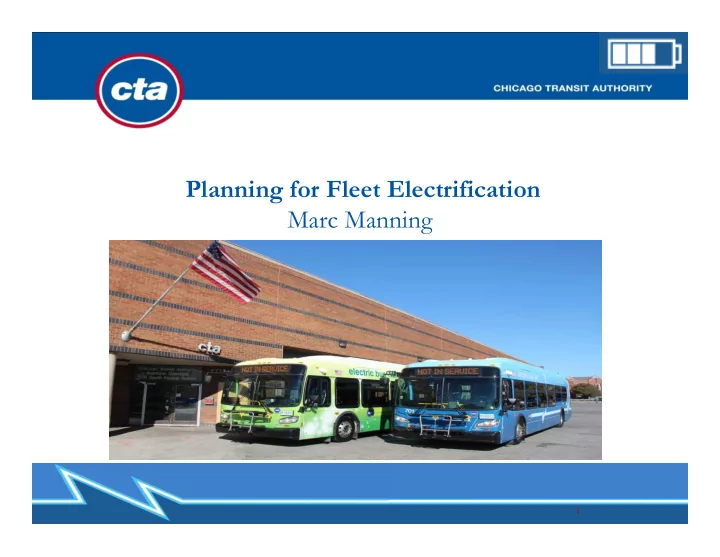
Planning for Fleet Electrification Marc Manning 1 CTAs Electric - - PowerPoint PPT Presentation
Planning for Fleet Electrification Marc Manning 1 CTAs Electric Bus 2 Electric Bus Design New Flyer XE40 with 300 kW-hr Battery Capacity String 3 String 4 String 5 Conventional Engine Compartment String 6 Rear Energy Storage
1
2
3
Strings 1 & 2 String 3 String 4 String 5 String 6 Conventional Engine Compartment Rear Energy Storage Compartment
4
5
Bypass Lane Bypass Lane Bus Parking Lane Bus Parking Lane
Building Beam Aligned with Front Door to ensure proper bus spacing.
6
Dedicated Bay for Electric Bus Manager’s office Yellow Parking Lines & Yellow Bollard for Front Door Positioning
Bus Inspection Lanes Bus Maintenance Bays
7
Note: Table from “E-Truck Performance in Cold Weather” by CALSTART
8
Morning Revenue Service 50-60 miles (~6 hours) Mid-Day Charge @ Garage (~3-5 hours) Afternoon Revenue Service 70-80 Miles (~8 hours) Overnight Charge @ Garage (~3-5 hours)
Note: Ridership for routes is published here http://www.transitchicago.com/ridership/
9
10
– 248-289 Buses per Garage – 308 60 ft. Buses & 1560 40 ft. Buses
Note: Estimated Battery Capacity based on 4 kw-hr/mile. This doesn’t account for end of life or 80% Useable State of Charge. Battery cost per bus based on Bloomberg New Energy Finance presentation on “Lithium-ion Battery Costs & Market.”
11
Only Vehicle Blocks <80 Miles
12
– Maximize Mileage: Charge Midday
– One Charge Per Day: Shifts Charging to Night Only
– 80 miles of Maximum Range before Charging – All charging directly to High Voltage Battery
– Buses are on schedule
– Buses are available immediately upon arrival for charging – Buses available for service after fully charged – No limit to Peak Demand – No limit for Maximum Number of Chargers.
13
Require Midday Charge Require 1 Charge Per Day 21 Buses could be charged Midday for Greater than 80 Miles
14
What Demand can Garage Support? How Many Chargers can be installed at Garage? Charge Mid-day to have spare available buses for PM Distribute Charging to Optimize Distribute Charging to Optimize
15
$2.00 Per Gallon (Diesel) $3.00 Per Gallon (Diesel) ~$0.14 per Mile Supply Charge @ $0.043 per kW-hr (Not Included) Shift charging to Off- Peak Distribute Charging to Optimize
16
17
– What is the Charging Location Limitation? – What is the Utility Limitation?
– Is there Enough Real Estate? – What Cost is Available for Each Charger? – Is there Enough Power to Support? – What type of Charger?
– What is the Variability for Diesel vs. Electricity Cost?
– Would the Utility create a E-Bus special rate?
18
Marc Manning 7801 S Vincennes Ave Chicago, IL 60620 Cell: 312.204.9235 Email: mmanning3@transitchicago.com