-- Planning and BMPs for Large LUPs Tanya Bllezikjlan. P.E . QSD/P - - PDF document

planning and bmps for large lups tanya bllezikjlan p e
SMART_READER_LITE
LIVE PREVIEW

-- Planning and BMPs for Large LUPs Tanya Bllezikjlan. P.E . QSD/P - - PDF document

~y~ ~j~a( ~i~:=~d ~:J: ~;:~tlple ,;~;tch 1 0/24/20 16 -- Planning and BMPs for Large LUPs Tanya Bllezikjlan. P.E . QSD/P Michael B aker International Western Chapter IECA Construct i on Site Management Workshop October 2016 Projects are


slide-1
SLIDE 1

·--

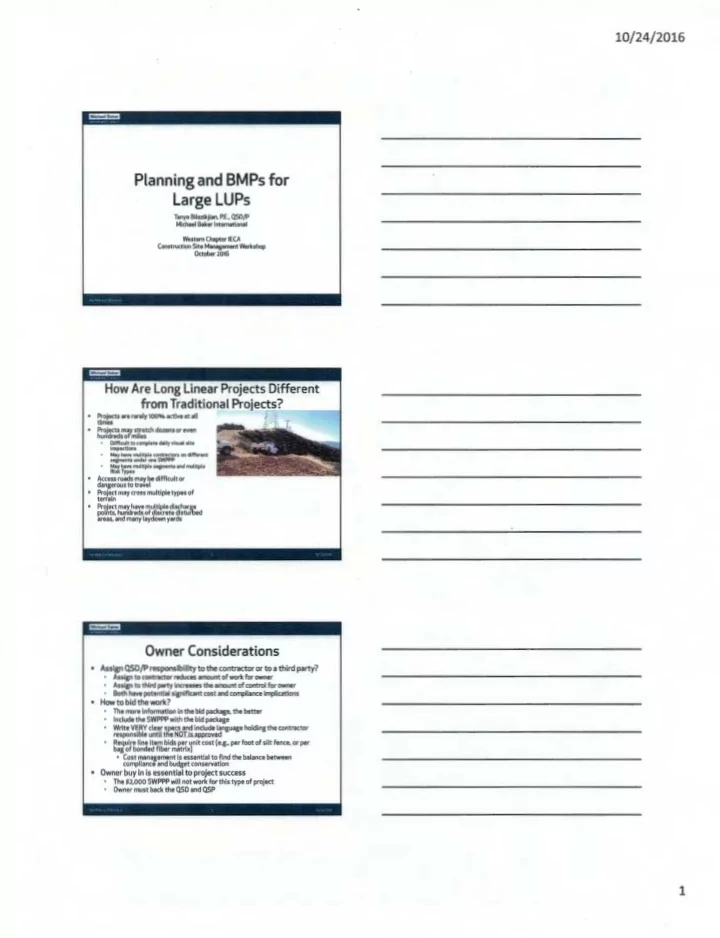
Planning and BMPs for Large LUPs

Tanya Bllezikjlan. P.E. QSD/P Michael Baker International Western Chapter IECA Construction Site Management Workshop October 2016 Projects are rarely 100% active at all times ~j~a( ,;~;tch dozens or even Dlfflcult to complet1 dally vlw.1 5't1 Inspections May Mve multiple contractors on different ngrrwnts under one SWPPP

:J

~;:~tlple segrMnts •nd multiple Access roads may be difficult or dangerous to travel Project may cross multiple types of terrain ~y~ ~:J: ~i~:=~d
  • areas. and many laydown yards

·---

Owner Considerations

  • Assign QSD/P responsibility to the contractor or to a third party?
  • Assign to contractor reduces amount of work for owner
  • Assign to third party increases the amount of control for owner
  • Both have potential significant cost and compliance implications
  • How to bid the work?
The more information in the bid package, the better Include the SWPPP with the bid package Write VERY clear specs and include language holding the contractor responsible until t~e NOI.iupp,ond Require line item bids per unit cost(e.g., per foot of silt fence, or per bag of bonded fiber matrix)
  • Cost management is essential to find the balance between
compliance and budget conservation
  • Owner buy in is essential to project success
The $2,000 SW PPP will not work for this type of project
  • Owner must back the QSO and QSP

10/24/2016 1

slide-2
SLIDE 2

QSD Considerations

1. Stay involved throughout the project. 2. Ensure clear understanding of all areas to be disturbed, particularly those not on the grading plans. 3, Coordinate with biologists and other environmental teams working on the project.
  • 4. Consider each site as an individual
project for overhead construction. 5, For underground work, consider challenges of trenches and topography.
  • 6. Focus on reducing land disturbance
and preserving ex ts ting vegetation. 7. Determine final stabilization a~proach ~U~P development using ~o%~"ri~hf~fo~\~ ~rig~;~.r~actor. agencies Identify areas that can be closed out via COi as often as possible Thoroughly document pre-construction conditions Review the SWPPP. particularly construction ~=~t~s:~!~:t~ :~:~:. : : : ~ preservation of vegetation, BMP installation Ensure yards are maintained and kept neat Daily: site inspections are difficult to achieve
  • n a
long linear project Sampling may be difficult or unsafe during rain events if access roads are unpaved or
  • steep. Document everything!

Project Closeout

  • Coordinate with restoration team
  • SWPPP final stabilization may not work
with habitat restoration plan
  • Coordinate with Regional Board
Discuss closeout and final stabilization plans in relation to restoration to gain buy tn I nvite to the site to demonstrate level of effort
  • Ensure contractor is aware of seasonal
limits on seeding- do not hydroseed between February and October
  • Verify RUSLE2 calculations for final
stabilization

10/24/2016 2

slide-3
SLIDE 3

Challenges During Construction

  • Access roads
Access to sampling locations
  • Road washout/safety due to
rainfall/bad drainage design
  • Birds and other critters
Access restrictions and need for monitor to accompany Nesting birds
  • Timing
  • Rainy season starts just as
nesting season ends
  • Fire danger may close project

sites

  • Challenges During Construction
  • Contractor pushback
Project team culture Communication
  • Commitment to SWPPP implementation and
compliance
  • Lack of owner support
Vegetation establishment
  • Seasonal seeding. poor soils, lack of water,
poor weather. overcompaction Slow or poor regulatory coordination COis must be approved before next COi can be submitted
  • RB may distrust P.roject or owner, need to
estabhsh good relationship Unanticipated issues

Wrap Up and Questions

  • Long_ linear projects have a lot of unique elements to
consider
  • All can be addressed, with good planning and dedication
  • CGP Review Issue #3 addresses much of this topic
  • http://www.waterboards.ca.gov/water issues/programs/stormwat
er/docs/training/cgp_review_issue3.pdf

Questions?

Tanya Bilezikjian, P.E., QSD/P. Trainer of Record tanyab@mbakerintl.com Michael Baker International

10/24/2016

3

slide-4
SLIDE 4

'

1 1

Project Examples

  • ,

I

Ephemeral Tributary • Turf Reinforcement Mat

1

to Rattlesnake
  • Erosion Control Blanket
Creek Streambank Stabilization
  • Rip·rap Toe Anchor

I

Ruxton Avenue
  • Concrete Removal

J

Channel Conver.;ion
  • Triple Box Culvert
  • Gravel Bag Check Dams

I Northwest Village

  • Channel Widening I Flattening

1

Creek Restoration in
  • Riprap Drop Structures
Chollas Water.;hed - Euclid /Market
  • Temporary K-Rail Check Dams
P""""'"" "" _...,., '~ Ephemeral Tributary to Rattlesnake Creek Streambank Stabilization
  • 1
project Back11m1md ~gu7~e[ 0 s~·:J!s~ai~,:e~d two severe erosion areas along the epherneral

~

Reinforce the channel to enhance funct100 ;md vatu~
  • f npanan streambank and ln·
str~m habitat$.

6/23/2015

1

slide-5
SLIDE 5

Project Background - Erosion Area #1

Erosion Area #1 20-foot x 9-foot erosion Velocities were calculated to be between 9 and 14 feet per second. Erosion Area 1 prior to temporary rlprap placement. Erosion Area 1 after placement of temporary 14 ton riprap. WC •l!CA CONSTltUCTIOfl SIU IU.tlAOUU:Jrtt WOJllUHO' I OCTOHll 2• , 2016
  • '~-
"""'. 4

Project Background - Erosion Area # 2

1

Erosion Area #2 80-foot x 13-foot erosion approximately Velocities were calculated to be between 6 and 16 fps. Erosion area 2 prior to temporary K-Rail placement (lookingdownstreaml Erosion area 2 following placement of temporary K·Ratt (looking upstream) wc-u:c.A COHSflUC'HOH SIT[ MAJllA0t:M£HT WOltltlttOP I OCTOIO H , 10U

r-·"" , I Design Approach ,

  • .
E XIST ING C ONDITIONS
  • WC· ICCA. COfrlSTIUCTIOM SITI: M•OIAGEM!MT WOll.kSHOP
I OCTOIU. U. 20U

6/23/2015 2

slide-6
SLIDE 6 ~ v

Design Approach

i

Existing Channel Conditions Areas of concern: Erosion Areas 111 and #2
  • Unreinforced channel cwves & existing erosion opposite the K·rail
  • Narrow channel in central reach (Temp K·rail location)
WC· l[C.-, CO NJT ll UCTIO N SITl MAN•<i UICNT WOlKU~O, I OCTOIU l • , lOl• "'t.'-'"" "" ,~,. '"""'" '

Design Approach

Design Challenges High V elocities and Shear Stress Existing 'Pillow Block' Retaining Wall Steep Slopes Narrowing Channel Adjacent Properties (including a structlJre) W( . l[C>. CO HSTllUCTtON SI U M>.N4GlMCMT WOlllUHO, I OCTOICll l•, 201 • "'"~._,._, ,,.,

Design Approach

·' pmoosed Bjppoaineertna So!utjon Channel Widening, L.'lying Slopes Back, Translt1ons Turf Reinforcement Matting (TRM) w/ Riprap Toe Protection Riprap Extension Erosion Control Blanket (ECB} W(.ll( ,t, CONSTllUC TION SIT!: MANAGCMENT wou:s"o' I OCTOIU 26 , 20 1'

6/23/2015 3

slide-7
SLIDE 7 '

Environmental Permitting .

Project Goals
  • Reinforce the channel to enhance function and values of riparian
streambank and in-stream habitats. Permitting Agencies Army Corps of Engineers Regional Water Quality Control Board California Department Fish and Wildlife Environmental Design Considerations Biological Surveys
  • Biological Baseline
Wildlife Surveys
  • Vegetation Surveys
Tree Removal Survey CEQA Analysis Archaeological Assessments&. Monitoring Restoration Maintenance and Monitoring Plan WC ·lfC.t. CO"STltUCTION SIT( MAN"G[Mt:NT WOllKStlOI' I OCTOICR 2' , 20U ~

Environmental Permitting

Involve Resource Agencies Early Pre-application meeting with agencies Preliminary design Photo exhibit &. descriptive narrative with figures Collaborative Design
  • ~i~e~n~;~l~n~{~;~ti
~o~i~f~i~i~"cia~et~':; the habitat was substantially enhanced Persistence CDFW: Streambed Alteration Agreement ACOE: RGP 63 (Emergency)- RGP 70 (Bioengineering) or NWP 13 (Stabilization) RWQCB: 401Certification Priorities
  • Self-Mitigating
Permits!!! WC · lfC.A CONSUUCT!Ofrl SIU: MAN4G[M(HT WOlllUHOI' I OCTOIU 2', 2016

.. '-· '

Environmental Permitting

WC •l(C 4 COHSTll!JCTION SITE M4NAGl:Mt:NT WO~KSHOI' I OCTOIU U , 1016

6/23/2015 4

slide-8
SLIDE 8 ~ ~ ' ~ "''""M'"'

Environmental Permitting

..

Existing Vegetation Communities

1 ~

I ~

SHRUB PLANTING Pl.AN TV ~ wc . tt:CA CONST llUCTION llTl MANAGUICNT WOllKSHO, I ocroeu 26, JOU

"'

'

'

C~struction

Phase

J

Proposed Slope Stabilization & Anchor System
  • Erosion Control Blanket and Turf Reinforcement Mat Layers
  • Gravel Backfill Bin
  • Riprap Toe Anchor
WC· lfC,t. CONSTllUCTION SIT( MAMAG[M(NT WOllK$HOP I ocroeu 2•, iou

.

  • Construction Phase
Proposed Structure Stabilization
  • Existing "Pillow Block" Retaining Wall
  • Proposed Modular Retaining Wall System
  • Retain Existing Residential Structures
Existing Newly Extended

6/23/2015 5

slide-9
SLIDE 9

[ ~

  • nstruction

Phase

.

Proposed Channel Bank Stabilization
  • Warped Wing Wall Transition
  • Modular R
etaining Wall System
  • TRM and ECB Placement and K
ey-in wc . 1r:c:>. CONSTRUCTION SIT[ M.t..NA(IUl[lrtT WOii KS HOP I OCTOllU u . 20 u 1 6

~

Construction Phase

,

Construction Challenges Limited Construction Access Points
  • Minimal Channel Access Along Construction Corridor
Residential Lot. Structures and Fencing Along Both Sides of Corridor
  • Limited Work Zone in Channel Bottom to Preserve Hardpan
wc.u:c.-. COIUfll:UCTION SITl MilNAOUl[l'IT WOlllCSHOP I 0'1010 :U, ZOU ...... ~ '"

· Construction Phase

WC ·l[CA COHSTRUCTION SIT! MAJU.CU:ll!fHT WOU:SHOP I OCTOH~ 2', 101•

6/23/2015 6

slide-10
SLIDE 10

6/23/2015

WC·l(Cll COHSTltUCTIOtl SITf: MAHAG[Mt:HT WOllXSHO, I OCTOHll U, 20 I' 21 lBI

7

slide-11
SLIDE 11 .... ~- ~

! Project Recap

  • Detailed Hydraulics to assess Velocities I Shear

Stress

  • Variable Permanent Solutions, Preserved

Existing Hardpan

  • Pre-app Coord w/ Resource Agencies
  • Temp Channel Crossing on Plans
  • Biodegradable ECB for Veg Establishment

;" Ruxton Avenue Channel Conversion

  • ~.

Project Summary

  • To provide mitigation for a prior project while

adding additional capacity to a portion of the drainage channel and an existing culvert.

  • Project Objectives

· Removing approximately 500 linear feet of concrete,

  • Restoring the channel to a natural meandering

alignment, and

  • Establishing low maintenance vegetation.
WC · if:CA COMHlt!JCTION SIU MAN4G01t:P<lt WOlllUHO' I OCTOUlt '.U , 2016 t

Ruxton Avenue - Before Construction

  • Upstream concrete channel

., I

WC · IEC4 COHSTlt!JCTIOl<I SITE MAfrUOEMlfllT WOlllCSHO, I OCTOlU 16, 2016

6/23/2015

8

slide-12
SLIDE 12

6/23/2015

  • ~-
  • ~ton

Avenue - Before Construction \

  • Bend area

r'-

  • Ruxton Avenue - During Construction

1

  • Triple box culvert construction

r "

Ruxton Avenue - During Construction

  • Temporary Gravel Bag Check Dams
WC ·l[C " CO JOl•UCTIO /'C 'UH MAHAGfMr:HT WOUSHO,

,, ma

9

slide-13
SLIDE 13 "•"'~ ... .,.~

Ruxton Avenue - After Construction .

  • Upstream channel
WCdl'.CA COHSTllUCTIOH SIH MAHAG!lll[HT WOllKUIO, I OCTOICll 2', lOU 28 ~

Ruxton Avenue - After Construction ,

  • Downstream channel
  • ·

Ruxton Avenue - Project Recap

  • Project Results
  • Environmental benefits from Concrete

Removal include the channel's natural function of infiltration and biofiltration.

  • During construction, erosion and

sedimentation controls resulted in controlled runoff and protected Spring Valley Creek immediately downstream.

WC· lf:CA CO JISTIUCTIOH sin MAllfAGtllllHT WOUSHO, I OCTOHI U , 101• )() ~

6/23/2015 10

slide-14
SLIDE 14 '
  • Northwest Village Creek Restoration

'

  • Project Summary
  • Located along South Las Chollas Creek, within

Chollas Creek Watershed · Prop 84 Grant - widen, stabilize, and vegetate

  • verbanks
  • Includes three riprap drop structures to

establish more stable longitudinal slope · Natural Cobble Bedload within Channel

WC• t[CJ. COMSTllUCTtON SITE M.ANAGfM[NT WOUHIOP I OCTOICll 2• , 2016
  • ,
Northwest Village Creek Restoration 31

~

·
  • Before Construction
ij WC · l[CA COMSTll:UCT/Ofrl SJTE MANAGEMENT WOltltSHOP I OCTOIElll :U, 2016 ~"- North- west Village Creek Restoration
  • Before Construction

'

6/23/2015 11

slide-15
SLIDE 15

6/23/2015

  • No
rth
  • ~est
Vi I I

age creek Restoration

~
  • During Construction
""No'r't'tiwest Village Creek Restoration _- .i:>~ring

Construction

j

" N~ ' r 't h' " ;est

Village Creek Restorat ion

  • After Construction (Upstream Segment)

12

slide-16
SLIDE 16
  • North.,;,est Village Creek Restoration
;
  • After Construction (Overbank Vegetation)

i

. A-- - -~- WC· l[CA COHSTllUC:TION SIU: MAM40UU'.NT WOllKSHO,. 17

~

" Norih;';;;est Village Creek Restoration
  • After Construction (Downstream Segment)
1. r·~-~

...

  • Project Recap
  • Widened Channel, Flattened Longitudinal Slope

wl 3 Riprap Drop Structures

  • Planted Overbanks, Pervious Throughout
  • Buried Riprap with Natural Cobble Bed Material
  • Very Mobile Cobble Bedload
  • Precluded Permanent TRM solutions and Temporary
ECB solutions · Utilized Temporary K-Rail during construction to simulate Drop Structures and control bedload / upstream sediment WC·l[CA CO HST1'UCTIO N SIT!'. MAH.t.Gl'M[Hl WOltXSHOP I OCTOllU. 2•, 20 1 6

6/23/2015 13

slide-17
SLIDE 17 .,. ___ ,.._... " What's Downstream You Ask??? .. A Floating Amphitheatre Stage' W(·l[CA (0/'ISTAUCTIOtt SIU MAfi4GEMtl'tt WOllKSHOP I OCTOHll 2,, 201 • What's Downstream You Ask??? ... A Floating Amph1theatre Stage! , WC.-U:C A COl'IHllUC.TION Sift MAN4GfMfHt WOlllCSHOP I OCtOlt:ll 2• , 201' Brendan Hast;e , PE, LEED AP Rick Engineering Company Water Resources Division Associate Phone: (619) 291·0707 bhastle@rtckengineering.com www.rickengineeling.com

6/23/2015

14

slide-18
SLIDE 18

Brendan Hastie, PE, LEED AP Brendan Hastie is an Associate in the Water Resources Division for Rick Engineering Company. He earned his Bachelor of Science in Civil Engineering from Penn State University and is a registered Civil Engineer in the State of California. He has specialized in water resource engineering for the past 16 years, with experience across a wide range of water resources projects, including the planning, design, and construction of channel rehabilitation projects for both Public Works and Land Development

  • projects. He has served on several Technical Advisory Committees including the County of San Diego LID

Handbook, City of San Diego Alternative Compliance Program, and Regional Bioretention Soil Mix Specifications. He has also been a member of the Green BMP Workgroup for San Diego River and served on the Consultation Panel for the San Diego River Water Quality Improvement Plan.

slide-19
SLIDE 19

10/24/2016 1

slide-20
SLIDE 20 ·t.onelt«l•ime · k><>k.ib•pi<lu"'
  • lnlgl•P~"'"'nl•im.,bkl
  • 1.ookMprofedhGW.oc•llY
  • Muimh:ing«>tfea1~,_
·l)e¥flopSwrPPtufy•1
  • drtf11101uhn
·nnd.ogoodQSD ·UM llMP "!<'Olnllfd 6MP w«•'1C•tlo11f ·Vtrify1h.M1be(O"tr..ctMlt•"•,.orswppp.nc1cc;r"'lui"'"''"'" ·Wb.tl•1htllltr1-n:byofBMr-mtnt•ndm;iin1t'!Wntt?
  • Mthtll.Ml'oino.i.lled<'Om'Ctly!
Long lead time Bringing proper departments into fold Build SWPPP development and inspection into contract
  • Understand what is necessary for CGP Compliance
  • Work collaboratively with other jurisdictional

departments

  • Know the different permitting requirements

Planning

Hurdle

Communication Enforcement

Solution

Set up lines of communication between jurisdiction, QSP, and contractor during contract negotiations Make enforcement a priority through contract penalties

10/24/2016 2

slide-21
SLIDE 21

Look at project holistically Maximize cost effectiveness Develop SWPPP early and refine

  • ften
  • Where are BMPs needed
  • What BMPs are most cost effective (hint: planning)
  • Dev~lop

construction SWPPP early

  • Make sure contractor understands SWPPP

requirements · Find a good QSD

  • Use BMP recognized BMP specifications

· Verify that the contractor is aware of

SWPPP and CGP requirements
  • Hold contractor to SWPPP specifications
  • Ask for assistance from the QSD

Development

Hurdle Solution

  • Communication

Set up lines of communication between jurisdiction, QSP, and contractor during contract negotiations

  • BMP Responsibility • Identify BMP

responsibility during contract negotiations

10/24/2016

3

slide-22
SLIDE 22

Development

Hurdle Solution

  • SMARTS

Spend time to get to know SMARTS or contract with someone that has experience

:=-.:.:.~":.":~= =
  • -=
  • ·"'
~.,!."=:-~:-U- "' ~:=: ___ .
  • What is the hierarchy of BMP

assessment and maintenance?

  • Are the BMPs installed

correctly?

  • Provide training and hire

experienced contractors

  • Verify that the BM Ps are

properly installed and maintained

Hurdle

Ineffective BM Ps

Solution

Request a QSD assessment and update theSWPPP Provide training or require that QSP is present full time

"

" 10/24/2016

4

slide-23
SLIDE 23

Implementation

Hurdle Solution

  • Lack of Maintenance • Request a QSD

assessment and update theSWPPP

  • Provide training or

require that QSP is present full time

Construction Entrance Inlet Protection

10/24/2016 " " 5

slide-24
SLIDE 24

10/24/2016

BMP Maintenance

,.

Sediment on Impervious Surfaces

17

.. 6

slide-25
SLIDE 25

10/24/2016

Improper BMP Implementation

"

Questionable Decisions

7