Planning Ahead for the Care You May Need: Health Care Decisions in - - PowerPoint PPT Presentation

planning ahead for the care you may need health care
SMART_READER_LITE
LIVE PREVIEW

Planning Ahead for the Care You May Need: Health Care Decisions in - - PowerPoint PPT Presentation

May 21, 2020, DAS COVID-19 Webinar Series Planning Ahead for the Care You May Need: Health Care Decisions in the Era of COVID-19 Anne Kinderman, MD Rebecca Sudore, MD Director, Supportive & Palliative Care Professor of Medicine, Division


slide-1
SLIDE 1

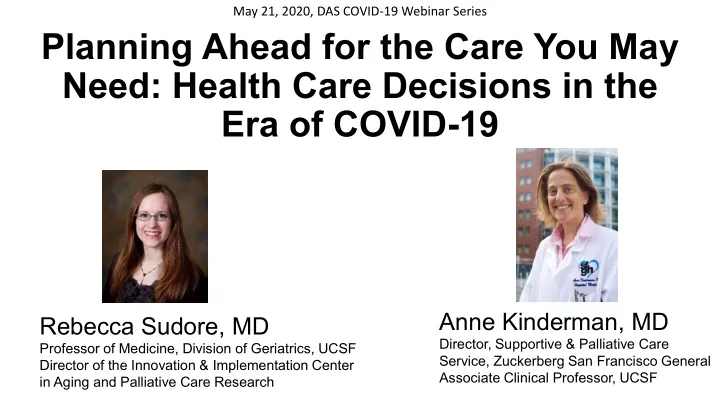
Planning Ahead for the Care You May Need: Health Care Decisions in the Era of COVID-19

May 21, 2020, DAS COVID-19 Webinar Series

Anne Kinderman, MD

Director, Supportive & Palliative Care Service, Zuckerberg San Francisco General Associate Clinical Professor, UCSF

Rebecca Sudore, MD

Professor of Medicine, Division of Geriatrics, UCSF Director of the Innovation & Implementation Center in Aging and Palliative Care Research

slide-2
SLIDE 2

Outline

  • Advance Care Planning (ACP)

– The goal of ACP – ACP & COVID-19 crisis – Tools to help people start ACP

  • Palliative Care

– Being in the hospital with COVID-19 – Key things to consider – How Palliative Care can help

slide-3
SLIDE 3

What is Advance Care Planning?

  • Definition: ACP is a process that supports adults at any age or stage
  • f health in understanding and sharing their personal values, life

goals, and preferences regarding current or future medical care.

  • Goal: The goal of ACP is to help ensure that people receive medical

care that is consistent with their values, goals and preferences during serious and chronic illness.”

Sudore et al., Delphi Panel Consensus Definition. JPSM 2017

slide-4
SLIDE 4

Why is ACP Important?

  • Improved patient satisfaction with care
  • Improved quality of life
  • Less unwanted medical care aligned with wishes
  • Less stress for the surrogate decision maker
slide-5
SLIDE 5

Advance Care Planning Realities

  • Advance care planning ~ 33% for the past 10 years
  • Lower among minority populations, ~ 15-20%
  • ~ 10-20% discussed wishes with medical provider
  • Among ICU decedents, ~ 20% no ACP before death
slide-6
SLIDE 6

COVID-19 Clinical Realities

  • Serious illness affecting both young and old (median 56 yrs)
  • Clinical picture can worsen very quickly
  • Families, surrogates not able to visit ER/hospital
  • Older patients not bringing hearing aids, glasses, or cell

phones or chargers

  • Frontline providers are DESPERATE to know any

information about the person and family contacts

slide-7
SLIDE 7
slide-8
SLIDE 8

Pack a Hospital 'Go bag' today!

https://prepareforyourcare.org/covid-19

slide-9
SLIDE 9

www.prepareforyourcare.org

Online Advance Care Planning Program in English & Spanish

slide-10
SLIDE 10

RCT:

  • Doubled completion rates
  • Overwhelmingly preferred

regardless of literacy/ language

10 languages

www.PrepareForYourCare.org

Easy-to-Read Advance Directive (AD)

Sudore RL et. al., Patient Educ Couns 2007

slide-11
SLIDE 11

Missing Puzzle Piece

  • PREPARE people with skills to:

–identify what is most important and how they want to live –talk with family and friends –talk with medical providers –make informed decisions –get the care that is right for them

Sudore RL. & Fried TR. Ann Intern Med, 2010

slide-12
SLIDE 12

www.PrepareForYourCare.org Interactive, multi-media website

slide-13
SLIDE 13

PrepareForYourCare.org

5-Steps of PREPARE

slide-14
SLIDE 14

Creating PREPARE

  • Co-created with diverse populations
  • Easy to understand: 5th-grade reading level

– Voice-overs & closed captioning (Eng/Span)

  • Range of video stories:

– Surrogate availability – Decision making preferences

  • Videos that model ACP behavior

* Sudore RL et. al., J Pain & Symptom Manage, 2012

slide-15
SLIDE 15

How to Ask a Decision Maker

slide-16
SLIDE 16

How to Talk with Family & Friends

slide-17
SLIDE 17

How to Ask Clinicians Questions

slide-18
SLIDE 18
slide-19
SLIDE 19

Efficacy of the PREPARE Program

Sudore, et al. JAMA IM: 2 RCTs,1400 English & Spanish speaking participants

slide-20
SLIDE 20

PREPARE Tools

slide-21
SLIDE 21

Easy-to-read ADs for all US States in English & Spanish

slide-22
SLIDE 22

Values & Space to write “Why” & COVID or other specific wishes

slide-23
SLIDE 23

Guided AD Step for CA (other states coming)

  • Integrates and guides users to complete the AD
slide-24
SLIDE 24
  • Additional information and videos available if needed

Guided AD Step for CA (Info & videos)

slide-25
SLIDE 25
  • Tailored answer automation

Guided AD Step for CA (pre-populates AD)

slide-26
SLIDE 26

PREPARE Tools

slide-27
SLIDE 27

PREPARE Pamphlet

Trifold English, Spanish, Chinese

slide-28
SLIDE 28

Group Movie Events

Zapata, Wistar, Lum, Horton, Sudore, Journal of Palliative Medicine, 2018

slide-29
SLIDE 29

Group visits through Video

slide-30
SLIDE 30

Pack a Hospital 'Go bag' today!

https://www.youtube.com/watch?v=x1rZdXoB_t8

slide-31
SLIDE 31

All Hands on Deck: Simple Scripts

J Am Geriatr Soc. May, 2020

https://prepareforyourcare.org/covid-19

  • Step 1: Ask about a surrogate
  • Step 2: Ask about prior ADs
  • Step 3: Give basic ACP information
slide-32
SLIDE 32

Scripts

  • Nurses, physicians,

social workers, physical therapists, assistants, students…anyone

slide-33
SLIDE 33

Questions

  • 1. Where can people start?
  • 2. How do you recommend organizations

use PREPARE tools?

slide-34
SLIDE 34

Outline

  • Advance Care Planning (ACP)

– The goal of ACP – ACP & COVID-19 crisis – Tools to help people start ACP

  • Palliative Care

– Being in the hospital with COVID-19 – Key things to consider – How Palliative Care can help

slide-35
SLIDE 35

If I need to go to the hospital, what can I expect?

Zuckerberg San Francisco General Hospital and Trauma Center 35

slide-36
SLIDE 36

Being in the Hospital Now: What is it Like?

Zuckerberg San Francisco General Hospital and Trauma Center 36

New things

  • Fewer people, less noise
  • Visiting is very limited in most hospitals
  • Staff will wear masks, sometimes face

shields, even if you don’t have COVID

  • Some providers/staff may only meet with

you by phone or video

Usual things

  • Staff will wake you up – to ask you

questions, draw blood, examine you, etc.

  • You will be seen by a doctor or advance

practice provider (Nurse Practitioner or Physician Assistant) daily – usually just

  • nce a day
  • Results can take time to come back
slide-37
SLIDE 37

Being in the hospital with COVID

  • Most people don’t need invasive

treatments

  • Special isolation unit of hospital
  • Staff wear more protective gear (gowns,

masks, face shields, caps)

  • Most/all of your in-person visits will be

from 1 doctor/1 nurse; other visits by phone/video

  • Most patients need oxygen by a small

tube in the nose (canula)

  • Close monitoring of your vital signs, blood

tests

  • No visitors – connect by phone/video
  • Once you’re out of the high-risk period,

you go home to finish out quarantine (or to special isolation accommodations)

Zuckerberg San Francisco General Hospital and Trauma Center 37

This Photo by Unknown Author is licensed under CC BY-SA

slide-38
SLIDE 38

Being in the hospital with COVID

  • 3 in 100 people in the US with

COVID need intensive care

  • Most need mechanical ventilation
  • Many need to be sedated to get

enough oxygen in, tolerate ventilator

  • Doctors communicate with your

designated decision maker

  • Some people get better, but it

takes a long time; some people die (chances increase with age)

This Photo by Unknown Author is licensed under CC BY-SA

CDC, MMWR March 27, 2020 / 69(12);343-346

Zuckerberg San Francisco General Hospital and Trauma Center 38

slide-39
SLIDE 39

Key things to think about before the hospital

  • Who would you want to make decisions for you?
  • If you get sicker very quickly, which of these best suits you?

Life Support for as long as it helps keep you alive

Life Support for a trial period Non-invasive treatments

  • nly

Zuckerberg San Francisco General Hospital and Trauma Center 39

slide-40
SLIDE 40

Key things to think about, in general

  • What would be most important for your healthcare providers or

loved ones to know if you became very sick and couldn’t speak for yourself?

  • What abilities are so important to you that you can’t imagine living

without them?

  • If you became very sick with COVID, how much are you willing to go

through for the possibility of having more time?

  • Who in your life have you talked with about your priorities and your

wishes? How much do they know?

  • What gives you strength in hard times?

Zuckerberg San Francisco General Hospital and Trauma Center 40

slide-41
SLIDE 41

Palliative Care Can Help!

Zuckerberg San Francisco General Hospital and Trauma Center 41

slide-42
SLIDE 42

Palliative Care Can Help!

  • Things palliative care teams help with:
  • Identifying what’s most important to you in life, as a guide for medical care
  • Providing clear information on what’s going on
  • Gathering important people to talk about your condition
  • Helping relieve physical, emotional symptoms
  • Addressing spiritual needs, big questions of life
  • Getting you connected to resources you need
  • Coordinating care across different teams, settings
  • Supporting caregivers, loved ones

Zuckerberg San Francisco General Hospital and Trauma Center 42

slide-43
SLIDE 43

How do I get palliative care?

  • Ask your doctor (hospital, primary care)
  • Ask your insurance company
  • getpalliativecare.org
  • Palliative care is available in ALL hospitals in San Francisco
  • Palliative care is increasingly available in clinics and homes
  • Palliative care is sometimes available in nursing homes

Zuckerberg San Francisco General Hospital and Trauma Center 43

slide-44
SLIDE 44

Things to Remember

  • These are uncertain and scary times, but there are things you

can do to prepare yourself and your loved ones

  • Identify a decision-maker and have a conversation
  • Think about what would be most important to you if you got very

sick

  • If you are worried about your risk of getting very sick with COVID,

talk to your primary care provider

  • Palliative care can help you and your loved ones, if you are

dealing with serious illness (COVID or other illnesses)

Zuckerberg San Francisco General Hospital and Trauma Center 44

slide-45
SLIDE 45

Questions?

anne.kinderman@ucsf.edu rebecca.sudore@ucsf.edu @prepareforcare PrepareForYourCare.org

  • PREPARE materials are free to the public. It is OK to provide a url link and to print

materials from the PREPARE website. Licensing is required for other uses.