Rethinking Health Care Expectations in a Global Context HOPE: - - PDF document

rethinking health care expectations in a global context
SMART_READER_LITE
LIVE PREVIEW

Rethinking Health Care Expectations in a Global Context HOPE: - - PDF document

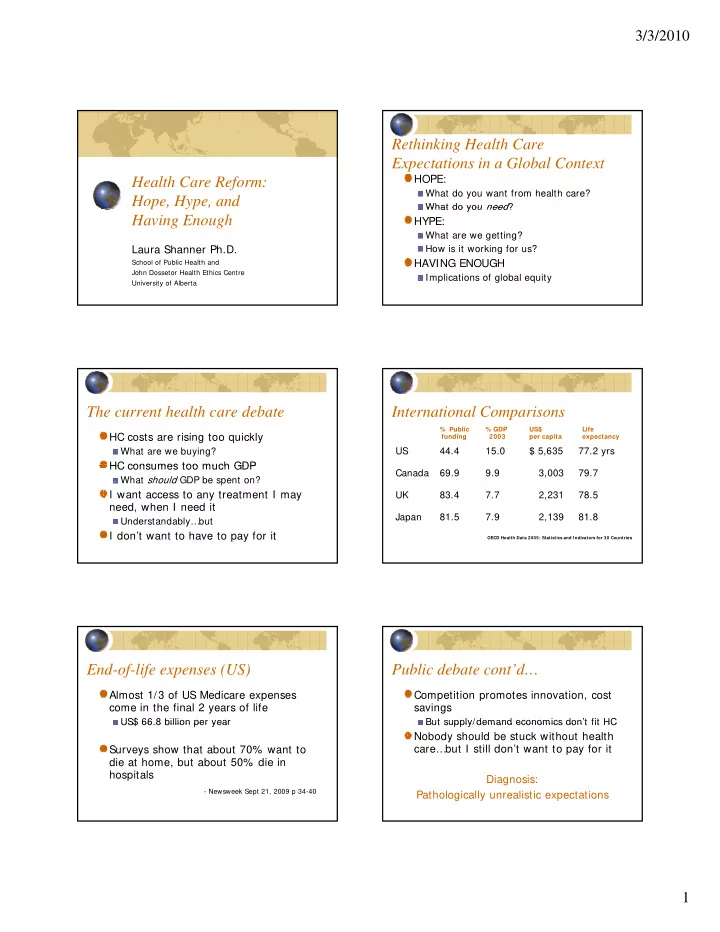
3/3/2010 Rethinking Health Care Expectations in a Global Context HOPE: Health Care Reform: What do you want from health care? Hope, Hype, and p , yp , What do you need ? What do you need ? Having Enough HYPE: What are we getting? How is


slide-1
SLIDE 1

3/3/2010 1

Health Care Reform: Hope, Hype, and p , yp , Having Enough

Laura Shanner Ph.D.

School of Public Health and John Dossetor Health Ethics Centre University of Alberta

Rethinking Health Care Expectations in a Global Context

HOPE:

What do you want from health care? What do you need? What do you need?

HYPE:

What are we getting? How is it working for us?

HAVING ENOUGH

Implications of global equity

The current health care debate

HC costs are rising too quickly

What are we buying?

HC consumes too much GDP HC consumes too much GDP

What should GDP be spent on?

I want access to any treatment I may need, when I need it

Understandably…but

I don’t want to have to pay for it

International Comparisons

% Public % GDP US$ Life funding 2003 per capita expectancy

US 44.4 15.0 $ 5,635 77.2 yrs Canada 69.9 9.9 3,003 79.7 UK 83.4 7.7 2,231 78.5 Japan 81.5 7.9 2,139 81.8

OECD Health Data 2005: Statistics and I ndicators for 30 Countries

End-of-life expenses (US)

Almost 1/3 of US Medicare expenses come in the final 2 years of life

US$ 66.8 billion per year US$ 66.8 billion per year

Surveys show that about 70% want to die at home, but about 50% die in hospitals

  • Newsweek Sept 21, 2009 p 34-40

Public debate cont’d…

Competition promotes innovation, cost savings

But supply/demand economics don’t fit HC But supply/demand economics don t fit HC

Nobody should be stuck without health care…but I still don’t want to pay for it Diagnosis: Pathologically unrealistic expectations

slide-2
SLIDE 2

3/3/2010 2

HC demands are INFINITE

We are mortal

Every time we are saved, something else will threaten us

If not terminal we seek improved QOL If not terminal, we seek improved QOL

Pain, impairment, life preferences

If not struggling, seek improvement

Cosmetic, performance enhancement

The laws of supply and demand do not apply to HC - supply cannot possibly meet demand

“Sometimes the measurable drives out the important” important

  • - Howard Brody, MD

What do you WANT and NEED from HC?

Primary vs. Secondary Goods (Rawls) Quality of Life Immortality?

What we emphasize: Technology

Diagnostics

Defensive medicine Non-problematic oddities treated X-ray, CT scan induced cancers

Intensive care life support

To what end?

Emergency rescue

But not rehabilitation and long term care

Replaceable body parts

But not health promotion strategies Cosmetic enhancements

A different vision…

We are vulnerable

physically, cognitively, emotionally, socially, etc.

We are mortal We are mortal We hate these facts

Most people seem to fear one more than the

  • ther: either being dead or what they would suffer

along the way

How can we help each other navigate our shared fears and vulnerabilities?

Determinants of Health

50% of person’s health determined by SES Only 25% of health status attributable to health care system

– Senate of Canada “Population Health Policy: Issues and Options” April 2, 2008 April 2, 2008

The remaining 25% is determined by: Genetics: 10-12% Large-scale events across SES groups (local disaster,

epidemic)

Personal lifestyle choices

slide-3
SLIDE 3

3/3/2010 3

“The historic dream of public health…is a dream of social justice.”

  • - Dan Beauchamp (1976)

GPI: Economic, Personal-Societal, Environmental Well-being

  • Redefining Progress, San Francisco; Mark Anielski, Edmonton

Alberta GPI Well-being Index vs. Alberta GDP Index, 1961 - 1999

OECD: Inequity in Canada Widens

“After 20 years of continuous decline, both inequality and poverty rates [in C d ] h i d idl i h Canada] have increased rapidly in the past 10 years, now reaching levels above the OECD average” among 30 member nations.

– OECD, “Growing Unequal” Oct 21, 2008

OECD 2008: Canadian trends

Top 10% income avg = US$ 73,000

Is 30% > OECD top decile avg of US$ 54,000

Poor and middle classes in Canada 18% richer than OECD avg richer than OECD avg Overall Cdn poverty rate = 12% overall

6% of elderly live in poverty 15% of children/youths in poverty Poverty = < 1/2 of median Cdn income

Canadians who fall into poverty likely to remain poor for longer than in most countries

Rx for HC reform in Canada, US

Increase % single-payer, public funding

Reduce administrative waste, complexity More importantly: p y

Refocus: well-being vs. $ Health protection vs. “sick care” Socioeconomic justice vs. competition ALL aspects of society vs. HC budget Governance vs. Politics

slide-4
SLIDE 4

3/3/2010 4

Ethics Requires Bifocal Glasses

(Gilligan)

One / many Now / future Local / global Policy / exceptions Common humanity / unique priorities

U.N. Millennium Development Goals

  • 1. Eradicate extreme poverty and hunger
  • 2. Achieve universal primary education
  • 3. Promote gender equality and empower women

4 R d hild t lit

  • 4. Reduce child mortality
  • 5. Improve maternal health
  • 6. Combat HIV/AIDS, malaria, and other diseases
  • 7. Ensure environmental sustainability
  • 8. Develop a global partnership for development

Life expectancy at birth

  • CIA World Factbook 2009 est.

Overall Male Female

Japan 82.12 78.8 85.62 Canada 81 23 78 69 83 91 Canada 81.23 78.69 83.91 US 78.2 75.6 80.8 Lesotho 40.38 41.18 39.54 Zambia 38.63 38.53 38.73 Angola 38.2 37.24 39.22 Swaziland 31.88 31.62 32.15

A Startling Statistic

In Sub-Saharan Africa in the early 1990’s

  • - BEFORE HIV/AIDS --

the median age at death was < 5 years

  • World Bank 1993 quoted in Paul

FarmerPathologies of Power

Infant mortality rates Deaths per 1,000 live births

  • CIA World Fact Book 2009

Angola 180 21 Singapore 2 31 Angola 180.21 Afghanistan 153.14 Liberia 138.24 Niger 116.66 Mali 115.86 Singapore 2.31 Bermuda 2.46 Sweden 2.75 Japan 2.79 Canada 5.04 US 6.22

Maternal mortality WHO 2005

Maternal deaths per 100,000 live births Lifetime risk = 1 in: Developed regions

9 7300

East Asia

50 1200

SE Asia

300 160

North Africa

160 210

Sub-Saharan Africa 900

22

slide-5
SLIDE 5

3/3/2010 5

Health in War Zones

Since 1970’s, mortality rates in Congo have declined during periods of armed conflict Why? Why? Relief agencies flood into refugee camps, bringing supplies and staff unavailable in community otherwise

Incl Public Health blitz (e.g vaccines)

  • Newsweek Feb 1, 2010 p. 6

“Stupid Deaths” - Haiti

Some deaths are unpreventable Some would have been easily t d l h prevented elsewhere

the medicines and techniques exist, but are not available here

Drug Resistant Tuberculosis

Standard TB treatment takes 6 months

Patients often stop showing up for treatment, and HC resources too limited to follow up and HC resources too limited to follow up

1990’s: MDR-TB - multi-drug resistant strains

Now found nearly every country DOTS: Directly observed therapy initiated 30% death rate even with treatment

XDR-TB

Extreme drug resistant TB discovered in South Africa 2006

Treatable by only one antibiotic Treatable by only one antibiotic Now found in 57 countries Kills 60% even with treatment Treatment takes 2 years Costs 200-1000 x standard TB treatment

First new TB drugs in 40 years in development now

  • Atlantic Jan-Feb 2010 pp 18-19

90/10 Global Expenditures (2000’s, annual)

Health Care: $2.2 trillion

87% spent on 16% of world population, who bear 7% of global disease burden g

Health Research: $70 billion

90% on diseases that account for 10% of global disease burden 1393 new drugs (1975-1999), only 16 for TB and all tropical diseases (0.01%)

Determinants of health redux

Health care accounts for only about 25% of health status Socioeconomic disparities account for at least 50% The issue is global equity, not global health care

slide-6
SLIDE 6

3/3/2010 6

Sub-Saharan Africa (2001-2)

Development aid received: $21.2 billion Debt owed: $275.6 billion 13 million displaced people 14 million AIDS orphans 40 million undernourished 475 million living on less than $2 / day

Producers and Victims of Greenhouse Gas Emissions

(Courtesy J. Patz Nov 6, 2007)

Ethics as Personal Commitment in a Global Context

The question is not ‘what do we want?’ or ‘what do we need?’, but ‘what do we deserve?’ What is our fair share of lifespan, quality of life, and HC resources?

Life expectancy, health status Per capita consumption and garbage generation

We tend not to like the answers…

“But the poor person does not exist as an inescapable fact of destiny. His or her existence is not politically neutral, and it is not ethically innocent. The poor are a by- product of the system in which we live and f hi h ibl Th for which we are responsible. They are marginalized by our social and cultural world…Hence the poverty of the poor is not a call to generous relief action, but a demand that we go and build a different social order.”

  • Gustavo Gutierrez, The Power of the Poor in History

The way forward

Equal worth of every human being

International Human Rights Liberation theology: “Preferential option for the ” poor”

Justice for future generations

Sustainability: environmental, economic, social

All social, political, economic activities

Not just health care

Hard questions for us to address

How many years of life are fair and reasonable for me to expect? When my body starts failing what When my body starts failing, what extent of life support, repair, or replacement is reasonable and fair? What should I write in my advance directive?

slide-7
SLIDE 7

3/3/2010 7

More hard questions

How must my lifestyle change not only to protect my own health, but to promote a more equitable world? q What are my responsibilities as a voter and as a citizen of the world?

Health care system design, financing and use Technology and scientific priorities Economic structures Environmental sustainability

Take-Home Message

Health is not dependent on health care, but on social economic and but on social, economic and environmental justice. Go forth and change the world! Thank you for being here today.