SLIDE 1
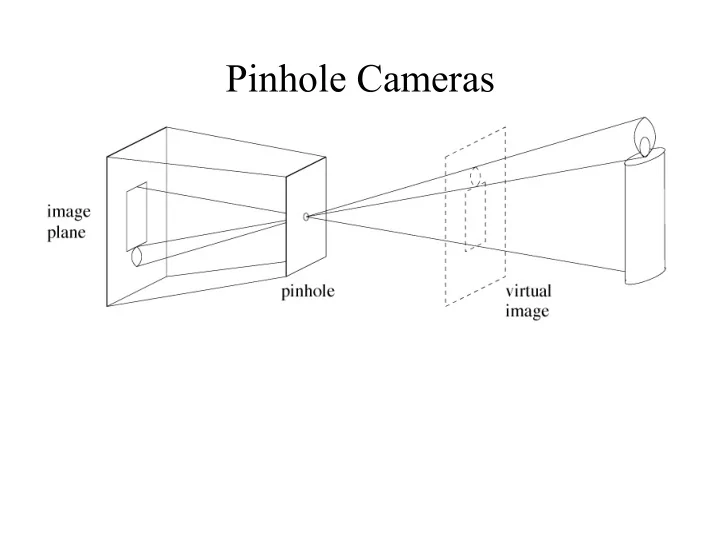
Pinhole Cameras
SLIDE 2
SLIDE 3
P z x y ! C p u v Retinal plane f Normalized image plane 1
SLIDE 4
SLIDE 5 Scale in x direction between world coordinates and image coordinates Skew of camera axes. ! = 90o if the axes are perpendicular Principal point = Image coordinates of the projection
- f camera origin on the retina
Rotation between world coordinate system and camera Translation between world coordinate system and camera Scale in y direction between world coordinates and image coordinates
Standard Perspective Camera Model
SLIDE 6 Alternate Notations 4 3 3x3 3x3 3x1 By rows: By blocks: By components: 3x3 3x1
Intrinsic parameter matrix Extrinsic parameter matrix
Q: Is a given 3x4 matrix M the projection matrix of some camera? A: Yes, if and only if det(A) is not zero Q: Is the decomposition unique? A: There are multiple equivalent solutions
SLIDE 7 Applying the Projection Matrix
Homogeneous coordinates
Homogeneous coordinates
Homogeneous vector transformation: p proportional to MP Computation of individual coordinates:
SLIDE 8 Observations:
- is the equation of a plane of normal direction a1
- From the projection equation, it is also
the plane defined by: u = 0
- Similarly:
- (a2,b2) describes the plane defined by: v = 0
- (a3,b3) describes the plane defined by:
! That is the plane passing through the pinhole (z = 0) Geometric Interpretation Projection equation:
SLIDE 9
u v a3 C Geometric Interpretation: The rows of the projection matrix describe the three planes defined by the image coordinate system a1 a2
SLIDE 10
p P Other useful geometric properties Q: Given an image point p, what is the direction of the corresponding ray in space? A: Q: Can we compute the position of the camera center "? A:
SLIDE 11 Affine Cameras
- Example: Weak-perspective projection model
- Projection defined by 8 parameters
- Parallel lines are projected to parallel lines
- The transformation can be written as a direct linear transformation
2x4 projection matrix 2x2 intrinsic parameter matrix 2x3 matrix = first 2 rows of the rotation matrix between world and camera frames First 2 components of the translation between world and camera frames
Note: If the last row is the coordinates equations degenerate to: The mapping between world and image coordinates becomes linear. This is an affine camera.
SLIDE 12
SLIDE 13
SLIDE 14
SLIDE 15 Calibration: Recover M from scene points P1,..,PN and the corresponding projections in the image plane p1,..,pN In other words: Find M that minimizes the distance between the actual points in the image, pi, and their predicted projections MPi Problems:
- The projection is (in general) non-linear
- M is defined up to an arbitrary scale factor
SLIDE 16
Write relation between image point, projection matrix, and point in space: Write non-linear relations between coordinates: Make them linear: The math for the calibration procedure follows a recipe that is used in many (most?) problems involving camera geometry, so it’s worth remembering:
SLIDE 17
Put all the relations for all the points into a single matrix: Solve by minimizing: Subject to: Write them in matrix form:
SLIDE 18
P1 Pi (ui,vi) (u1,v1) MPi
Calibration
SLIDE 19
Radial Distortion Model
SLIDE 20
Geometric Distortion
SLIDE 21
SLIDE 22
We can follow exactly the same recipe with non-linear distortion: Write non-linear relations between coordinates: Make them linear:
SLIDE 23
Put all the relations for all the points into a single matrix: Solve by minimizing: Subject to: Write them in matrix form:
SLIDE 24
From Faugeras
SLIDE 25
SLIDE 26
SLIDE 27
p