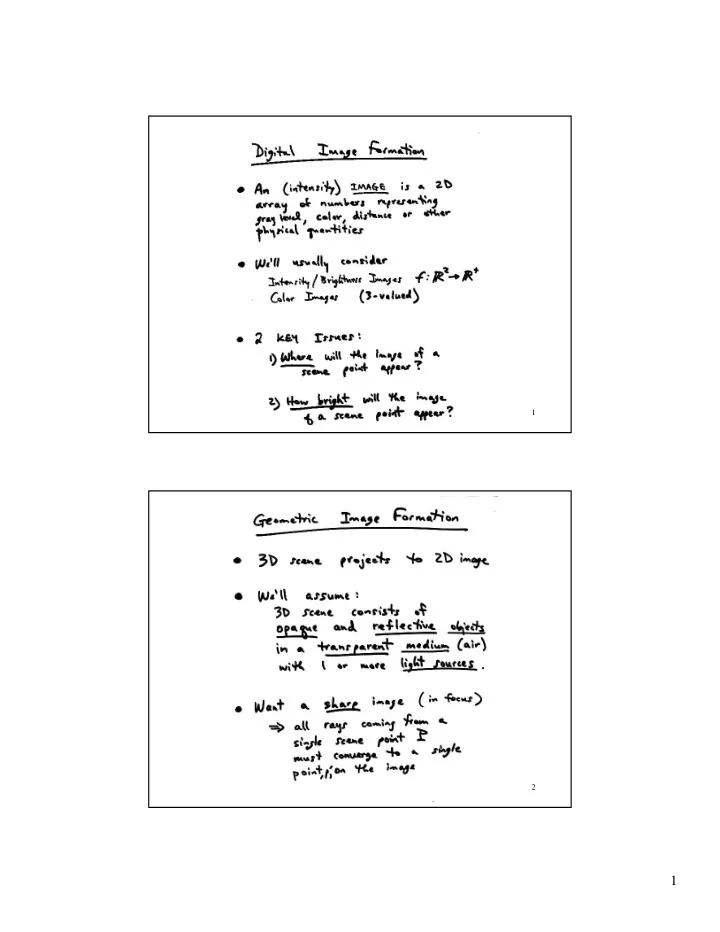
1 3 Lensless Imaging Systems: Pinhole Optics Pinhole optics - - PDF document

1
SMART_READER_LITE
LIVE PREVIEW

1 3 Lensless Imaging Systems: Pinhole Optics Pinhole optics - - PDF document

1 2 1 3 Lensless Imaging Systems: Pinhole Optics Pinhole optics focuses images without lens with infinite depth of field Smaller the pinhole better the focus less light energy from any single point 4 2


slide-1
SLIDE 1

1

1 2

slide-2
SLIDE 2

2

3 4

Lensless Imaging Systems: Pinhole Optics

  • Pinhole optics

focuses images

  • without lens
  • with infinite

depth of field

  • Smaller the

pinhole

  • better the focus
  • less light energy

from any single point

slide-3
SLIDE 3

3

5

Diffraction and Pinhole Optics

6

Diffraction

  • Two disadvantages to pinhole systems
  • Light collecting power
  • Diffraction
  • Diffraction
  • When light passes through a small aperture it does not travel in a straight

line

  • It is scattered in many directions
  • Process is called diffraction and is a quantum effect
  • Human vision
  • At high light levels, pupil (aperture) is small and blurring is due to

diffraction

  • At low light levels, pupil is open and blurring is due to lens imperfections
slide-4
SLIDE 4

4

7 8

slide-5
SLIDE 5

5

9 10

slide-6
SLIDE 6

6

11 12

slide-7
SLIDE 7

7

13 14

slide-8
SLIDE 8

8

15 16

slide-9
SLIDE 9

9

17 18

slide-10
SLIDE 10

10

19 20

slide-11
SLIDE 11

11

21 22

slide-12
SLIDE 12

12

23 24

slide-13
SLIDE 13

13

25 26

slide-14
SLIDE 14

14

27 28

slide-15
SLIDE 15

15

29 30

slide-16
SLIDE 16

16

31 32

slide-17
SLIDE 17

17

33 34

slide-18
SLIDE 18

18

35 36

slide-19
SLIDE 19

19

37 38

slide-20
SLIDE 20

20

39 40

slide-21
SLIDE 21

21

41 42

slide-22
SLIDE 22

22

43 44

slide-23
SLIDE 23

23

45

The Human Eye

  • Limitations of human

vision

  • the image is upside-

down!

  • high resolution vision
  • nly in the fovea
  • only one small fovea in

man

  • other animals (birds,

cheetas) have different foveal organizations

  • blind spot

46

slide-24
SLIDE 24

24

47 48

slide-25
SLIDE 25

25

49 50

Color Cameras

  • Two types of color cameras
  • three built in filters
  • three images are collected through red, green and blue filters
  • such cameras are 3x slower than comparable black and white

cameras

  • 3 CCD arrays packed together, each sensitive to

different wavelengths of light

  • more similar to human vision
slide-26
SLIDE 26

26

51 52