
SLIDE 1
11th May 2012
PINGU, MicroBooNE & LAr1-ND
Justin Evans University of Manchester
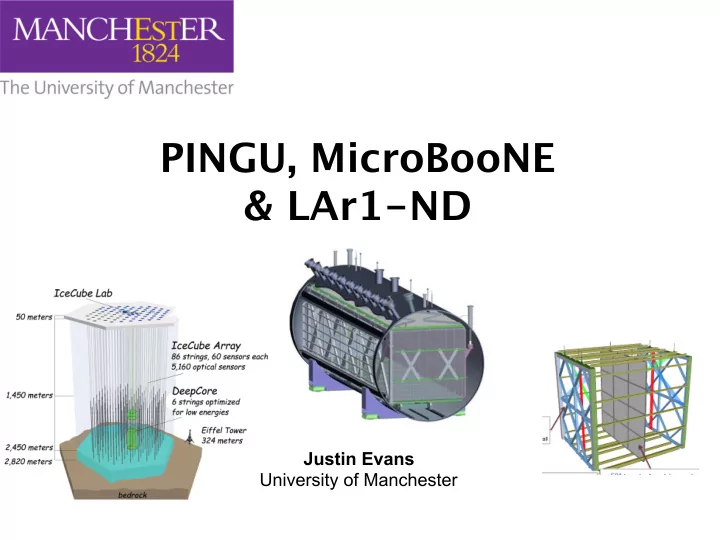
PINGU, MicroBooNE & LAr1-ND Justin Evans University of - - PowerPoint PPT Presentation
PINGU, MicroBooNE & LAr1-ND Justin Evans University of Manchester 11th May 2012 Neutrino oscillations Sterile neutrinos Neutrino mass hierarchy 2.3x10 -3 eV 2 CP violation 2 Neutrino oscillations Sterile
11th May 2012
Justin Evans University of Manchester
2
±2.3x10⁻³ eV2
3
LBNE, T2HK, CHIPS
4
MicroBooNE & LAr1-ND PINGU
Atmospheric neutrinos pass through the Earth
Ø Feel an interaction with the Earth’s matter
Electron neutrinos feel an additional interaction
Ø Acts like a refractive index Ø This efgectively changes the mixing angles
5
6
Lines of constant L/E
∆m2
32 = 2.32 × 10⁻³ eV2
sin2(2θ23) = π 4
7
Increasing density cosθz = -0.84 Outer core
∆m2
32 = 2.32 × 10⁻³ eV2
sin2(2θ23) = π 4
Neutrinos Normal hierarchy
8
Increasing density cosθz = -0.84 Outer core
∆m2
32 = 2.32 × 10⁻³ eV2
sin2(2θ23) = π 4
Neutrinos Inverted hierarchy
9
Ø 20 m between strings Ø 5 m vertically between DOMs
10
Ø DeepCore released impressive new oscillation measurements this summer
11
At least 3σ sensitivity after four years of running
Ø Can be even easier to determine, depending on the value of θ23
12
PINGU is the most competitive medium-term experiment
Ø Supported in the recent P5 report
A very afgordable option
Ø <10% the price of LBNE Ø A small contribution can make the UK a major player
13
Manchester
Ø Convener of mass hierarchy group Ø Working on DeepCore oscillation analysis
Queen Mary
Ø Expertise in neutrino interactions and cross sections
Oxford
Ø Theory group
Significant European involvement
Ø Germany, Belgium, Sweden, Denmark
14
This efgort is currently unfunded by STFC
Ø Since it came along after the programmatic review
Risk of losing a major opportunity for UK particle physics
Ø To determine the mass hierarchy within the decade
LSND and MiniBooNE see νe appearance signals consistent with short- baseline oscillations
Ø But is this a non-neutrino background? Or an inherent νe component of the beam?
15
NC π0 background
Repeat MiniBooNE
Ø But with a superior detector: liquid argon TPC Ø Greater ability to reject NC electromagnetic activity
16
EM shower Gap indicates NC background ArgoNeuT event
87 ton active mass 2.5x2.4x10.4 m3 TPC Ø Recently moved into its final location in the Booster Neutrino beam Ø Commissioning will occur this autumn Ø First neutrino events by the end of the year
17
Oxford
Ø Level-2 project manager for the TPC Ø Cosmic muon detector system for commissioning Ø Development of run control software Ø Event reconstruction
Cambridge
Ø Development of PANDORA event reconstruction chain
Manchester
Ø Not yet MicroBooNE members, but a new academic (Georgia Karagiorgi) will join in January Ø Convener of MicroBooNE oscillation group Ø Commissioning MicroBooNE readout Ø n-n and proton-decay analyses
18
MicroBooNE alone may not answer the sterile neutrino question
Ø It can tell us if the excess is really electron neutrinos Ø It can’t tell us if those electron neutrinos are intrinsically in the beam
19
A liquid argon near detector for MicroBooNE
Ø Characterize the beam composition Ø A near-far comparison cancels many systematic uncertainties (e.g. cross sections)
20
21
22
MicroBooNE alone 20% uncertainty on νe background prediction Using LAr1-ND to measure the backgrounds
UK will build much of the TPC
Ø Sheffjeld: anode frame Ø Manchester: anode wiring Ø Liverpool: cathode plane Ø Lancaster: cold testing Ø UCL: high voltage feedthrough
Vital part of our LBNE proposal
Ø Sets us up to make a significant construction contribution to the LBNE FD Ø LAr1-ND builds IL experience and demonstrates that the UK can build a working TPC
Oxford and Cambridge are also collaborators
23
PINGU
Ø Determining the neutrino mass hierarchy with atmospheric neutrinos
MicroBooNE
Ø Investigating the MiniBooNE low- energy excess with a liquid argon TPC
LAr1-ND
Ø Forming a highly sensitive two- detector search for sterile neutrinos
24